
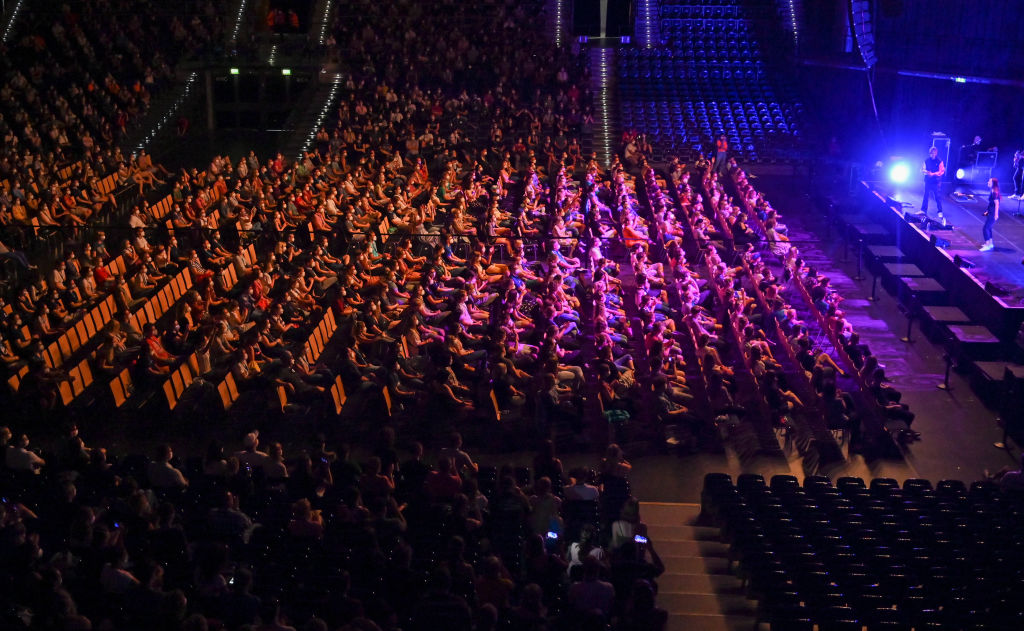
We're all hoping for good news today, and here's some we weren't expecting: Pandemic-era indoor concerts might be safer than anyone realized. Researchers in Germany recently staged an indoor concert as a test to study its effects on spreading COVID-19. As The New York Times reports, the news is good. As long as the right precaution measures are in place, those researchers say that the spread of COVID is "low to very low" at an event like this.
In August, German scientists booked the pop singer Tim Bendzko to play a show at Leipzig's Quarterback Immobilien Arena. Bendzko played to about 1,400 masked attendees on a Saturday morning, with a team from Martin Luther University Halle-Wittenberg studying the different effects. The attendees were all volunteers, and the scientists tried out different scenarios on them for about 10 hours. The used fog machines to study the flow of air and fluorescent-dyed hand disinfectants to observe contact from people in the crowd. They tried different arrangements of the crowd -- socially distanced, partially distanced, not distanced at all. They found encouraging results: "There is no argument for not having such a concert... The risk of getting infected is very low."
There are tons of caveats here. The German scientists announced their findings last week, but the results haven't been peer-reviewed yet. Also, the safety of indoor shows seems dependent on things like good ventilation, which isn't exactly the kind of thing that American clubs are known for. Strict hygiene rules and limited capacities are also crucial. Also, as far as I can tell, the study doesn't have anything to say about the possible effects of mass drunkenness. Still, festival organizers are keeping tabs on the study, and it seems like a reason for cautious optimism.