
February 11, 1989
- STAYED AT #1:4 Weeks
In The Alternative Number Ones, I'm reviewing every #1 single in the history of the Billboard Modern Rock Tracks/Alternative Songs, starting with the moment that the chart launched in 1988. This column is a companion piece to The Number Ones, and it's for subscribers only. Thank you to everyone who's helping to keep Stereogum afloat.
Timing is a funny thing. The standard line on the Velvet Underground is a quote generally attributed to Brian Eno: "The first Velvet Underground album only sold 10,000 copies, but everyone who bought it formed a band." The Velvets came along in mid-'60s New York and married driving gutbucket rock 'n' roll to avant-garde drone, a combination that might've never been attempted, or that was at least never done on anything like the Velvets' level. Lou Reed, the band's lead singer and primary songwriter, wrote about drugs and sex and degradation with steely, flat detachment. They made amazing music, but their records sold virtually nothing. Maybe they were 10 or 20 years too early.
A couple of decades after the Velvet Underground's heyday, though, the band served as a key influence on just about every act that was getting airplay on modern rock radio. Tons of bands covered the Velvets, and tons more shouted them out at every opportunity. At that point, the 46-year-old Lou Reed had been a solo artist for a long time, and he'd built up a famously spotty and confounding catalog, veering in wild new directions from album to album. In 1989, when the Velvet Underground's influence was arguably at its peak, Reed tapped into the spidery, tangled sonic aesthetic that he'd helped to invent, and he made what might be his best solo record. With New York, Lou Reed's timing was finally right. The album was one of the greatest critical and commercial successes of Reed's long career, and it gave him his first-ever #1 hit on any Billboard chart.
This column is going to require a lot of backstory, even as I just skim the highlights of Lou Reed's career before "Dirty Blvd." Lewis Allen Reed was born in Brooklyn in 1942, and he grew up in a comfortably middle class Jewish family in Freeport, Long Island. As a young man, Reed loved rock 'n' roll, and he made his on-record debut in 1958, when he was 16. Reed and some Freeport buddies started a doo-wop group called the Jades, and they played high-school talent shows and supermarket openings. They also released one single. Reed didn't sing lead, but he wrote, sang backup, and played guitar on the B-side "Leave Her For Me," recording alongside a group of sidemen that included saxophone great King Curtis.
The Jades didn't last long. As a young man, Lou Reed suffered from terrible panic attacks, and his parents responded by putting him through electro-shock therapy, a traumatic experience that would inform a whole lot of his music over the years. Reed went to NYU for a year, where he discovered free jazz, and then he went off to Syracuse University to study English. I studied English at Syracuse about 40 years later. Lou Reed and I both had college-radio shows, and we even lived in the same dorm. During his time at Syracuse, Lou Reed also discovered heroin and wrote the earliest version of "Heroin." I didn't do either of those things.
At Syracuse, Lou Reed led a party band and got close with the poet Delmore Schwartz. When he graduated, Reed found a job as a staff songwriter at Pickwick Records, a cut-rate pop indie that specialized in albums where session musicians would record sound-alike copies of whatever was popular at the time. Reed had to work in a bunch of different rock 'n' roll disciplines. One of the songs that he wrote at Pickwick was "The Ostrich," an absolutely ridiculous and at least partly ironic dance-craze single that sounds fucking awesome today. "The Ostrich" was promising enough that Reed's Pickwick bosses decided to release it as a single. Reed sang lead, and it was credited to the Primitives.
Lou Reed needed to put together an actual band to promote "The Ostrich," and he met a few avant-garde musicians at a Manhattan house party one night. One of them was John Cale, a Welsh classical prodigy who'd joined the ensemble surrounding the experimental composer La Monte Young. Cale became a Primitive, and he and Reed became close friends. They moved in together, did drugs together, influenced each other's musical ideas, and started a new band. At first, that band was called the Warlocks. By the time they played their first show at a New Jersey high school in 1965, they had a different name: The Velvet Underground.
The Velvet Underground were new. They made tremendous waves of noise with Moe Tucker's ultra-simple drumming anchoring everything and John Cale's viola shaping the chaos. Lou Reed, always sounding perfectly bored, sang about hard drugs and same-sex hookups. Most audiences couldn't stand the Velvets, but Andy Warhol caught an early club gig, and he knew that they were kindred spirits. Warhol signed on as the band's manager and booked them as part of the Exploding Plastic Inevitable, a kind of free-form sensory-overload night-out experience where the band would accompany Warhol's transgressive experimental films. Warhol also paired the Velvets up with Nico, an ultra-glamorous German model and actress, and hooked the band up with a Verve Records deal.
The Velvet Underground And Nico, the band's debut album, came out in 1967, and it reached a lofty peak of #129 on the Billboard 200. Over the years, though, that album would become a totemic and canonized alt-rock building block. The Psychedelic Furs, one of the band's that's already appeared in this column, took their name partly from "Venus In Furs," my favorite track on the LP. The Velvets' associations with both Nico and Andy Warhol would be short-lived. Lou Reed was a legendary crank with serious drug and mental health problems, and he rarely let anyone get close or stay close. Even John Cale only remained in the Velvet Underground for two albums.
The Velvet Underground made four albums that veered all over the aesthetic map, from the harsh abstractions of White Light/White Heat to the hushed, minimal beauty of their self-titled LP. The band had their acolytes; a teenage Jonathan Richman, for instance, was a huge fan who went to a ton of Velvets shows and even opened for them. But the Velvets never caught on. Their later records charted even worse than their debut; hilariously, White Light/White Heat only reached #199 on the Billboard 200. The band's singles never once charted. The press mostly disdained the Velvets, and their contemporaries didn't think much of them, either. (It's weird to think of the Velvet Underground playing shows with the Grateful Dead and the Allman Brothers, but they did.) Lou Reed was out of the band by the time they released their fourth album, 1970's Loaded.
After splitting from the Velvet Underground, Lou Reed moved back in with his parents and got a job working for his father as a typist. Soon, though, Reed was recording solo music. David Bowie, a huge Velvet Underground fan who covered the band before their first LP had even come out, co-produced Reed's second solo LP, 1972's Transformer. That album featured the deceptively catchy "Walk On The Wild Side," which randomly became the only mainstream hit of Reed's entire career, peaking at #16 on the Hot 100. (I know that's a totemic and important song, but I've been hearing it for my whole life, and I'm simply incapable of hearing it as anything other than a silly trifle. Blame a Tribe Called Quest, I guess.)
Lou Reed's solo records are an extremely mixed bag, and he cut a magnetically oppositional figure in the '70s. In the press, Reed's greatest champion was probably Lester Bangs, but the two were absolute dicks to each other in on-the-record interviews. On 1978's Live: Take No Prisoners, Reed also referred to my former co-worker Robert Christgau as a "toe-fucker" -- not exactly what anyone expects from a critics'-favorite type. Commercially, Reed was not a safe bet. He willingly torpedoed his market power with records like 1975's Metal Machine Music, an infamous double-LP of feedback and oscillating noise-drones. But Reed also went gold by playing slightly cheesy hard-rock version of Velvet Underground songs on his 1974 live album Rock 'N' Roll Animal. Somehow, that album sold way better than Transformer.
The early punks generally revered the Velvet Underground, but Lou Reed tended to regard them with distance and suspicion. Reed could've capitalized on the punk explosion, but he never really did. Instead, he continued to follow his own impulses, which sometimes led him to make tracks as startling and masterful as 1978's "Street Hassle," an 11-minute odyssey about hookups and overdoses, with an uncredited surprise Bruce Springsteen cameo.
In 1980, Lou Reed married Sylvia Morales, his second wife, and moved to New Jersey. He kicked drugs and got into martial arts. For a little while, Reed partnered up with Robert Quine, a guitar virtuoso who'd been one of Richard Hell's Voidoids. In 1982, Reed released the masterful LP The Blue Mask. That record was mixed so that Reed and Quine's guitars would play in separate speaker channels, answering each other back and forth.
But none of these Lou Reed albums were selling. Reed fell out with Robert Quine, just as he fell out with most of his collaborators. On 1984's New Sensations, Reed tried to keep pace with that era's commercial pop, and his attempts sounded limp and dinky. The single "I Love You, Suzanne" was a pretty big college-radio hit, but I find its processed rockabilly groove to be super-unconvincing.
Lou Reed never became a Reagan Republican in the '80s, the way many of his peers did, but he did his best to depict himself as a productive member of society and to get a piece of the capitalist pie. Reed showed up in anti-drug PSAs, licensed "I Love You, Suzanne" to Kids, Incorporated, and appeared in a TV commercial for Honda scooters, back when that simply wasn't a thing that credible rockers did.
On 1986's Mistrial, Lou Reed messed around with keyboards and programmed beats. Reed tried to adapt the sonic language of hip-hop on his track "The Original Wrapper." Maybe that was Reed's attempt to position himself as the father of New York records where people talk-sing about New York street-life degradation. I think it's cool that Reed was paying attention, but the song is mostly just funny.
Mistrial did have one college-radio hit. "No Money Down" had a sprightly keyboard-groove and a video where an animatronic Lou Reed puppet pulls its skin off. For some reason, that one didn't get a whole lot of burn on MTV.
While Lou Reed's solo career meandered, the reputation of the Velvet Underground only continued to grow. R.E.M., Joy Division, Susanna Hoffs, Echo And The Bunnymen, and Bauhaus all covered the band. The Velvets' influence was obvious in plenty of the other alt-rock bands of the '80s: the Smiths, the Feelies, the Go-Betweens, the whole Flying Nun scene in New Zealand. The Cowboy Junkies covered the Velvets' classic "Sweet Jane" on their 1988 album The Trinity Session, turning it into a blissed-out lullaby. The Trinity Session went platinum, and "Sweet Jane," peaked at #5 on the Modern Rock chart. In fact, "Sweet Jane" reached its peak in the same week that Lou Reed topped that very same chart. In effect, Lou Reed was competing with his younger self. ("Sweet Jane" is the Cowboy Junkies' biggest hit, and the song charted again in 1994, peaking at #9 after popping up on the Natural Born Killers soundtrack. It's a 9.)
In 1985, the Velvet Underground odds-and-ends compilation VU came out and peaked at #85 on the album chart -- much higher than any of the band's albums had gone during the group's actual lifetime. Maybe that's why Seymour Stein signed Lou Reed to Sire in time for the 1989 album New York. Reed co-produced that album with drummer Fred Maher, and it's the record that the world seemingly wanted from the man. New York is Reed and his bandmates playing spiky, swaggering guitar-rock, foregrounding Reed's stabbing spirals and his verbose talk-singing. Lyrically, New York is Reed going back to his roots, talking about desperate, violent scuzziness in his hometown.
Lou Reed had a little bit of a political awakening in the '80s. The Velvet Underground never fit in with the '60s counterculture, and Reed never exactly became a protest singer. In the '80s, though, he played Farm Aid and sang on Little Stevie's all-star anti-apartheid fundraiser single "Sun City." His New York lyrics paint a kaleidoscopic portrait of a desperately poor, crime-riddled city. The LP has a lot of sharp lines about the divide between rich and poor, something that's only became more stark in the decades since. On "Sick Of You," Reed gets positively prophetic, imagining an insider trader running over Rudy Giuliani and a world where "they ordained the Trumps and then he got the mumps and died being treated at Mt. Sinai."
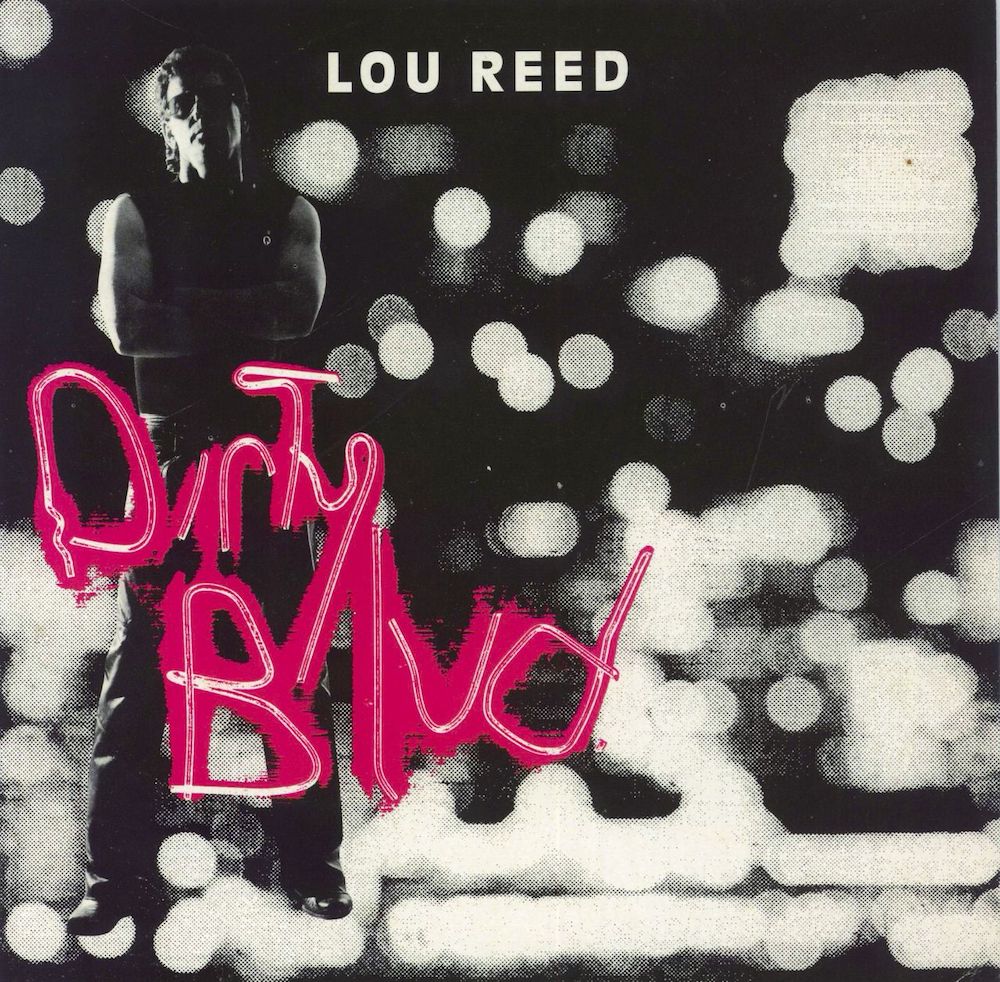
On lead single "Dirty Blvd.," Lou Reed tells the story of Pedro, a poor and abused kid growing up in a Manhattan welfare hotel. Pedro is the song's protagonist, but he's also Lou Reed's entry point. New York isn't set up so that a kid like Pedro can succeed. Instead, the city keeps sucking its poor dry, sending them into lives where they'll sell sex or drugs: "This room cost 2,000 dollars a month. You can believe it, man; it's true. Somewhere, a landlord's laughing till he wets his pants. No one dreams of being a doctor or a lawyer or anything. They dream of dealing on the dirty boulevard."
The most quotable line on "Dirty Blvd." is the one where Lou Reed wryly, angrily considers the inscription on the Statue of Liberty: "Give me your hungry, your tired, your poor, I'll piss on 'em. That's what the Statue of Bigotry says. Your poor huddled masses, let's club 'em to death and get it over with and just dump 'em on the boulevard." There's real venom in those words, but Reed recites them with flat, businesslike affect.
On "Dirty Blvd," Reed and his band bash out a swaggering, muscular groove. In that sprawling quilt of guitars, you can hear echoes of Velvet Underground acolytes like Television and R.E.M., but you can also hear a bit of Reed's buddy John Mellencamp. (One of the riffs sounds a lot like the one on Mellencamp's 1982 hit "Hurt So Good.") In the background, Reed's bandmates sing doo-wop harmonies. There's a toughness to the song, and that toughness goes a long way toward making this seething meditation on inequality into something catchy.
As "Dirty Blvd." goes on, Lou Reed's aperture widens. While Pedro struggles, movie stars arrive at a Lincoln Center opera, and Reed makes a meal out of the word "limousines." Reed himself floats above everything as an omniscient narrator. We never find out if he's more like the movie stars or the denizens of the dirty boulevard, but a certain fondness creeps into his voice when he talks about the latter. Near the song's end, Reed returns to the subject of poor Pedro, who's "found a book on magic in a garbage can." Pedro wishes that he could disappear and fly away, and Reed and his bandmates sing about flying away, again and again. Some gospel-style backing vocals come in, as the band riffs toward a grand finale. Maybe I'm imagining things, but I hear a sense of satisfaction in Reed's voice. He sounds like he's back home.
Promoting "Dirty Blvd.," Lou Reed played ball with his label. He cut a version of the song without words like "piss" and "suck" for radio airplay. He also made a video, but it's a live performance, not a lip-synced clip. The video shows Reed bespectacled, with lines on his face. His mullet is a weird one, with the back blown out into an awkward pouf. He still looks cool as hell. His bandmates, however, do not. One guy plays an electric stand-up bass that now looks profoundly silly.
"Dirty Blvd." got some mainstream rock-radio airplay, but it did a lot better on the alternative stations. The critics loved it, voting New York the year's third-best album, behind De La Soul's 3 Feet High And Rising and Neil Young's Freedom in the Village Voice's Pazz & Jop poll. Another single, "Busload Of Faith," went to #11 on the Modern Rock chart. It didn't happen until 1997, but New York eventually went gold -- the second and final gold record of Reed's entire career.
Moe Tucker, Lou Reed's former Velvet Underground bandmate, played drums on a couple of tracks on New York. In 1990, Reed reunited with his estranged musical partner John Cale for Songs About Drella, a full-album tribute to Andy Warhol, who died in 1987. "Nobody But You," one of the songs from that album, went to #13 on the alternative charts. That same year, all four classic-lineup members of the Velvet Underground reunited to play "Heroin" at a benefit show in Paris. A few years later, they'd ease into a more full-scale reunion, but it wouldn't last long. Lou Reed hadn't mellowed that much, and he and Cale still couldn't get along for too long.
New York and "Dirty Blvd." marked a major artistic comeback for Lou Reed, and they gave him a bit of the commercial spotlight that he only really held once or twice. That resurgence didn't last forever, and Reed went on to make plenty of other uncompromising artistic decisions that didn't make too many people happy. But alt-rock radio wasn't done with Lou Reed. We'll see him in this column again.
GRADE: 9/10
BONUS BEATS: David Bowie and Lou Reed didn't keep working together after Transformer because they got sick of each other; Bowie was just one more collaborator who Reed alienated. In 1997, though, Bowie threw himself a 50th-birthday party at Madison Square Garden, and it was full of special guests. One of those guests was Lou Reed, who Bowie introduced as "the king of New York." Here's video of Bowie and Reed performing "Dirty Blvd." together:
(David Bowie's highest-charting Modern Rock single, 1993's "Jump They Say," peaked at #4. It's a 6. Bowie actually did better on that chart with his short-lived rock band Tin Machine. Their highest-charting single, 1991's "One Shot," peaked at #3. It's a 7.)