
March 18, 1989
- STAYED AT #1:2 Weeks
In The Alternative Number Ones, I'm reviewing every #1 single in the history of the Billboard Modern Rock Tracks/Alternative Songs, starting with the moment that the chart launched in 1988. This column is a companion piece to The Number Ones, and it's for subscribers only. Thank you to everyone who's helping to keep Stereogum afloat.
Rock 'n' roll has never given us a better, bitchier human quote machine than David Lee Roth, and his best, bitchiest quote might be this: "The reason the critics all like Elvis Costello better than me is because they all look like Elvis Costello."
Now: It's entirely possible that David Lee Roth never said this. I've gone looking for the original quote, and I can't find it. In different accounts, the exact wording varies. This might just be one of those telephone-game oral-tradition things, but it's so specific and economical that I'm just going to choose to believe that it's real. Diamond Dave might've said that shit 40 years ago, and it's still true. As a skinny white guy in chunky black glasses, I'm here to tell you that I do, in fact, love Elvis Costello. I might even love him more than I love David Lee Roth.
Critics have always been hopeless before Elvis Costello. It's not just that many of us look like him. Many of us think like him, too. Here's this erudite, buttoned-up guy who's spent years studying all the miraculous things that music can do, and for some reason, he's just seethingly bitter most of the time. Every once in a while, that blank and purposeless rage leads him right up to the edge of self-destruction. Most of the time, it just leads to Elvis Costello firing off bitchy lyrical quotes of his own. If this guy hadn't become a rock star, he would've had to become a rock critic.
But then, it's worth asking whether Elvis Costello ever did become a rock star. For the vast majority of his career, Costello has been a total pop-chart non-factor. His early records sold respectably well, but his singles barely sniffed the radio. Even college radio never quite fell for the other Elvis. Instead, Costello's constituency was critics like me -- the folks who consistently put his albums near the top of the Pazz & Jop poll for years and years.
There was never even the remotest correlation between Elvis Costello's commercial success and his critical acclaim. If I'd been working in the '80s, a significant part of my job description would've been to keep close track of what Elvis Costello was doing, how he was changing from album to album or interview to interview -- the same as it is now for, say, Mitski. There was only one moment in his career where Costello truly tasted pop-chart glory: The time when he got together with an ex-Beatle to write a song about a nice old lady with dementia.
Elvis Costello came in with the first wave of UK punk, and he capitalized on that explosion by digging through the vast clutch of songs that he'd already written, putting the greatest focus on the simplest and fastest of them. But Elvis Costello wasn't really a punk, and the "Elvis Costello" persona was more the creation of Costello's managers than the man himself. By the time he landed his one big American hit -- the song that also became his first #1 on Billboard's Modern Rock chart -- Elvis Costello had revealed himself to be a classic acerbic songwriter, more Randy Newman or Warren Zevon than Johnny Rotten.
Declan Patrick MacManus grew up fully steeped in music. His mother sold records in department stores, and his father was a fairly successful singer and trumpeter for some of the UK's big jazz bands. When baby Declan was born, the news made it into NME. In this Stereogum interview, Elvis Costello says that his father happened to perform at the Royal Variety Show, an annual charity gig sponsored by the Royal Family, in 1963. Marlene Dietrich was also on the bill, with Burt Bacharach accompanying her. So were the Beatles.
Young Declan MacManus lost his mind for the Beatles. He loved a whole lot of other pop music, too -- Motown, Joni Mitchell, the Byrds, the pop hits that he didn't yet realize that his future collaborator Burt Bacharach had written. MacManus grew up mostly in the London district of Twickenham. I happened to live in Twickenham for a year when I was nine, and I loved it. It's like a little town within the big city. My parents would give me a pound coin and send me around the corner to buy fresh bread at a bakery, and then we'd go feed it to ducks by the Thames. I wonder if MacManus bought his Beatles and Motown singles at the same Woolworth where I bought Michael Jackson and Now That's What I Call Music tapes.
In the early '70s, Declan MacManus finished school and got a job outside of Liverpool as a computer operator, back when that meant loading punch cards. He held onto his day job up until just before his first album came out. MacManus had a lot of downtime at work, and he used it to write songs. He'd been writing songs ever since his teenage years, when he'd sometimes play solo-acoustic at folk clubs. In Liverpool, MacManus joined a folk-rock band called Rusty. That band broke up when his job transferred him to a London branch and he moved back into his childhood home. There, he tried to get himself booked at London clubs, and he started calling himself Declan Costello, since it was easier for people to understand over the phone.
In London, Declan Costello started a new band called Flip City. This was in the moment of pub rock, the back-to-basics movement that helped set the stage for punk. Costello wrote a lot of songs for Flip City, but the band was essentially a hobby for him, especially once he became a young married father. Still, Costello sometimes recorded demos -- sometimes with Flip City, sometimes just on his own. Eventually, the small London indie Stiff Records took notice. Stiff specialized in punk-adjacent stuff -- the Damned, Siouxsie And The Banshees, Motörhead, Costello's buddy Nick Lowe.
Stiff Records signed Declan MacManus, and label founders Jake Riviera and Dave Robinson became his managers. Riviera and Robinson had the idea to start calling him Elvis Costello and to swap out his regular-looking glasses for the thick, chunky Buddy Holly type. These were good decisions. Costello got to work on his debut album My Aim Is True, with Nick Lowe producing and with members of the American pub-rock band Clover backing him up. (Clover harmonica player Huey Lewis did not take part in the sessions.) Costello released his debut single "Less Than Zero," a snarly and catchy attack on British fascist Oswald Mosley, in March of 1977, and the album followed soon after.
None of the songs in My Aim Is True were hits; not even "Alison" or "(Angels Wanna Wear My) Red Shoes" made the UK singles chart. But the album sold reasonably well, and critics instantly loved Costello. In the 1977 Pazz & Jop poll, America's critics voted My Aim Is True the #2 album of the year, behind only Never Mind The Bollocks. Costello scored a pretty decent UK with "Watching The Detectives," an acidic quasi-reggae experiment that wasn't on the UK version of My Aim Is True. To promote the album, Costello put together a backing band that he called the Attractions, and they quickly gelled into a formidable unit.
My Aim Is True eventually went platinum in the US, though that didn't happen until 1991. That pretty much set the template for Elvis Costello's American career. In their first few years, Costello and the Attractions put out an absolute blitz of excellent records, ranging from the feverish garage-rock snarl of This Year's Model (my favorite) to the lush, dazed orchestral pop of Imperial Bedroom. Costello also proved to be brilliant at attention-grabbing stunts. Late in 1977, the Sex Pistols essentially broke up onstage in San Francisco, which meant that they couldn't make it to perform on Saturday Night Live. Costello and the Attractions, booked as last-minute replacements, stopped what they were playing mid-song and launched instead into the anti-broadcaster broadside "Radio, Radio." That got Costello banned from the show for a solid decade, but I bet it was worth it.
Costello had a prickly side, and it didn't always lead to moments as glorious as that SNL performance. In 1979, the Attractions and Stephen Stills' band were staying at the same Holiday Inn in Columbus, Ohio while on tour. Costello was drunk and surly, and in an argument with Stills' band, he used a racial slur in reference to both James Brown and Ray Charles, which kicked off a big fight between both bands. Costello, who'd always stood up for anti-racist causes, has been apologizing for that ever since. Afterwards, he started cutting back on drugs and alcohol, so that deeply shitty shit might've saved his life.
Elvis Costello's early records moved some units in the US. Armed Forces scraped the top 10, and that album and This Year's Model both eventually went gold. But Costello's first impact on the Hot 100 wasn't even his own. In 1979, the British rocker Dave Edmunds recorded "Girls Talk," a song that Costello had written but not released. (Costello's take eventually came out as the B-side to "I Can't Stand Up For Falling Down.") Edmunds' version of "Girls Talk" was a huge UK hit, and it made it to #65 in the US. It's a really good song.
https://youtube.com/watch?v=S4TzjRFfsJs&ab_channel=WarmerMusicVideos
As far as American critics were concerned, though, Elvis Costello was king shit of fuck mountain. This Year's Model and Imperial Bedroom both topped the Pazz & Jop poll in their respective years, and virtually all of his other albums charted high. In fact, the only early Elvis Costello albums that didn't do well on Pazz & Jop were Almost Blue, his 1981 record of classic-country records, and Goodbye Cruel World, the overstuffed smooth-pop album that Costello almost immediately disowned. But all that critical success didn't mean much at the marketplace. Costello didn't land a single of his own on the Hot 100 until 1983, when his Philly soul pastiche "Everyday I Write The Book" peaked at #36.
In his first decade, Elvis Costello made a lot of albums -- 11 studio LPs in the first decade of his career. (He also produced some great ones, like the Specials' self-titled debut and the Pogues' Rum, Sodomy & The Lash. I'd take those two over any actual Elvis Costello record, with the possible exception of This Year's Model.) On the 1986 Pazz & Jop poll, Costello had two albums in the top 10 -- King Of America at #2, behind Paul Simon's Graceland, and Blood & Chocolate at #9.
Costello recorded King Of America with T Bone Burnett, the former Bob Dylan guitarist whose love and encyclopedic knowledge of American music matched Costello's own. (On Blood & Chocolate, Costello played around with pseudonyms, crediting himself as songwriter under the name Napoleon Dynamite.) Stiff Records had upstreamed Costello to Columbia, and Blood & Chocolate was his last album for the label. After that, Costello took an uncharacteristically long break and found himself a new deal at Warner Bros., which was building a rep as the most artist-friendly of the major labels.
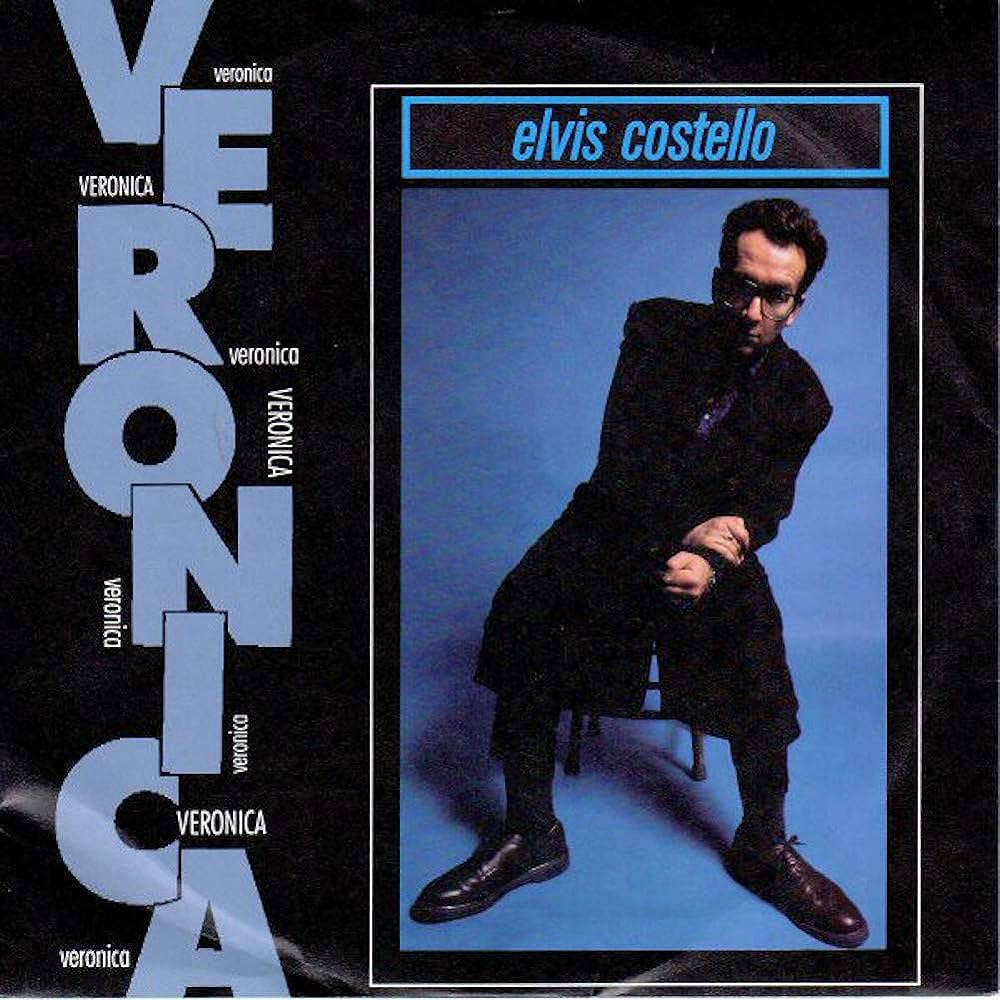
Costello came back three years later with his album Spike. By that time, internal tensions had driven the Attractions apart; Costello especially didn't get along with bassist Bruce Thomas. So Spike was Costello's first fully solo album since My Aim Is True. Warner gave Costello a huge budget for the album. In that Stereogum interview, Costello says, "It was very widescreen, like Lawrence Of Arabia with less camels. It was very expansive. Four cities. It was a sort of, 'Let’s have everything.' Let’s have an Irish ensemble, let’s have a New Orleans — everything I’d dreamed." Co-producing with T Bone Burnett and big-deal engineer Kevin Killen, Costello went to work with a dream team of musicians: Roger McGuinn, Chrissie Hynde, Jim Keltner, Allen Toussaint, the Dirty Dozen Brass Band. He also co-wrote a couple of songs with Paul McCartney, and one of those songs was "Veronica."
At the time, Paul McCartney was working on his own 1989 album Flowers In The Dirt, and he sent out an inquiry to see if Elvis Costello might want to co-write some songs. Paul McCartney never worked with the first Elvis, but he'd gotten to know Costello when Costello was recording Imperial Bedroom at Abbey Road. Costello never made a secret of his love of the Beatles; he sang "All You Need Is Love" at Live Aid in 1985. Together, McCartney and Costello wrote a bunch of songs. Some never came out, though they've been widely bootlegged. Others ended up on either Spike or Flowers In The Dirt. One of the Flowers In The Dirt collaborations was the McCartney/Costello duet "You Want Her Too." Another was "My Brave Face," the lead single from McCartney's album.
"My Brave Face" was a reasonably big hit on both sides of the Atlantic -- #18 in the UK, #25 in the US. In that Stereogum interview, Costello says, "Paul had a lot of hit albums. But his next top 20 single after 'My Brave Face' is Kanye and Rihanna. If only he'd thought to put all three of us in the band, imagine! We would’ve gone to #1! Kanye, Rihanna, Paul, and me. Come on, there's still time." And it's true; Paul McCartney didn't have another big chart hit until he made "FourFiveSeconds" with Kanye West and Rihanna in 2015. But the biggest song to come out of the McCartney/Costello collaboration was the one about Alzheimer's.
Elvis Costello wrote "Veronica" about Mabel Josephine Jackson, his paternal grandmother, whose Catholic confirmation name was Veronica. The track sounds light and buoyant, almost like a love song, but it's really Costello imagining what's happening in his grandmother's mind as he talks to her. Before we get into it, I have to tell you: I do not like dealing with dementia-related art. I didn't like that stuff even before my father got Parkinson's and died. Now, I stay away from it like it's radioactive. I saw my dad lose all sense of what was happening around him, and to vastly understate things, it fucking sucked. It looked like a terrible way to die. Parkinson's can be hereditary, so I live in constant fear of going out the same way. If I ever even start to exhibit symptoms, take me to the zoo and throw me into the fucking bear enclosure. Feed me to sharks, I don't give a fuck. I do not want that.
On "Veronica," Elvis Costello does not really plumb the depths of fear and pain that I associate with dementia. Instead, the song is a bright, uptempo jangle, with its sadness and anger mostly only evident in the lyrics. There's some real tragedy in the way he describes this lady's condition: "Well, she used to have a carefree mind of her own and a delicate look in her eye/ These days, I'm afraid she's not even sure if her name is Veronica." Mostly, it's Costello trying to follow his grandmother as her mind bounces around between different times of her life. That's a real thing. When my dad was dying, he was permanently confused, but he sometimes seemed to enjoy that confusion. He was living inside his own memory, and from time to time, he was happy there.
So Veronica comes unstuck in time. Suddenly, it's all of 65 years ago, when the world was the street where she lived, and a young man sailed on a ship in the sea with a picture of Veronica. She sits in her favorite chair, calling out old names or laughing at inappropriate times. The song's bridge shows up early, maybe mirroring that jangled-up out-of-time feeling. Costello also snarls at the aides "who shout her name and steal her clothes." That was a big thing with my dad, too. He always thought the hospice-care workers were stealing from him, or worse. That's one of those moments where I'm not sure whether Elvis Costello is singing from his own perspective or Veronica's. Maybe that confusion works for the song.
As a pure piece of music, "Veronica" is absolutely lovely. It moves with speed and energy, and Elvis Costello's voice is warm and gentle until he lets a little raw desperation creep in. The arrangement is full of tiny hooks, and some of them must've come from Paul McCartney. McCartney also played bass on the song, and maybe that was Elvis Costello flexing on his ex-Attractions bandmate Bruce Thomas -- replacing him with the most famous bass player in rock 'n' roll history. There are other killers on the song, too. Benmont Tench, from Tom Petty's Heartbreakers, plays the spinet, which is different from a harpsichord in ways that I don't understand. The song cranks chamber-pop up to bubblegum speeds. Maybe that lush giddiness is the reason "Veronica" doesn't repel me the way so many other dementia chronicles do, or maybe I just heard the song before I understood how much I hate to think about the condition that it describes.
Elvis Costello never obscured the subject matter of "Veronica." John Hillcoat, future auteur of The Road and The Proposition, co-directed the song's video, which won the VMA for Best Male Video. In the clip, Costello sits in a nursing home, trying to describe these conversations with his grandmother and sometimes singing along with his own pre-recorded track. That singing doesn't sound great, by the way. Costello was never a conventionally gifted vocalist, but his voice has bite and personality. When he's murmuring along with his own song, it loses something. As the song ends, Costello keeps talking: "You could try and figure out what's going on in her head, but it's something I think we don't understand -- not yet, anyway."
Alzheimer's songs have never been cool have never had a big commercial moment. Musically, however, "Veronica" was pretty on-trend for an era when layered, dreamy '60s-style jangle-pop was once again ascendant. In the US, "Veronica" remains the biggest hit of Elvis Costello's career. On the Hot 100, the song peaked at #19, and it pushed Spike all the way to gold. Costello even got invited back onto Saturday Night Live for the first time in a decade. His follow-up single "This Town" didn't make the Hot 100, but it peaked at #4 on the Modern Rock chart. (It's a 6.)
I don't think Spike is one of the great Elvis Costello albums. It's too unfocused, with too many ideas and a few truly grating moments. But I have to shout Costello out for "Tramp The Dirt Down," the song about how he hopes to live long enough to dance on Margaret Thatcher's grave. (I don't know if he's actually danced her grave, but he did perform that song at Glastonbury in 2013, after she died.) I don't think "Veronica" is Costello's best single, but it's a good one, and it deserves a spot in his pantheon. Costello hasn't made another real hit since then, but he remained a presence on modern-rock radio for the next few years. We'll see Elvis Costello in this column again.
GRADE: 8/10
BONUS BEATS: Spoon's Britt Daniel made a quick cameo on a 2006 episode of the great teen-detective show Veronica Mars, singing a karaoke version of "Veronica." Here's that scene:
(Spoon's highest-charting alternative single, 2017's "Hot Thoughts," peaked at #19.)