
June 9, 1990
- STAYED AT #1:5 Weeks
In The Alternative Number Ones, I'm reviewing every #1 single in the history of the Billboard Modern Rock Tracks/Alternative Songs, starting with the moment that the chart launched in 1988. This column is a companion piece to The Number Ones, and it's for members only. Thank you to everyone who's helping to keep Stereogum afloat.
Writing this column is funny, especially now, when we're looking at the moment before alternative rock became a giant cultural wave in America. Once grunge arrives, alternative rock will get a whole lot closer to becoming an identifiable thing. In this moment, though, we're still dealing with a nebulous, mysterious category of acts that don't necessarily have much in common with each other, then or now. Some of the time, we're looking at artists who joined the cultural firmament. Some of the time, we're looking at artists who have basically been erased from the historical record. World Party belong in the second category.
In one million years, you could not invent a band name that's more evocative of the late '80s and early '90s than "World Party." Say those two words out loud, and the sound tastes like Fruitopia with a Crystal Pepsi chaser. It looks like Corin Nemec's haircut on Parker Lewis Can't Lose. There's so much going on with those words. They evoke the short-lived and misplaced end-of-history optimism that popped up when the Berlin Wall came down. They sound like African masks mounted on liberal yuppies' walls. They sound like whatever was happening when someone came up with the phrase "Rock The Vote."
World Party, the actual one-man band that had a few alt-rock hits in that moment, don't sound much like the instantly archaic feeling that the phrase "World Party" evokes. Karl Wallinger, the man behind the World Party name, wasn't really chasing the circa-1990 zeitgeist. Instead, he was in love with the Beatles, the Stones, the Kinks, Bob Dylan, the Beach Boys -- the full range of ambitiously spiral-eyed '60s pop. There was some Prince in World Party's sound, too, but only the version of Prince that was on his own psychedelic '60s head-trip.
Maybe that retro fixation is why World Party's music doesn't get much burn today. Maybe we're collectively more drawn to the artists from that moment who looked forward, as opposed to the ones mining the past for inspiration. Weirdly, though, that fixation makes World Party sound so much more of its moment. After all, a whole lot of circa-1990 alt-rock bands were going for '60s jangle. When I hear World Party today, those songs instantly sweep me back in time. It feels good.
World Party actually had one pretty decent-sized American hit, and it wasn't "Way Down Now," their one Modern Rock chart-topper. But we'll get there. Since World Party is one guy, that one guy's story is the story of the band. The one guy is Karl Wallinger, a Welsh-born multi-instrumentalist who didn't even start World Party until he was about 30. Wallinger is one of these almost aggravatingly adaptable types who can play pretty much any instrument, and he had a whole life before World Party.
In the late '70s, Karl Wallinger played keyboard in a group called Quasimodo; two of his bandmates, Dave Sharp and Nigel Twist, would become founding members of the Alarm. After that, Wallinger worked as the musical director for the West End production of The Rocky Horror Show, which must have been an interesting job. Then, in 1983, Karl Wallinger joined the Waterboys.
The Waterboys are a bit of a blind spot for me. I have a few memories of people slightly older than me speaking their name in hushed tones, usually to say how they can't believe how underrated this band is. That kind of talk did not interest me. Nevertheless, the Waterboys were definitely a thing for a while. The group functioned, and actually still functions, as the brainchild of Mike Scott, a Scottish musician who was rooted in '60s rock but also inspired by punk. (He took the band name from a Lou Reed lyric.) Scott, living in London after the breakup of an earlier band, started the Waterboys as basically a solo project, and he started recording the band's self-titled debut in 1981.
The Waterboys' first album came out in 1983, and Scott needed to put together a live band. The Waterboys' first performance was on The Old Grey Whistle Test, the British live-music TV show. Just before that performance, Karl Wallinger joined up to play keyboards. The Waterboys' sound was vast and theatrical, full of pomp and catharsis and saxophones. It wasn't especially popular, at least at first, but the band got some big looks, opening for the Pretenders and playing Glastonbury. Pretty soon, Karl Wallinger's ability to play a whole bunch of instruments came in handy, and he started playing a bigger role, though it was still very much Mike Scott's band.
Karl Wallinger did a lot of things on the Waterboys' third album, 1985's This Is The Sea. Wallinger helped arrange and produce a lot of the songs, and he co-wrote the opening track "Don't Bang The Drum." Mike Scott called him a "one-man orchestra." That album had "The Whole Of The Moon," by far the Waterboys' biggest song. "The Whole Of The Moon" reached #26 on the UK charts, and when it was re-released in 1991, it went all the way to #3. Later on, Fiona Apple covered it. So the Waterboys had momentum, but Karl Wallinger finally decided that he didn't want to be in anyone else's band. He wanted to start his own thing, and that thing was World Party.
World Party, like the Waterboys, signed with the London label Ensign Records. Soon after he struck out on his own, Wallinger also helped Sinéad O'Connor, an artist who's been in this column a couple of times, land a deal at Ensign. She recorded her demos at Wallinger's home studio. Wallinger later went on to help arrange O'Connor's devastating 1990 song "Black Boys On Mopeds," and she sang backup on a couple of tracks from World Party's first two albums.
A few of Karl Wallinger's old Waterboys bandmates helped out here and there, but Wallinger played almost everything on World Party's 1987 debut album Private Revolution himself. Private Revolution is a weird one. You can hear the reverence for Wallinger's '60s forebears, but you can also hear him trying to get funky and sing soulfully, two things that do not come easily to him. Nevertheless, Private Revolution did have "Ship Of Fools," a vaguely anti-materialist song that sounded a little bit like INXS. "Ship Of Fools" was a minor hit on the UK charts, and it did better elsewhere, going all the way to #4 in Australia and peaking at #27 on the Hot 100. Suddenly, World Party was arguably more successful than the Waterboys.
"Ship Of Fools" was a bit of a one-off, and World Party never made the Hot 100 again. The second World Party album, 1990's Goodbye Jumbo, is a little bit more in the jangle-pop zone, though Wallinger still attempts some white-soul moves that really don't work for me. Wallinger is a perfectly sturdy singer, but there's not a whole lot of personality in his delivery, and he's in no way equipped to pull the Mick Jagger blues-honk thing that he sometimes attempts.
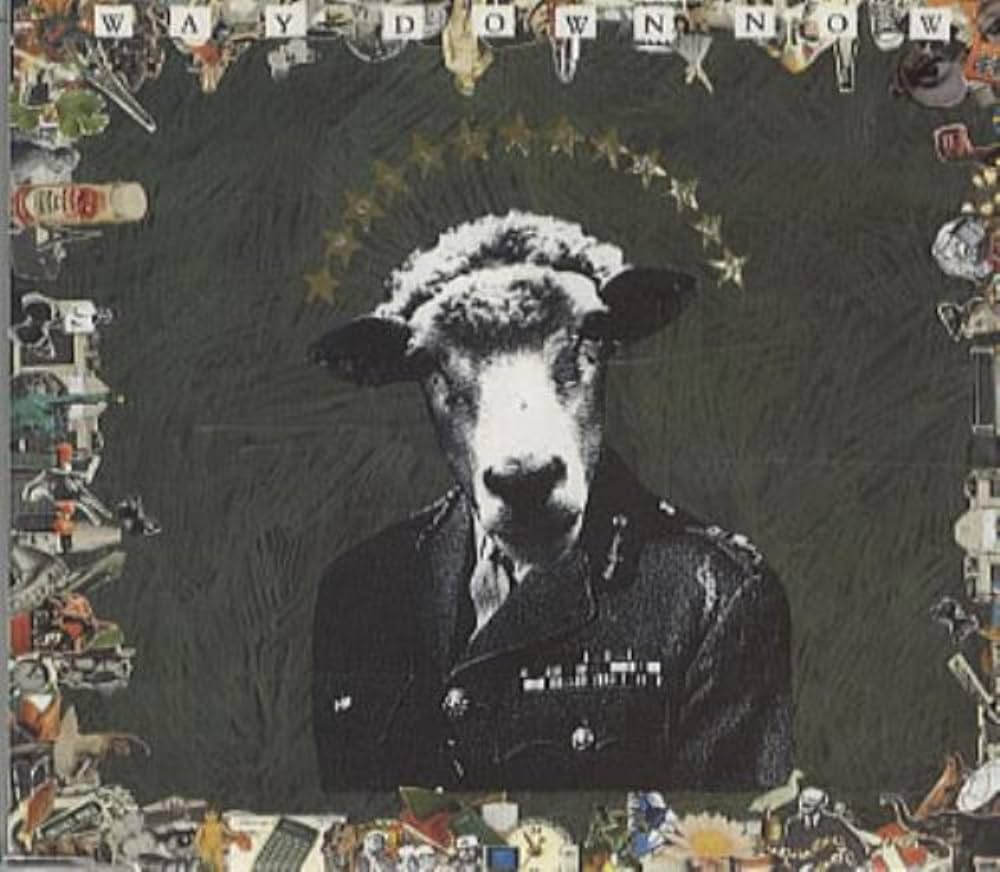
Karl Wallinger didn't make "Way Down Now," the lead single from Goodbye Jumbo, on his own. The Icicle Works' Chris Sharrock plays drums on the track, and future Sheryl Crow collaborator Jeff Trott plays guitar. I think it shows. Even if "Way Down Now" is ultimately all Karl Wallinger, it's got a little bit more of that full-band juice working for it. Wallinger sings about witnessing societal rot through television: "Some faceless git comes on the screen, the most honest man I've ever seen." He also imagines a bleakly trippy future: "The clocks will all run backwards/ All the sheep will have two heads/ And Thursday night and Friday will be on Tuesday night instead." But he doesn't sound too stressed out. He sounds like he's having fun.
"Way Down Now" is a total rave-up, and it moves too fast for anyone to pay much attention to what Karl Wallinger is saying. The mix practically explodes, as pianos and busy basslines and tons of different guitars all fight for space. The song has a beat, and it's close enough to "Sympathy For The Devil" that Wallinger even throws in some woo-woo action at the end. I think Wallinger really wanted people to dance to this, and it doesn't sound that far from the dance-rock stuff that was already starting to come from bands like the Soup Dragon and the Farm. Honestly, I wish "Way Down Now" sounded a little more like that stuff. If "Way Down Now" had a "Funky Drummer" breakbeat or some random dancehall toasting, it would sound even more like 1990.
But even as a fully retro exercise, "Way Down Now" is a fun song. It's big and juicy and silly, and it never stops moving. I was 10 years old when "Way Down Now" came out, and I lived a block away from the college where my dad taught. I have this misty but distinct memory of hanging around a college student who got so amped when "Way Down Now" came on the radio. (He might've been babysitting me? I forget.) I'd already heard the song, but it hadn't made much impression before that. Watching that guy react, I was like, "Oh, I guess this is music that college kids like." That made me like it more.
"Way Down Now" was one of those songs that was huge on modern-rock radio and nonexistent everywhere else. I didn't have cable as a kid, but I bet the antic video -- randomly shot in a warehouse full of precariously stacked boxes, with packing peanuts flying everywhere -- got a lot of burn on 120 Minutes. World Party followed that single with "Put The Message In The Box," and if you were listening to alternative radio at the time, you got that chorus stuck in your head the second that you read that title. All together now: "Put the message in a the box! Put the box into the car! Drive the car around the world!" Smack! That was the sound of you and me high-fiving just now. (The high-five is mostly for nostalgic purposes. The song is OK. It peaked at #8, and it's a 6.)
In 2012, Karl Wallinger told The Telegraph that he messed up by taking too long to make another album: "We were meant to be supporting Neil Young in America but [the record company] took us off the tour to make an album. That was it. There was a moment there: door open, door closes." When World Party followed Goodbye Jumbo with the 1993 album Bang!, the American alt-rock radio climate had shifted in some big ways. Bang! did have one pretty big radio hit: the vaguely folky "Is It Like Today?," which peaked at #5. (It's a 6.) But that kind of studied feelgood jangle was on the way out, and World Party never made the Modern Rock chart again.
World Party released a couple more albums after Bang!, and a few of their singles were minor UK chart hits. They also had a couple of songs on big soundtracks. Wallinger helped score 1994's Reality Bites, and that soundtrack had "When You Come Back To Me," a World Party song that's half a cover of David Bowie's "Young Americans." A year later, World Party also covered Mott The Hoople's Bowie-written "All The Young Dudes" for the Clueless soundtrack. I wonder if Karl Wallinger and Cher Horowitz had similar feelings about young men's fashion in the mid-'90s.
In 2001, when things were really slowing down for World Party, Karl Wallinger suffered a near-fatal brain aneurysm, which kept him on the shelf for years. He lost his peripheral vision permanently. Eventually, Wallinger got back to touring, and he worked with Peter Gabriel, an artist who will eventually appear in this column, on the 2008 album Big Blue Ball. But other than a few new tracks for the 2012 box set Arkeology, World Party haven't released anything since 2000. Wallinger seems to be retired now. I can't say that I love any World Party songs, but there are at least a few that work as instant-nostalgia time machines whenever I hear them. That's not an earthshaking legacy, but it's something.
GRADE: 6/10
BONUS BEATS: So there's no real "Way Down Now" bonus beat that I can offer you. That song has disappeared without leaving a cultural trace. But there's one World Party bonus beat that might actually overshadow everything else the band ever did. On their 1997 album Egyptology, World Party had a really nice ballad called "She's The One." Wallinger has said that the song took 10 minutes to write and an hour to record.
Now: When Karl Wallinger left the Waterboys, his replacement was a multi-instrumentalist named Guy Chambers, who also helped out on some World Party records. In 1997, Chambers became the main songwriting partner for Robbie Williams. Williams had been the resident bad-boy member of the hugely successful British boy band Take That, and he was just starting to launch what would become a gigantic solo career. Chambers brought "She's The One" to Williams, and he recorded a cover, releasing it as a single in 1999. Here's the video:
Robbie Williams' version of "She's The One" went all the way to #1 in the UK, and it also did pretty well around Europe. To this day, if you play "She's The One" around drunk British people, they will shout the whole thing back at you and maybe also cry. At first, the whole phenomenon pissed Karl Wallinger off. He told The Telegraph, "It was very strange. Nobody phoned me to say they were doing it, and they used the band I’d just been on the road with to record it. It also annoyed me that Robbie didn’t sing the right words. It was a weird one: You lose your friends, but you make loads of money."
But that money mattered. It gave Wallinger a financial cushion when he was recovering from his aneurysm, and I wouldn't be surprised if he's still living on the royalties today. Robbie Williams never mentioned the person who actually wrote the song, which further pissed Wallinger off. In 2019, Williams finally admitted, in an Alexa commercial, that he didn't write "She's The One."