
May 19, 2018
- STAYED AT #1:2 Weeks
In The Number Ones, I'm reviewing every single #1 single in the history of the Billboard Hot 100, starting with the chart's beginning, in 1958, and working my way up into the present. Book Bonus Beat: The Number Ones: Twenty Chart-Topping Hits That Reveal the History of Pop Music.
My parents were baby boomers, so I remember the sense of anxiety that set in when the iconic protest songs of the '60s started showing up in TV commercials in the '80s and '90s. Lots of things went into that story: Younger moguls like Michael Jackson buying up valuable catalogs, brands doing their best to co-opt happy memories of counterculture as youth culture, America's rapid descent into corporate servility. It made people upset, and maybe that's a testament to the power of the original songs. But if the song syncs in last night's Super Bowl ads made anyone upset, I didn't see it. Specifically, Childish Gambino's "This Is America," which was received as a powerful piece of protest art in 2018, soundtracked a commercial for a new weight-loss drug. There, the title of "This Is America" wasn't supposed to connote police murders or racial unrest. Instead, it was all about obesity, a societal epidemic that can supposedly be solved with this miracle pill. If your protest song is that adaptable, then maybe it never worked as a protest song in the first place.
I really love the people who read this column. I haven't met the vast majority of them, but it's been an absolute trip to watch the whole comments-section community come together and develop its own inside jokes and sub-columns over the years. It seems like many of the people who read this column might not otherwise pay any attention to Stereogum, and I know that most of them have musical tastes that are nothing like mine. That's awesome. Thank you for being here. Sorry for what I'm about to do.
I feel bad about it, generally, when I shit all over something that I just know a significant portion of the comments section is going to love. More often, it goes the other way: I like something, and people in the comments are like, "I never heard such horrible sludge, and I hope I never hear it again." That's fine. I don't feel bad about that. But then there are the moments that I roll through like, "This thing that you hold esteem? It's mid. Do better." That doesn't feel so good. But I just don't have the constitution to genuflect before something that's been culturally canonized. I can't give something a pass on acclaim and reputation. If I did, I wouldn't be me.
Childish Gambino's "This Is America," the protest-pastiche that debuted at #1 and became an all-purpose rallying cry for people who were fed up online during the first Trump era, has an absolutely amazing music video. It's one of the most mesmerizing little short films to find a huge audience in the past decade or so -- a rare moment of avant-garde mass culture that justified all the conversation around it. The song, though? The song barely exists on its own. It's a bundle of tics and ad-libs and vague gestures, and the best thing that I can say about it is that it gives the video an excuse to exist.
"This Is America" was greeted with such widespread rapture -- not even from music critics, but from general cultural commentators -- that I went from being mesmerized to being annoyed so fast. My attitude became: You guys know that other rap music exists, right? Other rap music explores the same tragedy and dissonance and anger and ambivalence as "This Is America," but it doesn't always point to its thesis with big blinking yellow arrows. It doesn't explicitly market itself as artistic disruption. It just is that. "This Is America" is the version that makes the same points obvious to people who might not pay close attention.
Seven years later, "This Is America" feels like a thing that happened on a different version of the internet -- a phenomenon that's not necessarily any worthier than the "Harlem Shake" thing. And as with "Harlem Shake," the music feels almost incidental. Donald Glover is an extremely sharp and canny public personality who sometimes makes fascinating sideways choices and sometimes gets on my fucking nerves. He's great at preaching to the converted, and I think that's ultimately what he did with "This Is America." He made a song that implied an urgent need for change, but he did it with such lack of precision that a weight-loss pill could sell itself with that song a few years later. Great video, though.
Donald Glover, the man who has apparently recently retired his Childish Gambino alter-ego, was born on an Air Force base in California, but he mostly grew up in Stone Mountain, Georgia, outside Atlanta. (When Glover was born, Billy Joel's "Tell Her About It" was the #1 song in this here America.) Glover's parents were middle-class Jehovah's Witnesses, and he was a comedy-nerd kid. Glover went to NYU to study dramatic writing, and he formed a comedy troupe with a bunch of other comedy-nerd kids. Glover also started playing around with music when he was at NYU, putting out a since-disowned mixtape and remixing Sufjan Stevens' Illinois album, both of which are absolutely things that hipster NYU kids would be doing around that time. Glover's Childish Gambino rap name comes from an online Wu-Tang Clan name generator. I used that one, too, but I don't remember what my Wu-Tang name was.
Around the same time that he graduated, Donald Glover got a job as a writer for 30 Rock, one of the funniest TV shows of this century. He was still an RA in an NYU dorm when he got hired for 30 Rock, and the mere fact that this guy wrote on the first season of that show is a good enough reason to take him seriously. It's fun to rewatch early 30 Rock seasons and see Glover occasionally pop up on camera. Glover didn't think he belonged in that writers' room, and he knew that he was hired specifically through an NBC diversity initiative, which made him feel weird. He also wanted to perform, and he and some of his NYU sketch-comedy buddies made the 2009 indie movie Mystery Team. That's the year that Glover popped up on a lot of people's radars, including mine, since that's the year that he was cast on Community.
Community, the relentlessly self-referential NBC sitcom, is right up there with 30 Rock on my list of this century's funniest TV shows. The show, with its relentless meta-hijinks, sometimes seemed designed to alienate as much of a mass audience as it could, so it naturally became a cult favorite. Community eked out a pretty long run despite a shifting creative team and the constant threat of cancellation, and Glover was the show's breakout star. He played Troy Barnes, a former high-school football player who develops a childlike best-friend bond with the socially awkward, pop-cult-obsessed Abed Nadir. As early as episode two, Glover and his co-star Danny Pudi would rap silly songs together during the end-credit signoffs. They were charming.
While he was on Community, Glover developed his own backstage unlikely-buddy situation with Ludwig Göransson, the Swedish composer who scored the show. Like Glover, Göransson was a creative young guy who was getting his first real shot. Glover and Göransson started making music together, and Glover cranked out a series of Childish Gambino mixtapes and EPs. At the time, music was a side-hustle, like Glover's brief stand-up comedy career. Music is still a side-hustle for Glover. His early rap persona was, I would say, actively unpleasant. He seemed determined to show that he actually could rap, that it wasn't a joke, but he kept forcing punchlines into his jaggedly nasal flow. He gave off the impression that he wanted someone to congratulate him for his cleverness. He sounded a lot like Big Sean, if Big Sean had no self-confidence. That's the Glover that I hear in the early Childish Gambino viral hit "Freaks And Geeks."
Even if music wasn't necessarily Donald Glover's main focus, it served as one more way for him to get attention, and he's always been good at that. The early Childish Gambino material got Glover a deal with the Glassnote label, and he released his proper debut album Camp in 2011. Glover and Ludwig Göransson produced the whole album together. Critics like me hated that record, and my friend Ian Cohen gave it a notorious 1.6 Pitchfork review. But Camp found a younger audience. Many Gambino fans knew Glover from Community and related to his anxious-hipster energy. The record sold a few hundred thousand copies and reached #11 on the albums chart. The next Childish Gambino album, 2013's Because The Internet, did even better. The LP eventually went gold. Its lead single "3005" is basically a Drake imitation, and it became Glover's first Hot 100 hit, peaking at #64. Its video was the first thing that Glover made with director Hiro Murai, another wildly creative figure who became an important collaborator.
Donald Glover, Ludwig Göransson, and Hiro Murai were all rising stars who met each other at the exact right moment, and they all went on to do huge things, sometimes with each other and sometimes not. In the early '10s, though, they were all internet heroes, and the wider world of pop culture started to notice. In 2010, fans started an online campaign to get Fox to cast Glover as Spider-Man in that Marc Webb reboot of the franchise. Glover never even got the chance to audition. The role instead went to Andrew Garfield, and the two movies that he made were butt. The Glover campaign became a meta-story, and he dressed in Spidey pajamas on an episode of Community. The comic writer Brian Michael Bendis liked the way that he looked, and he partly based the look of Miles Morales, the new alternate-universe Spider-Man that he created, on Glover. Today, Miles Morales is essentially on equal footing as original Spidey Peter Parker, and Glover made winky cameos in Spider-Man: Homecoming and Across The Spider-Verse. In both movies, he played Miles Morales' uncle, which is pretty accurate when you think about it.
During SXSW in 2011, I skipped a Childish Gambino showcase to make sure that I was in the room for this big-deal exhibition that Kanye West and his G.O.O.D. Music crew put on at what I believe was a shut-down power station. That was the last time that I saw Kanye live, and it'll always be the last time I saw Kanye live. Getting into that show was a total clusterfuck, and the space was packed. While waiting for the show to start, I felt an annoying pressure at my back, so I kind of shoved in that direction. I jostled back and forth with this unseen person for a little bit, and then there was a bit of buzz in the crowd, and some kid was like, "Yo, you should be Spider-Man!" I looked behind me, and the guy up in my space was Donald Glover. He's not small! Solidly built! I'm pretty sure this is the only Number Ones column that I'll write about somebody who I once shoved. Glover smiled and slipped off into another part of the crowd -- must've figured out I wasn't moving -- and I felt a little bad about it. At that point, he was famous enough for people to recognize him but not famous enough to get into the VIP area at that show.
Donald Glover left Community during the show's fifth season in 2014, and he got supporting roles in movies like The Martian and Magic Mike XXL, both of which are great. In 2016, he created and starred in Atlanta, an FX series about a guy who's trying to manage his cousin's chaotically exploding rap career. Atlanta was an amazing show -- strange and funny and incisive and often surreal. Hiro Murai, who'd made a bunch of increasingly ambitious Childish Gambino videos, directed most of the episodes, and he almost immediately emerged as a total visionary, probably the best filmmaker who hasn't yet made a feature. Murai went on to make standout episodes of great shows like Barry and Station Eleven. Anytime he directs something, it's appointment viewing. It's also worth mentioning that Donald Glover directed some of the best Atlanta episodes himself.
I was so relieved that Glover didn't try to play the rapper on Atlanta. Instead, he's the over-educated, directionless striver who latches onto his cousin because he doesn't really have any other options. I don't think Glover rapped once on Atlanta, across four seasons, and I'm thankful. Atlanta turned the little-known actors Brian Tyree Henry and LaKeith Stanfield into stars; they're both Oscar nominees now. Glover probably benefited the most. He won a pile of Emmys and Golden Globes, and one acceptance-speech shoutout became part of the story of "Bad And Boujee," the #1 hit from Atlanta guest-stars Migos. Atlanta also showed a sharp understanding of the rap universe, with all of its triumphs and dangers and humiliations and complications. I went through so many phases on Donald Glover, who kept making music that I couldn't stand and TV that I really liked.
The first season of Atlanta was amazing, but it took a long time before the show returned, presumably because Glover and his castmates were offered so many opportunities. Shortly after season one ended, Glover released the Childish Gambino album "Awaken, My Love!" -- punctuation his. Glover once again co-produced that record with Ludwig Göransson, but the sound was all different. Rather than rapping, Glover went into a surprisingly exact pastiche of '70s space-funk, singing most of the album in the feathery falsetto that he'd previously deployed on the occasional rap chorus. I didn't really get why anyone would need "Awaken, My Love!" in a world where actual P-Funk records exist. But lots of people disagreed, and the world received the album as a big deal.
"Awaken, My Love!" had "Redbone," the song that might've moved the term woke out of Black-activist spaces and into the harsh glare of mainstream attention, where it's become the kind of distorted cultural-boogeyman buzzword that can sway presidential elections. In any case, "Redbone" became far and away Childish Gambino's biggest hit to that point. The single peaked at #12, soundtracked an early scene in Get Out, and eventually went quintuple platinum. "Awaken, My Love!" itself went platinum, which makes it the biggest Childish Gambino album by far. It got nominated for the Album Of The Year Grammy, and it lost to Bruno Mars' 24K Magic, a sharper-edged take on old-school funk pastiche. During the album cycle, Glover kept talking about his intention to retire the Childish Gambino name, but it just seems to keep coming back. He also jumped from Glassnote to RCA, which would seem to indicate that he was nowhere near done with music.
https://youtube.com/watch?v=Kp7eSUU9oy8
In 2018, Donald Glover played his biggest film role to that point, portraying young Lando Calrissian in the Star Wars spinoff Solo. At that point, anything with the Star Wars name, even a side-quest story like Rogue One, inevitably became a billion-dollar global blockbuster. But Solo had a rocky development, and it was the first Star Wars entry that kind of came and went, leaving little cultural residue. I've started to watch Solo a couple of times, but I don't think I've ever made it past minute 15. From what I've read, Glover is the best thing about the picture. I wouldn't know.
Solo might've been a dud, but Donald Glover worked the promotional cycle for all that it was worth. In May 2018, with the release of Solo looming, Glover did double-duty as host and musical guest on Saturday Night Live. Years earlier, he'd auditioned for SNL a couple of times, and he was passed over. He was a great host, but the musical-guest moments were what people remembered most. During the show, Glover debuted "This Is America," the new trap-adjacent art-piece song that he'd made with Ludwig Göransson. The striking, mesmerizing performance. started out with Glover, shirtless in white pants and gold chains, standing near-motionless while little kids in school uniforms danced around him. As the song progressed Glover got more and more animated, until he was dancing and screeching in a laser-strobe barrage. During the show's broadcast, Glover posted the Hiro Murai-directed "This Is America" video, and it felt like that video was the only thing that anyone talked about for the next week.
Glover later told GQ that the song "started as a Drake diss, to be honest, as like a funny way of doing it." When "This Is America" came out, it became the first song to interrupt the recurring #1 run of Drake's "Nice For What." Years later, an onscreen graphic at Drake's 2023 tour said that "This Is America" was "overrated and over awarded." Drake was the main character of 2018 pop music. Everything was about him, whether he made the song or not. Everything is still about Drake, though he occupies a very different space right now. I'm guessing that most people are not going to have anything nice to say about Drake this morning, but he was right about "This Is America."
At first, the only thing that Glover had was the "This Is America" title line, which later became a social-media catchphrase for people to express angry befuddlement over some Trump scandal or other. Then it became an advertising motto for a weight-loss drug, but I'm getting ahead of myself again. Once again, Glover co-produced the track with Ludwig Göransson, who was already on his way to becoming one of his generation's most acclaimed film composers; he's now won Oscars for Black Panther and Oppenheimer. For "This Is America," Glover and Göransson built a rumbling groove with drums, synths, and acoustic guitars that split the difference between Atlanta trap and afrobeats. Glover used that sonic environment to play around with trap signifiers as a way to point out the inherent violence of Black American life -- the constant tension of being culturally celebrated, exploited, persecuted, demonized, and feared.
There aren't really that many lyrics to "This Is America." Instead, it's all allusion. Glover talks about dancing, partying, getting money, getting caught slipping, toting guns, selling drugs, looking good, and facing the constant threat of gun violence. These are all pretty common topics in popular rap music, and they usually don't have unseen quotation marks floating around them. My thing is: Rap music is already a commentary on all of those things. Even the most shallow rap song is deep. On "This Is America," Glover doesn't really carry himself as a rapper but as a guy commenting on rappers -- commenting on commentary. (I guess that makes this column a commentary on a commentary about commentary, but I refuse to think too deeply about that right now.) Glover groups all those topics into the vague umbrella of "America," and he's right to do so, but I don't know if that actually tells us anything. I'd rather hear the direct expression of the often-contradictory urges I hear in most rap than the song that knowingly points out the contradictions.
As music, "This Is America" is mostly a big nothing. The transitions between buoyant folk and thundering bass are unpleasantly jarring, and the bits of melody are mostly annoying. The chorus is catchy enough to be memorable even if it doesn't ultimately say that much, which is probably why it became such a meme. The song does have a lot of energy, and much of that comes from the all-star team of Southern rappers who came in to puntuate Glover's verses with ad-libs: Young Thug, 21 Savage, Quavo, BlocBoy JB, and Slim Jxmmi. Thug's backup vocals are prominent enough that he got a co-writer credit with Glover and Göransson, but they're not so prominent that he got a feature credit. (Thug, Quavo, and Jxmmi have already been in this column, and Thug will return. 21 Savage will also appear in the column. BlocBoy JB's highest-charting single, the 2018 Drake collab "Look Alive," peaked at #5. It's a 10.) It's a fun gimmick to have all these rappers come in to add their instantly-recognizable ad-libs but not actually rap on the track, but I would rather hear any of them rap than Donald Glover.
In any case, "This Is America" isn't meant to function purely as music. It's pretty much just a hook for the video. When Glover was thinking about the song, he mentioned the idea to Hiro Murai, and Murai said that he wanted to make the video. If Murai didn't have the idea for the clip, then we might've never heard the song. "This Is America" never got much radio play, and it has less than half the Spotify streams of "Redbone." I'm judging the song as music in this column because this is a column about hit songs, but the song is inextricable from the video, and the video is an obvious masterpiece.
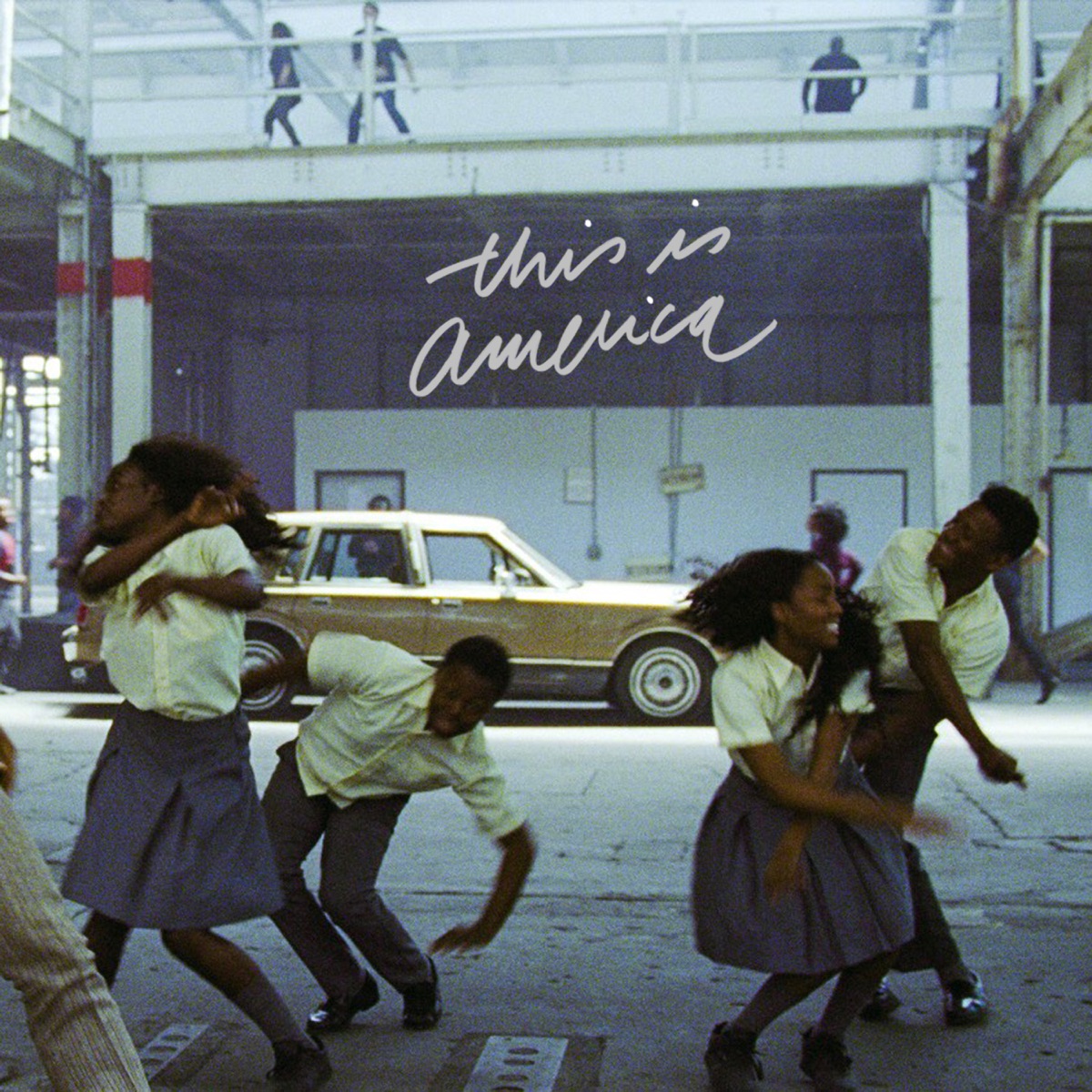
In the opening moments of the "This Is America," a nattily dressed middle-aged Black man sits on a chair in the middle of a warehouse and picks up an acoustic guitar. The camera drifts over to Glover, dressed the same as he was in that SNL performance, as he dances across the floor, pulls a few cartoonish facial expressions, and then pulls out a gun and shoots the guitarist in the back of the head as the bass drops. Glover continues to move fluidly, sometimes doing his own version of tribal African dances and sometimes doing moves associated with viral rappers like BlocBoy JB and Sada Baby. Sometimes, he's surrounded by more little kids in school uniforms. Behind him, chaos erupts, and it takes the form of symbolic spectacle -- cop cars, horses, rioters. At one point, Glover pulls out an assault rifle and massacres a gospel choir. Later on, SZA, a future Number Ones artist, makes a quick cameo, sitting on the hood of a mid-priced car. Glover looks nonchalant through all the violence, but as the video ends, we see him sprinting away from an out-of-focus mob, looking terrified.
The video's juxtapositions hit a lot harder than those of the song. Glover has that rare, ineffable movie-star charisma. He knows how to twitch his face in ways that convey more than words would, and you can't take your eyes off of him. When he dances, he's both funny and mesmerizing, and he uses physicality to link viral dances with racist Jim Crow imagery without necessarily shaming the people who might do those dances online. The sudden eruptions of violence keep the video from ever slipping into the realm of entertainment. They scream importance. "This Is America" might not be the most direct and obvious protest song, but it arrived after the Black Lives Matter movement made police violence into a crucial national issue, and it reflected the tension of the day, which hasn't exactly abated in the last seven years. Upon revisit, the "This Is America" video loses a bit of its original charge through sheer familiarity, but it's still a powerful piece of work. The song, meanwhile, is a thing that was on the internet for a little while.
The extended legacy of "This Is America" is so weird. It's part hot-button social-message art, part internet novelty song. It doesn't have the same fury or urgency as some of the great protest art, but it's too layered and intentional to be shrugged off as some aloof academic thing. It's not the fault of the song or the video, but I associate "This Is America" with a certain form of internet outrage -- the thing where people tut-tut over the news but either can't or won't do anything about it. Maybe I'm just annoyed because I see a reflection of some of my own most irritating qualities in the track -- the thing where you post angrily about politics but then continue to live your life relatively unaffected. But I also have a general impulse to distrust things that trumpet their own importance, and "This Is America" definitely did that. If the song really did have any real change-the-world juice, then Glover gave up on it when he licensed it to the weight-loss drug manufacturers.
As you might expect, "This Is America" blasted to #1 mostly on the strength of YouTube views. I wasn't surprised when it debuted at #1, but I was a little surprised when it managed a second week on top. "This Is America" was only ever meant to be experienced in the context of its music video; the song never even appeared on a Childish Gambino album. But the music industry still went nuts for Donald Glover. At the 2019 Grammys, "This Is America" won both Record Of The Year and Song Of The Year, beating hits by people like Drake and Kendrick Lamar in the process. It was the first rap song to win either of those awards. Until last week, it was the only rap song. The second rap song to win those two big Grammy categories -- a song that's in the news a lot today -- also started out as a Drake diss. Unlike "This Is America," that song stayed that way. We'll talk about it when it's time to talk about it. In any case, the "This Is America" wins are some real Grammy bullshit. That's the first rap song that wins the big awards? The one that doesn't properly function as a rap song? This is petty, but the avalanche of acclaim made me like the song less.
Donald Glover hasn't really made another hit song since "This Is America," and I don't think he's really tried. A few months after "This Is America," he released two more tracks, "Summertime Magic" and "This Is Summer," and both of them seemed minor almost by design. (They peaked at #44 and #54, respectively.) Glover's next big move was to play the voice of Simba in the 2019 computer-animated Lion King remake -- quite possibly the biggest paycheck job in the history of paycheck jobs. The movie made a lot of money, and it sucks butts. That summer, Glover headlined festivals like Coachella and Outside Lands. In the fall primaries, he campaigned for Andrew Yang, maybe the most obvious example of his tech-bro disruptor impulses at work.
Glover eventually got around to making more seasons of Atlanta. He signed a big development deal with Amazon, and he launched a production company called Gilga. In 2020, pretty much in the same week that the pandemic hit, he released the surprise Childish Gambino album 3.15.20. Later on, he took it down from streaming services and released a reworked version that he called Atavista. None of the songs from that record hit. Actually, the biggest Childish Gambino hit since "This Is America" isn't really a Childish Gambino song. In 2022, Glover and Lil Wayne guested on Latto's song "Sunshine," and it peaked at #25. (Lil Wayne has been in this column a few times, and Latto will eventually appear here.) These days, I think Glover works pretty well in unpretentious guest-rapper mode, but he's not in that mode very often.
Last year, Glover released Bando Stone And The New World. Supposedly, it's the soundtrack album to an as-yet-unreleased post-apocalyptic adventure film, but I'm not convinced that the movie exists. Glover likes to engage in high-minded pranks and hoaxes and whatnot, and his level of sincerity is always in doubt. In any case, the single "Lithonia" peaked at #69, and the album pretty much flopped. Glover launched an arena tour behind the record, but he cancelled it midway through, claiming he needed surgery for undisclosed reasons.
Music has never really been Donald Glover's primary focus, and his post-"This Is America" records almost seem like attempts to avoid the cultural zeitgeist that he briefly dominated. I don't blame him. Not everybody wants omnipresent fame. It seems like a pain in the ass. Glover has created a couple more TV shows and starred in one of them. I wasn't big on The Swarm, his horror-adjacent satire about the dangers of stan mentality, but its points were dead-on, and the show was well-made enough that I watched the whole thing. I did really like Glover's TV version of Mr. & Mrs. Smith, a sort of absurdist spy comedy that did a lot with his personal charisma. Supposedly he's got a Spider-Man movie and a Han Solo spinoff show in the works, but those two properties seem to exist in constant flux. Maybe they'll come out one day. Maybe not.
In any case, Donald Glover is the kind of popular artist who can do interesting things with intellectual property. Big companies hand him lots of money, and then he uses that money to make prestige-friendly surrealism. I tend to like his prestige-friendly surrealism, but I'm not sure that someone can really carry the torch for protest art when they're constantly cashing Disney and Amazon checks. "This Is America" made for an interesting moment, but the song means nothing to me today. It doesn't even make me want to try a new weight-loss drug.
GRADE: 5/10
We rely on reader subscriptions to deliver articles like the one you're reading. Become a member and help support independent media!
BONUS BEATS: There are many, many "This Is America" parodies out there, and some of them are about different countries. But at the suggestion of Stereogum Discord user 1_True_Link, I'm going with the deadpan absurdity of YouTuber videogamedunkey's "This Is A Chicken Wing":
The Number Ones: Twenty Chart-Topping Hits That Reveal The History Of Pop Music is out now via Hachette Books. This is a link. Buy it.