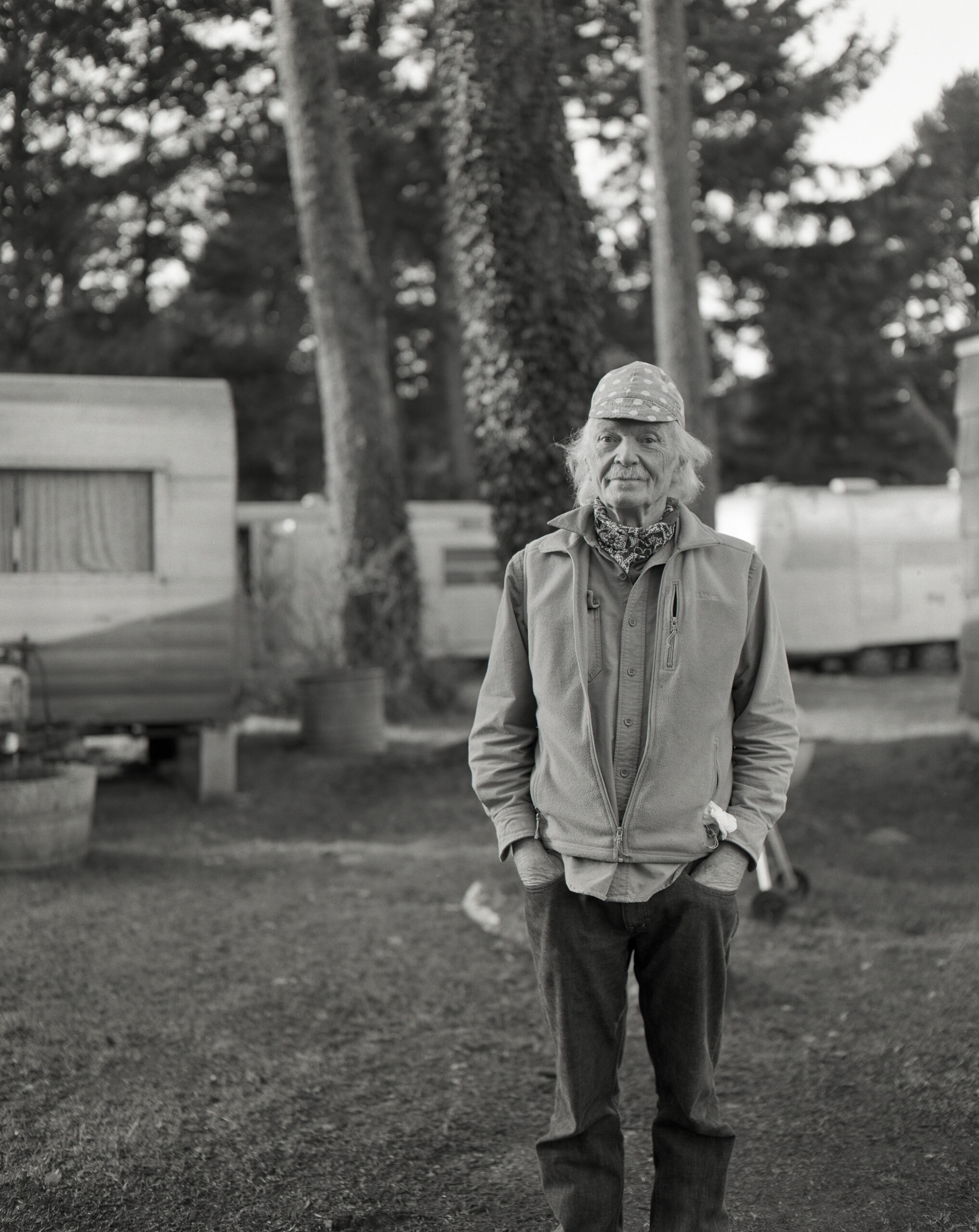
Michael Hurley, the singer-songwriter who emerged from the '60s Greenwich Village scene to become a legend of outsider folk music, has died. His family issued a statement confirming the death to Rolling Stone: "It is with a resounding sadness that the Hurley family announces the recent sudden passing of the inimitable Michael Hurley. The 'Godfather of freak folk' was for a prolific half-century the purveyor of an eccentric genius and compassionate wit. He alone was Snock. There is no other. Friends, family, and the music community deeply mourn his loss." Hurley was 83.
Born in 1941, Hurley — who liked to refer to himself by the nickname Snock — grew up in Bucks County, PA. As a young adult he shared a home with other young men including future Youngbloods frontman Jesse Colin Young, who also recently passed away. By his twenties Hurley made his way to New York City, where he became a vital contributor to the storied Greenwich Village folk scene. Hurley released his debut album First Songs for the highly regarded Folkways label in 1964. A raw, rickety, home-recorded collection seasoned with country blues, the album marked Hurley as an iconoclast within the then-booming folk music world. Decades later it turned him into a guiding light for mid-2000s freak folk artists like Devendra Banhart and Espers.
Though Folkways' Moe Asch handed Hurley $100 in 1965 and urged him to make his next album in a recording studio, he used the money to pay bills. He worked odd jobs near Boston for a few years until one day Young showed up unannounced at his apartment with recording gear. The Youngbloods had gotten their own Warner Bros. imprint, Raccoon, and decided to throw their support behind Hurley. He released two albums for Raccoon, 1971's Armchair Boogie and 1972's Hi Fi Snock Uptown, then spent the next decade-plus living in Vermont, sometimes playing gigs in ski towns.
On New Year's Day 1976 Hurley released his album Have Moicy! with the Holy Modal Rounders, a critical sensation hailed by the likes of The Village Voice’s Robert Christgau. For the next several decades, he kept releasing albums for labels like Rounder, Rooster, Bellemeade, and Blue Navigator, and others. Eventually, he left Vermont and moved around a lot. Artists like Cat Power, Yo La Tengo, and Will Oldham began to cover Hurley's music and cite him as an inspiration. By the time he settled in Astoria, OR circa Y2K, he had developed a fervent cult following, including many of the rising stars of the then-trendy freak-folk scene. Reissues, retrospectives, and a short documentary followed.
Though the hipster zeitgeist moved on from freak-folk within a few years, in his old age Hurley became a treasured presence within the experimental folk music underground. In 2007 and 2009, he released a pair of albums for Gnomonsong, the label founded by Banhart and Vetiver's Andy Cabic. He became a fixture at the Nelsonville Music Festival in rural southeastern Ohio, performing every year and writing a song inspired by the fest. In 2021, days before his 80th birthday, he released his final album, The Time Of The Foxgloves, on the stellar indie label No Quarter. As noted in Niemandweet's statement, just last weekend Hurley was in Knoxville performing at the great avant-garde music festival Big Ears. That's about as fitting a finale for his career as possible.
Below, check out some of Hurley's music and the mini-doc Snock 'N Roll: Adventures With Michael Hurley.