
August 20, 1994
- STAYED AT #1:5 Weeks
In The Alternative Number Ones, I'm reviewing every #1 single in the history of the Billboard Modern Rock Tracks/Alternative Songs, starting with the moment that the chart launched in 1988. This column is a companion piece to The Number Ones, and it's for members only. Thank you to everyone who's helping to keep Stereogum afloat.
Mike Dirnt hasn't played anything on his bass yet, but he's already stomping around the stage like a caveman. Then he's wandering up to his mic and banging it into his forehead. He's got on a Screeching Weasel shirt and one of those choker necklaces that dudes used to wear in the '90s. He turns to the soggy, gigantic crowd and waves hello. Over to his right, his bandmate Billie Joe Armstrong -- purple hair, black button-up with safety pins all stuck through it, red tie with a question park drawn on in magic marker -- asks a rhetorical question: "What is all this free fuckin' hippie love shit?"
This is a good question. It's August 1994, and we're at Woodstock '94, which is promoted as "two more days of peace, love, and music." It's the 25th anniversary of the first Woodstock festival -- or it's somewhere around there, anyway -- and the baby boom generation is here to celebrate itself. The bill is crammed with veterans of the first Woodstock: Country Joe McDonald; Santana; Joe Cocker; Crosby, Stills & Nash. Green Day have no business on this bill, and they clearly find the entire ordeal to be a vast cultural blank. But they can't act like they're too far above it because they're still here.
Once Armstrong gets his rhetorical question off, Mike Dirnt has one of his own: "How you doin', all you rich motherfuckers?" Tickets to Woodstock '94 cost $135 for the weekend -- an unheard-of expense in this day and age. The members of Green Day, products of the Bay Area DIY punk world, are not used to such extravagance, and they do not respect it. Armstrong spends the next half-hour intermittently clowning the entire idea of Woodstock nostalgia, mockingly invoking the names of Abbie Hoffman and Wavy Gravy. He's suspicious even of the crowd members who do not present as Woodstock nostalgists: "Oh hey, look, that guy with the green hair! He's a punk rocker! He's even tellin' everybody! You fuckin' hippie!"
It's been raining for three days straight. People have been covering themselves in mud since the very first day, just making a fashion statement out of it. My boss Scott Lapatine is there, still a kid, and he tells me that the mud by the smaller South Stage, where Green Day are playing, is so thick that you basically can't walk through it. (Scott is not present for what Green Day are about to do.) Green Day's South Stage timeslot is right in between a WOMAD-sponsored showcase of international musicians and a blues-rock all-star jam led by Bad Company's Paul Rodgers. Most of the crowd is over by the bigger stage, awaiting the hotly anticipated performance from Bob Dylan, who famously wasn't at the first Woodstock. He's an hour and a half late. Green Day still have a huge crowd, and these kids are ready to go.
The mud starts flying around early. It makes sense. Green Day's music is fast and fizzy and energetic. They clash with the entire Woodstock '94 vibe, and it's anyone's guess why they're even booked at all. They've already got three albums, but the first two would be totally unfamiliar to pretty much everyone here. Dookie, their major-label debut, just went gold. They had one song, "Longview," that was big on radio and MTV. A second one called "Basket Case" is only just now starting to gain steam. Maybe they're here as counter-programming, like the famously mud-spattered Nine Inch Nails set from the previous day. Or maybe the Woodstock bookers have no idea what they're doing and just stumbled into presenting something legendary.
Green Day are proponents of a certain crowd-interaction dynamic: They like to make fun of their audiences. This is a proud punk tradition. Johnny Rotten was happy to berate anyone who paid money to see a Sex Pistols show. NOFX's sneery slapstick mockery has a dash of Mel Brooks to it. Sheer Terror frontman Paul Bearer is basically an insult comic. That's the zone that Green Day are in. Mike Dirnt has the total sarcastic-guy voice filter on when he tells the crowd, "We suggest that you throw mud! That's fun!" Maybe sarcasm doesn't translate when you're talking to that many people. Armstrong and Dirnt get into an onstage discussion about how much the mud-clots look like human turds. It ends when Armstrong, who definitely looks coked out of his mind, barks, "Shit! It's shit! It's shit!"
Green Day play their two radio songs back-to-back, and the crowd goes wild. The band is getting used to this. They've just played their first seven shows opening the main stage of the Lollapalooza tour, where they've replaced the Boredoms halfway through the summer, and their sets are already famous for setting things off. As their Woodstock performance goes on, the clots of mud splatter the stage, getting closer and closer to the musicians. A whole mob security guards in ponchos holds up a sheet of plastic in front of the band, presumably to shield them from those flying mud-clots. It doesn't work. While the guards are otherwise occupied, more and more mud-freaks from the audience rush the stage, running around and grabbing the band members before diving off. Some of the pissed-off security guards get to clobbering the stage-crashers. Things are getting out of hand, and Green Day are not trying to restore order.
Green Day launch into an extended take on their early track "Paper Lanterns." By now, there's mud all over the stage, all over the band members. Armstrong plays an intentionally discordant guitar solo, then runs and slides in the now-mountainous pile of onstage mud. He throws some into the crowd, and they throw it right back. He's smiling. Everyone is smiling. Armstrong runs off to both sides of the stage and stands in the Jesus Christ pose, to present a better mud-flinging target. Dirnt sits onstage and makes mud angels while he plays bass. He looks like the Feral Kid from The Road Warrior.
Armstrong gets down on the ground and bangs the mic into the floor. He sings one line of Twisted Sister's "We're Not Gonna Take It," and the crowd tries to start a singalong, but no, it's right back into "Paper Lanterns." At some point, a little kid makes it onstage, yells "USA!" into the mic, and hi-fives Armstrong. Armstrong gets one side of the crowd to yell "Rock 'n' roll!" and the other to yell "Shut the fuck up!," and they go back and forth for a while. Then Armstrong gets the whole crowd to yell "Shut the fuck up!" at the count of three, and Green Day immediately comply. That's it. Show's over. The crowd chants for more. Dirnt puts his bass down, and one of those pissed-off security guards spears him like he's Roman Reigns. The guard thought Dirnt, covered in mud, was just another geek from the audience. The tackle knocks out at least one of Dirnt's teeth, and Green Day have to miss the next Lollapalooza date so that he can get emergency dental surgery.
The entire Woodstock '94 weekend is broadcast on pay-per-view, an early version of the festival livestreams that we get 20 times a summer these days. The camera doesn't capture Dirnt getting his teeth knocked out, possibly because at least one of the camera lenses is now completely coated in mud. Still, the entire spectacle makes for riveting television. Green Day already had a rocket strapped to them, but that rocket has now been turbo-boosted. Dookie goes shooting up the album charts, into the top five. It'll be platinum in a couple of weeks and double platinum a month after that. And "Basket Case," the single that's already started to get radio burn, will top the Modern Rock chart for more than a month, bulldozing its way to modern-classic status.
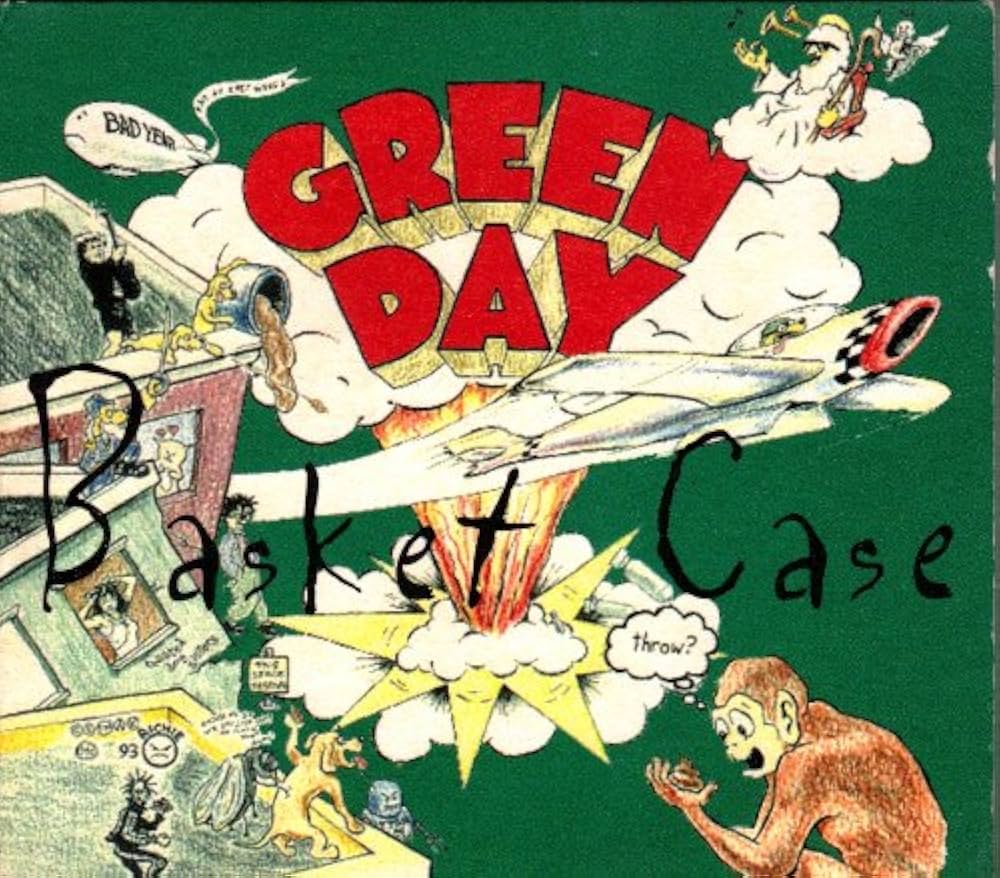
Green Day started to blow up thanks to "Longview," a fairly atypical song for them. It's got a big, fun, thrashy chorus, but its main hook is the wandering-goofball bassline that Mike Dirnt wrote when he was tripping on acid. "Basket Case" is much more fundamentally Green Day. It's fast and loud and mercilessly catchy, and it could've easily appeared, with minimal tweaks, on any of the band's independently released early records. Armstrong honks out lyrics about panic, paranoia, and nervous breakdowns, but he does it with such fired-up joie de vivre that the panic attacks sound like fun. You couldn't ask for a better public introduction to the band's style, or to the entire pop-punk underground. For a lot of people, "Basket Case" really was the introduction, since it quickly overtook "Longview" to become Green Day's biggest hit to that point.
Billie Joe Armstrong started to write "Basket Case" in 1992 or 1993, and he recorded the original demo version on a four-track. The melody is the one that we know, but it sounds way different. It's slower, and the drums are just Armstrong beatboxing. The lyrics are about two kids in love, and they're not very good. Last year, Armstrong told the Song Exploder podcast, "I was on crystal meth when I wrote the lyrics to it, and I thought I was writing the greatest song ever." When he sobered up, he was embarrassed about what he'd written. Later on, he revisited the song, changing the lyrics to sing about the panic attacks that he'd been suffering for his whole life. This was a good decision. Green Day recorded a full-band demo of the new version before they got their major-label contract. Once they signed, they re-recorded it again with co-producer Rob Cavallo, and they made that shit gleam.
As you are no doubt aware if you've spent an hour listening to alternative rock radio in the last 30 years, "Basket Case" opens with just Billie Joe Armstrong by himself. He's playing some choppy power chords on his guitar, and he's yelling about whether we have the time to listen to him whine about nothing and everything all at once. His voice doubles up for a few big harmony notes, but it's about as stripped-down as a big rock-song intro can be. This is not a problem. The melody is tight and coiled-up, and the guitar-crunch makes for a perfectly lively rhythm section by itself. Armstrong's voice -- an American imitating the British singers who imitated American singers -- is snotty and direct and, if anything, over-enunciated. Armstrong sings about self-pity, the way so many of his grunge peers did, but he does it with a disarming directness. There's no elliptical poetry happening here. Instead, Armstrong merely describes himself in self-deprecating language, insisting that he does not have his shit together. Sometimes, he gives himself the creeps. Sometimes, his mind plays tricks on him. It all keeps adding up. He thinks he's cracking up! And as he's hitting that last line, the drums come sprinting in, and the world explodes.
The hammer-drop moment on "Basket Case" has become so familiar through overplay that it's easy to take it for granted, like the drum-fill pedal-mash part of the "Smells Like Teen Spirit" intro. But when I try to lock in on "Basket Case" and hear it with fresh ears, it's pretty fucking remarkable. Tre Cool beats the shit out of those drums, and he does it with speed and grace and economy. The drum fills never get in the way or overshadow what Billie Joe Armstrong is doing, but they still bring the boom. When the rest of the band comes in, "Basket Case" turns into double-time power pop. Mike Dirnt's bits -- the quiently melodic basslines, the backup harmonies, that one stray bass note before the big drum fill -- sweeten things up so much that he almost sounds like a record-label sleeper agent. After the second chorus, Armstrong gets in a couple of perfectly timed grunts, and then the song jumps up another level on the bridge, the bass and guitar finding ways to harmonize. The whole thing blasts by quickly enough to leave you with a vaguely nauseous energetic headrush, like when you're a little kid and you spin around in circles until you collapse.
"Basket Case" is a song about feeling yourself break apart, but the track itself works like a perfectly wound hook-machine. Billie Joe Armstrong asks if we have the time to listen to him whine, and then he thoughtfully keeps the whining brief and compact enough to keep anyone from answering that no, they don't have time. ("Basket Case" is three minutes long, almost on the nugget, but it actually feels shorter.) He talks about how pathetic he is, but he shouts that stuff out with so much force, and the song is so linear, that it almost contradicts him. The song's sheer exhilaration is powerful enough that the one placeholder lyric that Armstrong never got around to replacing -- "ah yeah yeah yeah" -- feels as profound as anything else he has to say. He insists that his life is a wreck, that he has no control, but he sounds like he's having a great time.
On his second "Basket Case" verse, Billie Joe Armstrong mentions going to see a therapist who tells him to go get laid and then a sex worker who tells him to stop whining. When Armstrong first wrote the lyrics, the shrink was a man, and the whore was a woman. In the final version, he flips the genders around. Armstrong has always generally presented as a straight man, and he's been married to the same woman for the whole time that Green Day have been famous. (They actually got married in July 1994, a month before the "Basket Case" single came out. That was a busy year for Green Day!) But Armstrong came out as bisexual in a 1995 interview with The Advocate, and that's what the Dookie track "Coming Clean" is about. One of the coolest things about "Basket Case" is the way it makes same-sex attraction so offhand and casual, as if it doesn't demand further explanation. That's no big deal now, but nobody else was treating it like no big deal in 1994.
"Basket Case" blew up partly because it's a great song and partly because the Woodstock performance plugged Green Day right into the zeitgeist, but the video also had a lot to do with it. Director Mark Kohr, who also did "Longview," filmed Green Day at a decommissioned mental hospital. The song's structure makes for some fun staging. Armstrong is by himself in a waiting room, with orderlies hanging over him, thrashing at his guitar in a chopping-stabbing motion that was always fun to imitate. His bandmates come ambling in just at the moment when they should -- with Mike Dirnt looking like he's sleepwalking and Tre Cool being wheeled up to his drums. They get drugged-up and hallucinate, and the baby-masked patients at the end of the video are hard to forget. Kohr filmed everything in black-and-white and then colorized it later, giving it a gaudy, exaggerated look that feels quintessentially '90s. But even with all the fun visual gimmickry around them, the band manages to stand out. Billie Joe Armstrong's crazy-eyed presence could've sold the clip by itself, even without mental-hospital stuff. Single-location videos rarely played well on TV, but this one really sang. MTV put it into heavy rotation right away, and it was inescapable for a while.
Green Day didn't make a video for their next single. Reprise Records wanted to push "Welcome To Paradise," Green Day's re-recorded Kerplunk banger about finding purpose and meaning in the Bay Area punk scene. But by the time that radio programmers got to "Welcome To Paradise," Green Day were persona non grata within that scene. Outside some Green Day shows, a few punks even held picket-line protests, a spectacle that's extremely funny to contemplate now. (I am sure those protests were small, but they existed.) There would be no way to make a "Welcome To Paradise" video without bringing Green Day back to the places where they were no longer welcome, so someone just edited the song's studio version over footage of Green Day playing live. The lack of a proper video didn't stop "Welcome To Paradise" from becoming a radio hit. (On the Modern Rock chart, "Welcome To Paradise" peaked at #7 in November 1994. It's a 10.)
As alt-rock radio latched onto those Dookie singles, the Green Day legend spread. Green Day became avatars of restless '90s-kid excitement, and that feeling followed them around. A month after Woodstock, Green Day played a free radio-station show in Boston, and the crowd got rowdy enough that security cut the show short, which is never a good idea. The resulting riot led to dozens of injuries and arrests. Green Day played SNL for the first time in December 1994. (Guest host: Roseanne.) By the end of the year, Dookie was triple platinum, and it was really just getting started. On Spotify, "Basket Case" has 1.3 billion streams. If we're using that metric, it's the most popular song from Dookie and, for that matter, from Green Day's entire career. But another Dookie track would hit alt-rock radio even harder. We'll see Green Day in this column again soon.
GRADE: 10/10
BONUS BEATS: I had a hard time deciding that "Basket Case" should be a 10, since I've just heard the song so many damn times. Even when you're dealing with a compressed hook-sprint like that, radio overplay can just be death. Within a decade of its release, "Basket Case" already felt like classic rock. Case in point: Avril Lavigne, the artist who kicked off even more rounds of punk-vs.-pop discourse, covered "Basket Case" on her early tours, before she had enough of her own songs to fill out an arena show. Here she is, singing it in 2003 and helpfully closing by yelling the name "Green Day":
(Avril Lavigne has been in the other column, but I'm vaguely scandalized to learn that she has never been much of a presence on alternative rock radio. That really illustrates how male-focused this column will sadly become. Lavigne's only hit as lead artist on what's now called the Alternative Airplay chart is 2021's "Bite Me," which peaked at #23. That same year, she also made it to #21 as a guest on Mod Sun's "Flames.")
THE 10S: Mazzy Star's transcendent, dizzily romantic twang-dirge meditation "Fade Into You," one of the all-time great hipster wedding songs, peaked at #3 behind "Basket Case." Strange you always knew it's a 10.
Another song with some utterly beautiful Hope Sandoval vocals, the Jesus And Mary Chain's scrappy and heartwarming breakups-to-makeups story-song duet "Sometimes Always," peaked at #4 behind "Basket Case." Aw, it's a lucky son, lucky son of a gun, because it's a 10.
Weezer's all-chorus twinkle-splinter debut single "Undone (The Sweater Song)," probably one of the earliest and clearest beneficiaries of the post-Green Day glow, peaked at #6 behind "Basket Case." Aw man, it's the best, I'm so stoked to tell you that it's a 10. Take it easy, brah!