
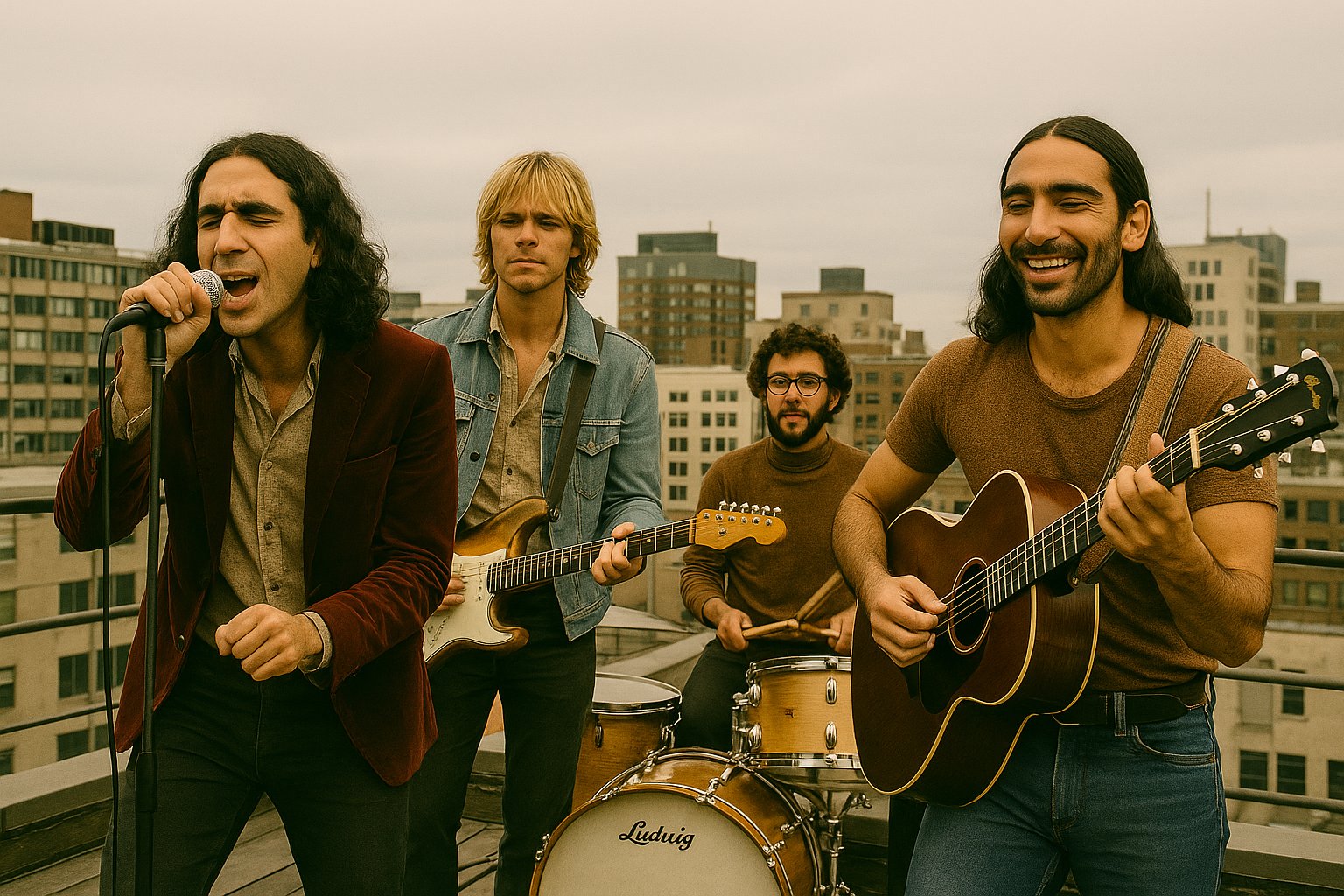
The plot has thickened tremendously. Yesterday Rolling Stone ran an interview with Andrew Frelon, a guy who claimed to be a spokesperson and "adjunct" member of the Velvet Sundown, a "band" made with AI whose songs have now garnered over a million streams total on Spotify. In that phone interview, Frelon admitted to orchestrating an "art hoax" with the Velvet Sundown, explaining: "It’s trolling. People before, they didn’t care about what we did, and now suddenly, we’re talking to Rolling Stone, so it’s like, 'Is that wrong?'" What is wrong, at least in my humble opinion, is tricking Rolling Stone into interviewing you; turns out that's what Frelon did. According to his blog and the Velvet Sundown's Spotify bio, he's not actually affiliated with the project after all.
In a lengthy and illuminating post to his Medium, Frelon -- who's using a pseudonym in all of this -- explained that he has a background in web privacy, and he's used generative AI "to uncover vulnerabilities in order to fix them." He's also used generative AI for his own creative pursuits outside of his day job. He says that on June 29, a day after Stereogum published this news post about the Velvet Sundown, he started seeing coverage about this AI "band," and he decided he wanted in on it. "A year ago with a friend, we attempted much the same formula as TVS seemed to be using as an experiment on Spotify to see if we could get an entirely AI-generated band to trend and earn money," he writes. "Because of those experiences, I completely understood TVS as a phenomenon. I also noticed based on media coverage that there were not really any social media accounts associated with the band, apart from an Instagram account with a few obvious AI-generated images of the band on it. Suddenly, I had the crazy idea, what if I inserted an extra layer of weird into this story? What if I re-purposed an old Twitter account I’d barely used for another project, and made that into an 'official' looking account for TVS?"
The Velvet Sundown's Spotify bio does link to a Twitter profile, but that one's not very active. This account that Frelon's been using, however, is extremely active, consistently trolling people who dare to insinuate they might not be a real band. (Even our own Danielle Chelosky caught a stray, but she deflected it well.) "I asked ChatGPT to write an angry tweet thread blasting journalists for not contacting us, and pinned this to the top of the profile," Frelon writes. "Then, I set about gathering all the existing coverage about TVS, and finding the articles’ authors on Twitter to the best of my ability, and then individually tagging them to blast them for not contacting us." How cool! Awesome, even!
After Frelon continued harassing music writers online for a while, they apparently started reaching out to him via Twitter DM. He made a fake Velvet Sundown Gmail account for further correspondence. Heck, he had us fooled for a minute there, too. Even after whoever's behind the Velvet Sundown Spotify added a link to their "official" Twitter account in their bio, Frelon's account was older and more active, so it prevailed. He was asked for an interview with Rolling Stone, but it focused on the AI aspect and not the possibility of this being a sham within a sham. That piece was published yesterday, and since then, the Spotify account for the "real" Velvet Sundown -- there's gotta be a more accurate word than "real" here, but you get what I mean -- was updated with a statement disavowing Frelon's involvement with the project. According to an update from Rolling Stone, the phone number Frelon used for their interview is no longer in service.
Here's Frelon's "Conclusion," which is a real doozy:
My findings suggest that there are numerous and large gaps in the verification process used by the majority of journalists, most likely occurring especially when they are chasing after a large and timely story such as that surrounding TVS. (Also, to be fair to them, I exploited a confusing situation around account ownership based on my professional knowledge in this domain. But they still should have done better.)
It seems that in the heat of the moment as journalists are trying to race to be the first to publish, many will disregard best practices around fact-checking and verification, as well as perhaps aspects of journalist codes of ethics which might be less convenient in meeting their tight deadlines.
I see what I have done as a kind of red-teaming of the media & platform ecosystems at large. I write this with the intent not of shaming anyone named in it, but in the hopes of inspiring a more careful approach to prevent the publication of blatantly false information by people with worse or more dangerous agendas than my own foolish experiment.
My conclusion: Please don't troll people who are just trying to do their jobs, music writers or otherwise, for the sake of an "experiment."