

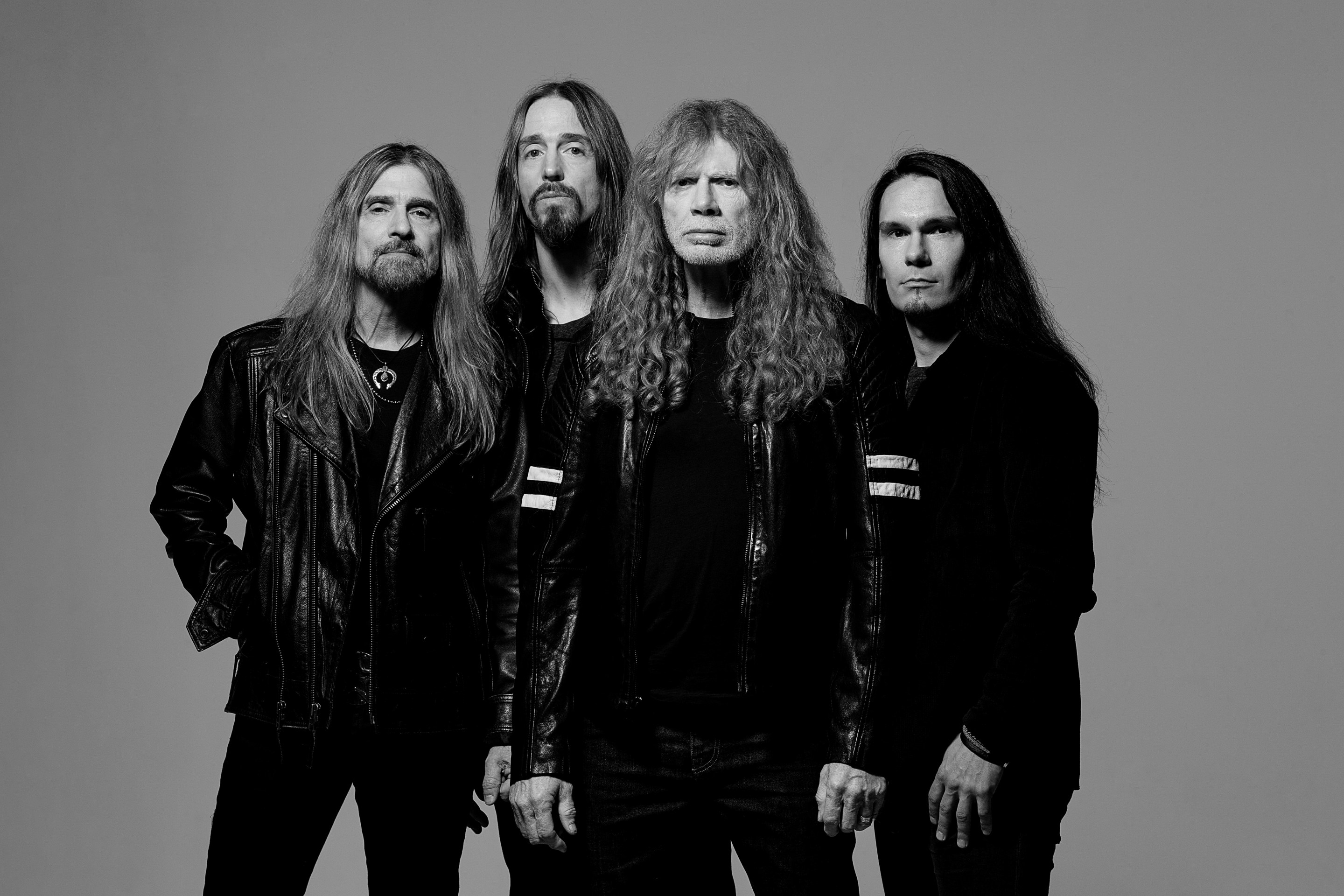
I remember the first time I saw Megadeth like it was yesterday. It was Sept. 23, 2006, at the Columbus stop of that year's Gigantour, an ultimately doomed Ozzfest competitor that booked some killer lineups in its short life. My friends and I got to Nationwide Arena hours before doors, because in those days, time was cheap and lining up at the barricade was priceless. After watching Sanctity (terrible), Into Eternity (solid), Overkill (a bit creaky), Arch Enemy (mindless fun), Opeth (mind-blowing), and Lamb Of God (not really for me, but inarguably at their energetic peak), we stood in awe as the mid-2000s iteration of Megadeth hit the stage. Dave Mustaine was front and center, of course, his leonine red hair cascading over a black dress shirt as he mean-mugged and shredded his way through the band's hit-loaded set. Mustaine was flanked by James LoMenzo on bass and brothers Shawn and Glen Drover on drums and second guitar, respectively. This being Megadeth, they wouldn't be long for this world.
The next time I saw Megadeth, in 2010, Shawn Drover was the only supporting member from that Gigantour lineup left, and by 2017, when I caught them at a sweat-choked secret show at Saint Vitus in Brooklyn, even he was gone. (LoMenzo returned for a second stint in the band in 2021.) Thirty-five people have been in Megadeth over the years, and the only reason that number is unlikely to grow is because Mustaine plans to retire the band after the touring cycle for their new, self-titled, allegedly final album. That there's been so much tension between Mustaine and his bandmates over the years shouldn't come as a major surprise. Megadeth was built on tension, friction, stress, spite. Conflict has been the band's greatest motivating force and the source of its worst acts of self-sabotage. At the center of it all is Mustaine, one of metal's all-time visionaries and one of its biggest pricks. The duality of man in one pissed-off vessel.
Megadeth's origin story is one of metal's foundational myths. In April 1983, a month before decamping to Rochester to record Kill 'Em All, Metallica fired Mustaine for his drug and alcohol abuse and erratic behavior. The revenge tour started in earnest as soon as Mustaine got back to Los Angeles. It took a couple of years to get a solid lineup together – foreshadowing – but when Megadeth finally hit, they hit hard. 1985's Killing Is My Business…And Business Is Good! was vicious, yes, but it also showed what a thoughtful songwriter and skilled player Metallica had let go — which was, of course, entirely the point for Mustaine.
The decade-long run of albums that followedremains one of metal's great hot streaks. With Peace Sells…But Who's Buying?; So Far, So Good…So What!; Rust In Peace; Countdown To Extinction; and even Youthanasia and Cryptic Writings, Mustaine made Megadeth into an irreplaceable lodestar of the heavy metal universe, mostly by trying his damnedest to one-up Metallica. Sometimes, he even pulled it off. Countdown is a far better to crossover-friendly hard rock transition than the Black Album, even if it seldom gets that credit, and Rust In Peace is the unquestioned apex of the entire history of the creative arts.
Sadly, it doesn't seem like Mustaine has ever truly enjoyed the spoils of his conquests, a sense that only grew for me after watching the band's new documentary/visual album, Megadeth: Behind The Mask. The film consists of Mustaine sitting in a studio, analyzing every song on Megadeth and talking about every album in the Megadeth discography. This was a band-made, Mustaine-approved movie, and to his credit, he didn't really act like he cared how it would make him look. But God, he comes off bitter! Every flop Megadeth ever had was somebody else's fault, and everyone who ever played in the band was a problem, except for his current bandmates, whom it would presumably be too awkward to shit on. (No one was interviewed for the film except for Mustaine.) He hasn't gotten over getting the boot from Metallica, which you can tell because he's constantly saying he's moved on, unprompted. He doesn't have anything kind to say about what's widely regarded as Megadeth's classic lineup: Mustaine, Marty Friedman, David Ellefson, and Nick Menza. In Mustaine's world, Ellefson and Menza were always asking for too much money, and Friedman quit because he wanted the band to play slower. Never mind that Friedman has enjoyed a long, fruitful second act as a neoclassical shred guitarist in Japan.
Megadeth haven't made a great album since Friedman left in 1999, though there have been occasional flashes of brilliance. I could make a sick hour-long playlist of 21st century Megadeth tracks, but I'd be pulling from nine albums. Megadeth doesn't break the pattern. For every rock-solid melodic thrasher ("Tipping Point," "Made To Kill"), there are a couple of duds, and Megadeth duds have never had the luxury of being merely forgettable. They're hopelessly cringe. "I Don't Care" and "Let There Be Shred" sound like they were written by a 12-year-old, and "The Last Note" is a self-congratulatory send-off with all the gravitas of a halftime speech on Senior Night. Worst of all is "Hey God?!", a song that Mustaine says was inspired by the fact that metalheads are, sigh, too scared to talk about God. In fact, talking about God isn't good enough. Twice in Behind The Mask and once in a recent New York Times profile, Mustaine talks about how he used his Grammy acceptance speech for 2016's Dystopia to thank Jesus Christ — not God, but Jesus. Merely thanking God is for poseurs, apparently.
In that same Times piece, Mustaine (sort of) confronts the idea that he's a right-winger: "I'm a Christian, and I answer to a different set of angels," he explains. I suppose those angels must have approved his multiple appearances on Alex Jones' execrable Infowars show and told him to spread the lie that Barack Obama was born outside of the United States. For years, Mustaine's politics were the toughest thing about being a Megadeth fan. Conspiracy theories and anti-authoritarianism were always right there on the surface of the albums, but Mustaine slid hard down the slippery slope to the Christian Right sometime in the mid-2000s. I'm not sure if he's had a change of heart or if he's simply gotten smarter about what he chooses to say in public, but he doesn't weigh in on politics so directly anymore. Even so, there's a brutal paper trail that's hard to forget.
This is hard to write about, because Megadeth still means a lot to me. They were one of the first metal bands I ever got into, and apart from Iron Maiden, the one that touched me the deepest. My username on the message boards I frequented as a teenager was "DethMaiden," and I took real pride in living up the road from Wright-Patterson Air Force Base, the alleged home of "Hangar 18" and its UFO debris and alien technology. (Cringe Dave at the peak of his powers: "Military intelligence/ Two words combined that can't make sense.") One of the first songs I learned on guitar was "Symphony Of Destruction," and I sang "Sweating Bullets" at karaoke on vacation just last April, sneering about Reader's Digest to a disinterested barbecue restaurant in Santa Fe. This band is in my blood. I'm really going to miss them when they go away. I have my tickets to see Maiden and Megadeth together in Toronto in August, and I plan to be up at the barricade, screaming along to "Holy Wars" and "Peace Sells" with teenage gusto.
I can't defend Mustaine's entire track record. He's a toxic narcissist and a political wild card, and he's always sounded much more comfortable talking about record contracts, songwriting splits, and management snafus than the creative work of making music. He's also been through a lot. In the early days of Megadeth, he was homeless, and he's battled drug addiction, alcoholism, neck fusion surgery, throat cancer, and now, severe arthritis that makes it difficult for him to play guitar. If I'd been through all that, I'm sure I'd be a little bit of a prick, too. I just hope that, as Megadeth winds down what was a singular, amazing career, Mustaine figures out how to enjoy it a little. He may not have sold more records or played in bigger venues than Metallica, but his discography can go toe to toe with theirs. On "A Tout le Monde," Mustaine sang that he "realized life was a game." What he seemingly hasn't realized yet is that he won. As it stands, he's at risk of living one of his best lyrics: "Sweet taste of vindication/ It turns to ashes in your mouth."
TEN NAILS THROUGH THE NECK
Archvile King – "Aux Heures Désespérées"
Location: Nantes, France
Subgenre: melodicblack metal
David Thiérree's stunning cover painting for Archvile King'sAux Heures Désespérées sucked me into the album before I heard a note of the music. Black metal album art has long tended toward a monochrome palette — black-and-white photography, nightscapes rendered in purple or cobalt. Thiérree is one of the finest cover artists working in metal today precisely because he rejects the idea that black metal should be drained of color. His covers are rich, expressive, and nuanced. Last year, for Cercle du Chêne's Récits d'automne et de chasse, he painted a menagerie of woodland creatures gathered in the shade of a late-autumn oak, its leaves a dozen different shades of carmine and umber. For Aux Heures Désespérées, Thiérree returns to this arboreal motif, this time painting a knight whose still-armored corpse and sword are overgrown with roots and vines. Stars blink against a deep-blue canvas of night, and a castle tower stands in ruin. Every nook and cranny of the painting is alive with detail, and the color palette is bright despite its tonal darkness. It's not cartoonish, but it's certainly a lot more animated than your average black metal album cover.
Archvile King's lively, melodic take on black metal lives up to the standard established by Thiérree's painting. The solo project of Nantes-based multi-instrumentalist Baurus launched with the thrashy Vile EP in 2020, and it's grown steadily more refined ever since. Aux Heures Désespérées moves with chivalric grace, layering medieval music-inspired riffs, martial drums, and dungeon synth padding into ever-ascending spires of sound. There's also a luxuriously elegiac feel to much of the album, reflected in its title (French for "in desperate times") and its end-of-empire cover. The stirring title track best encapsulates the spirit of what Baurus is going for here. It's the final riposte of a knight whose way of life has already come to an end, proud and mournful all at once. [From Aux Heures Désespérées, out now via Les Acteurs de l'Ombre Productions.]
Blackwater Holylight – "Poppyfields"
Location: Los Angeles, California
Subgenre: doom metal/shoegaze
A decade into their run, Blackwater Holylight remain deliciously difficult to pin down. Perhaps it's best to think of the LA-via-Portland trio as simply a rock band. That would at least grant them the stylistic freedom that they continue to exploit to such exciting ends. They clearly love shoegaze: its textured, hypnotic washes of guitar and its volume-forward ethos. They also love metal, a love that's expressed itself at various points in their career as driving, dusty desert rock and crushing melodic doom, and now, on "Poppyfields," as blitzkrieg black metal. The plaintive, open guitar notes that ring out through the song's first third are a feint. "Poppyfields" really begins when drummer Eliese Dorsay (also of the more explicitly metallic Urchin) starts playing blast beats. What follows is Blackwater Holylight's idea of a black metal song, one that has as much room for resonant violin and dreamy clean vocals as it does blown-out riffage and double kick drums. [From Not Here Not Gone, out now via Suicide Squeeze Records.]
Heavens Die – "The River"
Location: Shenandoah Valley, Virginia
Subgenre: sludge metal/hardcore
It's no secret that hardcore kids love Crowbar. I'd go so far as to say it's hardcore kids who have kept Crowbar at the forefront of heavy music culture in the 2020s, far more than metalheads. If you've counted the Broken Glass shirts in a spin-kick pit in the past couple of years, you know what I mean. The Virginia crew Heavens Die is what happens when the natural affinity between sludgy fat-guy riffs and menacing tough-guy stomp gets consummated, and "The River" is their beautifully ugly love child. It feels blessed by Kirk Windstein and the ghost of Dimebag – those squeals! – but written for a straight-edge 17-year-old who wants to see some blood on the floor. It also reminds me a little bit of Rhea Sylvia, Thou's 2018 "grunge" EP—a release that, not coincidentally, was home to a cover of Crowbar's "The Lasting Dose." Shit's gnarly. [From Heavens Die's 12" split with Sinister Feeling, out now via Delayed Gratification Records.]
Valiant Sentinel – "Elden Lord"
Location: Athens, Greece
Subgenre: power metal
Last week, nine months after I first picked up the base game, I defeated Promised Consort Radahn, the final boss of Elden Ring's Shadow of the Erdtree DLC. That's not the only reason this Valiant Sentinel song is in Breaking the Oath this month, but it's one of them. "Elden Lord" is one of those metal songs whose lyrics straightforwardly describe some piece of IP, and my months playing through Elden Ring definitelysoftened me up for its charms. But it also rules!
Valiant Sentinel play a Euro-style power metal/USPM hybrid that skews maybe 70% toward the Euro stuff. It's muscular enough for the power metal skeptics to bang their heads to it, but it's most at home when it's ladling on the extra cheese. Blind Guardian's Frederik Ehmke plays the rocket-propelled session drums on Neverealm, and he's crucial to the final product. His buttoned-up playing brings a professionalism that elevates the songs, which might top out at "charming" without him. He's in lockstep with guitarist Dimitris Skodras on the tricky verses of "Elden Lord," while vocalist Giannis Veandok owns its belting chorus ("Mark my words, I will be the Elden Lord!"). Greece is the power metal capital of the world right now, and Valiant Sentinel are one of the most promising young bands flying its flag on the world stage. Do what I did when I finally beat Radahn: Embrace cheese. [From Neverealm, out now via Theogonia Records.]
Invictus – "Altar Of Devoted Slaughter"
Location: Nagano, Japan
Subgenre: death metal
There's a rawness, even a crudeness, to the way Japanese trio Invictus plays death metal. The bass strings rattle against the body of the instrument. The snare drums clank as often as they snap. The lead guitar frequently seems to be fighting its way out from behind a curtain of noise, and it's not unusual to hear a bum note interrupt a particularly thorny run. It's a testament to the band's commitment (and songwriting) that this all manages to come across as an appealing earthiness. Invictus are true underground death metal, their instinctive songs seem to say, not fodder for tourists. On songs like "Altar Of Devoted Slaughter," I can hear Imperial Doom-era Monstrosity, Here In After-era Immolation, maybe even a little Considered Dead-era Gorguts. All those bands would grow more polished on subsequent releases, but it sounds like the albums Invictus are drawn to are the ones with a little scum oozing from the seams. Someday, if we're both so lucky, this column might be citing "Nocturnal Visions-era Invictus." [From Nocturnal Visions, out now via Me Saco Un Ojo Records.]
Qasu – "Death Dreams"
Location: United Kingdom / United States
Subgenre: experimental black metal
For all its concern with authenticity and poseurs, black metal takes on outside influence better than any other metal subgenre. At this point, I've heard black metal cross-pollinated with just about every other style of music that exists, both ancient and modern. It's very hard to surprise me. The UK/US trio Qasu surprised me with "Death Dreams," a song built around Daft Punk-style pitch-shifted vocals, dissonant crashes of power chords and synths, and drums that sound like Animal from The Muppets trying to play along to Battles In The North. (In fact, the drummer is Nikhil Talwakar, the wunderkind behind the iconoclastic brutal death metal project Anal Stabwound.) The closest thing I've heard to what Qasu is doing on A Bleak King Cometh, their certifiably batshit debut, can be found in the darkest corners of some of the Body's weirder records. Is it black metal? Yeah, sure, I guess — but Qasu won't be limited by anybody's idea of what that's supposed to mean. [From A Bleak King Cometh, out now via Phantom Limb.]
Stabbing – "Their Melted Remains"
Location: Houston, Texas
Subgenre: brutal death metal
Bridget Lynch is so good at brutal death metal vocals that when I saw Suffocation in Detroit in 2023 and Ricky Myers was too sick to go on, she filled in on zero notice and won over the entire room, not even an hour after ripping through Stabbing's support set. Stabbing aren't as technical or as twitchy as Suffocation, but they're every bit as nasty, and Lynch sounds fucking disgusting on Eon Of Obscenity. She's matched pound for pound by the rest of the band, who keep things high and tight through corridors of chugging, stop-start riffs, skronking pinch harmonics, and BDM's signature trash-can snare hits. My favorite tune on the record is "Their Melted Remains," a relative epic at four minutes, with more than enough brutal, nausea-inducing riffs to earn its runtime. [From Eon Of Obscenity, out now via Century Media Records.]
The Ruins Of Beverast – "Babel, You Scarlet Queen!"
Location: Aachen, Germany
Subgenre: black/doom metal
Alexander von Meilenwald's long-running project the Ruins Of Beverast is probably underrated. I at least know that I underrate them, because every time I listen to a Ruins of Beverast album, I wonder why they're not gigantic. Their latest, Tempelschlaf, is no exception. If anything, von Meilenwald is becoming a better, more economical songwriter as he gets older. Tempelschlaf is the first Ruins Of Beverast record to clock in under an hour, and only one of its tracks clears the 10-minute mark. Melodic hooks play a newly central role, supplanting the psychedelic atmospherics that underpinned past efforts. Fundamentally, Ruins has always been a hybrid of black metal and doom, and it's still that. The balance just feels more intuitive than ever, and the bands von Meilenwald seems to be nodding to most often now – Type O Negative, Paradise Lost, Woods Of Ypres – hit my pleasure centers in a way that feels new. I'm highlighting the black metal-led "Babel, You Scarlet Queen!" here, because I love it, but know that it isn't fully representative of everything Tempelschlaf pulls off. [From Tempelschlaf, out now via Ván Records.]
Serpent Column – "Scherzo For A Dead Republic"
Location: Detroit, Michigan
Subgenre: avant-garde black metal
I can't keep up with Serpent Column's comings and goings. The dizzyingly progressive black metal project was inactive from 2020-2024, but it reignited in that year to release Tassel Of Ares. The follow-up to that album, Aion Of Strife, just dropped a week ago, but in the intervening days, Serpent Column's status on the Metal Archives has changed back to "split-up." I guess mainman Jimmy Hamzey doesn't want to get anyone's hopes up about a live debut. Anyway, Aion Of Strife is nuts. Serpent Column have been celebrated for their infusion of mathcore elements à la Botch into avant-garde, dissonant black metal à la Deathspell Omega, and that's still what's going on here, at a level of sophistication that few extreme musicians can touch right now. There's perhaps a bit more lightness here than on previous Serpent Column albums, but only in the form of gallows humor. Scherzos are, by definition, playful pieces of music, but "Scherzo For A Dead Republic" sounds more jaundiced than jaunty as it dances on the grave of a collapsed empire. (Ours, most likely.) I wouldn't bet on us getting another Serpent Column album. If this is the end, Hamzey left us with one of his best. [From Aion Of Strife, out now via the artist.]
Exxûl – "Blighted Deity"
Location: Longueuil, Canada
Subgenre: epic power metal/progressive metal/doom metal
Whatever type of metal you typically gravitate toward, you should have a favorite Phil Tougas project by now. The Quebecois guitarist boasts one of the most varied discographies in metal, spanning various strains of progressive death metal (First Fragment, Chthe'ilist, VoidCeremony), black metal (Worm), funeral doom (Atramentus), power metal (Eternity's End), and bass-driven, subgenreless freakery (Zeicrydeus). Tougas's newest band is already the one that's closest to my heart.
On his website, Tougas describes Exxûl as "Epic Power Doom Metal with Black Metal Influences," a Frankenstein genre that doesn't even exist yet scarcely covers the breadth of Sealed Into None. This feels like his anything-goes project, a repository for all his ambitious, melodic, idiosyncratic metal influences from the late '80s and early '90s. Sometimes it sounds like Solitude Aeturnus; other times it sounds like Queensrÿche. Plenty more obscure reference points, from Swedish prog-thrashers Hexenhaus to Russian epic doom dealers Scald, dot the record's map of inspiration.
Two things help Exxûl transcend to greatness. One is Tougas' playing, precise and lyrical in the doomy passages as well as the intermittent bursts of shredding pyrotechnics. The other is Stargazer, the vocalist tasked with ferrying these songs across currents of deep emotion. So much melodic metal these days can be quickly dismissed because of the singer, because they lack technical chops or identity or both. Stargazer lacks neither. "Blighted Deity" is a good showcase of his range: melismatic, sky-piercing falsetto; Geoff Tate/Ray Alder-style baritenor; rumbling, growly lows, all delivered with confidence and personality for days. The songs on Sealed Into None deserved a great singer, and in Stargazer, Tougas found one. [From Sealed Into None, out now via The Stygian Oath.]


