

Skip to Content
Ugly Beauty: The Month In Jazz

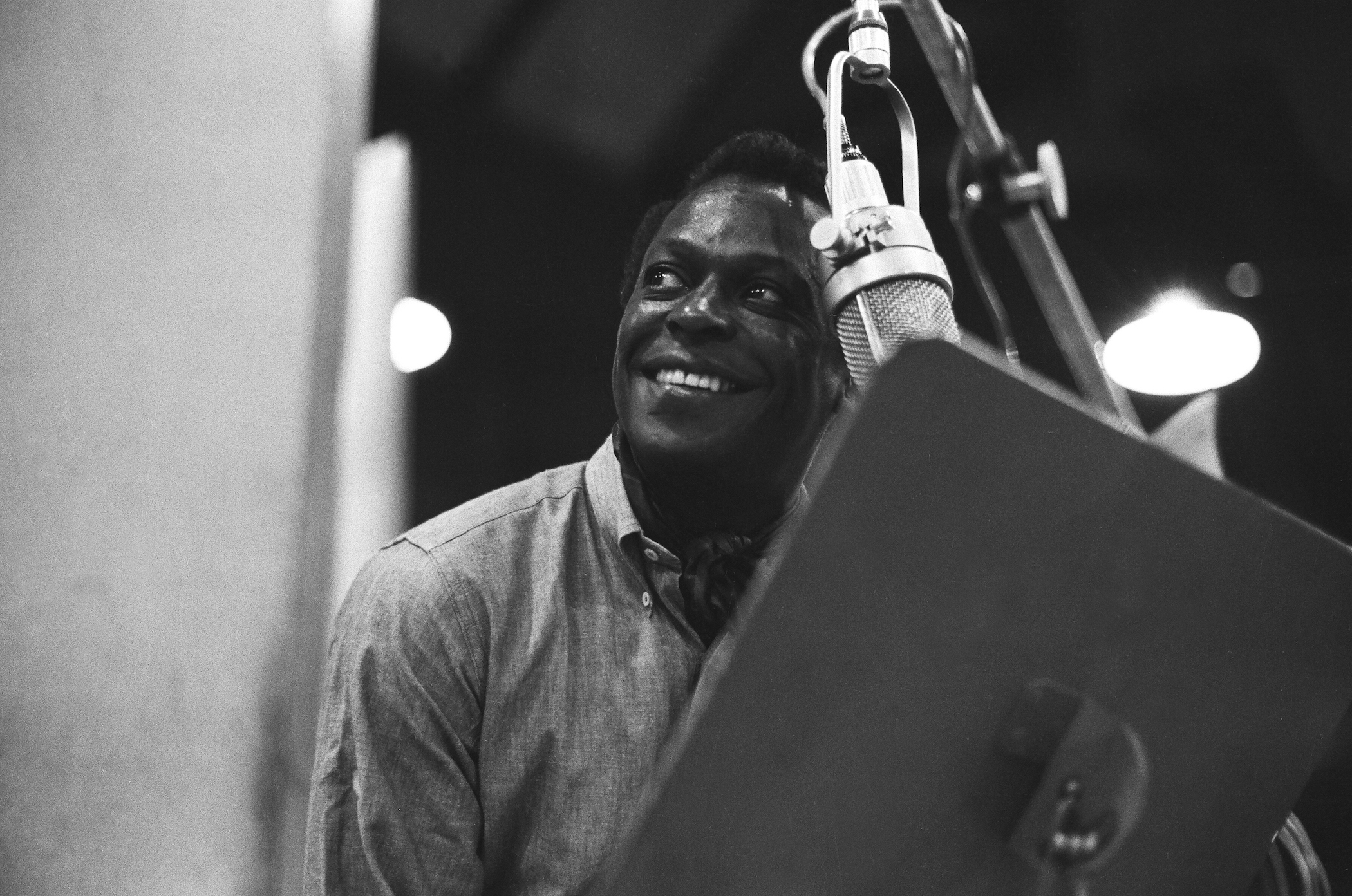
The Closest Miles Davis Ever Came To Playing Free Jazz
Sony BMG Music Entertainment

Miles Davis was born in Alton, Illinois on May 26, 1926, and the Miles Davis estate and Sony Music — and probably to a lesser degree Warner Bros., which owns his last few releases — are celebrating the legendary trumpeter's centennial this year. I fully expect to see a ton of reissues, and possibly some new vault material, all year long. (It's John Coltrane’s centennial, too – he was born September 23, 1926 in Hamlet, North Carolina – and there’s a whole lot going on with his estate and archives as well.)

The first Davis release of the year is a reissue of a legendary box: the eight-CD Complete Live At The Plugged Nickel, first released in the US more than 30 years ago, in July 1995. (A slightly different, edited version came out in Japan in 1992.) I still have an original copy on my shelf; I bought it the week it came out, at a long-shuttered record store in Hoboken, NJ, and I’ve listened to it countless times since then.

The story behind the box is pretty fascinating. Davis had formed what came to be known as his Second Great Quintet – with Wayne Shorter on tenor sax, Herbie Hancock on piano, Ron Carter on bass, and Tony Williams on drums – in 1964. (An earlier version of the group featured George Coleman on sax; we talked about them in 2024.) In his autobiography, Davis wrote:

I knew that Wayne Shorter, Herbie Hancock, Ron Carter, and Tony Williams were great musicians, and that they would work as a group, as a musical unit. To have a great band requires sacrifice and compromise from everyone; without it, nothing happens. I thought they could do it and they did. You get the right guys to play the right things at the right time and you got a motherfucker; you got everything you need.

If I was the inspiration and wisdom and the link for this band, Tony was the fire, the creative spark; Wayne was the idea person, the conceptualizer of a whole lot of musical ideas we did; and Ron and Herbie were the anchors. I was just the leader who put us all together. Those were all young guys and although they were learning from me, I was learning from them, too, about the new thing, the free thing.

That last sentence is crucial, because it’s what makes the music recorded at the Plugged Nickel, a small club in Chicago where Davis often performed around Christmastime, so astonishing. 

The quintet recorded their first studio album, E.S.P., in January 1965. But they couldn’t get on the road to support it right away; as Davis explained:

My hip was operated on in April 1965, and they replaced the hip ball with some bone from my shin, but it didn’t work and so they had to do it again that August. That time they put a plastic joint in. My sidemen now had big reputations so they didn’t have any problems working while I stayed home and recuperated, watching the Watts riots on television.

In fact, they made some incredible albums during that time span: While Davis was idle, Herbie Hancock recorded Maiden Voyage; Wayne Shorter recorded The Soothsayer, Et Cetera, and The All Seeing Eye; and Tony Williams recorded Spring (which featured Shorter, Hancock, saxophonist Sam Rivers and bassist Gary Peacock).

Back to Davis:

I didn’t play again until November 1965, at the Village Vanguard. I had to use Reggie Workman on bass because Ron — who would do this kind of shit periodically — couldn’t, or wouldn’t, break a commitment to someone else. It was a great comeback and the people received the music real well. After that, I went on the road in December to Philly and Chicago, where we played the Plugged Nickel and made a record there... Columbia still has some tapes they haven’t released from that taping. But Ron came back for this gig and everybody played like we hadn’t been separated at all. Like I said, I have always believed not playing with each other for a while is good for a band if they are good musicians and like playing with each other. It just makes the music fresher, and that’s what happened at the Plugged Nickel, even though we were playing the same book we had always played. In 1965 the music that people were listening to was freer than ever; it seemed like everyone was playing out. It had really taken root.

They performed at the Plugged Nickel for a week, and two nights’ worth of music was recorded: three sets on December 22, and four sets on December 23. As Davis mentions, the band was not playing their new music onstage. They were playing tunes from his 1950s catalog like “Milestones,” “If I Were A Bell,” “Stella By Starlight,” “So What,” “My Funny Valentine” and “Autumn Leaves.” Only one piece from E.S.P. is performed on the Plugged Nickel box: “Agitation.” And it’s only played twice, across seven sets of music. Perhaps this is what inspired the approach the band chose to take, which has become an infamous piece of Davis lore.

The story goes that on the plane to Chicago, drummer Tony Williams — who, again, Davis described as the band’s “creative spark” — suggested to Shorter, Hancock and Carter that they play “anti-music” on the gig. As Herbie Hancock put it, “Whatever someone expects you to play, that’s the last thing you play.” This wasn’t free jazz, but it was a deliberate confounding of both band and audience expectations. So if a song had traditionally built to a fiery climax, on these two nights in Chicago they would let the music dissipate like a popped balloon. If a groove got too strong, Williams would break it up, or let it slacken until it was a struggle to move forward at all. If Hancock would ordinarily create a lush harmonic bed beneath a soloist, now he’d let them float out there alone, like Wile E. Coyote running off a cliff. And here’s the thing: The band all agreed to this idea, and they didn’t tell Davis.

And perhaps even more courageously, they stuck to the plan even when they got to the club and realized that Columbia was going to be recording them.

The resulting music is wild. It swings hard as hell — this band was never going to not swing. But tunes are introduced with the barest nods to the melody; Shorter’s solos go flying off in all directions or turn in ever tightening spirals like he’s trying to drill himself into the stage; the rhythm is double or triple time, then suddenly slows to a crawl; and pieces will end with a sudden, half-discordant chord and a cymbal crash, leaving you thinking, That’s it?

And even without being in on the plan, Davis manages to contribute perfectly. He was still not in good health, and his playing lacks a lot of the precision you hear in the studio and on other live LPs from even the year before. A lot of notes slide away from him, dribbling from the horn’s bell or coming out like the scrowl of a wet cat. I mean, listen to that version of “Stella By Starlight.” That is raw.

But he’s never lost amid what his band is doing; he gives them all the room to run they could ever want, and when he chooses to make himself heard, his leadership is unquestioned. He takes over, and instantly it’s like everything that’s been happening the whole night was his idea. This is as close as Miles Davis ever got to playing free jazz, and he made it work. And whether it was pure star power or the ability to grasp what was happening on the night, the audience was with the band all the way. This version of “So What” is nothing like the classic studio version from 1959’s Kind Of Blue, but the crowd is loving it:

The Plugged Nickel recordings were not released right away. Columbia shelved them. Two LPs’ worth, Live At The Plugged Nickel Vol. 1 and Vol. 2, came out in Japan in 1976, after Davis had retired from public performance; those were combined as a double LP for the US market in 1982. A few more pieces were released as Cookin’ At The Plugged Nickel in 1987. But for whatever reason, the sheer radicalism of this music didn’t really sink in for people until all seven sets came out in 1995, and people could track what Davis and his band did over the course of those two nights in Chicago. When the box hit, it was almost immediately hailed as some of the most fascinating live Miles material available. I know I’ve been enraptured by it for 30 years, even though it’s not an easy listen by any means. And now that it’s back in circulation, you should absolutely check it out.

TAKE 10

10

Angelika Niescier - “Rejoice, Disrupt, Resist”

German alto saxophonist Angelika Niescier enjoys collaborating with Americans. A few years ago, she had a New York-based group with bassist Christopher Tordini and drummer Tyshawn Sorey; they made three albums. Now she’s turned her attention to Chicago. This album features flutist Nicole Mitchell, alto and tenor saxophonist Dave Rempis, vibraphonist Jason Adasiewicz, bassist Luke Stewart, and drummer Mike Reed. The music they make together has a hard-charging energy, particularly thanks to Reed, whose drumming is parade-ground precise, with Stewart beside him delivering bass lines of a Charles Mingus-esque intensity. “Rejoice, Disrupt, Resist” opens the album with a quick shimmy of vibes before the rhythm section leaps into action, and when the horns come in, wavering like a mirage, the music falls into place with a very Chicago feel; it reminds me of something Fred Anderson and Ken Vandermark might have played together back in the ’90s. (From Chicago Tapes, out now via Intakt.)

9

Dave Holland/Norma Winstone - “Will You Walk A Little Faster”

This is a fascinating record. A collaboration between bassist Dave Holland and vocalist Norma Winstone, with saxophonist Mark Lockheart, pianist Nikki Iles, and drummer James Maddren, with guitarist John Parricelli appearing on five of the nine tracks, it’s entirely composed of previously unheard pieces by trumpeter Kenny Wheeler, a longtime collaborator of Holland’s. Three of the pieces use poems (by William Blake, Lewis Carroll, and Stevie Smith) as their lyrics. The rest are by Winstone. But what really sets this record apart is the presence of the London Vocal Project, a 25-member choir. Jazz plus a choir is not that common: Kamasi Washington does it, and a few other players (Andrew Hill, Donald Byrd) did it in the ’60s. And the choir here is not singing wordlessly, as they do on Washington’s records; they’re singing the poems. Carroll’s “Will You Walk A Little Faster,” which struts and bounces, is beautiful. (From Vital Spark, out now via Edition.)

8

Tomeka Reid Quartet - “Oo long!”

Cellist Tomeka Reid’s quartet with guitarist Mary Halvorson, bassist Jason Roebke, and drummer Tomas Fujiwara is just a fantastic working band. This is their fourth album after a self-titled 2015 debut; 2019’s Old New; and 2024’s 3+3, and their collective voice is stronger than it’s ever been. The title, Dance! Skip! Hop!, conveys a kind of uncontainable joy, and that’s audible throughout the album. These four musicians are going off throughout this record. But this isn’t “free music” (defined however you like); Fujiwara and Roebke swing hard on every tune. And because they have a full-time bassist, Reid is not required to fill that role. Instead, she’s up front with Halvorson, playing really nice unison melodies and then tossing ideas back and forth as a duo. “Oo long!”, named in tribute to a restaurant Reid visited in Düsseldorf, features one of the noisiest, skronkiest solos in Halvorson’s catalog. (From Dance! Skip! Hop!, out now via Out Of Your Head.)

7

Dave Douglas - “Sandhog”

Trumpeter Dave Douglas loves to start bands. His latest is a quartet with pianist Marta Warelis, bassist Nick Dunston, and drummer Joey Baron. (The Four Freedoms of the album title were articulated by US president Franklin Roosevelt in 1941: freedom of speech, freedom of worship, freedom from want, and freedom from fear. No comment from me.) Their debut album was recorded on July 6 and 7 of last year at a festival in Spain’s Basque country — live, and then on the same stage, without an audience. The tracks that end with raucous applause and those that don’t blend seamlessly together, and the performances are uniformly red-hot. “Sandhog,” named for the workers who dug New York’s subway tunnels, is a hard-edged tune set to a big, pounding Baron beat, with Dunston — who also introduces the piece with a pulsing vamp — taking a fiercely string-slapping solo halfway through. (From Four Freedoms, out now via Greenleaf.)

6

 Corcoran Holt - “Rae Ray”

Bassist Corcoran Holt’s second album as a leader is a deeply personal and even autobiographical statement; the compositions are often tributes to members of his family, evocations of major events in his life, or nods to personal and professional heroes. The band is excellent — it includes one of my favorite saxophonists, Stacy Dillard; trumpeter Josh Evans; keyboardist Benito Gonzalez; drummer Lewis Nash; and percussionist Kweku Sumbry. The music is occasionally intercut with voicemail messages from family members and other musicians, which mostly serve to tell us that Holt is a guy who’s not great about returning phone calls or emails. But, you know, if I had a message from Benny Golson on my phone, I’d never throw that shit away, either. “Rae Ray” is a dual dedication to legendary bassist Ray Brown and Holt’s wife Raven; it’s a piano trio piece with the bass featured prominently throughout. (From Freedom Of Art, out now via Holthouse.)

5

 Jazz Sabbath - “Iron Man”

When I first heard about Jazz Sabbath, the idea seemed both obvious and deeply goofy. Jazz arrangements of Black Sabbath tunes – ha ha, hilarious. But Geezer Butler and Bill Ward were the most swinging rhythm section in hard rock, and all their songs are fundamentally blues tunes, so it makes musical sense. On their studio albums, they bring in horn players and guitarists, but on this double live LP, recorded last year in the Netherlands, you just get the core trio: keyboardist Adam Wakeman (son of Yes member Rick Wakeman, and Ozzy and Sabbath’s touring keyboardist for many years), performing here as “Milton Keanes,” bassist Jerry Meehan, aka “Jacque T’Fono,” and drummer Ash Soan, aka “Juan Take.” This version of “Iron Man” (a tune also covered by the Bad Plus) jumps the tempo up significantly, abandoning the clanging doom of the original in favor of a loping swing. (From Jazz Sabbath Live, out now via Blacklake.)

4

Quinsin Nachoff - “Patterns From Nature: I. Branches”

Brooklyn-based saxophonist Quinsin Nachoff’s latest album is a fascinating orchestral work recorded with a dozen players who travel the zones in between jazz and modern classical music, and the Molinari String Quartet. It consists of two long suites, the four-movement, 42-minute “Patterns From Nature” and the three-movement, 21-minute “Winding Tessellations.” If you’re looking for long horn soliloquies, look elsewhere. This is ensemble music, instruments coiling around each other like vines climbing a tree, with little blossoms of sound every once in a while as a single player may get a brief moment in the spotlight before being swallowed up by it all. “Patterns From Nature: I. Branches” opens with bells like we’re being summoned; drummer Satoshi Takeishi uses rattles, brushed snare and more to sketch a backdrop as pianist Matt Mitchell ripples and trills, with the strings, high and low, all around, calling out like invisible birds hiding in trees. (From Patterns From Nature, out now via Whirlwind Recordings.)

3

Melissa Aldana - “La Sentencia”

Filin, which I had never heard of until writing this column, was a style of Cuban pop music, inspired by romantic ballads from America and popular in the 1940s and 1950s; it’s pronounced like “feeling.” Saxophonist Melissa Aldana, who’s from Chile, has adopted the style for her latest album, interpreting songs from the era (plus a version of Brazilian composer Hermeto Pascoal’s “Little Church”) in a manner that reminds me of Dexter Gordon. Gordon always insisted it was crucial to know the words of the standards he played, in order to make sure he treated them like songs, not just melodies and chords. Aldana takes that approach here, and has said that since the songs were originally written in Spanish, she connects with them even more deeply. She’s joined by pianist Gonzalo Rubalcaba, bassist Peter Washington, and drummer Kush Abadey, and Cécile McLorin Salvant sings on two tracks. (From Filin, out now via Blue Note.)

2

Asher Gamedze - “Air”

South African drummer Asher Gamedze’s fourth album is all about community, friendship, and collectivism. The musicians — trumpeter Keegan Steenkamp, keyboardist Nobuhle Ashanti, bassist Zwide Ndwandwe, and percussionist Ru Slayen — don’t just play their instruments, they also sing spiritually inspired lyrics (by Gamedze) and are heard reading from an essay by South African civil rights activist Steve Biko, as part of a regular reading group. But the music is neither didactic nor preachy; it’s purely enjoyable no matter the context. “Air” is a slowly pulsing groove intended to make your head bob and your hands clap. Ashanti’s synth contributions are fascinating, seeming to include vocal samples as well as an almost theremin-like solo, as Ndwandwe, Slayen and Gamedze put together intricate rhythm patterns and Steenkamp floats in like a cooling breeze through a window on a hot, dry afternoon, playing a melody so gentle you’ll feel like you dreamed it. (From A Semblance: Of Return, out now via Northern Spy.)

1

The Messthetics And James Brandon Lewis - “Deface The Currency”

The Messthetics were an interesting band even before James Brandon Lewis came along. In 2018, 15 years after the legendary post-hardcore dub-rock quartet Fugazi had gone on hiatus, its bassist and drummer, Joe Lally and Brendan Canty, reunited in an instrumental trio with chameleonic noise-fusion guitarist Anthony Pirog. Their self-titled debut and its sequel, 2019’s Anthropocosmic Nest, were filled with rifftastic monster jams like “Quantum Path” and “Better Wings,” while mellower pieces like “The Inner Ocean” and “Because The Mountain Said So” showed their softer side. Both these albums were on Dischord, Fugazi’s label, which made the link between past and present possibly more emphatic than Lally and Canty might have intended.

In 2024, though, the Messthetics made two surprising moves: They expanded to a quartet with the addition of tenor saxophonist James Brandon Lewis, and they signed to Impulse! Records. The collaboration with Lewis didn’t come out of nowhere; Pirog had appeared on the saxophonist’s albums No Filter and An UnRuly Manifesto. (I saw Lewis’ quartet with bassist Luke Stewart, drummer Warren Trae Crudup III, and Pirog play with Harriet Tubman in 2017 or so. They killed it.)

The Messthetics And James Brandon Lewis worked well because Lewis is a very riff-oriented player. His melodies aren’t complicated. They’re big and brash, and they come right at you, which means they work just as well on electric guitar as on tenor saxophone. And when he and Pirog were soloing simultaneously, as on a piece like “Three Sisters,” with Lally and Canty laying down a thick, dubby rhythm behind them, the music soared. 

That record could easily have been a one-off. James Brandon Lewis is a busy guy. But now there’s a second album, Deface The Currency, and they seem to have really congealed as a band in a way that makes their pre-Lewis albums feel like a whole different thing. The way Pirog and Lewis take turns playing short solos, and the way Lally and Canty react differently to each of them (giving the guitarist a whomping hard rock backbeat, and the saxophonist a funky call-and-response), before they all come together at the 3:30 mark for a punk rock free jazz blowout, is fantastic. This is an album meant to be played loud. (From Deface The Currency, out now via Impulse!.)

OUTWARD BOUND

GET THE STEREOGUM DIGEST

The week's most important music stories and least important music memes.