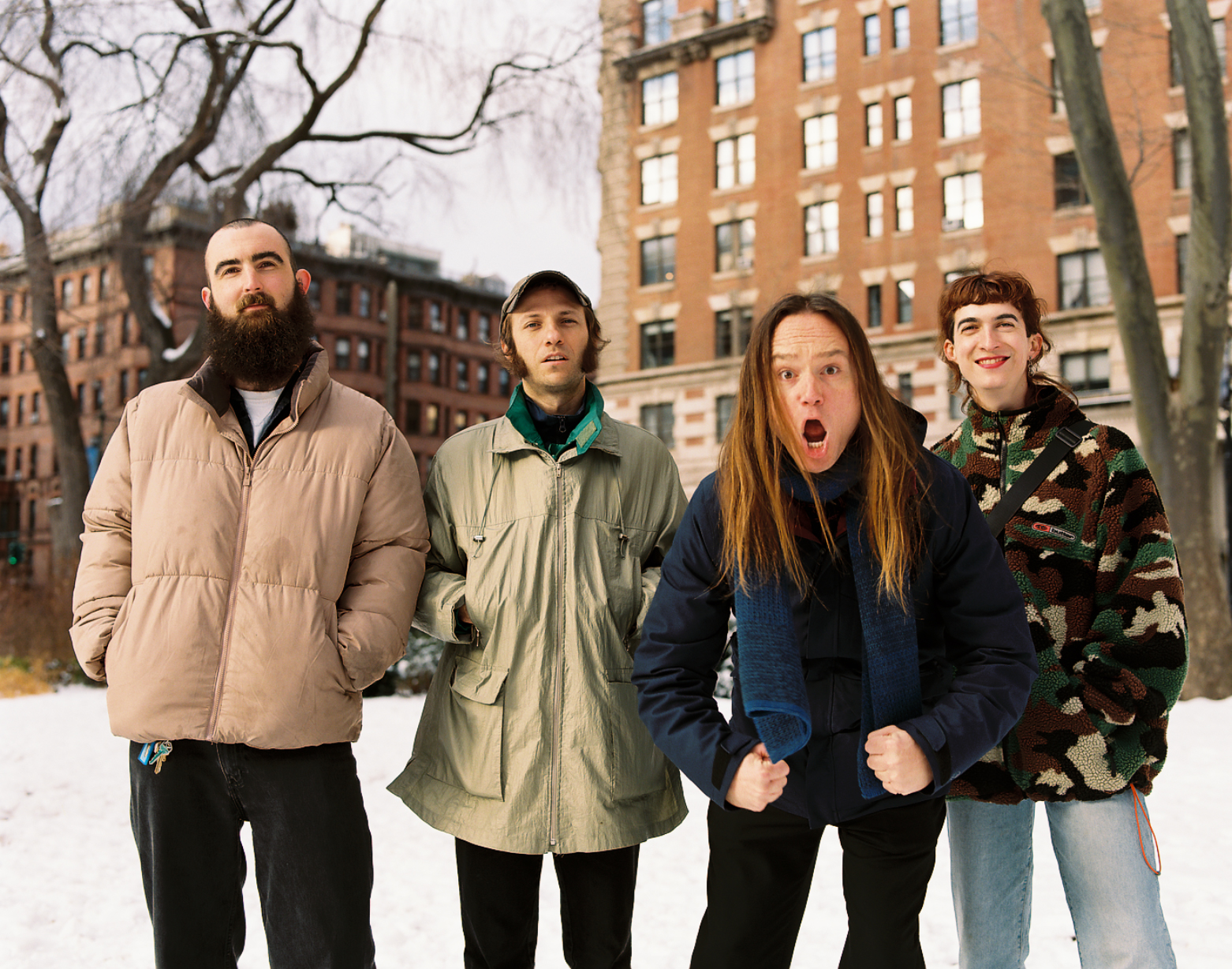

Midway through my video chat with Cootie Catcher, guitarist/vocalist/beatmaker Nolan Jakupovski suddenly wields a prop: “This, I think, is what we want to sound like.” He’s holding a copy of the Pastels’ 1998 remix album Illuminati, on which the Glasgow indie greats have their songs reworked by the likes of My Bloody Valentine, Stereolab, and Jim O’Rourke. “A lot of the songs on here, I hear them, and I'm just like, 'Oh, this is literally what we want to do, but live.’”
Having heard Cootie Catcher’s excellent new album Something We All Got, out later this week, I’m not surprised that one of the Toronto quartet’s primary reference points bridges the gap between jangly, twee guitar pop and electronic manipulation. At various points across the record, fuzzy lo-fi melodies are backed by skittering programmed percussion; today's new single "Quarter Note Rock," on the other hand, is a seemingly straightforward rock number that gradually deconstructs into glitched-out distortion.
As for contemporaries, Cootie Catcher's music draws parallels to indie pop juggernauts like Box For Buddy, Box For Star by This Is Lorelei — whose Nate Amos, incidentally, mixed Something We All Got — but rather than coming from a single narrator, Cootie Catcher’s songs tackle multiple points of view, with Jakupovski sharing vocal duties with bassist Anita Fowl and synth player Sophia Chavez. Thematically and sonically, contrast is a common thread binding Something We All Got. Read our conversation, edited for clarity, below.
Embracing Awkwardness
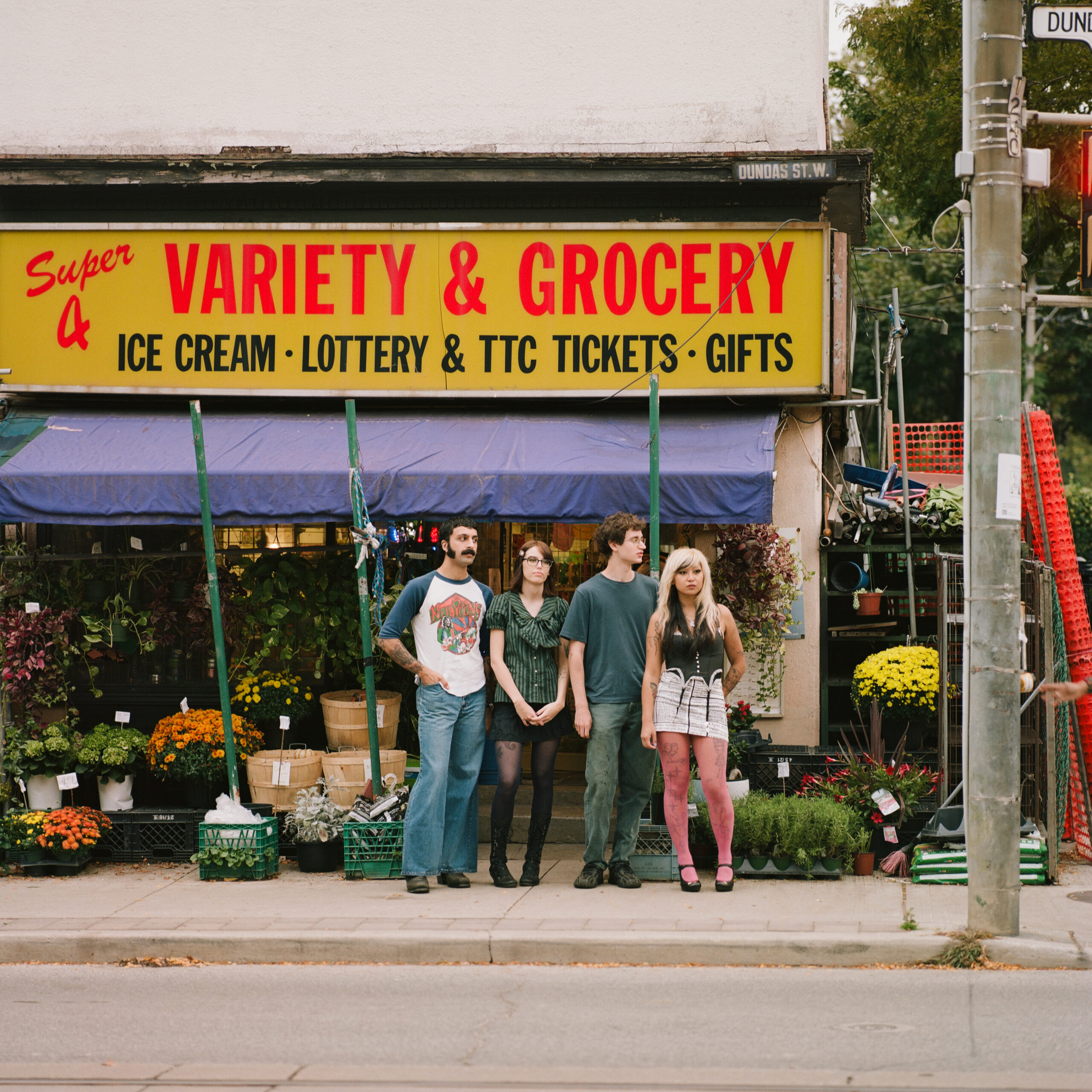
ANITA FOWL: A lot of my songwriting comes from a place of feeling sort of disconnected between what I'm thinking of saying and what ends up actually coming out. Wrong place, wrong time situation. And that's very much the case with songs like "Straight drop." We're all roughly around the same age, mid-20s. When you're a teenager and you're awkward, that's just part of growing up and being in a transition phase. But I feel like when you hit 25 and you're awkward, it's like, this is kind of just who you are. If you're feeling a bit socially challenged, you kind of just have to embrace it. And so I let out a lot of those frustrations through the music, but even the album art is awkward; it's a photo of all four of us crammed in this, like, school portrait situation. And I feel like it really highlights that even if we are trying to be our most serious selves — we got ready, posed, sat in a studio — we still come off a little awkward. And what's more awkward than promoting an album that has your own face on it?
HBO’s Girls
NOLAN JAKUPOVSKI: I think the social aspects of Girls are really influential for us lyrically. It covers all these different types of relationships so well, but it doesn’t take itself too seriously. And it’s really funny. I think we’re all really funny.
FOWL: And with the little music subplots, the characters are such good examples of people in the music scene. It’s eerily accurate.
Which of the girls do you feel like you most strongly identify with?
JAKUPOVSKI: I think there’s a little bit of Hannah in everyone.
FOWL: Toronto is full of Booth Jonathans, for sure.
How would you describe Toronto’s music scene to people unfamiliar with it?
JAKUPOVSKI: Toronto has a lot of small groups and cliques.
SOPHIA CHAVEZ: I think that’s why we have a lot of different voices on our album. We’re obviously besties, but we’re all kind of in different scenes and do our own thing.
Playing Live And Watching Live Sets On YouTube
JAKUPOVSKI: When we first started I was making beats for us to play along to live, but I wasn’t really considering that they’d be impossible to play to live. It can’t be too cool or too messed up. Now I have to think about that when I write or I’m composing beats.
FOWL: When we were first starting out, way in the early days, not even all of our songs had the DJ track. Sometimes we’d have to have other songs prepared just in case the venue or sound person couldn’t accommodate the DJ thing. That really inspired how we write songs, and I feel like on the new album we really figured out our formula.
Logistically, do you think watching videos of other bands playing live influences your setup?
JAKUPOVSKI: Yeah, we try to keep our setup as simple as possible. We bring a DJ controller, a synth, drums, bass guitar, laptop — that's pretty much it. I think we're definitely blessed that we can just pull up with that. I think this is why we are a product of current time and not a band from the '90s or something.
What are some of your favorite live sets to watch online?
JAKUPOVSKI: There’s this whole concert video of Meat Puppets, Hüsker Dü, and Minutemen all playing back to back. It’s pretty magical. But I even like watching just local bands on YouTube.
Disco Inferno
JAKUPOVSKI: There’s a lot of audio of them performing live, but I can’t find a single video, which is kind of tragic to me. They were an early instance of a band doing digital sampling live. I’m not actually sure how they're making those sounds, to be honest — it must be a sample pad or something. But they were kind of doing what we’re doing in terms of the things they chose to sample, just in the ‘80s and ‘90s. It sounds more ethereal.
We sample each other a lot. I don’t think there’s anything too crazy on the record, but often we’ll sample a background vocal of us singing or a guitar idea and manipulate it and add it in somewhere else.
Electrelane
JAKUPOVSKI: There's almost a rigidness to them that I really like. I really like how the drummer plays in that band and the way they use keys. What's that song where they almost speed up...?
FOWL: "To The East?"
JAKUPOVSKI: It might be that song. I love when the drums come in, and I also really love that era of production in the 2000s. We also love those kinds of vocals — Nico kind of sings the same way.
FOWL: There's a real affectation to it.
How you discover a lot of your favorite music?
FOWL: I found Electrelane through Nolan, like most things. I remember him telling me about them and then I started to get recommended them through the YouTube algorithm.
JAKUPOVSKI: Maybe our influence is actually the algorithm. [Whole band groans] It's true, though! Jim O'Rourke used to not be on streaming, and I only have this album because I found it on YouTube.
FOWL: I was definitely a YouTube-to-MP3 converter warrior growing up. I think a lot of our generation was like that.
I do think the YouTube algorithm tends to be less sinister. There's something a little more personal and niche to it.
NJ: Yeah, I'll take the YouTube algorithm any day. There's a lot of evil stuff on there, but most of the time it's like, "Here's an Arthur Russell live video for you."
Something We All Got is out 2/27 via Carpark.