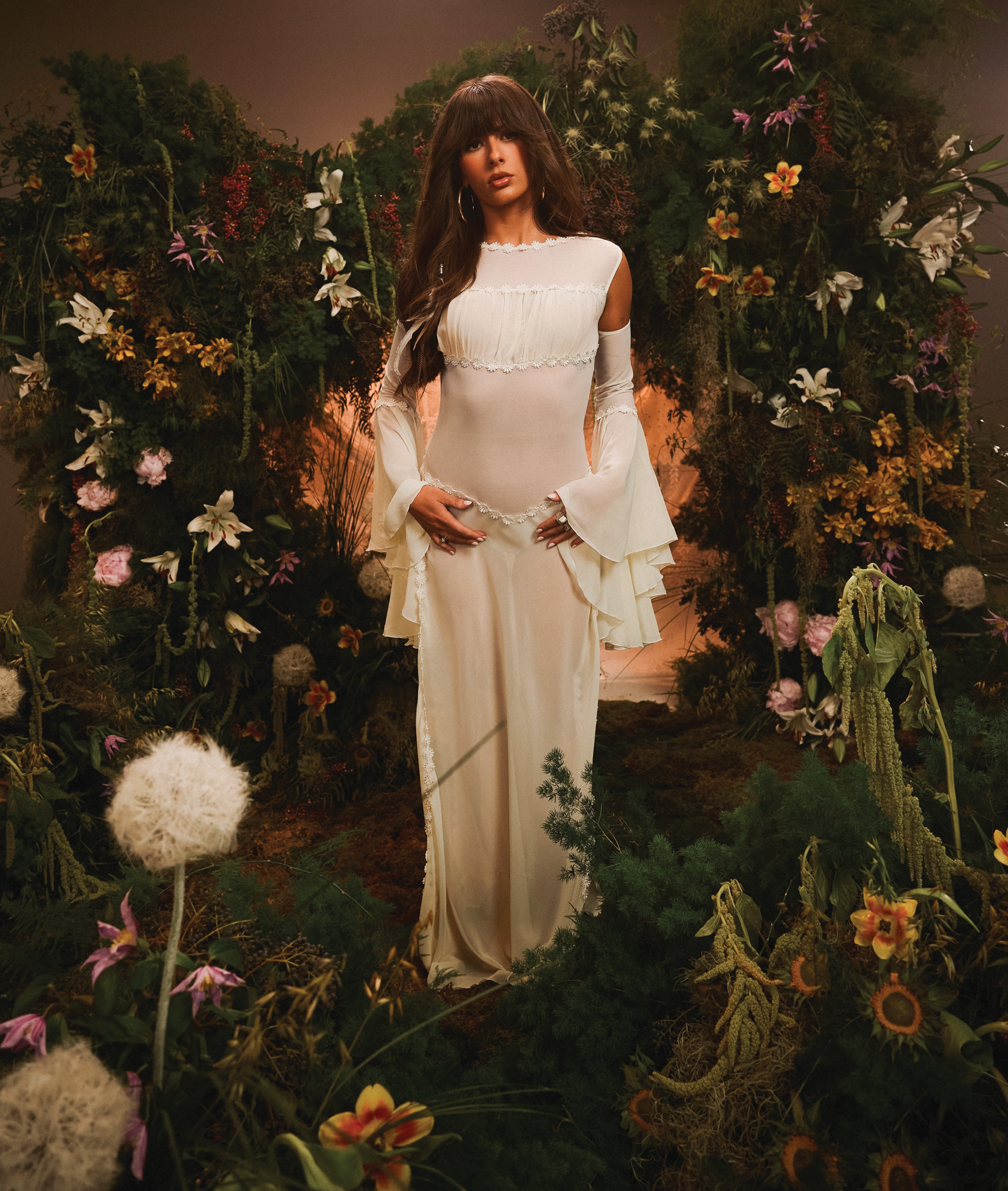

Ella Langley's "Choosin' Texas" is not only a #1 hit but a historic #1 hit. The song, a gentle country weepie about losing your cowboy paramour to his exes down in you-know-where, made Langley the first woman to reach the top of the Billboard Hot 100, Hot Country Songs, and Country Airplay charts simultaneously. Based on the numbers, she's just collected a full set of tickets to the monoculture.
There are two reactions one may have here. Either Langley's superstardom has been obvious to you for months now, or you've never heard of her until just now. The latter is probably not your fault. "Choosin' Texas" does have its champions outside country fandom — YouTube pop critic Todd In The Shadows named it the third-best hit of 2025 — but otherwise, Langley has gotten very little coverage in the mainstream music press. If you want to know about Ella Langley, you end up watching hour-long podcasts called The MeatEater Podcast with The Brothers Hunt on God's Country. (This is real.)
For those who'd rather not watch The MeatEater Podcast with The Brothers Hunt on God's Country, here's a quick intro. Langley grew up in deep Alabama and was raised on classic country, Stevie Nicks, and hard rock — she named one of her dogs Crue, as in Motley. She's been gritty since childhood; on the advice of a mentor, she learned 50 songs to cover at future gigs before attending college. She built up connections the old-school, boots-on-the-ground way — hustling for gigs, shopping around video press kits. Then came the publishing deal, then the record deal, then the tours with Randy Hauser and Koe Wetzel and the Grand Ole Opry debut.
And then came Langley's first monster hit: "You Look Like You Love Me," a duet with fellow country artist Riley Green. It wasn't meant to be a hit: "I didn't think that song was ever gonna leave my audio recordings," Langley said. "It was a joke." If it was a joke, it was well-timed. Langley discovered a shrewd strategy, wielded by Laufey and Olivia Dean before her: Do a throwback single, but throw it back several decades farther than everyone else. Specifically, "You Look Like You Love Me" evokes the talk-singing country of the '60s and '70s, popularized by artists like Hank Williams. The verses are completely spoken: she and Green nonchalantly recap their respective sides of a bar hookup. The chorus, a pickup line that Langley semi-jokingly encourages listeners to try themselves, is vintage twang.
Once again, you've either been bombarded with "You Look Like You Love Me" for over a year, or you've never heard it. (You should; it's good.) This is unusual even among dark-horse hits, often called "FYPcore," after their huge familiarity gap between TikTok lifestyle content and the pop-star zeitgeist. Even if you know nothing about, say, Alex Warren, you've undoubtedly absorbed "Ordinary" via osmosis. It's possible to go through life without encountering Langley's single even by accident.
What's behind this selective virality? Unlike other country crossovers — most recently, Shaboozey's J-Kwon-interpolating "A Bar Song (Tipsy)" — "You Look Like You Love Me" is hardcore period-piece country. Relentless earworm of a chorus aside, it makes very few concessions to pop. "Choosin' Texas" is pop-country, but the average person would probably not classify it as a pop song. And until recently, pop radio's been lukewarm on it. On the Top 40 airplay charts over the past few weeks, "Choosin' Texas" has consistently lagged in the mid-40s, right behind Hilary Duff's "Roommates" — an artist 20 years removed from Disney stardom, recording what's basically a Gracie Abrams song about giving someone head in the back of a dive bar. Langley’s song is popular enough to top the pop chart, but unlike “A Bar Song” or Wallen’s “Last Night,” it hasn’t really permeated the pop market.
The elephant in the room here is the MAGA of it all. Music Row, and many of its artists, have historically skewed decidedly conservative as an institution. What's changed lately is how overt they are. During the last Trump administration, artists went stealth mode, commissioning songs about how "politics" — nebulously defined — are such a damn buzzkill. This time, emboldened further by grievance-based #1 hits like Jason Aldean's "Try That in a Small Town," the politics are loud and proud. And unlike the last time this happened — the post-9/11 years marked by Toby Keith's "Courtesy Of The Red, White And Blue (The Angry American)" — the country industry is positioning themselves in explicit opposition to mainstream music, most notoriously Kid Rock and his Turning Point USA-affiliated counterprogramming.
Langley has not defined her politics so overtly, but she has played the right cards to thrive in the current country environment. She’s played Kid Rock's festival series Rock The Country and will be back this year (though she didn't perform on his fake Super Bowl halftime show). She's cool with Morgan Wallen, slurs be damned, but so are lots of her colleagues from both the country and pop worlds. In a scene where women face a much steeper climb to stardom, she’s worked hard to court a country contingent that has become defiantly anti-mainstream, and it may be limiting her prospects beyond that world.
It's hard to talk about this subject without sounding dismissive. A lot of disdain for country genuinely is mixed up with disdain for the genre's often working-class audience. And mentioning politics in this context has a tendency to make country music heads come out of the woodwork mentioning the same handful of vaguely liberal country songs (e.g. "The Pill"), the same few progressive-coded critical darlings like Kacey Musgraves, and how Tim McGraw voted Democrat or whatever. But the average music listener does not know, care, or want to care about any of this. They hear lyrics like "Can't change how I was raised, the Bible in my blood, and the 'Bama in my veins" ("Dandelion"), and they are as capable as anyone else of parsing the intentional statement about who is and is not supposed to relate.
Like it or not, this is the barrier to mainstream stardom, and for female artists, it's particularly stifling. Music Row has long been reluctant to champion women — in 2015, radio consultant Keith Hill infamously compared them to "the tomatoes of [the] salad" of playlists: to be used sparingly, as a garnish. To illustrate: "Choosin' Texas" was co-written by Miranda Lambert, probably the biggest female superstar in country music over the past two decades. It was Lambert's first pop #1 hit, too. The rarity of this kind of chart success saddles any breakout female artist with pressure, as country music journalist Marissa Moss has noted, to be the one who'll Change Everything for Women, with the implication that they've failed when they inevitably don't. It's probably not a coincidence that when male country artists cross over to pop, like Morgan Wallen or Jelly Roll, it just means they now have two bases of support. When female artists cross over, like Taylor Swift or Kacey Musgraves or Maren Morris, they leave the industry entirely.
So Langley's success — getting her own breakout hit, without needing a male duet partner — comes with behavioral expectations. Early single "Country Boy's Dream Girl" presented her as a rough-and-tumble sort tailgating on a river bank; she's now dolled up in gowns and pageant makeup. Her old website described her as a maverick and a "straight-shootin’ songwriter who pulls no punches"; her new one has a lace-and-stationery design and a ChatGPT-core missive about the broader symbolism of dandelions. Nor is the pressure just aesthetic. When promoting "You Look Like You Love Me," Langley repeatedly expressed the same verbatim hesitance: "That's kind of a risque thing."
Meanwhile, go back a few years and Langley holds her own in podcast bro-downs about hookups, deer hunting, and "nut-scratchers." The idea that alluding to sex with Hayes Code-compliant vagueness is alienatingly risque is ridiculous — including to her audience, if the YouTube comments on the Bobby Bones interview are any indication: "This is exactly what I did 40 yrs ago. I walked up to my Ray in a bar. We now have been married for 32 yrs. + 7 yrs living together." "My daughter found her first husband sort of the way this song suggests. Halloween, she was dressed as a cop, arrested him in a bar, a former college football player." (But be warned, prospective pickup police: "They got married, after a few years, 2 kids, his true personality imerged [sic] and they are now divorced.")
Most disappointingly, these expectations seem to have stifled Langley's music too. To my ears, she sounds far more in her element on her raucous material from previous albums Hungover and especially Excuse The Mess — self-loathing barnburner "Make Me Wanna Smoke," swaggering cheater-revenge anthem like "Better Be Tough" ("Screw you — I won't"), lonesome plaints like "Hungover" and "Paint The Town Blue," and the wonderfully self-aware "Girl Who Drank Wine," which flips the standard "city girls drink champagne, us girls drink Jack" country trope into the wine-drinker as a mysterious outlaw fatale.
Since then, her music's gotten gauzier, and her songwriting's become fuzzier. "Choosin' Texas" can't quite decide whether Texas is a metaphor for the girl, the girl is a metaphor for Texas, or maybe whether there's some kind of nickname situation. "Dandelion" tries to turn the titular flower into an omni-symbol — wild and untamed, unlike roses, but also thornless and unassuming unlike roses — like a floral Mary Sue. Not only is "Be Her" a poor fit in its Taylor-esque featheriness, Langley has other songs about insecurity that are far less emotionally shallow. Perhaps that's why Langley's patterned herself upon Lambert, whose megastardom has earned her the permission to make music that's as mean and messy as she wants. Langley deserves the same.
POP TEN
Noah Kahan - “The Great Divide”
"The Great Divide" leapfrogs Kahan's acoustic cohort in part for being higher-energy and closer to rock-rock. But the real reason is that Kahan is simply a better songwriter, with more precise observations and more cutting lines. I certainly wouldn't want to be on the receiving end of "I hope you're scared of only ordinary shit, and not your soul and what He might do with it."
Lana Del Rey - “White Feather Hawk Tail Deer Hunter”
I think it's a good sign that I have no idea from one single to the next whether I'll be on board with Lana Del Rey's current thing. "White Feather Hawk Tail Deer Hunter" is genuinely bizarre: a shudderingly orchestrated showcase of yandere tradwifery, where Lana's vocals are inspired equally by Betty Boop (not for the first time) and mumble rap, and where she undercuts her otherwise straightforward love declaration not with thuddingly on-the-nose lyrics, but with an meticulous, ominously minor-key arrangement. Bizarre is better than boring; bizarrely captivating, better yet.
Remy Bond - “Cherry Red Balloon”
If you were more on board with Lana Del Rey's last thing, "Cherry Red Balloon" has you covered: woozy and vaguely Lynchian, with an Emile Haynie type beat and a Lisa Frank/Precious Moments video. Also, the best song about Kokomo since "Kokomo."
IVE - “Bang Bang”
IVE capitalizes on the fact that they're the group who made the song that K-Pop Demon Hunters' "Golden" ripped off. I continue to be in awe at the speed at which K-pop mints new genres: in this case, surf-rock that you can sing "Put A Donk On It" over. (Plus a half-time bit, a Jersey club bit, and plenty more; a free-gift-with-purchase deal of an arrangement.)
sombr - “Homewrecker”
sombr combines his two calling cards — making pop hits, and being kind of a fuckboy — to their logical conclusion: making a song as anthemic as "Call Your Girlfriend," on the same messed-up-if-you-think-about-it topic. Robyn pulled it off with her unsuppressable underdog charm; sombr pulls it off with his (I sure hope) self-aware skill at playing the heel. I mean, "I don't wanna be how you formulate opinions on astrology" is just such a sombr line, right?
Justine Skye - “Thong”
It's amazing to witness the absolute glow-ups that the once-B-list R&B starlets of the mid-2010s are having all at once. Ten years ago, Skye was making "Bitch Better Have My Money" ripoffs. Now she's making immaculate, glassy lounge music, courtesy of Kaytranada at his best.
Chloe Qisha - “YDH”
Imagine Peggy March's "I Will Follow Him" — there's what sounds like an interpolation — except with another F-word. If I'm being completely honest, not all of Chloe's punchlines work, and you may not get through this song without at least twice going really? But the moment she put "horny" through a Daft Punk-like vocoder, I was sold.
CORTIS - “GOAT”
Boy band CORTIS' current single is the Tommy Richman-esque "Go!," but "GOAT" is the track that's gotten them their own historic first: they're the first K-pop group to play NBA's All-Star Weekend. And what a jock jam they did it with. The only possible improvement would be for CORTIS to lean into the fact that this is the theme song for Steph Curry's Sony Pitcures Animation movie, and sample Steve Kerr saying "thumping techno club music."
Dove Cameron - “Do I Wanna Know”
I usually don't include covers here, but Cameron's version of the Arctic Monkeys song — a theme for her new thriller series, 56 Days — is both a swerve for a former Disney star, and genuinely transformative. She translates the song from scuzzy rock to despairingly sullen downtempo R&B so well that it took me a while to recognize the song's provenance. It reminds me of JoJo's "Marvin's Room" flip; I guess I'm just a sucker for former child stars making dramatic breakthroughs.
Katseye - “Internet Girl”
I highly doubt that Katseye's original Pop Star Academy exit strategy was to become the queens of trollgaze, but it's working for them. An incomplete list of what "Internet Girl" reminds me of: "Gnarly" made even gnarlier. Toy-Box's "www.girl" updated for the 2020s. Josie And The Pussycats-style, except the subliminal messaging isn't for Coca-Cola but Big Zucchini, and that's the joke. Sadly, "Internet Girl" so far hasn't had the staying power of the less-interesting "Gabriela," so vote with your streams.