
May 8, 2021
- STAYED AT #1:2 Weeks
In The Number Ones, I'm reviewing every single #1 single in the history of the Billboard Hot 100, starting with the chart's beginning, in 1958, and working my way up into the present. The column is now biweekly, alternating with The Alternative Number Ones on Mondays. Book Bonus Beat: The Number Ones: Twenty Chart-Topping Hits That Reveal the History of Pop Music.
Again and again, lightning forks across the sky, bisecting the screen. The electrical-storm cutaways are quick. When you've got two famous and foxy people onscreen, you want to devote most of your attention to those people, not to weather phenomena. But the focus keeps coming back to those clouds rubbing against each other and generating electrical charge. The symbolism works every which way. The song is very specifically about sex and secondarily about the ambient static charge of chemistry itself. The song itself is its own kind of lightning — two disparate weather systems colliding, generating a heat that's not native to either of them.
Before he showed up on the 2014 Ariana Grande single "Love Me Harder," the Weeknd was a murky, mysterious cult-fave auteur type. He sang about drugs and debauchery in a lonely, vulnerable quaver over sleek production with cool-kid art-pop references, and he became an internet favorite. He had mystique, but he didn't have hits. He wanted hits, so he intentionally switched his approach in a very successful bid to achieve straight--up general-population stardom. "Love Me Harder" was his first step on that adjusted trajectory.
When she recorded "Love Me Harder" with the Weeknd, Ariana Grande was right in the middle of her push to be taken seriously as a grown-up pop star. She'd come up in the salt mines of children's television, and she'll probably always look like she's 12 years old just because of her permanent baby face and her tiny, birdlike skeleton. Her sophomore album My Everything pulled off the difficult tightrope walk of making her sound like a real pop star without alienating her Nickelodeon-raised adolescent base. That's always the challenge for the many, many singers who get their start as child stars, and Grande pulled off the transition better than almost anyone. For her, "Love Me Harder" was merely part of a huge run of big, fizzy singles. By teaming up with the Weeknd, Grande advanced her narrative.
The collision, the friction that turns into frisson, is really the entire point of "Love Me Harder." It's one of those songs that's obviously entirely about sex but that grants itself the thinnest sheen of plausible deniability. There's a reason it's not called "Fuck Me Harder," even though that's the clear message. Ariana Grande, shaking off her public innocence, launches into an on-record affair with a shadowy bad-boy type, and it pays off for both of them. That's how I heard "Love Me Harder" when it came out, anyway. Maybe the thing I should've noticed was the productive combination of these two voices together, holding space.
As pure vocalists, the Weeknd and Ariana Grande just make sense together. Both of them are distantly rooted in '90s R&B, but both of them take those influences in different directions. Grande's North Star is the fluttery ululation of prime Mariah Carey. Her fantastical dips and twirls sound like a fairyland fantasy come to life. The Weeknd sings of darker things, and he doesn't have her athletic capacity for melisma. His voice is high, too, but he brings a romantic delinquent vulnerability like the single teardrop sliding down Cry-Baby Walker's cheek. He delivers his melodies straight-up and plaintive. When he and Grande sing together, he gives her a base, and she pirouettes all around it. They complement each other.
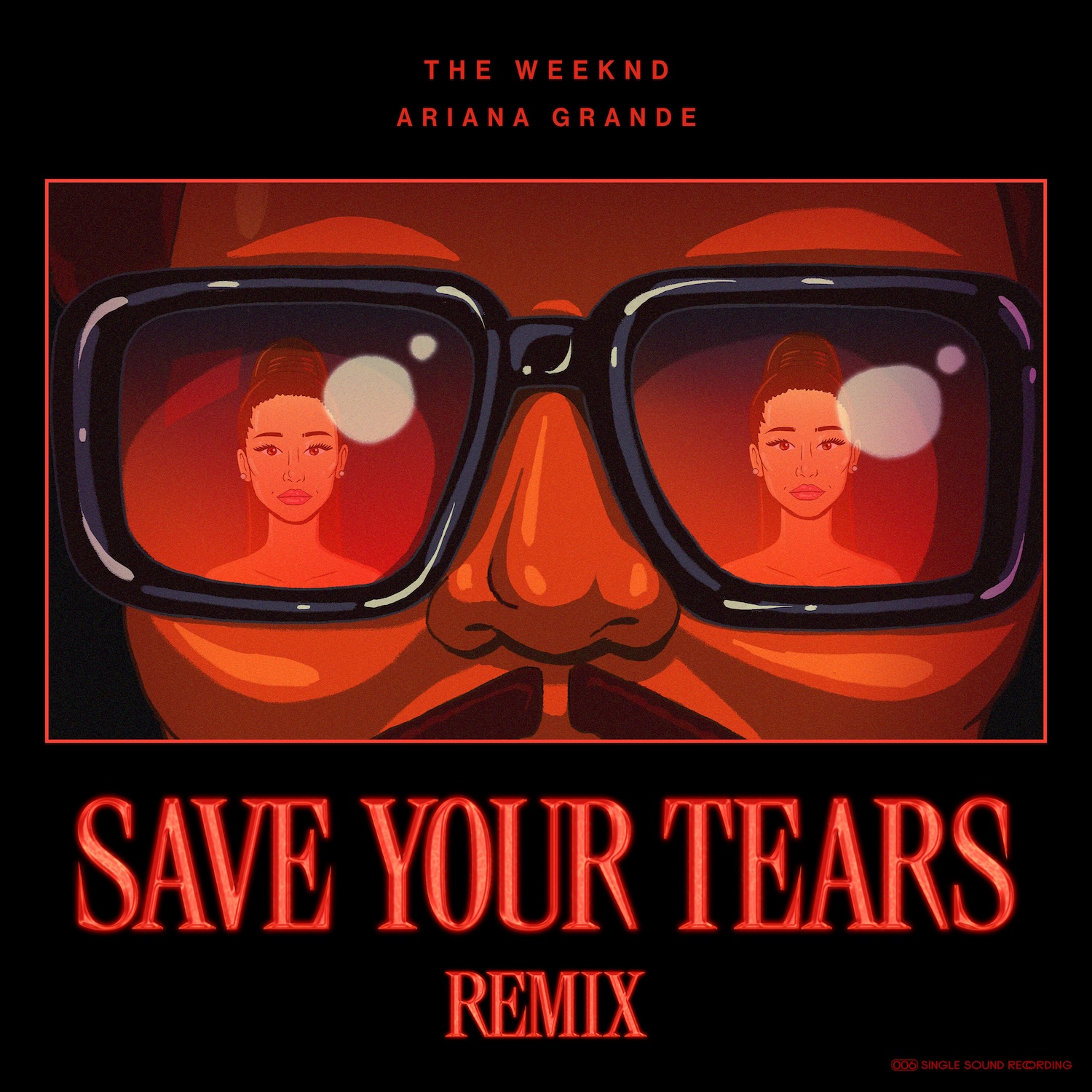
For Ariana Grande, "Love Me Harder" was one more very good hit song in a succession of them. For the Weeknd, it was a breakthrough. This was the singer's first time in the Billboard top 10. ("Love Me Harder" peaked at #7. It's an 8.) It was also the Weeknd's first time working with Swedish mega-pop alchemist Max Martin. The two of them really clicked, and the combination of the Weeknd's approachable debauchery and Martin's glitter-cannon melodic sensibility turned the Weeknd into one of the era's biggest stars. "Love Me Harder" came out in the moment just before the Weeknd and Ariana Grande started regularly cranking out #1 hits. When they got back together seven years later for the "Save Your Tears" remix, the track became the sixth chart-topper for both of them. This time, the combination was pure pop spectacle, a canny and cynical gambit to give a big hit its final push to #1. Fortunately, the two of them still sounded good together.
The world-historic 2020 success of "Blinding Lights" gave the Weeknd a problem, though it might've been one of those good problems. The song was so big that it overshadowed every other song on the After Hours album. More than that, it overshadowed the album itself. It's fortunate that the Weeknd was as big as he was before "Blinding Lights" came out, or else it might've overshadowed the man's whole career. A little while before "Blinding Lights," the Weeknd had another #1 hit with "Heartless," but "Blinding Lights" spent more than a year in the top 10 and turned "Heartless" into an afterthought. The same thing kept happening with the singles that followed.
The title track from the Weeknd's After Hours album peaked at #20. His song "In Your Eyes" peaked at #16. These songs were engineered to be just as big as "Blinding Lights." Some of them had music videos that were supposed to plug into the same vague gruesome-glamor A24-horror-movie narrative. And they were big songs; they just weren't "Blinding Lights" big. It took a solid year for another After Hours track to solidly connect with the public.
"Save Your Tears" was sitting right there. The song hits most of the same wet, gleaming '80s-synthpop retro-blockbuster notes as "Blinding Lights," and the two songs come from the exact same creative team. The Weeknd co-wrote "Save Your Tears" with Max Martin and his fellow Swede Oscar Holter, a guy who works with Martin all the time. Two of the Weeknd's regular collaborators also helped write it: His Toronto friends DaHeala and Belly. (This is Belly the rapper, not Belly the alt-rock band who appeared in the other Number Ones column. This Belly's biggest Hot 100 hit, the 2015 Weeknd collab "Might Not," peaked at #68.)
Like "Blinding Lights," "Save Your Tears" is a song with an idea, a vibe. "Save Your Tears" starts out with a bouncy, staccato keyboard pulse and a whole lot of wistfulness. Abel Tesfaye's narrator keeps running into his ex, and he keeps ruining her day whenever he shows up. The ex always bursts into tears and then immediately leaves when she notices him, and she won't talk to him about it. He might regret the mess that he made of things. He might want to get back together. He won't quite apologize, though. Mostly, he wants to stop making her cry. So that's why the chorus is a directive and a plea: "Save your tears for another day."
As a call for romantic reconciliation, "Save Your Tears" isn't very convincing. You know that this guy would just destroy everything again because you know that he's the Weeknd. He's an established pop-star brand, and romantic wreckage is what he does. But his doomed pitch works just fine as a top-shelf pop song. The hooks are sneaky; they worm their way in there. It's the kind of song where you might not realize how much you like it until you catch yourself singing along in the car. Tesfaye hits all these immaculate little pockets, sliding all around the synth-bounce. He holds back on the big chorus, building up to it without quite getting there until we're about a minute and a half into the song. When it arrives — "Save! Your! Tears for another day!" — it feels like release, even if that's not what the words promise.
The interlocking parts are all so sleek. Soft layers of blinky-blink riffs dart in and out of each other without getting in the way. A sad robot shows up to sing along with the chorus reassuringly. Four echo-drenched drum-machine claps announce the hook like royal trumpets. A choir of multi-tracked Tesfayes add ahh-ahh-ahhs like they're the less famous members of a girl group. One keyboard mimics a mournful noir-soundtrack saxophone. Another sounds like the bubbling sound effects that used to tell us we were about to watch a dream sequence. Tesfaye himself gets a chance to stretch his voice out, hitting his most plaintive Smokey Robinson ad-libs without ever losing the melodic thread.
Part of the magic of After Hours is that the album just has so many beautifully produced hook-machine songs that they all have a hard time standing out. "Save Your Tears" was the album's fifth single. These days, it's exceedingly rare for an album to spin off multiple hits over the span of more than a year. Blockbuster albums might've done that in the '80s or '90s, but we're in the streaming era now. You can't just pick another song and push it to the radio. Your album might be completely forgotten after it's been out for a week or two. To put another song into a position where it might catch a zeitgeist wave, you have to work the machine just right. The Weeknd did that, and After Hours is now triple platinum.
"Save Your Tears" first broke onto the Hot 100 at #41 the week after the Weeknd released After Hours, when a bunch of album tracks hit the chart. The Weeknd started pushing the song to radio late in 2020, and he dropped a video in the first few days of 2021. It's your standard nonsensical psychedelic art-horror situation. The Weeknd is in the clip as a grotesque, exaggerated plastic surgery addict, like Bruce Campbell and his minions in Escape From LA. He's a nightclub singer, and he performs in front of a crowd of motionless, mannequin-looking figures in shiny Eyes Wide Shut masks. He doesn't think they're real people, so he goes crazy up there, spraying champagne all over them and tossing heavy trophies heedlessly out into the void.
Except wait, no, there is one actual person in the crowd. Naturally, she's a stunning model. She comes up onstage and dances with him, but he's hiding a gun behind his back. Now, she's got the gun to his forehead, which seems to surprise both of them. Wait, no. That's not right. What's really happening is he's dancing through the crowd, pretending to shoot the motionless onlookers. And now he's onstage, holding the gun to his own head. He pulls the trigger, and confetti shoots out. While it falls down on him, the crowd suddenly comes to life and applauds.
You know what? Don't even worry about it. It's not supposed to make sense. It's drugs. It's fame. It's attention. The Weeknd is the unreliable narrator. He's performing for people even though he feels a deep disconnect from them. He's so worried about his looks that he makes himself into a freak. It's your standard pretentious alienated-pop-star business. What matters is that, like so many other Weeknd-related products, it feels arty and vaguely transgressive. It makes a statement, even if nobody's quite sure what the statement is.
The Weeknd was about to make another statement like that, too. "Save Your Tears" was the last Weeknd song to come out before he did the Halftime Show at the one deep-pandemic Super Bowl — the one where there was a crowd but they made a halfhearted show of social distancing. The whole time I was watching, I was like, "Wait, is this OK?" That happened with any public spectacle back then. If a Super Bowl Halftime Show had to happen under those weird, unsettling circumstances, the Weeknd was a good choice. The Weeknd reportedly spent millions of his own dollars on the production, brought in his avant-synth collaborator Oneohtrix Point Never as musical director, and staged a bizarre fantasia full of disorienting camera angles and dancers with bandaged faces. It was very silly, and I had a good time watching it.
The Weeknd sang "Save Your Tears" during the Halftime Show, though the song that got the big fireworks-blazing finale spot was obviously "Blinding Lights." I have to imagine that "Save Your Tears" got some juice from that performance, but I think the song mostly blew up on its own merits. The timing worked out, too. "Blinding Lights" was still the #1 song on radio deep into 2021, but there was finally enough room for another Weeknd song to catch on. "Save Your Tears" made it into the top 10 in February and then made it as high as #4. For a few months, it just lingered there, usually around #5 or #6. To make the final push to the top, "Save Your Tears" needed a remix.
"Save Your Tears" already had one remix; a cool Oneohtrix Point Never reworking came out back in 2020. But that's not the kind of remix that turns a hit into a bigger hit. For that to happen, the Weeknd needed to release a big duet version of the song, and he knew just the person. At that point, his old friend Ariana Grande was a human pop-chart cheat code. In 2020, she topped the Hot 100 by singing duets with both Justin Bieber and Lady Gaga, and she got there with her solo track "Positions" as well.
I think of the Weeknd and Ariana Grande as regular collaborators, but they don't have as many songs together as I thought. After "Love Me Harder," it was six years before they worked together again, and their next duet was merely a deep cut on Grande's Positions album. ("Off The Table," never pushed as a single, peaked at #35.) But both the Weeknd and Grande still worked with Max Martin pretty often, and they both worked for the same label, Republic. The superstar-event remix was an old tactic to get a #1 song; we've covered tons of previous examples in this column. This was a situation where the two singers at least had a history together, so it felt a little more organic than some of them.
It still didn't feel that organic. This wasn't clouds rubbing together and producing lightning. This was lightning created in an expensive lab. Listening to the version of "Save Your Tears" with Grande, I never get the impression that these two people were in the same room at the same time at any part of the recording process. This is standard, and it's not even necessarily a problem with artists like these, singers who always seem at least a little bit computer-controlled in one way or another. (In the Weird Science-esque animated video, the Weeknd constructs an Ariana Grande robot. Fine, but he should be a robot, too. It should be robots making robots.)
Importantly, Grande sounds like she belongs on the track, and her appearance isn't just a quick 12-bar cameo. We hear a lot of Ariana Grande on the "Save Your Tears" remix. She replaces the Weeknd's ahh-ahh-ahh backing vocals with her own mellifluous sighs, and she sings her calligraphic ad-libs all over the second half, sometimes achieving the fully uncanny dolphin-whistle effect. We get the pleasing sensation of these two very different voices filling in different parts of the track, though it's all a bit too mathematical to feel fully inspired. Grande also sings her own lyrics on her second verse, adding in some bullshit about seeing you under a Pisces moon, and earns herself a songwriting credit in the process.
The Weeknd/Ariana Grande version of "Save Your Tears" is not the definitive one, and it's not really supposed to be. It's a version that tinkers with the original track without losing its magic, which is the sweet spot for one of these retroactively glued-together confections. When the Grande version of the song came out, "Save Your Tears" jumped from #6 to #1, and it stayed on top for an extra week before Bruno Mars and Anderson .Paak's "Leave The Door Open" took its throne back. About a month after the remix came out, the Weeknd and Grande performed it together for the first and I believe only time at the very prestigous iHeartRadio Awards while a masked-up crowd looked on in awe. They looked and sounded very nice together. A month after that, "Save Your Tears" was triple platinum. It's diamond now.
Both the Weeknd and Ariana Grande were at the end of their album cycles when the "Save Your Tears" remix came out. Neither of them went away after that song. For the rest of the year, both singers made occasional guest appearances on other people's tracks. Both of them, for instance, showed up on past and future Number Ones artist Doja Cat's Planet Her album. Grande also spent a season of The Voice as a coach, and she made her first real push into movie stardom when she took a glorified cameo role in Adam McKay's misbegotten all-star Oscar-bait Netflix satire Don't Look Up. Both Grande and the Weeknd harbored cinematic ambitions, but the Weeknd was still in the cartoon-guest-voice stage of his acting career. As I write this, his movie-star moves haven't been anywhere near as successful as Grande's.
In that moment, though, the Weeknd was more eager to keep making music. Later in 2021, he appeared on past and future Number Ones artist Post Malone's single "One Right Now," a #6 hit. (It's a 6.) At the very beginning of 2022, the Weeknd released Dawn FM, his much-anticipated After Hours follow-up, and it kind of fizzled. I honestly have no idea why. I think that album fucking rules. It might be as good as After Hours. For whatever reason, though, Dawn FM just didn't have hits. "Take My Breath," its lead single, stalled out at #6. (It's a 9.) None of its other singles even went top-10.
The Weeknd scored a much bigger hit early in 2023, when he just straight-up sang Mario Winans' 2004 R&B jam "I Don't Wanna Know" over a Metro Boomin instrumental. The song "Creepin'," also featuring past and future Number Ones artist 21 Savage, came out on Metro's Heroes & Villains album and peaked at #3. (It's an 8, just like the real "I Don't Wanna Know," which peaked at #2. Metro Boomin will eventually appear in this column.)
At this point, we can definitively say that After Hours was the Weeknd's imperial peak, but it wasn't the end of his reign. We'll see the Weeknd in this column again. We'll see Ariana Grande, too. We might even see them back together.
GRADE: 8/10
BONUS BEATS: Here's Natalie Imbruglia covering "Save Your Tears" with the BBC Concert Orchestra behind her in 2022:
(Natalie Imbruglia's highest-charting single is obviously her 1997 Ednaswap cover "Torn." Duh. But because of the goofy-ass Billboard chart rules of the '90s, "Torn" only peaked at #42 after the Hot 100 rules changed in 1998. It should've gone way higher, and it did top the Radio Songs chart, so I feel comfortable giving it an 8.)
The Number Ones: Twenty Chart-Topping Hits That Reveal The History Of Pop Music is out now via Hachette Books. Buy my book 'cause I wanna stay, save your tears for another day.