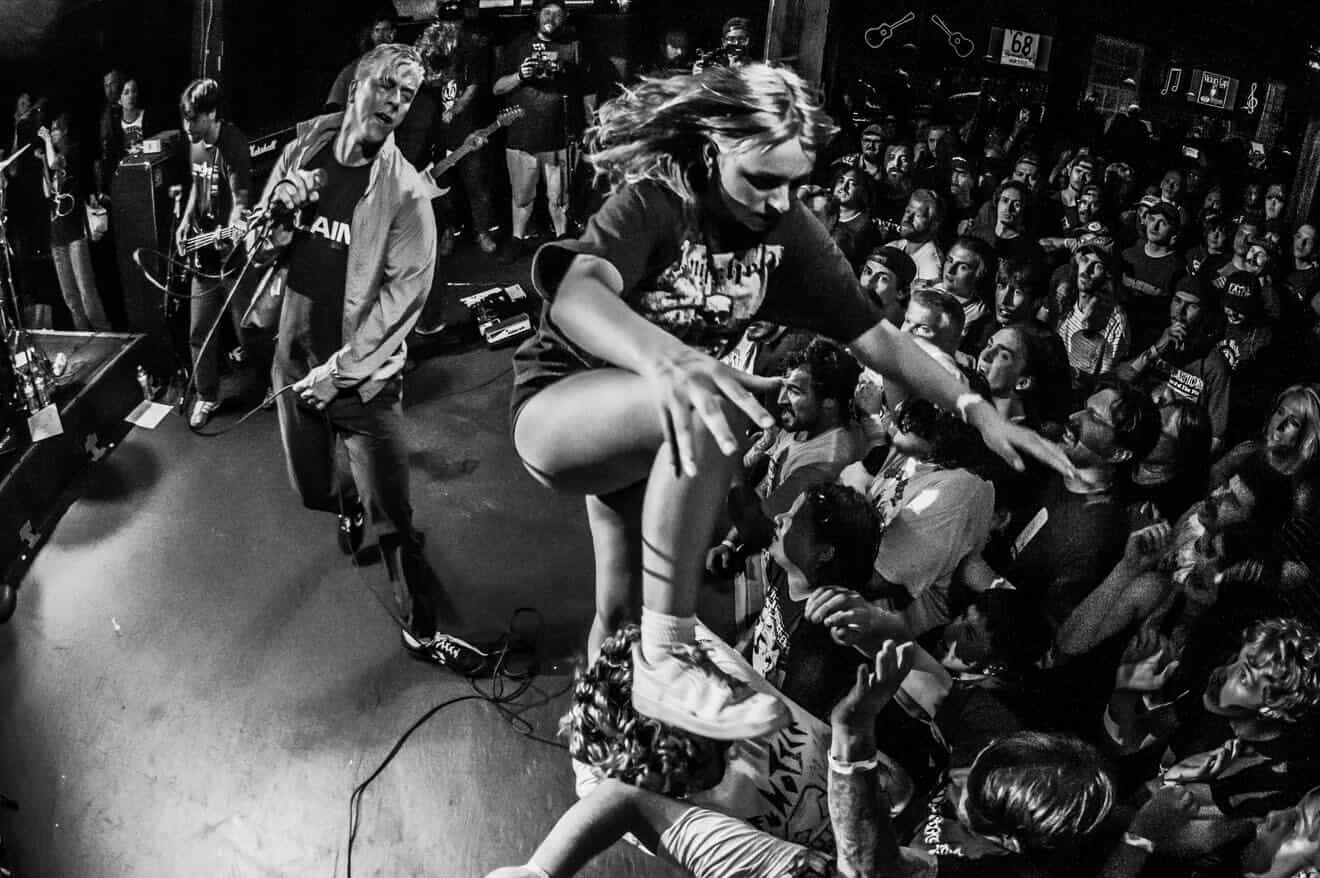

United Blood festival 2026. The Canal Club in Richmond, Virginia. Lots of dudes who kind of look like Zach Bryan. Lots of high fades with tattoos on the sides of scalps. An impressive number of really beautiful women, even though dudes make up the vast majority of the crowd. Faded '90s vintage shirts, either fished out of the back of dresser drawers or purchased for ungodly sums on Depop. Haywire jerseys. Haywire shirts. Camo pants. Whiskers with more salt than pepper. Dudes carrying dozens of shirts that they purchased at the merch tables downstairs. Little kids in the side-stage area wearing ear-protecting headphones and still clamping their hands over those headphones during loud moments. An ambient body-odor smell that intensifies as you get closer to the stage. After a few hours, it starts to feel like home.
In some ways, maybe it is home. United Blood started as an annual ritual in 2007, kept going right up until the pandemic, and then returned last year after a few years off. A good handful of the bands on the 2026 bill were on the 2007 bill, too, or their members were in different bands on the 2007 bill. You could make a case that it's always 2007 at United Blood, or that it's always 1988. This festival is not concerned with the extended moment of visibility that hardcore has enjoyed (or "enjoyed") in the past few years. It's not trying to show the breadth of the genre in 2026. It's not interested in the various tributaries or hardcore-adjacent mini-genres out there. It's all about the guttural chug popularized in New York in the late '80s, the sound that never really goes out of fashion within hardcore even as things within that universe wax and wane. More importantly, it's concerned with the community that has grown out of that sound within the past 40-ish years.
People always talk about community at hardcore shows, but they talk about it more than usual at this year's United Blood. There's a reason for that. A little more than a week before the festival, Harm's Way guitarist Bo Lueders passed away at the age of 38, apparently by suicide. Harm's Way played United Blood a couple of times, and many of Lueders' friends are on the bill. Lueders was one of the two hosts of the Hardlore podcast, which became almost indisputably the most important media outlet within the hardcore world in the past few years. Everybody in the room, myself included, felt like they knew Bo, even those of us who'd never met him. His death blindsided us. At United Blood, impermanence is in the air. From the stage, band after band talks about people they lost to suicide. They talk about seizing the moment, appreciating the limited time that we have. Nobody knows quite what to say. That kind of heaviness resists the power of the platitude.
It resists most platitudes, anyway. Here's a platitude that still has some power, even in the face of all that loss: "I'll take these words! To whatever! Fateful end!" That's the refrain from the thunderous title track of To Whatever Fateful End, the North Carolina straight-edge band Magnitude's 2019 debut album. Those words mean something on their own, and they mean a lot more when Magnitude play the song live. "To Whatever Fateful End" is the last song of every Magnitude set, and people always pile all over each other to scream those words into the mic. I've seen the spectacle online dozens of times, but I'd never seen it for myself in person. When you're in the room, it hits different, especially in one of those moments where a fateful end feels that much more tangible.
It's not about the platitudes, anyway. It's about the rituals that give this culture its shape and its direction. In hardcore, those rituals take the form of reckless physicality. Frontmen bellow out dance instructions: "Side to side!" "Everyone two-step!" "Get the fuck up!" They don't have to say those things because everyone knows what to do and when to do it, but they say it anyway. Really, there's only a small percentage of the crowd moshing at any given moment. There are plenty of places to stand where you won't catch an errant elbow to the solar plexus. But when you're in the splash zone, things happen. Two divers will run out at the same moment from opposite sides of the stage and collide mid-air, or one will land directly on top of the other one. Someone will do a full-speed running spear into the wooden support beams next to the stage, doing untold damage to their own ligaments. Someone will try to springboard off a singer's back, flipping over him and giving him a kind of accidental RKO on the way down. This is what's supposed to happen. And even if you don't throw yourself into those rituals, it feels good to be around when they're happening.
The Canal Club has been this festival's home for many years, and it's really not that big of a room. If there were a bigger venue that was amenable to this kind of chaos in the immediate area, then United Blood could easily happen there. Since the festival returned from its hiatus, both editions sold out in mere minutes. Other annual fests, like LA's Sound And Fury, take place in spaces that are much, much larger. The three guys who organize United Blood could tell you why they don't move it to a bigger place, but my sense is that they don't feel like they need to do that. It's not how they measure success. Expansion is no the mindset here. Instead, it's a family reunion.
United Blood is named after an Agnostic Front song, the title track from their 1983 debut EP. Agnostic Front are on the bill at UB this year; it's their third time playing the festival. They're an institution. Vinnie Stigma, the band's larger-than-life founder and guitarist, turned 70 last year, and he's still about that life. So are '80s NYHC vets Breakdown and Killing Pace, here to play the songs that they released on legendary demos before many of the people in this crowd were born. From the outside, it might look a little sad to be in the back half of your life, going out on the weekends to play the songs you wrote generations ago. But there's something beautiful about that, too — the sense that these guys made things that they already know will outlast them. Some of them keep themselves in fighting shape, too. Merauder, Brooklyn hellraisers from the '90s, play to what sure looks like the biggest crowd of the weekend, and their set-closing singalong shakes the rafters: "Liiiiiife! Is fuckin' paaaaain!"
After a couple of days of this, my body is in fuckin' pain, and I barely even go near the pit. United Blood is a commitment. It's 37 bands in two days, even if most of them play sets that don't go longer than 15 minutes. If you're not into this, it starts to feel like an endurance test. I am into this, and it feels like an endurance test anyway. Maybe that's because I don't really feel like I'm part of this community. I'm a music critic. I'm here because I want to witness something and document it. I'm on the outside, or maybe I just trick myself into thinking I'm on the outside. I'm here by myself and mostly keep to myself, which is the wrong way to do it. You're supposed to go around and get into random conversations with people you've never met, and I do some of that, but I clam up too much. My brain gets tired. My body does, too. By the end of the weekend, I keep seeking out the barstools at the back of the room. Sometimes, you can't bring yourself to be social at the antisocial people's social occasion. I'm still glad I went because I got to see some things.
At a festival where all 37 bands are in the same basic lane, little variations stand out. I like how Northeast newcomers Sin Against Sin never go fast, always chasing the evillest, most reckless mosh part they can find. I also like how they have two singers who don't really sing different things. Instead, they bellow together — one pitched low, the other pitched high — and the resulting sound is some elemental demonic shit. Wit's End and TS Warspite, two British bands, go back-to-back, with hulking Wit's End singer Tom Pimlott (also of the Flex and Violent Reaction and a million other UK bands) jumping behind the drums for TS Warspite. Florida's Method Of Doubt set themselves apart with sheer frenzied sincerity. Crush Your Soul's Jay Peta is a true character, coming to the stage with an Italian flag draped over his shoulders. Long Islanders Incendiary famously only play on weekends because they're all adults with jobs, but they've transformed themselves into a weaponized machine, moving together like they share a single mind. They are a sight to behold.
When the festival lineup was first announced, the one band who seemed like it might not belong was Fiddlehead, who I tend to mentally file into the hardcore-adjacent pile even though two of those guys were in Have Heart, arguably the most consequential of the bands who played that first United Blood back in 2007. Before this weekend, I'd only seen Fiddlehead once, at an emo-nostalgia fest with a barricade in Las Vegas. But when you see Fiddlehead in something closer to their natural habitat, it's a little more obvious that they are a hardcore band. They're as raw and primal and physical as any other band on the bill, and they look just as comfortable, even if this is their very first time playing Richmond.
All weekend, members of the bands who didn't play United Blood in the old days talk about how this festival has always held a legendary place in their minds. Nobody makes that case more forcefully than Speed frontman Jem Siow, who talks about all the UB sets that he used to get stoned and watch from his house in Sydney. This time last year, Speed were playing Coachella, and people at UB made fun of the way that people at Coachella tried to mosh. For Speed, a band who work to evangelize for hardcore on the biggest stages they can find, it means something to headline this festival, and you can tell. Guys from Richmond bands keep running up and for guest-spots. The headline moment of the whole fest happens a few minutes into Speed's closing set. Suddenly, the members of Richmond heroes Down To Nothing, a band who hadn't played a show in years, run out onstage, making their surprise return and ripping through their minute-long 2007 anthem "Along For The Ride," the Speed guys playing right along with them — a giddy display of intercontinental and inter-generational connection.
Richmond itself shows out all weekend. Other bands, like Swamp Thing and Cast Aside, come back from the past. Dimension Six, local warriors who carry the Down To Nothing flame forward, play a standout set. So do faster-than-fuck HCPM monsters Killing Pace, who close out an absolutely brutal 10-minute barrage with a fire alarm of a Slayer cover. Division Of Mind absolutely demolish, coming right off the release of their transcendently heavy new album Exoterror. All through the weekend, DOM frontman Lee Acosta-Lewis keeps returning to the stage to guest during other bands' sets. I really enjoy the sight of him carefully taking off his glasses and putting them to the side before front-flip cannonballing directly into the crowd.
But the moment that I'll probably remember the longest happens at the end of the first day. Atlanta straight-edge giants Foundation broke up in 2016 and started playing occasional reunion shows last year. These days, frontman Thomas Pearson is a teacher and a coach, and he's one of the many bandleaders who makes genuinely inspirational between-songs speeches about the importance of this culture for people who are struggling and about the pain of losing some of those people. When Foundation play their 2011 song "Anthem For Redemption," Pearson yells this message: "For Bo! For his friends! For his family! For the people you love! Up here, and let him feel it!" Then he hands the mic off to Combust's Andrew Vacante, another guy who's been returning to the stage repeatedly all weekend. Vacante shouts out the breakdown to that song, an impassioned apology to people let down over the years. He stands there with his jaw out, looking tough as hell, but I think he might be crying. He doesn't quite make it to the last line of the song: "And don't leave me."
Balmora - "Ophelia" (feat. Holder's Brie Percy)
I love when I can tell that a band has absolutely optimized every single part of a song for sheer maximum nastiness. For instance: the cymbal taps on this fucking thing. The entire song is a beast, an ungainly metallic bowel-smasher that goes on forever, where even the quiet and pretty parts throb with dread because you just know that another mosh apocalypse is right around the corner. But the tiny little cymbal-taps, the little triangle-dings that only show their face a few times on the song, have a profound ugliness all their own. That one little noise right before the final breakdown is like the glint from an incomprehensible future-monster's iron fang right before it eats your face. [From These Graven Halls, out 5/29 on DAZE.]
Big Ass Truck - "Pushed Beyond The Brink"
Marvin Heemeyer, the Colorado mechanic who went on a destructive bulldozer rampage before dying by suicide in 2004, has been a figure of extreme-music folklore since probably the moment that he demolished his town hall and the house of his former mayor. Big Ass Truck's ode to the so-called Killdozer raises a few questions. For instance, now that they are officially known as Big Ass Truck I.E. for what must be legal reasons, did Big Ass Truck consider changing their name to Big Ass Killdozer? Also, does a bulldozer count as a truck? If not, what would happen if a bulldozer crashed into a big ass truck? To answer that last one: It would probably sound a lot like this song. [Stand-alone single, out now on Nuclear Blast.]
Drug Church - "Pynch"
Drug Church made a love song! They also shot the video for that love song in the arenas that they played when they opened for the Deftones in Europe. The video's thumbnail is a quick shot of one super-hot lady in the crowd at one of those shows. That seems kind of cynical and misleading, to the point where it's genuinely funny. But what's not funny is the song's entire lyrical idea, which Patrick Kindlon delivers with elemental force — the total understanding that you need the person who shares your life because, among other reasons, without this person you would be fated to "sleep on a park bench and die alone." That's the realest shit. I know exactly what he means. [Stand-alone single, out now on Pure Noise.]
Fentanyl - "Cobrar El Dolor"
Video of the year. The charming young gentlemen of Fentanyl ride around in a limo, rocking matching suits and raising hell, before playing a wild-ass hardcore show and spraying champagne on the crowd. It's like: What if the Hives and Spy were somehow the same band? They would be fucking awesome, that's what. The song itself is a frantic anthem that doesn't need the context of the video, but why would you want to strip that context away. More context: Fentanyl frontman Kenny Turner is also the only member of Foghorn, the Bay Area beatdown project who don't sound anything remotely like Fentanyl. Foghorn's new track "Fogless Nightmare" is another merciless banger that you need in your life, and I wish it had a video like that. [From Fentanyl, out 5/1 on Convulse.]
Gouge Away - "Figurine"
Gouge Away already had one foot fully outside of the hardcore world, and now they're about to spend their summer opening for the Foo Fighters at stadiums. Maybe they're not supposed to be in this column anymore! But also, fuck it! This song rips! The thing that Gouge Away understand better than most is that the hard parts hit harder when there are some soft bits mixed in there, too. "Figurine" is a song more for basements than stadiums, but maybe it belongs in both. [Stand-alone single, out now on Run For Cover.]
A Knife In The Dark - "Drown Hesitation"
North Carolina's A Knife In The Dark share members with bands like One Step Closer and Magnitude, and they make holy-hell metallic straight-edge music with demented ferocity. So they're a Magnitude side project who sound like Magnitude. That works for me! More bands should sound like Magnitude! Lots of bands actually do sound like Magnitude, but this one sounds like Magnitude and also like trees being blown to splinters from nuclear-explosion aftershocks, so they're doing better than most. [From Songs Without Witness EP, out now on Bitter Melody.]
Knumears - "Untitled"
Depending on who you ask, screamo is either a hardcore subgenre or its own thing, a unique subculture that only overlaps with hardcore the same way that, say, death metal sometimes does. LA's Knumears have the scrambling, seething sincerity of true screamo, but you can tell they come down on the hardcore side when "Untilted" ends with a reckless intent-to-harm mosh part. The song is less than two minutes long, and it's already a crazy downhill rush before that part. But when the slower riff comes in, it might be enough to make you reflexively spinkick a hole in your drywall. [From Directions, out now on Run For Cover.]
Rainswept - "Front Line" (Feat. Short Fuse)
Rainswept are from Italy, but they're so consumed with the style of American hardcore from the '90s that this song opens with a sample of a newscaster talking about the Rodney King verdict. That's fucking ridiculous! It's pure cosplay! Presumably, Italy has its own outrages, and some of them might've even taken place within the past quarter-century. On the other hand, though, super-angry '90s hardcore is fucking awesome, and this is an especially ugly take on it. Both the bass tone and the snare sound should frankly be illegal under international law (complimentary). [From Winter Promo 2026, out now on Cruzade.]
Screaming Fist - "Gotas"
Most of the people who revive early-'80s hardcore sounds tend to forget a very important thing: The best of that stuff was made by kids who grew up on a steady radio diet of Ted Nugent and Van Halen before they found Bad Brains. Their music was catchy. That's one of the reasons that Restraining Order stand out so much; they never forget that part of the recipe. Oakland's Screaming Fist don't sound anything remotely like Restraining Order, but they remember it, too. This is some righteously breakneck music that sounds like surfing on a tidal wave of sludge, but in the fun way. [From Santa Plaga EP, out now on Convulse.]
Stand Tall - "Blind To The Truth"
For reasons that will be obvious to anyone who has ever seen me in person, I am predisposed toward liking a band called Stand Tall. But that's not why this Bay Area straight-edge crew is here. They're here because this song packs in all these different musical ideas without ever diverging from the anthemic format. I love all the little riffs and grooves that find their way into this track. They're also here because singer Justin Vela sounds like a rabid cocker spaniel general giving the Patton speech to a battalion of other rabid cocker spaniels. [From Line Of Defense: A Straight Edge Hardcore Compilation, out now on From Within.]