
I'm about to describe my favorite scene in Mother Mary, the new David Lowery arthouse character-piece in which Anne Hathaway plays the titular pop star. It's not exactly a spoiler. The scene in question happens half an hour into Mother Mary. It's not too deeply woven into the film's plot architecture, but it is key to the ideas that the picture explores.
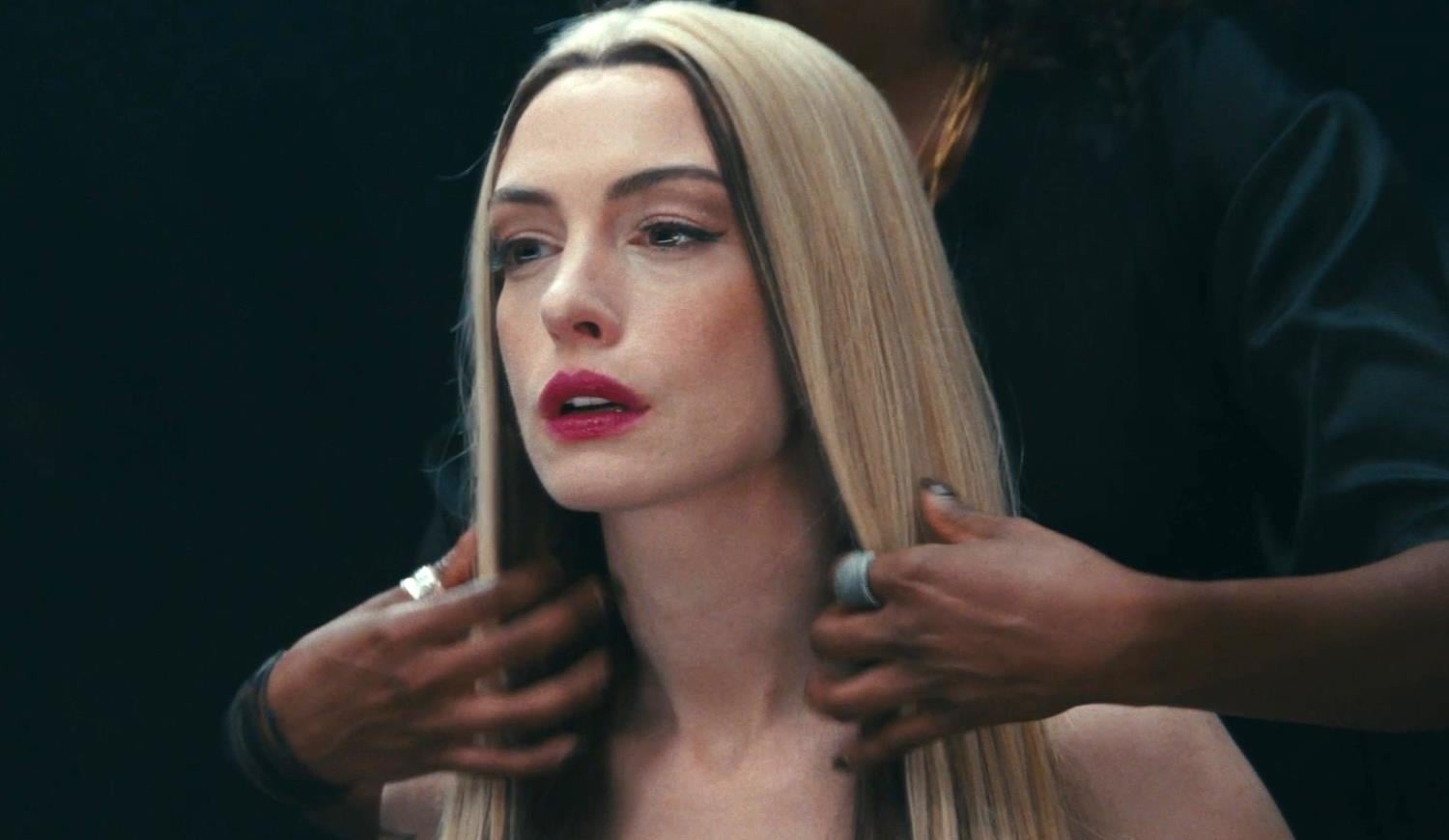
The setup is this: Hathaway is Mother Mary, an efflorescent singer who's had a turbulent time in the public eye. She's trying to come back from a calamitous moment, and she's getting ready for an important performance where she'll debut "Spooky Action," the single that's supposed to spark her comeback. A few days before the performance, Mary freaks out. The dress that she's supposed to wear doesn't feel like her. So she sneaks off and jumps on a plane to England, seeking out Sam Anselm, a fancy fashion designer played by Michaela Coel. Mary and Sam have a long history, and Sam helped craft the Mary persona in the first place. But they haven't spoken in years, and Sam holds a grudge. She refuses to listen to Mary's music anymore, but she still needs to see the way that Mary dances if she's going to design the dress. So she tells Mary to do the dance that she's planning to do, without the music.
Mary, barefoot in sweats, takes to the floor in the dusty barn that Sam uses as her studio. Sam looks on, motionless. Mary starts to move, and she almost instantly transforms into something mythic. As she breathes heavily and stomps around rhythmically, you get the impression that mysterious forces are flowing through her, that she may not quite be in control of what's happening. She whirls, rips at her own hair, falls to the floor, humps the ground, rises, staggers, collapses again, twists her body into shapes that almost violate physics. She makes animalistic noises, grunting and growling. It's a masterful moment of physical acting from Hathaway, and it looks less like a performance and more like a moment of demonic possession.
Mother Mary is a mess. It's ponderous and self-serious and overly impressed with its own metaphorical currents. For a film about someone who's supposed to be a global cultural figure, it's almost jarringly small — a two-hander that mostly takes place in a single location. Coel's character endlessly vents her bitterness about the way her old friend (and, the movie heavily implies but never confirms, lover) left her out in the cold. The performances are great, but I almost never enjoy the feeling of watching a movie that wants to be a play. I get restless. I was restless throughout Mother Mary.
On top of that, the film seems to have no knowledge of or interest in the actual workings of present-day pop stardom, in the fascinating anti-glamorous practicalities of maintaining that cultural position. It's like: This lady is debuting her new song at a midnight performance on New Year's Eve? And she's calling it "the best song in the history of songs"? And she's freaking out because she simply does not know how she wants to present herself to the world? So she disappears, and nobody knows where she is, and her team has to go hunting for her? That's not how any of this works.
Pop stars do not helplessly place themselves into other people's hands, searching for some ineffable thing that's missing. For the most part, they're type-A psychos with ultra-specific ideas about what they want, and they plan their rollouts with militaristic precision. Mother Mary is interested in dream, not reality, but I found its misty-fantasia view of the profession to be distracting.
For a movie that basically stinks, though, Mother Mary has more than its share of mesmerizing moments like that no-music dance scene. Lowery has always shown a particular gift for arcane imagery, and his 2021 medieval head-trip The Green Knight seemed to spring fully-formed from the collective unconscious. Within his filmography, the closest cousin to Mother Mary is A Ghost Story, the 2017 film where Casey Affleck is the white-sheet ghost of a dead guy and Rooney Mara is the woman mourning him. Mother Mary goes just as heavy on mood and longing, and plenty of its images have their own dizzy electricity. Wind howls. Lights flare. Rain comes down in buckets. Bodies float suspended in space. Wisps of deep red emerge from an inky black void.
Mother Mary gets its greatest physical spark from the faces of its two leads. Micaela Cole, who's never had a meaty role in a big movie like this, absolutely eats the screen up. She can do amazing things with her eyes while keeping her face perfectly still, and that face has all kinds of angles and planes that feel unearthly, abstract. Anne Hathaway has always combined shimmering glamor with human warmth, and the movie makes heavy use of both qualities. The Mother Mary character's visual trademark is the halo that she wears while performing. That's kind of a clumsy way to frame fandom as idolatry, but it does look cool.
With the name and religious imagery, the most obvious real-world comp for Mother Mary is Madonna. The songs on the soundtrack, which is cleverly being sold as a Mother Mary: Greatest Hits EP, come from a team of writers that includes FKA twigs, Charli XCX, Jack Antonoff, and Hathaway herself, and they've got some of the swirling gothy grandeur of Ray Of Light-era Madonna. But it's not a one-to-one. Sometimes, I get the feeling that Mother Mary is supposed to a version of Lady Gaga or Britney Spears, or that the arty interiority of her songs is supposed to reflect the real Charli or twigs. (FKA twigs also has a super-memorable one-scene performance, playing a mystic figure rather than a pop star.) Lowery told Empire that Taylor Swift's Reputation Tour was a big influence, which tracks.
For the most part, Mother Mary seems like a slightly tonier version of recent fictional gothic-cinema pop stars — Lady Raven from Trap, Skye Riley from Smile 2, Jocelyn from The Idol, Celeste from Vox Lux. (August Moon, the very funny fake One Direction from the previous Anne Hathaway joint The Idea Of You, do not belong to this canon.) Plausibility isn't the point of Mother Mary, but Mother Mary herself, with her futuristic lighting and her architectural stage design, is a more plausible pop star than most of her fictional peers. Hathaway has the alien charisma to play just such a figure. In the scene where she sings the soundtrack song "Holy Spirit 2," I got just a hint of the charge that I get at actual arena-level pop shows.
We never really learn where Mother Mary sits in the larger cultural climate of the film's world. She's been around for long enough to develop conflicted feelings about the young stars coming up behind her, but that's about it. The film is more interested in the psychological function that pop stardom itself serves. Early on, Sam tells Mary why she matters: "You give people the gift of giving a shit about you." It's also interested in the psychological impact that this function has on the stars themselves. Later on, another character asks Mary about the fans at her shows, who are mostly depicted as disembodied cheering sounds and cell-phone lights floating in the air. The person talking to Mary is a fan, but she wants to know, "They're all there, all at once, putting out all that energy, all of those ups and downs, and all of it is laser-focused right at you — how do you handle that?" Mary is not quite sure how to answer that, and neither is the film.
Is there something magical in the role that pop stars play in society? Are they creatures of the fame-industrial complex, there to generate wealth for themselves and their benefactors? Are they humble artists who have been lifted to vaunted positions by forces beyond their control? Or are they doing something more sacred than that? Do they serve as vectors for the fantasies and longings of their millions of fans? Do they act as digital-age oracles, bridges between our shared dreamlife and the physical world?
Those questions lead Mother Mary to some frankly absurd places. Even before things get supernatural, the dialogue feels overwritten to the point of parody, and the pacing drags like an album that opens with five back-to-back ballads. There's no joy, no self-awareness, and only distant implications of actual sex, which means its understanding of the power of real-deal pop music is limited at best. Still, I like that Mother Mary is asking those questions. I don't like the movie, but I'll probably pull up individual scenes on YouTube years from now. Maybe one day, some other filmmaker will build on its ideas, and we'll get a movie worthy of those questions.
Mother Mary opens in limited release tonight, via A24. Mother Mary: Greatest Hits EP is out 4/18 via A24 Music.