Earlier this year, Live Nation Entertainment and Ticketmaster reached a surprise settlement with the Justice Department in a major antitrust case — a deal President Donald Trump reportedly pushed for, to the dismay of his ally Kid Rock, who has advocated for regulatory action against the company. The agreement avoided a breakup of Live Nation/Ticketmaster, even after a federal jury later found the company to be an illegal monopoly in a separate lawsuit brought by dozens of states.
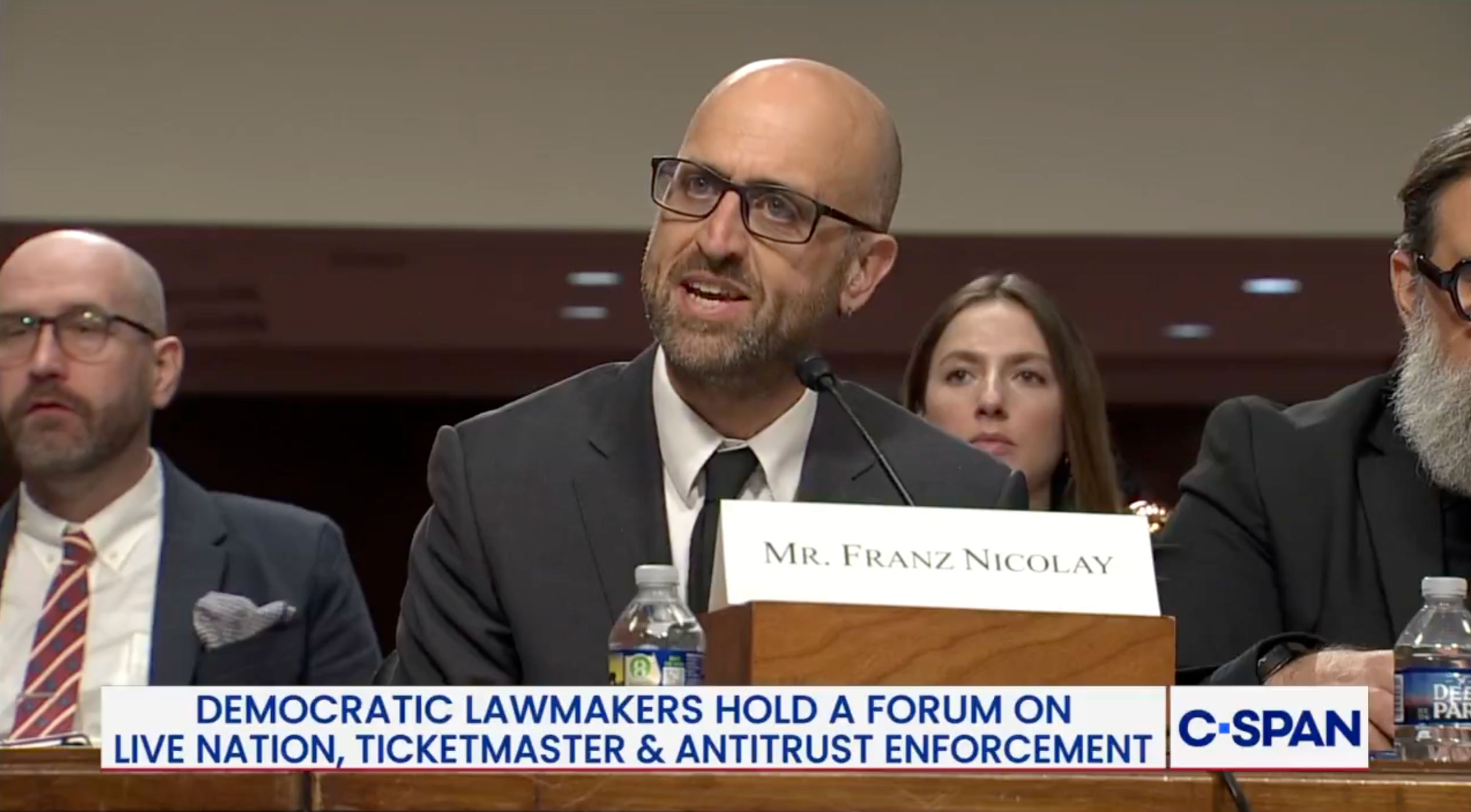
Monday, Democratic lawmakers held a forum on the DOJ settlement and monopoly verdict, headed up by the Ranking Member of the House Judiciary Committee, Rep. Jamie Raskin, a Maryland-based Democrat who has a long history with the live music industry. (Per Damon Krukowski, Raskin promoted a Mission Of Burma concert at Harvard back in 1981.) In his opening remarks, Raskin detailed Live Nation/Ticketmaster's history of monopolistic practices and decried the settlement , saying it "did nothing at all for consumers, artists, industry workers, or venues."
One person who participated was Franz Nicolay, the musician best known for manning the keyboards in the Hold Steady, who is also the author of the book Band People and many fine journalistic ventures. Nicolay testified that Live Nation represents "the epitome of the kind of monopolistic power that antitrust law was created to address." It's worth hearing that statement within the context of his remarks, which provide great insight into the ways Live Nation's operation damages the careers of working musicians:
We're also, to fans, the face of ticket sales. So if concert tickets sell out in seconds and instantly appear on secondary markets for five times the price, or if mysterious fees add 20 or 30% at checkout, they can't complain to Ticketmaster. They come to our Facebook page. So business practices we can't control hurt our crucial relationship with our fan community.
In a healthy competitive market, with multiple independent venues, promotion, and ticketing options, predatory fee schemes could be avoided without the burden falling on the relationship between artists and our audiences. But live music hasn't been a healthy competitive market. Instead, a vertically integrated corporation that controls venues and tour promotion and ticketing and artist management, to the almost total control of many music markets, is — to a comical degree — the epitome of the kind of monopolistic power that antitrust law was created to address.
We are artists simply don't have the range of city to city, venue to venue choices that would constitute a healthy ecosystem, as non-Live Nation venues are consolidated or forced out of business or feel pressure to adopt extractive Live Nation policies to stay afloat. And we're in solidarity with independent venues and promoters because they gave us gigs when we didn't have any fans and helped us build what we've been able to build.
So we ask that ticket resale and speculation be capped at or near face value so that our fans are not being exploited at no benefit to us, the artists. We ask for full transparency about fees, going further than the floor set by the FTC rule, so fans are aware of who's responsible for higher ticket prices. We hope that the remedies phase of the lawsuit results in the breakup which doesn't just separate Ticketmaster from Live Nation, but also separates the venue and artist management businesses from their tour promotion businesses.
We simply want to be able to retain and manage the relationship between musician and audience without the influence of extractive corporate power. We try to do business in a sustainable way that embodies respect for fans rather than squeezing every last dollar from them. And we want the opportunity to partner with companies who share those values.
Watch Nicolay deliver those remarks below, and check out his full written testimony as well as some reflections on the experience here.
Musician @FranzNicolay: "We simply want to be able to retain and manage the relationship between musician and audience without the influence of extractive corporate power." pic.twitter.com/d7L2bnf2wH
— CSPAN (@cspan) May 18, 2026
Here's footage of the full three-hour hearing: