
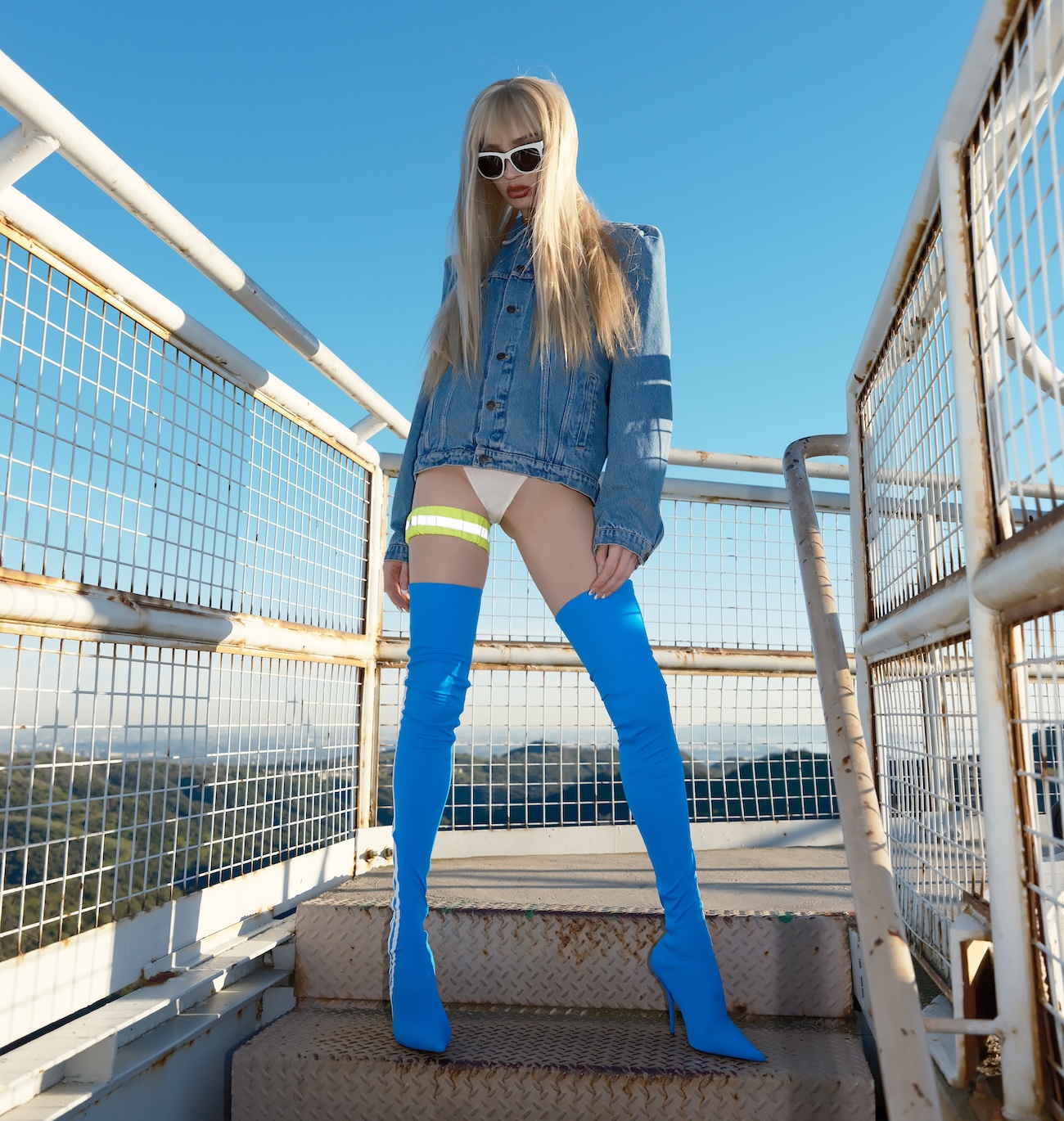
Kim Petras begins with the end on her latest album. Earlier this year, the German-born, LA-based pop star parted ways with her major label, Republic Records. With Detour, self-released today, Petras steps into a new era of independent pop reinvention defined by risk, rupture, and creative off-roading.
She’s already had an expansive career as a trailblazing trans pop artist, launching with early tracks like 2017’s “I Don’t Want It All” and 2018’s “Heart To Break,” before collaborating with the late producer SOPHIE and Charli XCX, defining eras such as Slut Pop and her Halloween cult favorite mixtape TURN OFF THE LIGHT, and later scoring a global smash with Sam Smith on “Unholy.” Now, by her own request, she’s stepped away from the traditional major-label pop highway. Off the beaten path, she returns today with the riotously fun Detour, her strongest album to date, made with underground pop collaborators Margo XS, Frost Children, and Porches.
Over the past few months, Petras has been teasing a string of chaotic, high-energy singles. Detour leans fully into a vision of pop reinvention through disorder, where personal history and industry mythology blur into a single narrative. The album maps out a restless drive through Los Angeles — hedonism, late nights in statement looks, and clandestine romances stitched together like scenes from Fear And Loathing In Las Vegas meets Thelma & Louise meets Spring Breakers.
“This is the beginning of the end/ Everything before is just pretend,” she declares on the self-titled intro track. It’s glamorous and doom-laden, capturing a sense of collapse as inevitability: If everything is falling apart anyway, why not find clarity inside the wreckage? Petras leans into that collapse as both spectacle and transformation, layering 2000s production nostalgia with flashes of Gwen Stefani's solo career and Timbaland's GOATed era of maximalism.
She directly confronts the industry on “Need For Speed,” taunting: “My label is yelling in my ear/ ’Cause they love the money and they want it now/ And they love it when I got no boyfriend in my life.” Throughout, she is sharply aware of how visibility and exploitation intertwine. “You don’t really know me/ No one really knows me,” she sings later.
But Detour also opens up new angles on Petras as an artist. On “Brutalist,” she pushes further into vulnerability and experimentation, singing about her dad taking her to hormone therapy and the gentrification of historic architecture. She wades into meditations on decay, structure, and emotional inheritance. Across the album, she reframes self-destruction not simply as collapse, but as clarity, release, and rebirth.
Where renovation implies refinement, Detour is about demolition: breaking things down as a creative tool, rebuilding narrative from fragments, and embracing storytelling with sharper intention. It’s music built from motion rather than arrival, the sound of endless driving, fractured memory, and the sensation of outrunning yourself long enough to become someone new.
Read our conversation below.
Each album in your whole career captures a different persona or caricature, and Detour feels more personal and gets into some meta topics in terms of being a pop artist. What is the most absurd or inaccurate thing someone has ever assumed about you personally based on your music that you've released?
KIM PETRAS: Oh, probably that I'm a nepo baby [laughs], because all my first music was very much "I am just this hot girl in LA who gets whatever she wants," that's the character I created. I really moved to LA by myself and was a songwriter for a long time before anything started happening, and I worked really hard for this. People can take my music too seriously, especially like on Slut Pop. I wrote that record because it was so fun to play with that topic and those words and the taboo-ness of it. But, I'm a pretty shy person, and that's the music that allows me to live out the parts of myself that I am maybe too afraid to live out in real life.
I think that's why I’m constantly changing. I like reinvention and the use of persona, and it's what really fascinates me about pop stars — that element to me is amazing, because it shows that you can always change your life and your perspective and everything around, and it's never too late or too early to do that. You're allowed to change your mind and be a fluid person that goes in all kinds of directions and finds or looks at all the ugliest and most beautiful parts of themselves — so that to me is a super important part. I think just like the spoiled rich kid [assumption], that is just something that annoys me.
That's interesting what you're saying about reinvention, because I was definitely thinking about with this album teeter-tottering between reinvention and self-destruction and how those things go hand in hand. I'm curious how your understanding of reinvention has changed over time in the music industry?
PETRAS: There's things I've done that I was like, "Okay, I'm going to do this, so that then I can have freedom to explore these parts of myself," and then that becomes a spiral of things. With this one, I feel so in my body, and with my friends, and I'm really living everything on this album. I think the downfall of the pop star was really interesting to me on this album. I usually like the downfall of a pop star more than the rise. The rise, or the hometown hero that made it big, you know, we've all seen it a million times, and it's awesome, it's touching, and it's inspiring and amazing, but the downfall, cracking under the pressure, feeling like you've built yourself a prison that you want to escape from, that is really interesting to me. So, looking at that and not shying away from that was important to me. I think artists get more and more interesting over time, and it's cool that I feel like I haven't reached my ceiling. I feel like I have more interesting things to say than ever.
I don't know if it's a human nature thing, or do you think it's just your own personal fascination with that narrative? Because I do think there's also something strange that’s perpetuated in the media. It's really interesting to use music and that space to dissect something that I think is culturally fascinating to all of us in a way.
PETRAS: A lot of times when you choose yourself and you're like ‘I'm gonna trust my gut,’ and I mean, that's my experience with this one that it was like I want to trust my gut, and I love this music, and I believe in it full heartedly that this is like a perfect project to me. And then people kind of question your sanity, and being like, ‘oh, why don't you have hit-makers doing this with you? Why do you work with these like new kids? Why do you believe in this underground culture? We want something proven.’
I think people in my orbit really took it as, ‘oh, she's going crazy,’ instead of, ‘oh, she's finally becoming an artist.’ I think playing with that — the independence somehow being turned on you and being made out to be the downfall, or she's going off the edge, or she's driving off the cliff, or she's ruining her life, she's ruining her perfect pop image, her perfect pop vocals — that's something that I think I'm known for in the past, the perfect stacked pop vocals, in the way that just pop in the 2010s sounded like. I really wanted to learn that, and I'm really proud I learned that, but breaking away from that and having things feel messy and mispronounced and off-the-grid and off-timing was such a cool tool to reemphasize this note of ‘this is my downfall,’ you know, this like, oh, she's unstructured and going off the rails, and yeah. I hope that made sense —
Yeah, no, definitely. With these newer collaborators, Frost Children and Margo XS and Porches, did they help you lean into that imperfection? What was your journey of retraining your brain to not be the perfect pop singer?
PETRAS: There was a lot of philosophizing about music going on in the making of this. Margo, the Frost Children and Porches, they all have their own worlds created so nicely, but we all really believed in picking the most emotional takes over the most perfect takes. We all are on the same page there, that it's all about the emotion and the storytelling of it, and that perfection can stand in the way of emotion and realness, and the real glimpse into the psyche that I feel like I give you on this.
Also just shared life experience, the shared opinions on music were really amazing to have with the Frost Children and with Margo and with everyone involved — definitely having people who get you and who are like ‘I love this vocal crack and this flat note,’ and ‘I love how you timed this,’ kind of allows me more life as a vocalist on this album and not feeling so robotic. Because I look at some of my past music and I'm like, the perfection is kind of what is making it worse, for me — even though I love my old music.
There's this myth around striving towards perfection, when really it's actually keeping you from leveling up or reaching like some sort of deeper realm.
PETRAS: Yeah, just from being known — I think it can keep you away from being known. A strong lesson for me recently has been that I want to be known by people. I don't want to hide away under perfection and under a guise, and I think the characters that you make up in your mind are as real as the person that you are. I think like the Slut Pop persona is a part of me, and it is real, and the Turn Off The Light persona is a part of me and is real, and I think that the things your imagination, those parts of you are as real as the reality.
Yeah —
PETRAS: Some deep shit. [laughs]
No, totally. [laughs] I think it's fascinating, and why pop music can still be really fun and crunchy and crazy, but also make you spiral down into existentialism while having a good fucking time.
PETRAS: Yeah, I mean, that's what happens to me when I party, all the time. Either I'm gonna have a mental breakdown, and I'm thinking about all the things that are wrong in my life, or I get really sad and I cry, and then a song changes, and suddenly I'm really happy. That’s the thing — I love dance music, you know? I love going to warehouse parties, and I love to dance. I just love dancing; I don't love socializing. I go to parties to get out. This record is an accurate representation of how on edge I feel on a night out, and how many things are going through my mind.
I love that, and I think Detour is so fun to listen to. One song I actually really want to hear your experience about making is “101.” That's one of my favorite songs I keep coming back to, and also it is the one song I feel like goes in like five different directions or detours of its own.
PETRAS: Yeah, thank you. I'm glad you clocked that. The songs kind of go into detours — I feel this, and now all of a sudden, boom, I'm in a completely different mental space, and everything sounds different, everything feels different. “101” is — we were thinking of this album as a map of LA in many ways, and the 101 is what connects a lot of the parts. Also just going super fast down the 101 makes me feel like I'm like this cocky, hyper version of myself. I just got my driver's license around the time that we made this album, and so driving was really influential on this album. The cockiness on that song, of like: you bitches are all stealing from me, and I'm getting no recognition, but fuck it, I'm in my fast car, and I'm like gonna drive all over everyone, and that kind of bombasticness of that song is really cool. It started just being on the 101 and coming back [starts singing chorus of “101”]. It’s almost vocal stimming. My friends and I just do that a lot for entertainment.
There's a lot of nostalgic references, which I feel is very purposeful, but there's a part in that song that reminds me of “Wind It Up,” by Gwen Stefani — a little melody that takes me back to the 2000s.
PETRAS: I love “Wind It Up” by Gwen Stefani, a jam, thank you.
Did you meet all of your collaborators for this project while you were in LA?
PETRAS: I met Margo at a party a few years ago, and then we just stayed in touch. Frost Children, I reached out to because I heard a remix they did of a song that I couldn't stop listening to, and I was like, "Are you guys ever down to work?” and they were and then we became really good friends from there on. Porches is kind of in my friend group, just like around. We would meet at parties, and is a really special artist that I recommend looking into and has been dropping amazing music for years. Yeah, it's a mixture of friends that I met at parties, friends of friends, and people that I'm a fan of, and whose culture I really respect.
It’s interesting because I feel like Porches and Frost Children, maybe it's just because I lived in New York, but for some reason I really associate their music with New York City. It’s funny that this album is really grounded in LA, and I'm curious how you guys all connect on that.
PETRAS: I have a really strong connection to New York. I feel like my career started there — that's where clubs first started playing my music, that's where I kind of came up, and I think that New York is a very inspiring, rich place, and it's cool to bring people from New York to LA and kind of have the culture shock and all of that. It's a bi-coastal album a little bit. I feel like my world revolves a lot around LA and New York. But they're New York legends for sure.
Another song I really wanted to know more about was “Basketball.” I mean, obviously, because SOPHIE, you worked with her on that song — is that the oldest song on the album? How did that get incorporated into this era or why you felt that it needed to be on this album?
PETRAS: Yeah, it is. It is the oldest one on the record. It's from 2019. It's a song that's been floating around and I've always wanted to include it on something, but it didn't narratively fit into anything and — Sorry I’m just like drinking soda and like being on Twitter, and like watching how people are reacting.
You’re good.
PETRAS: There's this little narrative on this album around sports, and with “Bitch Ball Out,” and with “Basketball,” and dating athletes was a really interesting character study to me — the locker room, the closeted feeling that sports sometimes have, and the tension in that, and Darby Park, and meeting someone there just felt really, like [on “101”] with “Your boyfriend buss a lot/ When I walk it in my outfit in the parking lot.” They just have this connection. In my dating experiences, I've rarely met guys who openly wanted to date me. It was always kind of like DL, and I really wanted to address that. I love that that song does it in such a sweet way, because it just reminds me of an older version, and this new version of myself.
It fit narratively really well into this project, because it's also kind of different guys, I'm dating different people, I'm becoming [different] when I'm dating them, when I'm seeing them — so having this undertone of dating an athlete, and it's under wraps, and no one knows, and that tension was really interesting to me. I'm really happy the song got to come out. I've made so many songs with SOPHIE, and this is definitely the last one I'm ever going to put out with her, so it feels bittersweet. I think that bittersweetness is tangible in that song.
Yeah, thank you so much for sharing that. It fits so beautifully on the album. It's one of the softest but it also bittersweet songs of the album, it's an interesting contrast and comparison.
PETRAS: Thank you.
I know you've been doing a lot of press around this album, and I'm always curious, for artists, as journalists project theories and their own ideas onto an album, as you're like thinking about this, was there an interpretation of this record that surprised you or changed how you saw it?
PETRAS: No, I think I'm really surprised by how much people are understanding this. I thought it was more outlandish than it is.I feel like all the things I'm reading and seeing are pretty much along the lines of this, going off the track and what going off a lane that feels destined for you feels like, and taking an uncertain swing. So I'm really happy with how people are interpreting it, and seeing it for exactly what I wanted them to see. It’s amazing to me that I feel really understood on this one.
Detour is out now.