
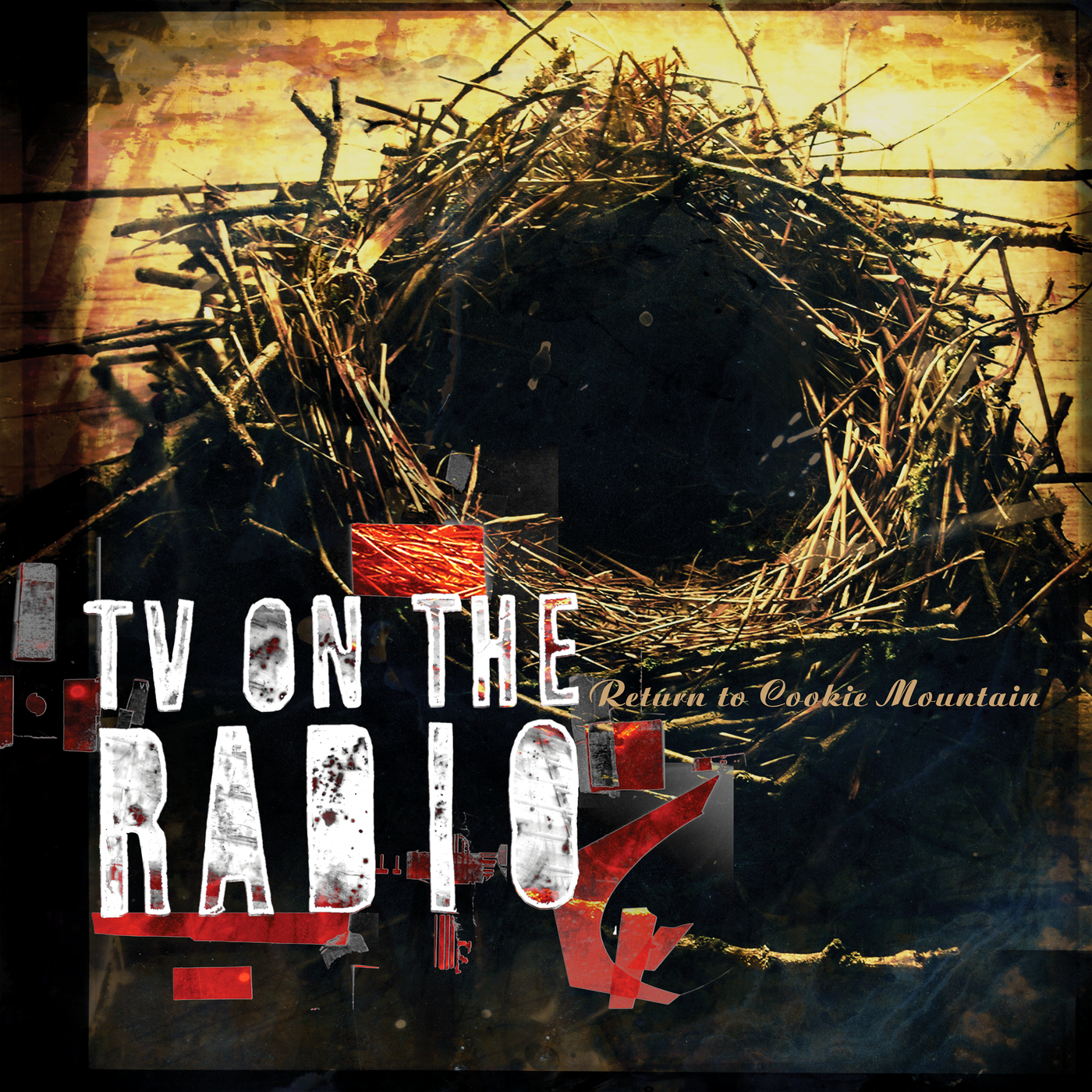
- Touch And Go/4AD/Interscope
- 2006
On the cover of the Village Voice, Bob Dylan ran over Kyp Malone in a Rascal scooter. This was February 2007, and 64-year-old Dylan's 32nd studio album Modern Times had just barely snuck past TV On The Radio's sophomore LP Return To Cookie Mountain to top the Pazz & Jop poll, the Voice's annual rock-critic survey. It was a photo finish — 1123 points for Dylan, 1109 for TVOTR. One critic, forgetting to file on time, could've easily shifted the result. God only knows what the newspaper would've put on the cover if that happened.
When that issue hit the red plastic newspaper boxes all over New York City, I worked at the Voice, and the office was in complete fucking chaos. A rapacious out-of-town conglomerate had just bought the paper, and it was in the process of tossing all of the legendary institution's redoubtable journalistic paragons out on their asses. One of the first people they fired was Robert Christgau, the guy who basically invented alt-weekly rock criticism and who'd overseen every Pazz & Jop poll since he launched the whole damn thing in 1971, and then again in 1974. The Pazz & Jop issue adorned with Kyp Malone roadkill was the first one ever that didn't feature a long, fascinating Christgau essay about What It All Meant. His presence was sorely missed.
That moment at the Voice was a fucking shitshow. Nobody knew if they'd have a job by the next morning. I was safe, at least in that moment, because I was young, worked for peanuts, and wrote almost entirely for the website that they were desperately trying to solidify, but I didn't know that I was safe. The staff union kept threatening to strike. The new owners kept firing great writers and editors. Plenty of august music critics blogged that they would boycott that year's Pazz & Jop poll, though Christgau wasn't one of them. The website Idolator launched Jackin' Pop, its own critics' poll, specifically to take the place of the presumed-dead Voice version, and the Voice's new owners did not like that one bit.
Chuck Eddy, the music editor who hired me at the Voice, was another casualty. In his place, the new owners installed someone who they thought would be a company man: Rob Harvilla, the young music editor from their West Coast paper the East Bay Weekly. Except Rob did not turn out to be a company man — not for those fuckers, anyway. The first time I met Rob, I was sure I'd want to tar him, feather him, and run him out of the office on a rail. Within a few days, we were good friends. Rob did everything in his power to maintain the critical voice of the Voice, to keep an embattled institution running. It wasn't easy. Ahead of that issue, there were furious negotiations. One of the company bigwigs wrote an article that attempted to dunk on the entire rock-critic landscape, proclaiming that they were new the sheriffs in town or some shit. Rob kept that from happening, and the associated stress probably took years off of his life.
In the midst of that whirlwind of shit, nobody thought that maybe that cover illustration, the one where an exaggerated Bob Dylan caricature scooter-murders an exaggerated Kyp Malone caricature, was a bad idea. That shit just skated right past everyone. I honestly don't even remember whether I saw the cover before it went to press. People were just trying to get that thing out. When readers hated the cover illustration, I remember everyone being like, "Damn, of course, yeah. Should've thought that one through."
One of the people who hated that Village Voice cover was Antibalas Afrobeat Orchestra member Martín Perna, one of the musicians who played on Return To Cookie Mountain. He wrote a letter to the editor, which was still a thing at the time: "Intentionally or not, this cover sends the all-too-familiar message to people of color: Make something too unique, make something outside of your assigned place-role, and get run over by a white man." This was not a unique perspective. There were compelling arguments that the illustration was both racist and antisemitic, as well as the whole thing about literalizing the imaginary violence that happens when you put two artists against each other. Whoops.
Anyway, it wasn't a surprise that Bob Dylan beat TV On The Radio that year. If Bob Dylan had a new studio album out around that time, the critics of America were going to vote that album to #1 on the Pazz & Jop poll. Time Out Of Mind crushed OK Computer. Love And Theft obliterated Is This It. The records before and after Dylan's three-album run, 1993's World Gone Wrong and 2009's Together Through Life, had middling Pazz & Jop placements, underneath Yo La Tengo albums. But in that late-career comeback window, Dylan was simply unbeatable. You wanted those metaphorical tire tracks on your back. That meant you'd achieved immortality.
Since Bob Dylan and TV On The Radio are not competitors in any arena except the Pazz & Jop critics' poll, there's probably a better story to be told when you hold Modern Times and Return To Cookie Mountain up next to each other. That story might involve two different generations of elusive rock-musician poets, products of two vastly different NYC underground scenes, looking at the confounding wreckage of Bush-era America and trying to find transcendence within the embers. Today, I hear Cookie Mountain as a chaotic masterpiece for a chaotic moment, a fitting soundtrack for that wild scramble.
Return To Cookie Mountain hit record store shelves in the UK and Europe exactly 20 years ago today. In the US, though, the album came out just one day after fifth anniversary of 9/11, and plenty of critics had to point that out. Before Cookie Mountain, TV On The Radio achieved buzz-band status at least in part because they came from the world-renowned Williamsburg, Brooklyn scene that was already emerging before 9/11 and got tons of press in the years after. They were connected to every other cool New York band, especially the Yeah Yeah Yeahs. You could find plenty of sex and drugs in TVOTR's whirling, skittering rock 'n' roll. But their music was also magnificently mournful, a wounded elegy for a dying, brutal empire that continues its tedious death throes to this day.
That funereal feeling is all over TV On The Radio's full-length debut, 2004's Desperate Youth, Blood Thirsty Babes, but the band hadn't yet learned to capture the grandeur of their vision. In retrospect, Desperate Youth was a rough draft, an outline. TVOTR had already shown that they were capable of touching greatness, as they did on the 2003 EP Young Liars, and they took the years after Desperate Youth to figure out how to become truly great.
Step by step, TVOTR got there. They stopped using drum machines. The band, once a trio, brought their two newer members, bassist/keyboardist Gerard Smith and drummer Jaleel Bunton, fully into the fold. (Smith and Bunton were both guitarists who didn't really play those instruments when they first joined the band, and part of the Cookie Mountain magic is that they sort of play bass and drums like they're guitars, if that makes sense.) TVOTR made even more connections, leading to the goosebump-raising appearance of Actual David Bowie on "Province." They joined the YYYs on the Interscope Records roster even as they kept their associations with Touch And Go and 4AD. Talking to SPIN, Sitek explained, "We wanted to reach people who aren't reading Pitchfork." One might argue that they never quite succeeded but that the "people who are reading Pitchfork" demographic multiplied.
Return To Cookie Mountain is the sound of a band making the grand leap. The things that were always great about TV On The Radio — Tunde Adebimpe's towering howl, its contrast with Kyp Malone's falsetto yip, the carefully layered chaos of Dave Sitek's production, the sense of gospel gravitas applied to indie rock grit — were still great. But TVOTR also learned to expand on that, to find epic resonance in their squall. They also learned how to write an anthem. Older songs like "Young Liars" and "Staring At The Sun" already sounded vast. But there's those tracks, and then there's the way "Wolf Like Me" could blow your eyebrows off your face the first time you heard it.
"Wolf Like Me" sounds like OK Computer and Is This It at the same time. It's a guttural, soulful bellow of hunger and determination. Like all instant-classic songs, it sounds both eternal and like a monument to the exact second in which it was conceived. The riff is interstellar rock on overload, like Spacemen 3 traveling through the 2001 stargate. The feral, post-verbal backup vocals, from Kyp Malone and frequent collaborator Katrina Ford, could go on howling forever. Tunde Adebimpe sounds like he's surfing on lava, freaked-out and exhilarated in equal measure. His heart's aflame, his body's strained, but God, he likes it. You ever see the video of TVOTR playing that song on Letterman? Whoo, baby. Even after decades of watching indie bands playing on late-night TV, that performance feels impossible, unreal, a miracle. "TV On The Radio, that's all you're lookin' for! Nice goin'!"
When Return To Cookie Mountain leaked online in spring 2006, "Wolf Like Me" was the opening track. (It's still wild to think that a leak like that could happen and the actual album still wouldn't come out until like six months later.) There's a lot to be said for a band to put its most undeniable song at the very beginning of a record, but it would've been the wrong call in this case. "Wolf Like Me" needed its buildup. It needed room to breathe. And as titanic and totemic as that song remains, my return to Return To Cookie Mountain has me wondering if the monolithic eight-minute album closer "Wash The Day Away" isn't maybe just the tiniest bit better. Look, you don't have to agree with that take. You just have to acknowledge that Cookie Mountain is the kind of overwhelming record that could lead a reasonable person to that conclusion.
Even at its most charged, heedless moments, Return To Cookie Mountain is a symphony of anxiety. You can read all kinds of anxiety into the band's feverish, tortured wails. There's the constant instability endemic to living as a predominately Black band in a predominantly white milieu. There's the unsustainable fact of existence in a rapidly gentrifying megalopolis with a smoking crater where its signature landmark once was. There's the futility of dissent in the bloodthirsty Bush years. TVOTR had already taken an explicit stand, an all-too-rare rare thing in indie rock at the time, on their 2005 free-download protest song "Dry Drunk Emperor." Cookie Mountain comes with the built-in understanding of being powerless to stop the carnage around you, a feeling that most of TVOTR's peers weren't really ambitious enough to convey.
TV On The Radio had that ambition. Their sound had vision. Cookie Mountain is full of grandeur. On "Let The Devil In," TVOTR's friends in Antibalas and Dragons Of Zynth join in to scream out a euphoric jazz-funeral dirge about joining the bees. On "Dirty Whirl," Adebimpe conjures the ghost of sex so powerful that it knocks your world off its axis. In a better world, an entire international shoegaze-funk scene would've sprung out of the mystical clatter of "Playhouses." The most hopeful moment on the whole album might be when David Bowie, singing along with Adebimpe and Malone, lends his stentorian gravitas to the life advice of "Province": "Hold your heart courageously as we walk into this dark place! Stand steadfast, erect, and see that love is the province of the brave!" We can be heroes, just for one day.
About a week before Return To Cookie Mountain got its European release, I was one of thousands of people who came out to see TV On The Radio play a free show at Brooklyn's bucolic Prospect Park Bandshell. From what I remember, this was a friendly, familial atmosphere. People sat on picnic blankets and snuck in bottles of wine. Little kids ran around. Clouds billowed overhead ominously but only squirted out a few drops of rain. I thought the two opening bands, Voxtrot and Matt Pond PA, were pretty terrible, but even terrible indie rock sounded pleasant in that environment. And then TVOTR came out with all this coiled, explosive energy. They sounded like they were too big for a big outdoor space. This band was going for it. If Prospect Park had a roof, they would've blown it off that motherfucker.
Twenty years later, Return To Cookie Mountain still sounds like a band going for it. That's why it's still thrilling. TVOTR weren't going for it commercially, necessarily. They didn't get much play on the radio or MTV. "Wolf Like Me" earned its generational-anthem status, but it took 18 years to go gold, so it's not exactly "Mr. Brightside." The band got rapturous reviews and played bigger rooms, but they didn't seem to have any aims or illusions about becoming rock stars. The goal, as far as I can tell, was to make an album that would pull electric currents out of the air and immortalize them on wax — to make something that was both of-the-moment and eternal. In that, they succeeded.
The craziest thing about Return To Cookie Mountain is that it might not even be the best TV On The Radio record. The band, and their ambitions, only grew. Those ambitions never turned them into rock stars. But thanks in part to those ambitions, the next TV On The Radio LP came in at #1 on the Pazz & Jop poll, in a year with no Bob Dylan album.