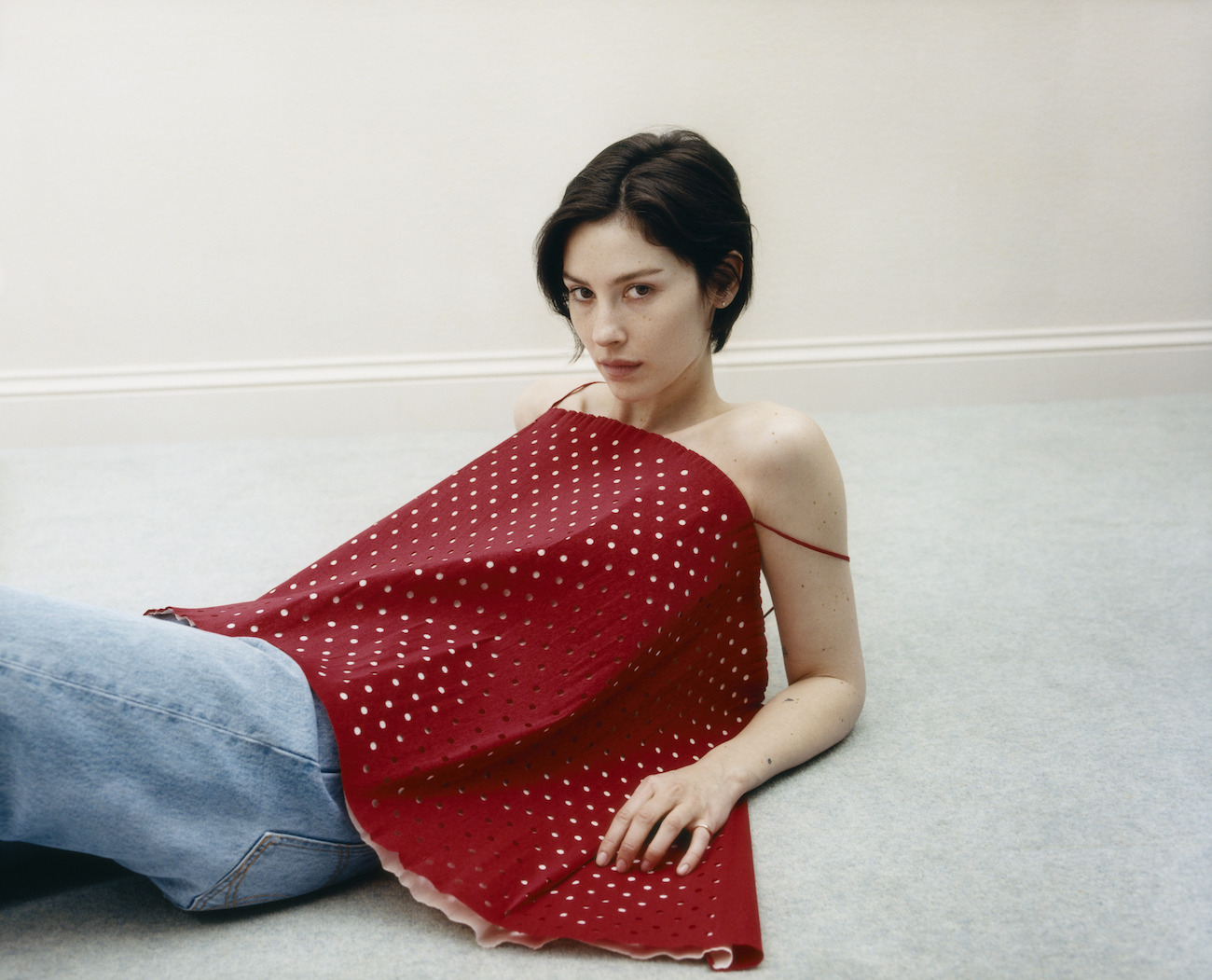

Gracie Abrams, for most of her career, has lived inside labels. The LA-based singer-songwriter is a former Taylor Swift superfan and current Taylor Swift protegee. To her fans, she's a generational exemplar of "sad girl" pop; if you Google that, you'll find an impressively long Spotify playlist called "gracie abrams but it gets progressively sadder." And she is, as commenters perennially delight in pointing out, the daughter of storied showrunner J. J. Abrams.
Most of those labels have never sat right. The Abrams thing is played out. If the Swift thing wasn't played out before, it certainly is now; Taylor has spiraled so far into such a solipsistic lyrical world (for better or worse) that very few people are doing what she's doing right now. And the "sad girl" thing was a description imposed on Abrams; it's not something she embraces or performs. She's more inclined to downplay and deflect: to describe, as she did during a giggly hangout with Olivia Rodrigo, the feeling of missing Audrey Hobert as a "cute loneliness." (Can you imagine Lana Del Rey speaking the words "cute loneliness"? Or Gracie Abrams writing the lyric "the blue of my oblivion"?)
That Rodrigo interview is interesting to watch alongside Abrams' other album promo, like this traditional sit-down with The New York Times' Popcast. The two venues, naturally, attract very different audiences: surprised appreciation in one comments section, wishful parasociality in the other. But Abrams herself is a noticeably poised constant. You often sense her carefully formulating her responses, and those responses are uncontroversial and consistent across each platform; you could almost splice one video into the other. It's like she's acquiescing to all the demands that she prove herself, determined to resist any label but "put-together" or "refreshingly normal." Media training is nothing new, and Abrams certainly has access to the best. It's also hard to blame her for giving the same answers when for most of her career, she's been asked the same questions. But the poise is just a little discordant for someone whose new album is called Daughter From Hell.
The record, Abrams’ first Billboard 200 #1 album as of today, has the outward trappings of rebellion; Abrams fumes in the cover art, glaring at the corner a la Jagged Little Pill, and her lead single "Hit The Wall" dwells on trauma and institutionalization. The music itself, though, is decidedly more sedate — and that's entirely due to Aaron Dessner. Daughter From Hell is the culmination of Dessner's ongoing efforts to remake pop music in the National's beige image; if Folklore and Evermore were the prototypes, this is the capstone.
Folklore brought Justin Vernon of Bon Iver into the mainstream pop fold after a decade of mostly guesting on hip-hop; he's on this album too. So is the apparently-not-maligned-anymore Marcus Mumford. Even actor Paul Mescal is here, duetting with his girlfriend (Abrams, in case you didn’t know) on the cutely supernatural “Imaginary Friend.” Unsurprisingly, they provide Abrams with an album of ersatz folk that's often surprisingly trad.
The verses of "Humming" follow the rhythms of the centuries-old "May Carol"; the harmonies on "What If It's Right?" (provided by Mumford) are in the vaguely remembered vicinity of bluegrass. Meanwhile, "Good Reason" and "Daughter From Hell" evoke a more vernacular folk canon. The former is "Fade Into You" with the spacey mystique subbed out for Abrams' overanalytical fretting, while the latter finds Abrams worshipful of her mother, over a track that's so straightforwardly propulsive that it could easily be repurposed as worship music. "I want your sugar" is kind of a weird thing to say to God, but there's weirder stuff in the Bible, right?
What these genres have in common is that they are communal. They are designed to subsume any individual musician into a collective humanity. Their musical values are accessibility and timelessness, not virtuosity or singularity. The problem is that in order to establish a distinct identity as a singer-songwriter, you need either virtuosity, singularity, or both. Fans and sympathetic critics often credit Abrams' idiosyncratic lyrical phrasing and off-kilter vocal timing, but I just don't hear it. She's competent, but not singular. Abrams never claimed to be a virtuoso singer, and the low-key, harmony-heavy arrangements on Daughter From Hell accommodate that. But they do, sometimes, call for more; Abrams can manage a frustrated, vibrato-free loudness, as on "Men Like You" and "Hit The Wall," but a stagey ballad like "Mews" requires an amount of gravitas that she simply hasn't developed. She often, quite literally, disappears into her collaborators' voices.
This line of thinking is a little treacherous. People still attribute young female artists' visions to the men they collaborate with, and bedroom-pop artists like Abrams seem especially prone to it. And gender aside, it's not always easy to tell which way influence flows from one artist to another; rarely does it flow one way. But tellingly, Abrams' disappearing act doesn't just happen when it's beardos sharing the credits. She also takes on the more playful attributes of Hobert, her lifelong friend and collaborator, whose own career is taking off right now on the strength of last year’s Who's The Clown? Hobert cowrote about half of Abrams’ prior album, 2024’s The Secret Of Us, including “That’s So True,” Abrams’ sole top 10 hit so far. This time around, she only worked on one song.
"Minibar," the sole Daughter Of Hell track co-written with Hobert, is wildly different from the rest of the album. The hooks are sweet enough for Radio Disney, the rhythm skips and shimmies, and — is that a punchline? — "Someone perceived me: kinda scarred." The energy is as infectious as it is gawky; it's probably not a coincidence that "Minibar" became a fan favorite. (It's also probably not a coincidence that Abrams' two poppiest tracks here — this and the "I Can Do It With A Broken Heart"-esque "Look At My Life" — are about hating the sorts of parties that big pop songs get you into.)
But even this burst of life has one telling lyric: "But I'm always subtle when I'm causing trouble." Whether Hobart or Abrams wrote the line, it encapsulates Abrams' stated musical philosophy. In multiple interviews, she's said that having been both the heartbreaker and brokenhearted, the writer of songs and the written-about, she's resolved not to write anything that might go too far. I tend to fall on the Anne Lamott side of this debate — "If people wanted you to write warmly about them, they should have behaved better" — but you can argue the merits.
British folkie Laura Marling serves as a good foil here: she's one degree of separation from Abrams (having dated Mumford) and also records confessional but traditional folk. Marling's 2007 debut single "My Manic And I" is strikingly mean, verging on ableist; I genuinely doubt someone in Abrams' position could release it today without being semi-cancelled. But it's also, well, striking; there's a distinct voice there. Abrams, meanwhile, is so careful — her words — in her songwriting that she becomes cautious, afraid to approach the line of unrelatability. The agony she says she inflicted on her parents was sneaking out a lot; if that constitutes being a "daughter from hell," then hell has paternity over a whole lot of daughters.
This is one philosophy of songwriting: to write from your most universal experiences that can resonate with the most people possible. By design, this school has many devotees, and they're sincere. There's another one, though: to take specific experiences, described in specific ways, and make them relatable. Abrams, this far established in her career, is in an especially good position to make the transfer. The fans will follow.
POP TEN
Carly Rae Jepsen - "On Wires"
The song in which Jepsen went from pure crushing to pure wanting, its evolved but no less yearning form; the kind of thing that you hear in muscular '80s power ballads and put to use in doomed confessions of simmering love. (But not doomed for her!) Elemental stuff.
sombr - "My Body Isn't Ready"
Memeable title, but otherwise completely unironic about its insecurities; it blows past Tears for Fears on the sincerity axis and ends up at "non-platonic 'Reflection'." I am also being completely unironic when I say that a lot of people in their teens and 20s need that right now.
Riize - "Do Your Dance"
An ode to the beat, and a lot of vocals and changeups and head-shoulders-knees-and-toes instructions that are less important than the almighty beat. (It greatly amuses me how quickly, in the video, the guys give up on doing the dance in the specified order.)
Girlset - "Chat"
Another ode to the almighty beat, this time by K-pop label JYP's answer to their rival label's Katseye. (The comparison is a little played out, but only because it's accurate in almost every way, down to the inter-band animosity.) You will be relieved to know that "chat" here means "group chat" or, given the video, possibly "Twitch chat," and not "GPT."
Aitana - "Superestrella"
Spanish pop princess Aitana's 2025 hit is electropop that sounds light and sugary enough for Radio Disney (in a good way); sure enough, there's an affiliation. But the more important affiliation is the World Cup, in which Spain prevailed: she performed "Superestrella," and the ensuing good vibes made it yet another example of the official FIFA songs being overruled on the charts.
Victoria Monét - "Reach Out"
More of the luxuriant, assured ballroom R&B that Monét can do in her sleep. After hearing "Reach Out," it also wouldn't surprise me to hear that she could do Mariah whistle tone in her sleep. That's a lot of music to pack into your full eight! Get some REM sleep, Victoria!
Henry Morris & Ella Boh - "My Girlfriend"
Morris, who's new enough in his career that he's competing for Google-results space with the Wikipedia article on an unrelated "young Earth creationist, Christian apologist and engineer," and Boh, a producer-turned-singer who seems to have decent taste, open for Artemas and hear the Tupac song you're thinking of, then release this duet that's surprisingly understated for all its braggadocio.
Tsatsamis - "Angelina"
A wistful, yearning, desiring bridge: how things should be! That bridge comes from a guy who isn't making the greatest case for his desirability — if you want to be uncharitable, this is "guys only want one thing and it's fucking disgusting: The Song" — but the arrangement doesn't know that.
Chad Hugo - "Jumpupw!nya" (Feat. Tierra Whack & Leikeli47)
You've got to wonder why Chad Hugo decided to start a solo career now. The Neptunes are nowhere near their peak, nor in alignment — Hugo and Pharrell aren't even on speaking terms — and Pharrell already had one full career arc in the time it took Hugo to start. He started well, though: recruiting two inventive rappers I'm always jazzed to hear, and standing back to let them cook.
Paris Paloma - "Pre-Raphaelite"
Best invocation of Dante Gabriel Rossetti since "Celebrity Skin"! No but seriously, I just think this is a good concept, especially when you decide that the sound that most evokes "pre-Raphaelite" is Portishead's "Glory Box." I bet you could find a William Morris hope chest.
CLOSING TIME
DOXXING PEPPA PIG BECAUSE OF CLAIRO SHADE..
— petal army ꕤ (@ptlarmy) July 9, 2026
1. her house
2. her grandparents house
3. her school
4. her family pic.twitter.com/mVvuyue2dA