
- Jagjaguwar
- 2016
“It's important to make it sound new,” Justin Vernon explained. “It used to be just a G chord on a guitar for many years. The longer I've done it, I've become interested in a bunch of other sounds, too.”
It was Sept. 2, 2016. Vernon was seated at a table in a conference room at the Oxbow Hotel in his hometown of Eau Claire, Wisconsin, holding a press conference about his third Bon Iver album. 22, A Million was still about a month away from release, but after four years in self-imposed exile, the Bon Iver promo machine was finally in motion. In mid-August, the band had debuted the album in full at Vernon’s Eaux Claires festival, a surprise reveal that became all the more surprising when people heard the music.
That sense of astonishment went worldwide 10 years ago today, when 22, A Million officially entered into the world. In those days, Bon Iver was already an institution. The band essentially spent the length of Barack Obama’s presidential campaign and first term in office becoming one of the most successful indie acts in the world, a designation that could open up incredible opportunities for you in those days without necessarily turning you into a household name.
Vernon's success had emerged from failure, summoned from the ether during a mythic winter spent at his father’s woodland cabin when he was reeling from the end of a romance and the band he’d hung his hopes on. With 2007’s tender, dejected For Emma, Forever Ago, Vernon had presented a more digestible evolution of the so-called freak-folk that flourished in the 2000s underground, smoothing its rough edges without betraying its experimental essence. It was powerful music, eerie and distinctive but also accessible enough to break containment.
Celebrated by snobs and normies alike, For Emma and its companion EP Blood Bank had ripple effects Vernon never could have anticipated. The projects helped pave the way for stomp-clap and a whole cottage industry of anodyne indie-folk, thrust Vernon’s signature falsetto into Kanye West’s sonic universe, and sent him scrambling to define himself as more than the “Skinny Love” guy. Side projects proliferated: post-rock with Volcano Choir, soft rock with Gayngs, jazz on the live album A Decade With Duke.
For 2011’s Bon Iver, Bon Iver, Vernon redefined his main band too, turning it into “a collaborative effort with Vernon as its galaxy-brain center,” as our own James Rettig once put it. The music grew more expansive, trading out stubbly, celestial folk for windswept emotional epics that defied genre. It made Bon Iver an even bigger deal, winning further critical hosannas and rocketing the project to an unlikely Best New Artist win at the 2012 Grammys. This led to widespread public confusion (turns out you can have Pitchfork’s #1 album of the year and still be a niche concern — sorry, Los Thuthanaka!) and an SNL sketch in which no less than Justin Timberlake parodied Vernon.
As it so often goes, success left Vernon restless and distraught. “This spectacular upheaval of life after these albums provoked an inner storm, a mental sickness of anxiety for Justin,” his friend Trevor Hagen later wrote in an essay accompanying 22, A Million. “Of course it did. The dream had taken on its own life.” Vernon’s response was to pointedly, publicly step away from Bon Iver. The oft-circulated quote, delivered in an interview on Minnesota public radio: “I look at it like a faucet. I have to turn it off and walk away from it because so much of how that music comes together is subconscious or discovering. There's so much attention on the band, it can be distracting at times. I really feel the need to walk away from it while I still care about it. And then if I come back to it – if at all – I'll feel better about it and be renewed or something to do that.”
He then spent essentially Obama’s whole second term searching for fresh inspiration. There was another Volcano Choir album, more Kanye collabs, a revival of his blues-rock power trio the Shouting Matches, further adventures in hip-hop with the Gayngs crew’s Jason Feathers project. He also traveled to the Greek isles alone, where he suffered panic attacks and sought a way forward. “I was trying to find myself,” Vernon said at the press conference. “I did not.” But the voyage did provide the spark that led to Bon Iver’s next phase.
During his time in Greece, Vernon was messing around with a Teenage Engineering OP-1 sampler and synthesizer. In his hotel room, after days spent anxiously wandering, he captured a lyric he couldn’t shake, about the feelings that were consuming him: “It might be over soon.” Vernon chopped up the recording with the OP-1 and noticed a repeating syllable in his garbled vocal that sounded like “two, two.” He’d always liked the number 22. To him, it implied duality, the sense that “it might be over soon” could be a foreboding or relieving sentiment. A seed was planted.
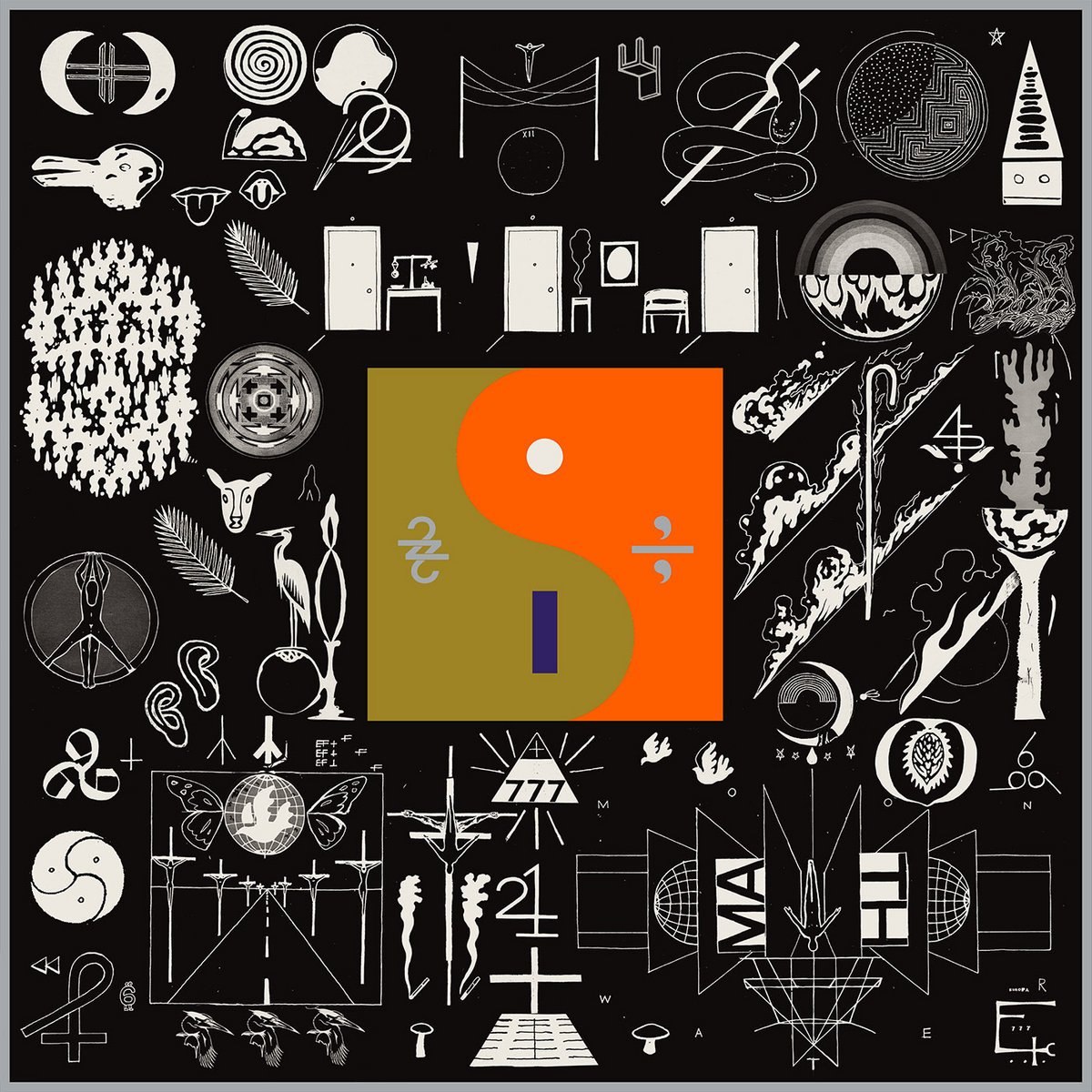
All told, Vernon came home from Greece with just 11 seconds of audio. For months, that’s all he had. But eventually, the floodgates opened, and a vision for a new Bon Iver came into focus. It would be personal and spiritual in nature, rooted in numerology and oblique symbols, manifested on an audio level but also in Eric Timothy Carlson’s graphic design and song titles like “21 M◊◊N WATER.” Rather than his trusty acoustic guitar, the default would be “hooking different tools up in the studio, electronically, trying to mess things up.” This was a subversion of the old Bon Iver: samples galore, manipulated vocals, a collage of the rustic, the elegant, the mechanical, the otherworldly. It was as if they’d cracked open Bon Iver, Bon Iver and built strange new alien structures from the wreckage.
By the mid-2010s, the idea of an indie band “going electronic” was at least as much of a cliché as sensitive beardo folk-rock, but in this case “going electronic” wasn’t synonymous with “going pop.” Vernon was participating in a separate longstanding tradition: the one in which a popular and influential artist recognizes themselves becoming a trope and reacts by distorting and obscuring the very elements that have inspired so much loving imitation. This was Picasso embracing cubism. More directly, it was Kid A, from the success-induced existential breakdown to the embrace of avant-garde electronics to the obfuscation of a peerless, achingly beautiful voice. (To cite our old pal James again: After watching Bon Iver debut the album at Eaux Claires, he immediately drew connections to Oneohtrix Point Never, which feels congruent with Radiohead channeling Aphex Twin circa Y2K.)
If this were a strictly reactionary endeavor, a thwarting of expectations for thwarting’s sake, 22, A Million could have been a bunch of high-concept bullshit. But the makeover was a resounding success, partially because Vernon transformed his process in service of profound personal expression. These were songs where the Christianity inherent to Middle America collided with the Taoism that so fascinated Vernon in college, where the duality of a finite person ran up against the infinity of the great unknown. There are flashes of everyday life in these songs, but the temporal buts up against the eternal at every turn, like when the song called “33 ‘GOD’” name-checks the Ace Hotel en route to asking Jesus, “Why are you so far from saving me?” Even as Vernon grasps for transcendence, he weighs competing priorities: “A word about Gnosis: it ain't gonna buy the groceries.”
A record that overlays so many concerns required a multi-disciplinary approach. And beyond the specific demands of the material, Vernon needed a way to convey his ideas that didn’t feel like going through the motions. So, with a little help from his friends, he created a new musical language for Bon Iver, one that mirrored his lyrical attempts to untangle thickets of memory, philosophy, and sensation. With co-producer Chris Messina, April Base’s studio manager, Vernon developed “The Messina,” a hardware/software vocal processor that morphed his voice to angelic and demonic extremes. BJ Burton, then emerging as one of his era’s most visionary sonic manglers, applied his special sauce throughout. Dozens of friends from the Bon Iver extended family chipped in, allowing for a unique merger of harsh electronics, regal orchestration, dreamy soft-rock, and, yes, some earthy folk-rock textures too.
The results are staggering. Opener “22 (OVER S∞∞N)” unmoors you right away, floating from your speakers like a hologram emerging from a crackling gospel record, its baseline flickering drone pierced by Mahalia Jackson samples that strike like lightning. From that weightlessness we plunge into the intensely pressurized “10 d E A T h b R E a s T ⚄ ⚄,” a parade of rumbling distorted drums and digital bass that suggests Vernon learned something from Yeezus. When the classic Bon Iver ingredients pop up, as on the spectacular fingerpicked ballad “29 #Strafford APTS,” they’re translucent and hyperreal, as if beamed in from heaven on a projection screen.
The album is a triumph of audio world-building, one that somehow stays true to Bon Iver’s indie roots even as it transplants those roots to a new enviroment. It sounds huge, but artisanal-huge, all at once evoking IMAX and a scrapbook. The maximalist moments still feel intimate, as though you’re physically submerged in the ProTools console, Tron-style. Yet for all its splendor, the album’s minimal passages may be its most gorgeous. Consider the closing sequence: “____45_____,” a hymn about being forged in the flames, built on little more than an anti-gravity brass section, followed by “00000 Million,” an echo-chamber piano spiritual that finds Vernon resolving to accept the bad along with the good in this life. True to the album's devotion to duality, it’s a lesson one might learn from Buddha or the book of Job, albeit with different conclusions about how to proceed.
One of Vernon’s goals for this album was to move on from the sorrow that permeated early Bon Iver. “For this one, there's some dark stuff,” he explained, “but I think cracking things, and making things that are bombastic and exciting and also new, and mashing things together and explosiveness, and kind of shouting more — I think that was more of the zone.” They certainly achieved the excitement and explosiveness, but on songs like the “Woods” sequel “715 - CR∑∑KS,” there’s still romantic discord tangled up with his spiritual malaise. It’s telling that nearly a decade later, when Bon Iver returned from another long absence with SABLE, fABLE, Vernon was still talking about trying to break free from his identity as the earnest sad guy with a guitar. But if 22, A Million did not deliver him unto salvation, its depiction of that search remains dazzling and resonant. Ten years later, it still sounds new.