

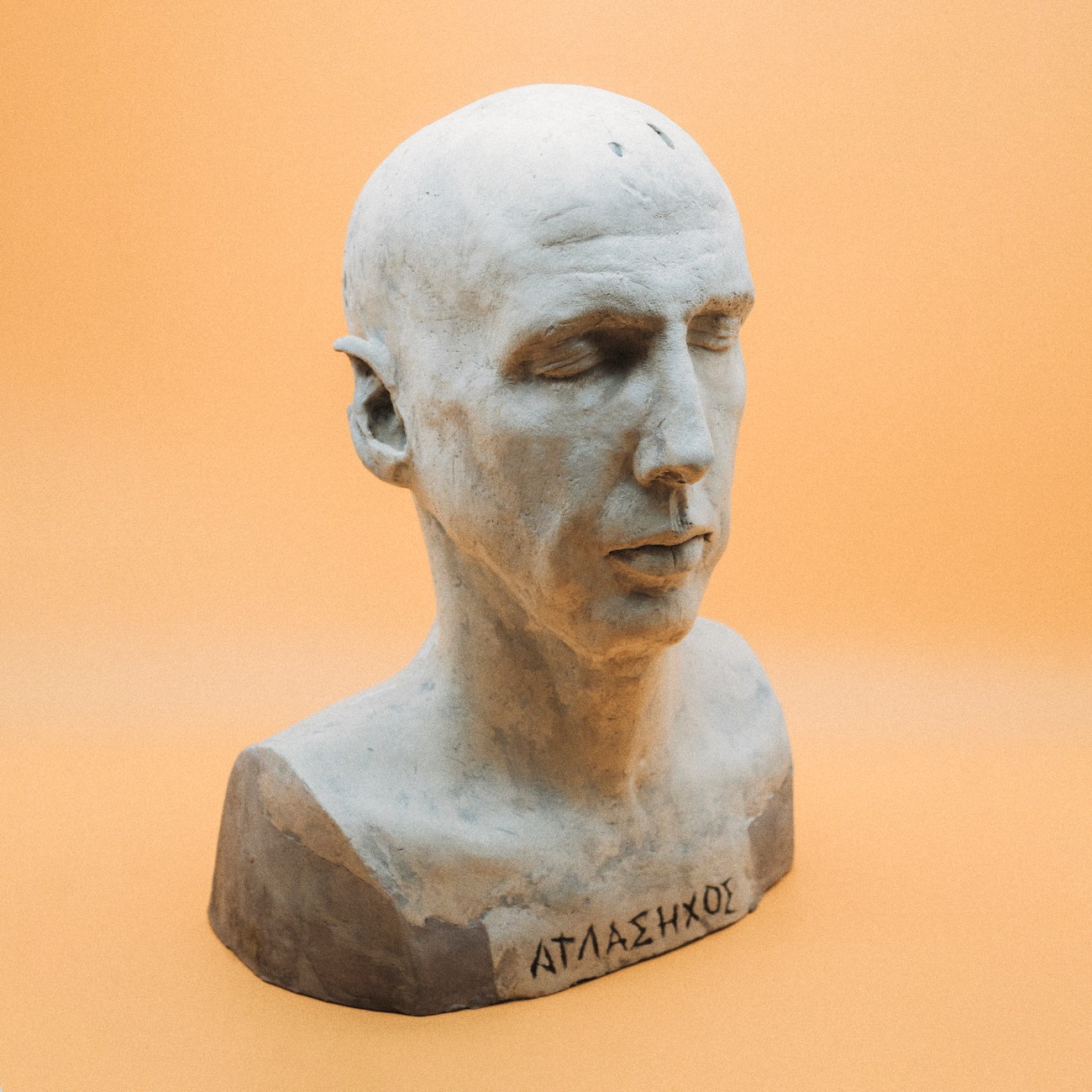
Is Bradford Cox dying? The more I immersed myself in Thanatos, the more the thought crept into my mind. Ever since the pandemic, Cox has been laying low at home in Atlanta. His band Deerhunter hasn’t released music or performed live since 2019. His solo project Atlas Sound had been dormant for even longer before staging a surprise return this fall. Now, he’s emerged from his attic with an album of frail, fragile lo-fi tracks, littered with lyrics about illness and mortality, named for the personification of death.
Cox has often spoken of his abiding love for David Bowie: “There’s nobody that’s had a bigger influence on my entire life — not just on the way I make music, but also the way I think and feel about things.” He wrote a eulogy for Leonard Cohen, noting that Cohen’s death was accompanied by “a very clear sound of the hammer driving another nail into the coffin of authentic culture.” It didn’t seem crazy that he would release his own Blackstar or You Want It Darker. That the “nightflight over Cleveland” could be a trip to the Cleveland Clinic. That there might be some painful biography in all the talk of doctors and medicine and blood in the mouth and ceasing to exist; of radiation rippling through bones and skin; of feeling like he got hit by a truck (Cox would know); of color slowly draining, a parade of skeletons, diminishing flames; of a shallow grave and breath that can’t be saved; of crows and weakened branches; of tombs, broken bones, praying for a cure. The final words on the lyric sheet: “Last night I had a vision/ Of myself in strange clothes/ Walking into a crowded mall/ Right before it explodes.”
I don’t know what’s going on with Cox. Maybe he’s fine, to the extent that anyone so alienated from the trajectory of modern life can be fine. Maybe he’s just mourning the vanishing of his beloved 20th century, the world enlivened by static and debris, smothered by optimization and immaculately curated online personae. Maybe Thanatos, with its bleary textures and bleak observations, is his treatise on the decline of Western civilization. Maybe such sparse, brittle music is a natural response to a culture that grows more grotesque with each passing day. Maybe it’s just that we’re all dying, little by little, all the time.
One miraculous aspect of Thanatos is the way such minimal songs become dark caverns of meaning to be explored. If it’s easy to hear the album as one man’s death rattle, it’s just as natural to hear it as that man’s rejection of life as we know it. There are more overt political references than I expected: “Democracy molds in the basement of America,” Cox sings on “Akron” after noting “the West’s failed promise.” “Day For Night” alludes to recurrent right-wing paranoia over mythic immigrant caravans storming the border, while “Passing Strange” laments the concentration of power in the hands of perennial failures. Millions have identified Donald Trump as a symptom of a sick, decaying society, but few albums so vividly reflect back that depleted state.
Yet there’s no one-dimensional reading of Thanatos that does it justice. A line like “You are a member/ Of everything that you have ever dismembered” could be about a DOGE-era country eating itself from the inside out, but Cox is too agile a writer to let his album descend into an MSNBC segment. Similarly, when he sings about coping with depression and anxiety on “Passing Strange,” it’s more poetic than polemic. His songs work like prisms: crystal clear in some ways and opaque in others, altering your perspective by reflecting back beauty and ugliness at odd angles. Extended exposure to this batch of anti-pop gestures might reconfigure your concept of beauty and ugliness entirely.
Despite the potential for big-picture interpretations, Cox’s work remains as intensely personal as ever. Alongside death, disease, and corruption remain the sexuality and spirituality that have always been intertwined in his work. Adrift within the woozily stuttering psych rock of “Arcadia,” “Beautiful but queer” subtly becomes “Beautiful and queer.” I can’t help but hear that song in conversation with the half-melted finale “Kora”: “Last night I was a Christian/ Praying for a cure/ This morning I woke up/ I said, ‘I can’t take this no more.’” In the stark, acoustic “Roots Without A Tree,” there’s even a will they/won’t they love song of sorts — or is it an account of tenderly nursing someone as they wither away?
From that track’s raw, bluesy posture to the low-key funky “Come And See” to the soulful falsetto he strikes on “The Property Is Condemned,” Cox continues to lean into his Southern heritage. Here, rather than the roadhouse rockabilly of “Pensacola” or the snarling country funk of “Snakeskin,” those impulses are woven into an electro-organic landscape haunted by the ghost of Alan Vega, nauseously droning, chiming, clicking, hiccuping. Cox recorded everything himself using a portable 8-track, and the otherworldly sheen that hung over prior Atlas Sound records gives way to a handmade DIY quality. Even the loudest, lushest, most surreal passages shed Cox’s signature dreamy aura for a more corporeal feel.
Beyond the lyrics, a sense of looming mortality is embedded in this music on a molecular level — “each instrument played like it’s his last night on earth,” as Cate Le Bon explained it in her illuminating liner notes. Thanatos came together in nocturnal creative outbursts, and more than any of Cox’s prior work, it evokes a dark night of the soul. Yet it’s not an album overwhelmed by despair. For all the disconcerting qualities in these songs, I’m heartened by the lyrical throughline about making the most of your time. It gives me hope that Thanatos is not a parting message from Cox but the beginning of a creative rebirth.
Thanatos is out now on 4AD.