
August 25, 1990
- STAYED AT #1:2 Weeks
In The Alternative Number Ones, I'm reviewing every #1 single in the history of the Billboard Modern Rock Tracks/Alternative Songs, starting with the moment that the chart launched in 1988. This column is a companion piece to The Number Ones, and it's for members only. Thank you to everyone who's helping to keep Stereogum afloat.
I remember exactly where I was the first time I heard "Jealous," Gene Loves Jezebel's only big hit on the Billboard Modern Rock Songs chart. I was on my way to see The Wizard, the kids' road movie where Fred Savage has to take his autistic-savant little brother across the country to compete in a Nintendo tournament. The release of this movie was a major event for me. If you went on opening night, you'd get a free issue of Nintendo Power magazine! I didn't even have a Nintendo -- parents' decision, not mine -- but I was still, for some reason, very invested in this movie. Like: I might have to be content with playing Frogger on my parents' Apple II, but I was going to get a good look at Super Mario Bros. 3 and the Power Glove before they were even out. Nobody could tell me shit.
The girl in The Wizard? That's Jenny Lewis, nine years before she started Rilo Kiley. Now that I'm doing the research, it actually seems very unlikely that I heard "Jealous" when I was on the way to see The Wizard. The movie came out Christmas 1989, and the song didn't arrive until months later. Maybe I was going to see some other movie, perhaps at the same theater where I'd already seen The Wizard. Maybe it was the first Ninja Turtles, or perhaps Spaced Invaders. I guess it could've even been Home Alone. But it's The Wizard in my memory, so it will continue to be The Wizard in this column.
On the ride out to the movie theater, I heard something awesome on the car radio. There was this headbangin' guitar riff, and this guy with this weird honking voice screaming about "you are so beautiful and that is a fact, yeah yeah!" This song rocked. It was exactly what I wanted in a big, stomping hard rock song. There were no whiney slow parts, no big melodies, none of that crap. It was just rock, and it sounded so cool. I was on my way to see The Wizard, so I already felt cool. When I heard that song, I felt even cooler.
I was 10 years old when I heard "Jealous," and I mostly listened to Baltimore's AOR station, which was really heavy on hair metal. (It's still really heavy on hair metal. Whenever I'm back in town, I can count on 98 Rock to play Slaughter right next to Five Finger Death Punch or whatever. Baltimore has always been a hair metal town, probably because we had Kix.) At the time, that AOR station and WHFS, the local DC modern rock station, were right next to each other on the dial. I didn't listen to WHFS much. Most of the music on that station sounded weird and fancy. It didn't rock. I was probably looking for 98 Rock when I heard "Jealous," and I was probably a little bit confused when the song ended and it turned out that I was hearing HFS. The DJ said that we'd just heard the new one from Gene Loves Jezebel, and I knew that the band name was stupid, but I couldn't decide whether it was good stupid or bad stupid. I loved the song, though. I knew that much.
So: Why was "Jealous" on the modern rock station? I didn't know. They never played it on 98 Rock, even though it sounded like such a 98 Rock song. I kept going back to HFS, hoping to hear "Jealous" again. I heard it a few times, and I always liked it, though I never liked it enough to buy the album or anything. Years later, I read the name "Gene Loves Jezebel" in an article about goth, and this was even more confusing. I knew that there was a big difference between '90s goth and '80s goth, but I also knew that "Jealous," the one Gene Loves Jezebel song that I'd heard, was not goth. So what was going on? Were there two Gene Loves Jezebels?
At the time, there were not two Gene Loves Jezebels. Instead, the story of that band is a case study in how social positioning and actual musical genre are not the same thing. Instead, they're forces that can work in direct opposition to one another. Gene Loves Jezebel had the cachet of being a goth band, and that's why their hair metal song was on the station that played goth songs, not the one that played hair metal songs. I think that's pretty interesting.
Anyway, now there are two Gene Loves Jezebels. But we'll get to all that.
In 2017, the Mountain Goats released Goths, an album that's about both the bands of the '80s and the subculture that surrounded them. Goths doesn't sound like goth; the Mountain Goats rarely attempt to musically evoke whatever they're singing about. But John Darnielle writes beautifully about a world that he clearly knew well, and he ends Goths with a song that's all about Gene Loves Jezebel. I'm tempted to just skip the usual biographical portion of this column and just let you listen to "Abandoned Flesh" instead. It's not like I could tell that story better than Darnielle.
Don't worry; I'll still tell the story. For some godforsaken reason, I cannot resist the temptation to give myself more homework. Gene Loves Jezebel were the creation of Michael and Jay Aston, two prettyboy twin brothers from the Welsh town of Cornelly. Around 1980, they formed a band that was initially called Slavaryan. A year later, they ditched all their bandmates, moved to London, found more backing musicians, and changed their name to Gene Loves Jezebel. Julianne Regan interviewed the brothers for the music magazine ZigZag, and then she spent a little while as their bassist before leaving to form her own band All About Eve. In 1982, Gene Loves Jezebel signed to a Beggars Banquet sub-label and released their debut single "Shaving My Neck." (That might be the harshest post-punk song that the band ever wrote, and it's the one that got them signed. They thought it was just a crappy demo, and they got away from that sound almost immediately.)
Gene Loves Jezebel's early records fit squarely into the goth aesthetic, which was just establishing itself at the time. But the Aston brothers were glammier and more theatrical than their peers, and their songs weren't as memorable as the ones that are now recognized as classics of the genre. The Aston brothers looked striking, and they wore makeup and big hair and frilly clothes. In a 1987 Spin profile, Legs McNeil, one of the creators of the original late-'70s Punk zine, attempts to position Gene Loves Jezebel as heartthrobs for hipsterish teenage girls in middle America. McNeil doesn't seem to take the band's music very seriously, but he has fun describing their look: "Their charm is in their elegant androgyny -- long flowing locks, lipstick, Way Bandyish makeup, flamboyant, regal fashions that make them more attractive than your average American woman -- and a brooding, aloof sound."
You wouldn't call Mötley Crüe or Poison "elegant," and nobody would refer to those bands sounds as "brooding" or "aloof." Otherwise, though, that's basically how most people were describing the Sunset Strip glam-metal bands who were starting to blow up around that time. Gene Loves Jezebel and the American hair bands probably had a lot of the same influences -- T. Rex, David Bowie, the New York Dolls -- but they were usually doing different things with those influences, at least musically. As time went on, though, the distinctions wore away.
Gene Loves Jezebel never had a steady lineup. Instead, the Aston brothers surrounded themselves with ex-members of punk and new wave bands like Generation X, the Associates, and the Thompson Twins. They cranked out their first three albums in rapid succession, and they did pretty well on the UK indie charts. In 1985, they toured America with John Cale, the Welshman who'd been a member of the Velvet Underground. They tried to record with Cale, too, but that didn't work out. Gene Loves Jezebel's third album, 1986's Discover, got US distribution through Geffen, and their single "Heartache" got some traction on American college radio. It sounds a little bit like the band's '80s goth peers, but the glam metal streak was already totally there.
Discover sold fairly well in the UK, but Gene Loves Jezebel were more interested in chasing American fortune. By 1987, the band built up some momentum over here. That's when they released The House Of Dolls, which is a very hair metal album title. That LP charted higher in the US than any other Gene Loves Jezebel record, though it peaked at #108, so we aren't exactly talking about huge numbers here. "The Motion Of Love," a hair-flipping power ballad with very little goth in its DNA, made it onto the Hot 100, even if it only reached #87. The band also incurred the wrath of the Dead Milkmen. On 1988's "Bad Party," Rodney Linderman sang, "God I really hate this music/ I can't stand Gene Loves Jezebel/ If there is a God in heaven, I'm sure that band will burn in hell."
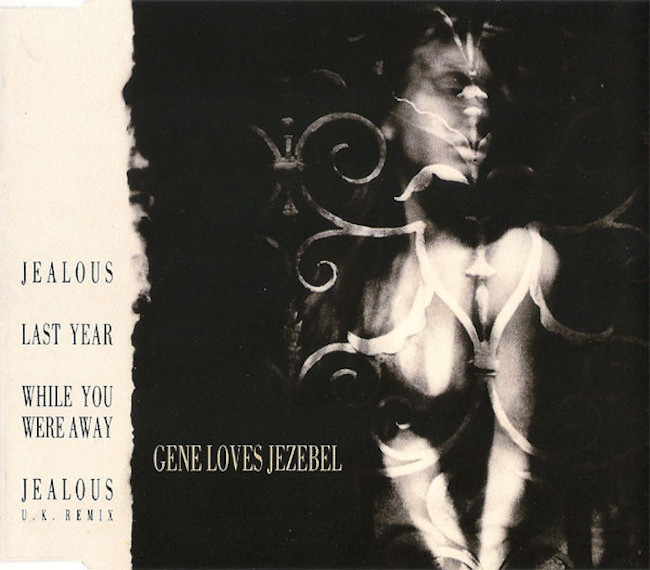
If you know anything about the history of British brothers who start bands together, you will not be shocked to learn that Jay and Michael Aston did not get along. Before Gene Loves Jezebel recorded their 1990 album Kiss Of Life, Michael left the group. He moved to Los Angeles and started a new band, the Immigrants, who never did anything noteworthy. Jay kept going with Gene Loves Jezebel, and he was the driving force behind "Jealous," the song that would become the band's biggest American hit. In a 120 Minutes interview around the time the record came out, Jay said that he couldn't remember the name of Michael's new band. He also said that "Jealous" came out of seeing a young couple out in London. He was going through a breakup at the time, so he felt jealous of them.
On "Jealous," Jay Aston does not sound especially jealous. Instead, he's trying to do the primping, purring flirtation that ruled American rock radio in that moment. Jay does sing about spotting two lovers on the Old Brompton Road and feeling so jealous because he needs someone to hold. But he mostly addresses someone who presumably looks a lot like one of the big-haired rocker girls in the "Jealous" video. He keeps singing that something's wrong with this lady, seemingly taunting her for being jealous. Maybe she's also jealous of the lovers on the Old Brompton Road? He also honks that he likes her a lot and he'll make her happy. Near the end of the song, during the shred-happy guitar solo, Jay also asks, "How do you like the cat?" There are only so many things that phrase could possibly mean on a rock song, and none of them are very goth.
"Jealous" is not alternative rock. "Alternative rock" is a fairly meaningless phrase, but you'd have to work really hard to explain how it applies to "Jealous" in any way. Instead, "Jealous" is full-on Sunset Strip sleaze-rock, and that is exactly what I like about it. As someone who was 10 years old in 1990, I have an abiding affection for the cheesed-out glam metal bands who arrived just a little bit too late -- the Bulletboys and Tora Toras and Trixters of the world. Gene Loves Jezebel entered themselves into that category entirely by choice. "Jealous" isn't even a great song by glam metal standards, but I love its shamelessness.
"Jealous" has energy. The central riff absolutely fucking rules. It's cheap and nasty and fun. I like the little melodic guitar-spangles on the pre-chorus, and I like the weird voice that Jay Aston uses. His accent is thick, but it also sounds like he's trying to do a completely different accent -- like Shrek doing his best impression of the Bachman-Turner Overdrive guy. This almost makes up for "Jealous" not having a chorus other than just the title being repeated a few times. I recognize that most readers of this column are going to hear "Jealous" as a tacky cheese-fest, but that's exactly what I like about it.
So why did any self-respecting modern rock station put "Jealous" into rotation? I have a theory about that. The modern rock stations couldn't play Guns N' Roses. Those stations had positioned themselves in such a way that their listenership would've regarded that as a kind of betrayal. But GN'R had so much more juice than any of the moody British makeup bands that those stations must've seized an any opportunity to play something that reminded people of Guns N' Roses and pulled in the male adolescent rocker demographic -- the people like 10-year-old me. (See the Number Twos section below for further evidence.)
The temptation must've been especially strong for LA giant KROQ, which set the tone for most of the other modern rock stations in the country. That probably worked out well for Jane's Addiction and the Red Hot Chili Peppers, two bands that'll appear in this column soon. It probably also had something to do with the way grunge took over a couple of years later. Even college-radio audiences wanted to hear something that rocked.
Beyond opening track "Jealous," Gene Loves Jezebel's Kiss Of Life album didn't do much to satisfy that urge. Most of that record sounds like thin, replacement-level circa-1990 rock. It could've come from Nelson, a considerably more stable twin-brother act. If I'd bought the Kiss Of Life cassette on the strength of "Jealous," I would've done the thing where you keep listening to an album, trying to wring any value out of it, simply because you'd already sunk money into it. (This was a very familiar process for kids who bought music in the '90s.)
"Jealous" crossed over to the Hot 100 and reached #68, but nothing else from Kiss Of Life charted. Gene Loves Jezebel didn't even tour the US behind the LP. In a story published on the band's website, bassist Pete Rizzo says that they had plans to tour with Concrete Blonde, the group that appeared in this column last week: "At the last minute, they pulled out with no explanation. We found out a couple of years later that one of us had apparently slagged the singer off in an interview, which pissed her off so much that she cancelled the tour. Jay denies it, so it was probably Mike."
Instead of touring the US, Gene Loves Jezebel went out in Europe as an opening act for Billy Idol, who had been in Generation X with Gene Loves Jezebel guitarist James Stevenson. (Stevenson later became a touring member of the Cult, another band who did well on modern rock radio despite basically being hair metal. Billy Idol's highest-charting Modern Rock single, 1990's "Cradle Of Love," peaked at #7. It's a 7.) Stevenson: "I remember saying to Jay, '"Jealous" is a hit in the USA. Why are we playing in Leipzig tonight?'" Gene Loves Jezebel did not score another hit in the USA. "Josephina," the lead single from their 1993 follow-up album Heavenly Bodies, only made it to #18 on the Modern Rock chart, and I don't think I've ever heard it before today. After that, Gene Loves Jezebel never charted anywhere again.
In the mid-'90s, Michael and Jay Aston got back together, and they assembled another Gene Loves Jezebel lineup around themselves. It didn't last. By 1999, the brothers hated each other again, and they haven't been in a band together since. Eventually, both brothers put together their own versions of Gene Loves Jezebel, and they sued each other over the rights to the name. They finally came to a compromise. Michael Aston's version of the band is known as Gene Loves Jezebel in the US, and they're Michael Aston's Gene Loves Jezebel in the UK. The other version of the band gets to call itself Gene Loves Jezebel in the UK, but in the US they're Jay Aston's Gene Loves Jezebel. Here's how John Darnielle describes the situation on "Abandoned Flesh": "The two main guys are related/ They're at war with each other/ Now there's two Genes loving Jezebel/ One for each brother."
This arrangement seems absolutely fucking ridiculous, to the point of comedy. For instance: Michael Aston wasn't involved in Gene Loves Jezebel's biggest US hit, so why does he get to be the Gene Loves Jezebel guy over here now? What sense does that make? Mostly, though, I'm impressed that there's enough demand to make two different Gene Loves Jezebels into viable enterprises. Jay's version of GLJ has continued to make records, and they got to have one more moment in the sun. I'll let John Darnielle describe it: "To be fair to Gene Loves Jezebel, Billy Corgan brought them on stage/ It was in 2011/ It's on their Wikipedia page." That is on the Gene Loves Jezebel Wikipedia page. So is the Mountain Goats song "Abandoned Flesh."
The point of "Abandoned Flesh" is that all things are temporary. Some people got rich off of goth. Most did not. Time leaves casualties, and both versions of Gene Loves Jezebel are among those casualties. John Darnielle sings, "The world forgot about Gene Loves Jezebel," and he's mostly right. But I heard "Jealous" on the radio while going to the movies one night in 1990, and that will be with me forever.
GRADE: 7/10
BONUS BEATS: I'm looking at some limited options for this one, but here's François Kevorkian's thoroughly superflouous dance-adjacent seven-minute "Jealous" remix:
THE NUMBER TWOS: Iggy Pop's highest-charting Modern Rock hit, the Slash-assisted shimmy-growl "Home," peaked at #2 behind "Jealous." David Fincher directed the video, which is fun to think about. It's an 8.
(Do yourself a favor and watch the Letterman/Iggy interview after that performance. What a time to be alive.)