
- Sub Pop/Bella Union
- 2015
By the time his mid-thirties loomed, Josh Tillman had been multiple people already. An evangelical upbringing precipitated a crash landing in Seattle, working dead-end jobs while releasing melancholic folk music under the moniker J. Tillman. He toiled in obscurity and through a listless depression until he got the call to play drums in the shockingly successful folk-indie troupe Fleet Foxes. He'd made it, but that didn't quite work for him either. So he quit, drove a van south, took a lot of drugs in Big Sur, and reincarnated himself as an amalgamation of West Coast iconography and pop history called Father John Misty. Upon the release of his 2012 debut Fear Fun, he'd already transformed; he'd already given critics and listeners alike a gleefully unlikely origin myth to chew on. Then, as if all that wasn't enough, Josh Tillman fooled around and fell in love.
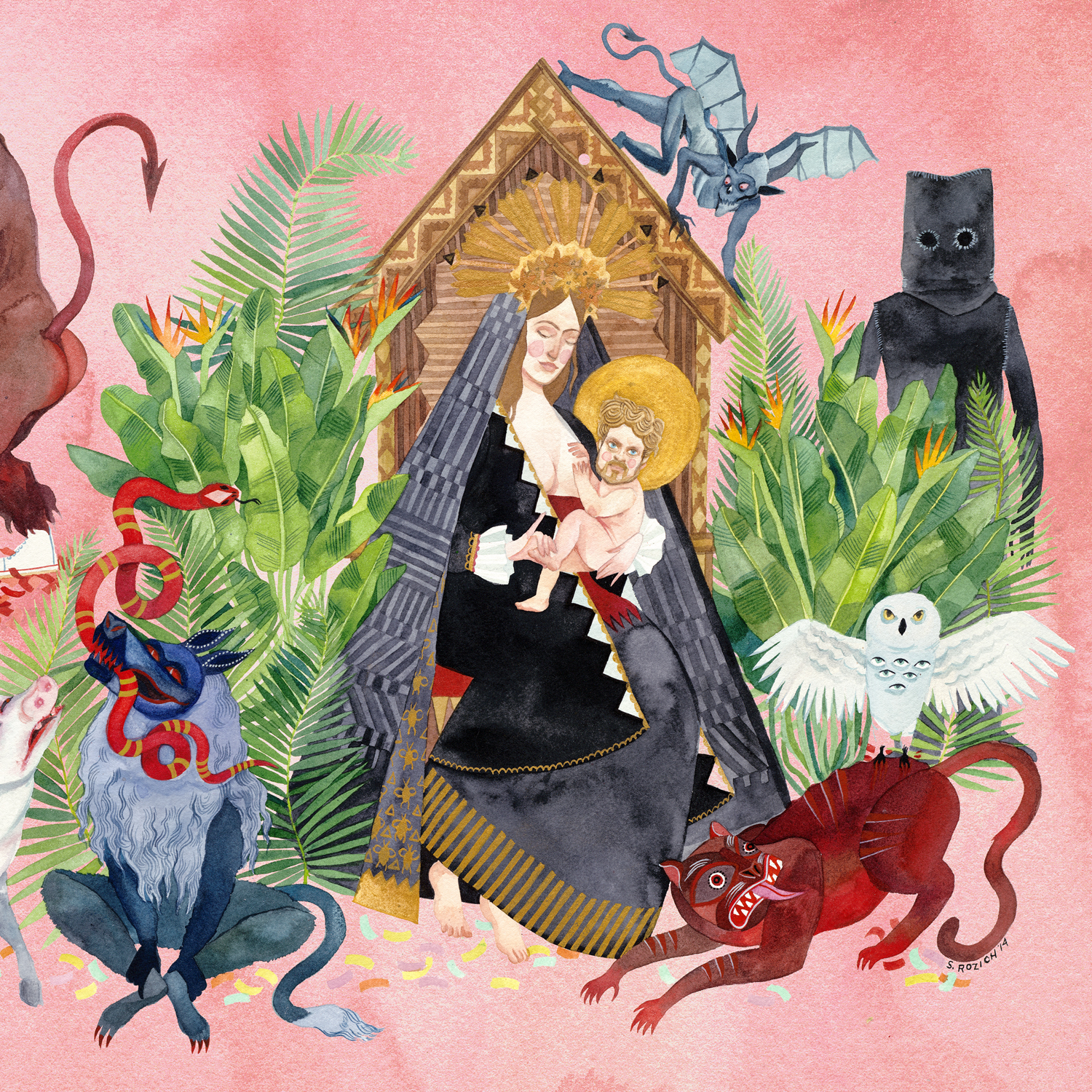
When I Love You, Honeybear arrived 10 years ago this Sunday, it was the last time anyone needed to be (re-)introduced to Tillman. It was the last time his unlikely career arc — generic folkie turned indie-rock drummer turned hedonistic shaman with an intellect and wit sharp enough to dissect not only his own ego but a host of our 21st century neuroses — was a necessarily prologue to his implausible rise. Soon, Tillman's outsized character, media shenanigans, and acclaimed albums would anoint him an Important Artist. He had already pulled off one of the great rebirths in 21st century rock/indie/whatetever-you-want-to-call-it. With Honeybear, he kicked off one of its great ascensions.
Tillman had tapped into a rich vein when he became Father John Misty. Both playing into and dismantling a vast array of California psych-rock tropes, Fear Fun was a brainy-yet-freewheeling reinvention. He could've milked it for a while, given us a few more albums of sordid, sardonic tales from the chronicles of a man living out the louche, decadent rockstar travails of yore. And originally, that was the intent. Some songs on Honeybear dated back to before the release of Fear Fun and indeed documented bad behavior, self-loathing, self-medication, misadventures with questionable strangers.
Along the way, Tillman loitered at the Laurel Canyon Country Store, a mainstay of old LA counterculture scenes that remained several iterations of the city later. One day, he introduced himself to a photographer named Emma Garr after running into her outside the store. He'd seen her around. What followed changed everything. Tillman fell into a hopeless, crazed love, the kind where the two of them partied their way around LA and found themselves inseparable, until it deepened into a love no less hopeless or crazed, but more mature and seismic.
New songs arrived. Some cataloguing dizzy, beautiful moments early in Tillman's new relationship, some the foibles and growing pains of a touring musician trying to maintain a new relationship, and some grappling with what it means when that new relationship could become a forever relationship. Tillman, deeply allergic to "sentiment" and "cliche" in his acerbic, winking new Father John Misty guise, was wracked with how to honestly write about love without it sounding passé and cheap. (He remained anxious about this endeavor by the time Honeybear was coming out, with a self-written 2015 album bio full of self-reflexivity wrangling with what Father John Misty had wrought this time.)
The album Tillman thought he would make mutated — not just spiritually and thematically, but sonically too. Emma told him: "Don't be afraid to let it be beautiful." Swooning, wistful strings danced around the title track as it opened the album, a mariachi band serenade accompanied "Chateau Lobby #4" and its account of city escapades and early lust morphing into dizzy love. Then on a song like "Holy Shit," there was Tillman's voice, clear and powerful, carrying unabashedly gorgeous melodies.
We rely on reader subscriptions to deliver articles like the one you're reading. Become a member and help support independent media!
Throughout, Honeybear presented a guy at war with his own cynicism. He didn't allow anything about the album to be treacly. "The Night Josh Tillman Came To Our Apartment" recounts a night of partying and hooking up in which Tillman harbors as much disdain for himself as his paramours. Later, "The Ideal Husband" upped the BPMs for a frenzied freakout that, like, no, really, he's not cut out for this marriage thing. Sometimes, Tillman's humor would both undercut the proceedings and in its weird way amplify their poignance, like the much-noted "Insert here, a sentiment re: our golden years" line in the otherwise vulnerable tribute of "I Went To The Store One Day." Honeybear wasn't just a batch of love songs but had room for self-indictments and the messiness of falling in love all the things you broke on your way here. Pairing "Holy Shit" and "I Went To The Store One Day" at the album's conclusion always felt like a hard-won redemption.
Honeybear’s release was accompanied by a collection of in-depth interviews fascinated with their subject and greeted by a round of acclaim that eventually landed it on lists of the best albums of the year (and, eventually, the decade). Josh Tillman had finally, really, arrived. Some fans likely still hold it up as his best, as people often do with the album that first made them fall in love with the artist in question. You can go back and pick apart the songs that didn't stand up over the years — the intentionally artificial "True Affection" was emotionally relevant in the album's context but pales compared to the apocalyptic grandeur of later experiments like "The Next 21st Century," while Tillman would soon leapfrog himself several times over after trying too hard for a state-of-the-world opus in "Bored In The USA."
While Honeybear’s sophistication already refined the scrappiness of Fear Fun, there's a way in which it now, too, feels inherently part of a less-formed Father John Misty chapter than what came later. Soon afterwards, he'd return with the blown-out, sprawling Pure Comedy. The first part of his arc concluded, all the chaos and love and self-destruction resulting in the crises and reckonings of God's Favorite Customer. Since then, he's made albums that twist and turn, invert his sense of self as his favored subject. And his writing, rightfully lauded upon the advent of Father John Misty, has leveled up a few times over; Tillman is one of the strongest lyricists working today. Though Honeybear remains a complex and nuanced work on its own, its position in the catalogue can now make it feel like Father John Misty was, in actuality, still coming into focus — especially when placed against the impeccable writing on God's Favorite Customer and last year's Mahashmashana.
In a sense, this only reiterates what Tillman was trying to say, or make sense of, across Honeybear 10 years ago. Yeah, he fell in love and his career took off, but do we ever really "arrive" and stay there? There are always more mistakes to be made, there is always more life to live. He was 33 and married and maybe, finally, an adult. But then came public acid benders and private personal struggles, and eventually Father John Misty became more soulful, more measured, still wry but a little wiser. The love he depicted became more weathered, more enduring; the world outside heavier and heavier. The Josh Tillman of 2015 was so worried about writing a stereotypical love album, an easy happy ending. And it wasn't. It was just the beginning of another story, of him again becoming another person that, one day, he'd have to leave behind like he had so many times before.