
- Matador
- 2025
Car Seat Headrest albums are never fully autobiographical. Even when Will Toledo writes from experience, his choice of literary references, religious allegories, and speculative histories and futures always find their way into his songwriting. The Scholars — the band's first album in five years, out this Friday — is Toledo's hardest pivot into fiction. But the boundaries between his real and imagined worlds are porous, and it's near-inevitable that fragments of Toledo's own life might sneak into the stories he tells about made-up characters. Most noticeable are the album's various lyrical references to illness: "Is it the sickness or you that's talking?" he asks on "The Catastrophe (Good Luck With That, Man)." On "Gethsemane," a track about a medical student named Rosa who is cursed/blessed with the superpower to absorb the pain of her patients, Toledo sings, "Your body is a temple but your holy wounds are aching," and alludes to bedridden paralysis.
Perhaps this reading of Toledo's fiction is unfairly personal, but it's hard not to connect these lyrics to his own experiences with illness and disability that have fundamentally altered his career and his life over the past few years. His struggle with Long Covid and histamine imbalance left him unable to tour and at times unable to even leave his bed. Tasked with adapting to a slower way of life — one that isn't particularly amenable to the demands of a full-time music career — he began to study Chan meditation and various Buddhist traditions. When Car Seat Headrest announced The Scholars, perhaps their most heady and conceptual record yet, it seemed like the kind of project that could only be born out of long periods of contemplation.
Will Toledo got his start recording music under the Car Seat Headrest moniker, self-releasing at least an album a year on Bandcamp for the first half of the 2010s. Sprawling, narrative-driven records like Twin Fantasy condensed lofty, multi-song arcs and crudely operatic arrangements into laptop-mic proportions. Initially released in 2011, Twin Fantasy garnered Car Seat Headrest a cult following and stands as arguably the definitive album of Bandcamp's golden age. For Toledo, Twin Fantasy as it existed in its original form was proof of concept; he'd go on to release a full re-recording and re-imagining of Twin Fantasy in 2018, now complete with a full band and label support from Matador Records.
The years between the two versions of Twin Fantasy had catapulted Car Seat Headrest into indie rock household name status. It was nearly impossible to tune into any college radio station without hearing a song off 2016's Teens Of Denial, their highest-fidelity release, in which Toledo spun epics from teenage tragedies, suburban legends, and bad acid trips. By the time the Twin Fantasy was re-released, Car Seat Headrest were regulars on the music festival circuit and playing high-profile live sessions from KEXP to NPR's Tiny Desk to The Tonight Show With Jimmy Fallon.
Their first record post-Twin Fantasy (and their first of entirely new material since Teens Of Denial), the hard-pivot of Making A Door Less Open began its doomed rollout in early 2020. To be fair, much of MADLO’s misfortune was no fault of its own — the pandemic time warp swallowed up many albums that, in hindsight, deserved better. It was especially unlucky that this one's promotional cycle happened to heavily feature Will Toledo with his face obscured by a gas mask.
MADLO was a strange experiment. Toledo had built his career on immaculately sequenced, thematically cohesive records whose individual tracks were building blocks for an overarching narrative; MADLO was, by his own admission, his attempt at making a playlist of shuffle-friendly songs, purposely released with three different track listings for streaming, CD, and vinyl. Though far from his best work, MADLO’s gems were some of the most brilliant in Car Seat Headrest's catalog — the quietly crushing dirge "There Must Be More Than Blood"; the cinematic pop-rock sleeper hit "Life Worth Missing." These sat alongside puzzling left-fielders like the glitchy, strobing "Hymn" and the butt-rock monstrosity "Hollywood," but it's not like Will Toledo didn't warn us — he said it himself in the band's 2019 TIDAL documentary, I Haven't Done Sh*t This Year: "I'm gonna be making a lot of bullshit."
In hindsight, MADLO demonstrates that building a body of work is a matter of trial-and-error, and that you can't return to form if you don't deviate from it. And that's how The Scholars has been positioned: as a return to what drummer Andrew Katz calls "loud, fast, dirty rock music." From the first single, "Gethsemane" — revealed in pieces through a convoluted WebQuest to match the record's educational themes — it seemed that Car Seat Headrest were going back to basics. Aside from a whirring electronic effect in its first movement, the 11-minute lead single teasing an hour-plus concept album was as clear an indicator as any that MADLO was a mere detour.
The Scholars is a rock opera that takes place at the fictional Parnassus University, founded by a playwright called the Scop; the eight songs are sung by various characters who make up the university's faculty and student body. The events of the rock opera are inspired by an also-fictional poem by "Archbishop Guillermo Guadalupe Del Toledo." A lyric booklet illustrated by Will Toledo's longtime friend and collaborator, furry comic artist Cate Wurtz, accompanies the record and details which character sings when. Toledo is no stranger to the bildungsroman as a narrative organizing principle. You could argue that The Scholars is an example of the erziehungsroman — which translates from German to "education novel" — a coming-of-age story pertaining to an educational setting and formal schooling.
If this makes The Scholars sound like the least accessible Car Seat Headrest record since the unnamed "numbered" albums, you'd be somewhat correct — though an in-depth knowledge of the record's lore isn't necessarily essential to one's enjoyment of the music itself. Then again, Car Seat Headrest have built up a self-selecting audience of people who are into that kind of thing — Easter egg-hunting and connecting dots Pepe Silvia-style across the band's discography. The group's back catalog has no shortage of lengthy songs and meta-references (all the way back in 2013 on a Nervous Young Man track titled "Afterglow," Will Toledo sang, "I'm not responsible for what happens after this song/ Why do you think mine are always so long?"). The Scholars will probably only deter casual listeners who were never all that invested to begin with, or ones who tapped out after MADLO. The diehard fans are the kind of nerds who'll gladly do the homework Professor Toledo assigns to them.
It's worth mentioning that Car Seat Headrest's fanbase has skewed considerably younger and newer to their music in the past five years or so. The band had a largely TikTok-based level-up in the early 2020s — much smaller in scope but similar in phenomena to that of Mitski. Both of their audiences grew exponentially during times in which said artists were promoting records that they were unable to tour and uninterested in doing a lot of front-facing press for, but these records (MADLO for Car Seat Headrest, Laurel Hell for Mitski) weren't the ones that new fans were latching onto in droves. Instead, pulls from these artists' back catalogs found unexpected virality. When I search for Car Seat Headrest on TikTok, I find an onslaught of videos set to songs like "It's Only Sex" and "Sober To Death," or videos of users juxtaposing their baby photos with their current faces, soundtracked by the explosive bridge of "Destroyed By Hippie Powers": "What happened to that chubby little kid who smiled so much and loved the Beach Boys?/ What happened is I killed that fucker and I took his name and I bought new glasses!"
Though his songwriting has long been as allegorical as it is autobiographical, in some ways following Will Toledo's career arc has also meant watching him grow up. Car Seat Headrest's most prolific era was pre-Matador, when Toledo was in his late teens and early twenties, a time densely concentrated with milestones — going away to college, choosing a career path, first loves, first heartbreaks, moving far away from home — and these formative experiences were central to his musical output. A side effect of this was that Toledo became the reluctant leader of a cult of personality. The Scholars is perhaps his least personal work to date, calling to mind an approach taken by one Joshua Tillman back in 2022. Tillman's fifth record as Father John Misty, Chloë And The Next 20th Century, shifted the focus away from his idiosyncratic stage persona and instead shined the spotlight on a series of character-driven vignettes. In a similar turn, the latest effort from Car Seat Headrest has effectively removed the "character" of Will Toledo from the equation.
The Scholars is Car Seat Headrest at their densest and most esoteric. The catchy melodies and heartbreaking one-liners are still present and as hard-hitting as ever, but they're buried behind heavy prog-rock sprawl, wordy philosophizing, and the occasional bongo breakdown. The layered hooks on opener "CCF (I'm Gonna Stay With You)" are the bread-and-butter of Toledo's songwriting, as are the casual profundity of lines like "Most of what memory tells us is/ 'Watch out, that shit will hurt us'/ Like I never forget/ Every lover ranked from worst to best." But they sit on the other side of a jammy, Remain In Light-reminiscent Latin-chanted intro — a litmus test to see if the listener will ride this groove into the record's easier, poppier passages. The second movement of "Gethsemane" is a marathon of killer hooks, and its refrain of "I can do whatever the fuck I want when I want to!/ You're only wearing my skin!" is nothing short of electrifying, a fragment of pop perfection woven seamlessly into an all-over-the-place 11-minute suite.
We rely on reader subscriptions to deliver articles like the one you're reading. Become a member and help support independent media!
"Gethsemane" recalls longtime live favorite "Beach Life-In-Death," which gets its own meta-reference on Scholars track "Reality" (Toledo sings about "Muttering BLID to get me through the next 12 minutes"). Who's to say if fans will be put off by The Scholars’ expansive cast of characters, intersecting storylines, biblical parables, allusions to traditional folk ballads, the most notable "Rama Lama Ding Dong" reference since Le Tigre's "Deceptacon," or extended passages written and sung by guitarist Ethan Ives (who's kind of doing Scott Walker by way of Lou Reed by way of Dan Bejar). The Scholars has a little something for everyone, but it's unlikely that everyone will stick it out long enough to find the specific something that appeals to them.
It's not an exact one-to-one, but this anti-accessible turn reminds me a bit of Ethel Cain's recent output. Earlier this year, she dropped Perverts, a 90-minute collection of ambient drone songs that she refers to as an EP — which is how Will Toledo categorized How To Leave Town, his 2014 release of almost the same length. Many interpreted Perverts as strategic pushback on Ethel Cain's part against her own marketability, or even a preemptive fuck-you to the fans angered by the lack of moodboardable pop songs like "Crush" and "American Teenager" that catapulted Cain into stardom. But Perverts doesn't sound like an artist trying to antagonize her fans, and neither does The Scholars — both sound like an artist sacrificing potential commercial appeal and instead letting their obsessions lead the way.
A rock opera feels like a natural progression 15 years into a career largely driven by Toledo's meticulous dissection of rock history. The Scholars shares obvious DNA with genre landmarks like The Wall, Tommy, Bat Out Out Of Hell, and Ziggy Stardust (the latter of which gets a shoutout from Ives in "Planet Desperation"). As for its 21st-century precedents, it calls to mind Drive-By Truckers's Southern Rock Opera, the Decemberists' The Hazards Of Love, of Montreal's Hissing Fauna, Are You The Destroyer?, Green Day's American Idiot, or even Tony-nominated composer Dave Malloy's high-concept song cycles like Preludes and Ghost Quartet. These comparisons are much more apt when applied structurally rather than sonically. With a record like The Scholars (and to an extent, Car Seat Headrest's catalog as a whole) that kind of compartmentalization feels essential. The most "classic Car Seat" songs on The Scholars — "Devereaux," "Gethsemane," and "The Catastrophe (Good Luck With That, Man)" — marry a '70s approach with a '90s sound.
"The Catastrophe" in particular feels like a knot of musical inclinations ever-present throughout Car Seat Headrest's discography — Beach Boys-worshipping pop composition; fuzzy, guitar-forward production; yelpy, overdubbed vocals. Its touchpoints are meta-narrative; it's music about musicians making music: "Stuck in the smallest green room/ No way out except through the main room/ An hour to kill with the shirts on our back, four dead phones, and a cigarette packet." Though "The Catastrophe" is about a fictional troupe of clown troubadours, it feels like the closest thing to autobiographical songwriting on The Scholars. Songs about being in an aspiring rockstar are well-trodden territory for Toledo, and "The Catastrophe" sounds like the most fun he's had with this staple of his discography since the 2018 re-recording of "Bodys." The best lines are the ones whose classic rock grandiosity burns bright enough to transcend the song's boundaries of fantasy and fidelity: "Signs point in every direction/ Advertising a one-night heaven/ Got no clue what's driving us/ Blind as hell and burning up with your love."
Clocking in just shy of 19 minutes, penultimate track "Planet Desperation" surpasses behemoths like "The Gun Song" and "Famous Prophets (Stars)" for the coveted title of longest Car Seat Headrest track. A slow piano build led by Ives' crooning gives way to a plinky space-age keyboard melody and Toledo howling the kind of lyrics he's been working toward for his entire career: "When I get to the pearly gates/ Will I see you on the inside pointing at me/ Mouthing 'There he is officer! There's the prick I warned you about!'/ The best part of me is dying/ I'm running out of places to bury your body again/ And every song is a crime scene." Later in the same movement, he kicks off the song's glam-rock pivot, singing, "Hesitation on a wedding night, drag you down the aisle/ Nails down the sides to the bridal chamber."
His commands to "shut down this carnival ride" are rejected by the supersonic tear of Ives' guitar solo and Katz's relentless drumrolls. Katz — Car Seat Headrest's resident jokester, known among the fandom for spearheading the band's comedy EDM side project 1 Trait Danger and accompanying video game universe — takes the lead vocals at the beginning of the fourth movement, singing over bongos and tambourines in garbled, pitched-down vocals that sound like something off Ween's The Pod. It's after this freaky little interlude, a tunnel of Rush-esque guitars, and a rollercoaster howl from Toledo, that we get one of the best and most Car Seat Headrest-y choruses of the band's career: "Till the kids grow up alright/ Till our hearts don't break anymore/ Until we don't spend the rest of our lives fixing everything that happened before." He then brings back the "You can love again/ If you try again" refrain from "Gethsemane," which was originally part of an unreleased track titled "Stop Lying To Me." Leave it to Will Fucking Toledo to write a great pop song and bury it 16 minutes deep in a 19-minute prog epic.
Speaking of great pop songs, the Scarborough-Faire-referencing closing track "True/False Lover" is the shortest on the album and one of the most joyous in Car Seat Headrest's catalog ("Home forever, out the backdoor, one more time/ Fields are planted, waiting for the summertime"). On the lyric sheet, stage directions indicate the full cast entering one by one during the pre-chorus guitar solo. You can imagine it down to the beat — characters running onstage, taking turns singing their last lines before they swell into a full-ensemble chorus, singing and clapping along as each of them takes a bow. It's a surprisingly neat and poppy end to an album that's neither of those things.
I find myself back at the question of (in)accessibility. I'm unsure if it's even a relevant one here, especially since "accessible" has all but become synonymous in music journalism with "commercial." If you're looking to get into Car Seat Headrest, you probably shouldn't start with The Scholars. That's not a knock against the record; not every album needs to be an entry point into an artist's discography. Some albums are best appreciated as something to work up to after becoming familiar with the artist's other works. As for longtime Car Seat Headrest fans well-acquainted with the band's oeuvre, the esotericism and conceptuality of The Scholars could be a draw just as much as a deterrence, especially since it's been so long since we've heard this band playing to their strengths than against them. "Return to form" is a bit of a misnomer. The Scholars is a band laying out the impulses and fascinations that they've been leaning into for their entire career, and letting themselves fall in headfirst.
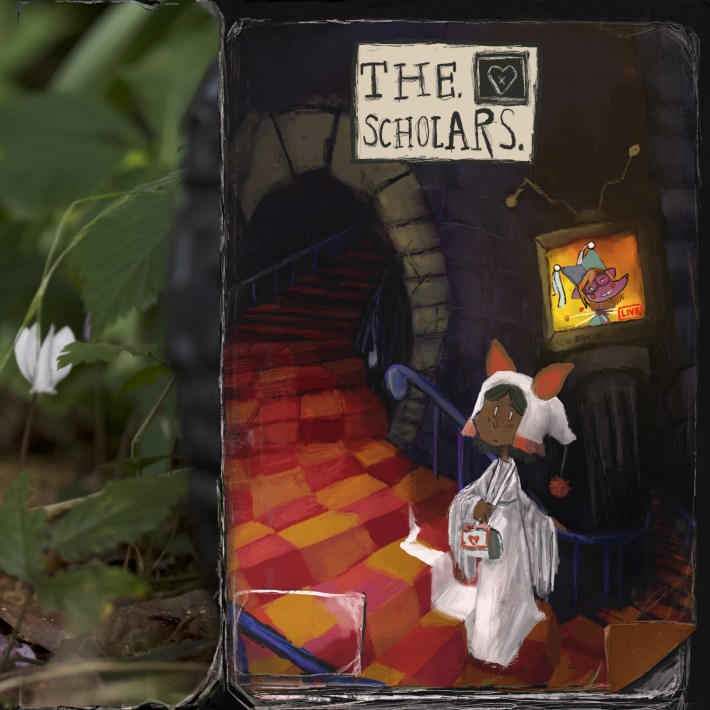
The Scholars is out 5/2 on Matador.