
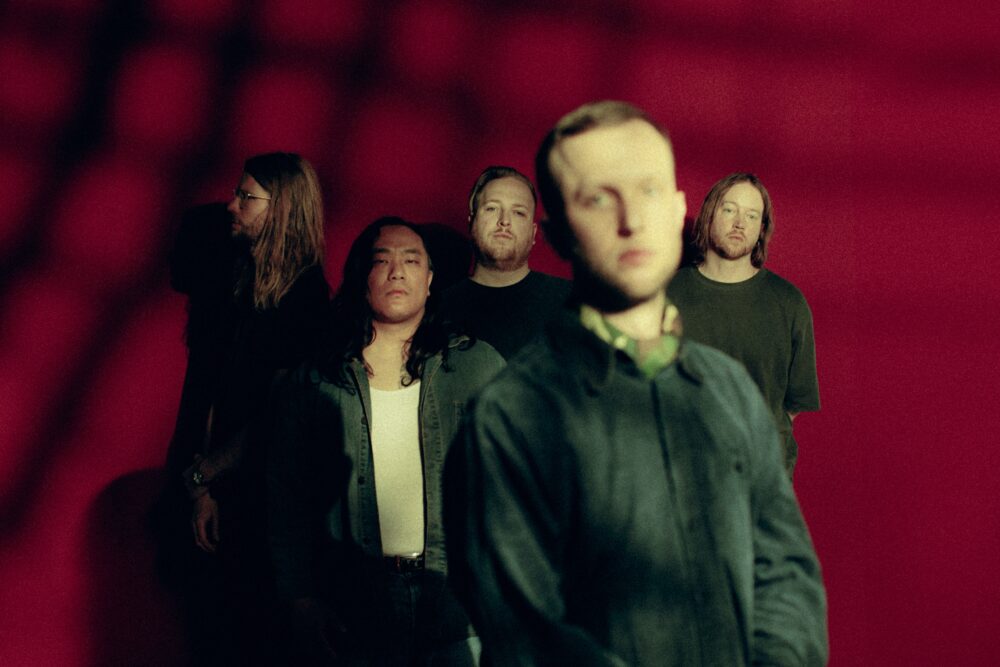
La Dispute's wracked, sincere, poetic take on post-hardcore has made a difference in a lot of people's lives, and their latest song is a truly powerful piece of work. The Michigan band hasn't released an album in six years, but they're coming back in September with the new LP No One Was Driving The Car. We posted the first three songs, and all of them are great. They have nothing on the scope of "Environmental Catastrophe Film," La Dispute's latest.
Per frontman Jordan Dreyer, "Environmental Catastrophe Film" is the album's "second act." It's a sprawling meditation that takes up nearly nine minutes. As the tingly guitar squalls build up to grand crescendos, Dreyer narrates a morbid unstuck-in-time dark-thoughts reverie. He considers the history that led to a part of Michigan to devolve into a polluted wasteland, imagines how a river might kill him if he fell in, and considers the life of a chair. It's a stirring, thought-provoking piece of music with a couple of real goosebump moments. Dreyer has a lot to say about it, so I will cede the floor to him:
the second act -- more or less the thematic center of the record -- is a single song split into three parts. it begins with a boy beside a creek-bed in a wooded area near home, holding a snapping turtle above the flowing water, before tracing its winding path to the river around which the city was first built, and through a brief history of the city itself -- its settlement, the creation of the christian reformed church, and the furniture industry that dominated its early economic growth.
from there we return to the boy beside the creek. he sees his own lack of control in the flailing creature he holds, then again at church, listening to a sermon delivered on the calvinist doctrines of predestination, man’s innate and total depravity, and the irresistible grace of his family’s god. at the end of it, he returns for the first time in adulthood to that same church, at the funeral of an old friend dead by suicide, from which the conversation shifts back to the creek as metaphor for life and time, and to what we ultimately maintain the least control over in life: that we can change neither the fact it moves nor the direction it ceaselessly does.
in the final section, the city’s history of the furniture manufacturing returns as additional metaphor, presenting us as un-hewn wood, locked within the lathe of time and against its blade turned, to carve away with each rotation fragments of self en route to new forms -- perhaps useful, perhaps beautiful, perhaps not. and as the layers shaved away fall to ground, they are swept up at day’s end and thrown inside the furnace: to burn and be breathed in as smoke, felt as heat, and to return one day as rain from the atmosphere in which they’ve dissipated. what’s left on the lathe is given purpose—placed as slats in chair backs or as table legs -- and from this image the focus narrows again: to life with another—where, ultimately, the narrator finds his own comfort against the tumult -- via the furniture moved and used by them from one shared home to another, and the person with whom he’s shared them.
I would strongly suggest hearing "Environmental Catastrophe Film" while watching its video, in which you can read Dryer's lyrics against the backdrop of nature imagery that he shot himself. It's not boring, I promise. For me, the words hit harder when I can see them. Check it out below.
No One Was Driving The Car is out 9/5 on Epitaph.