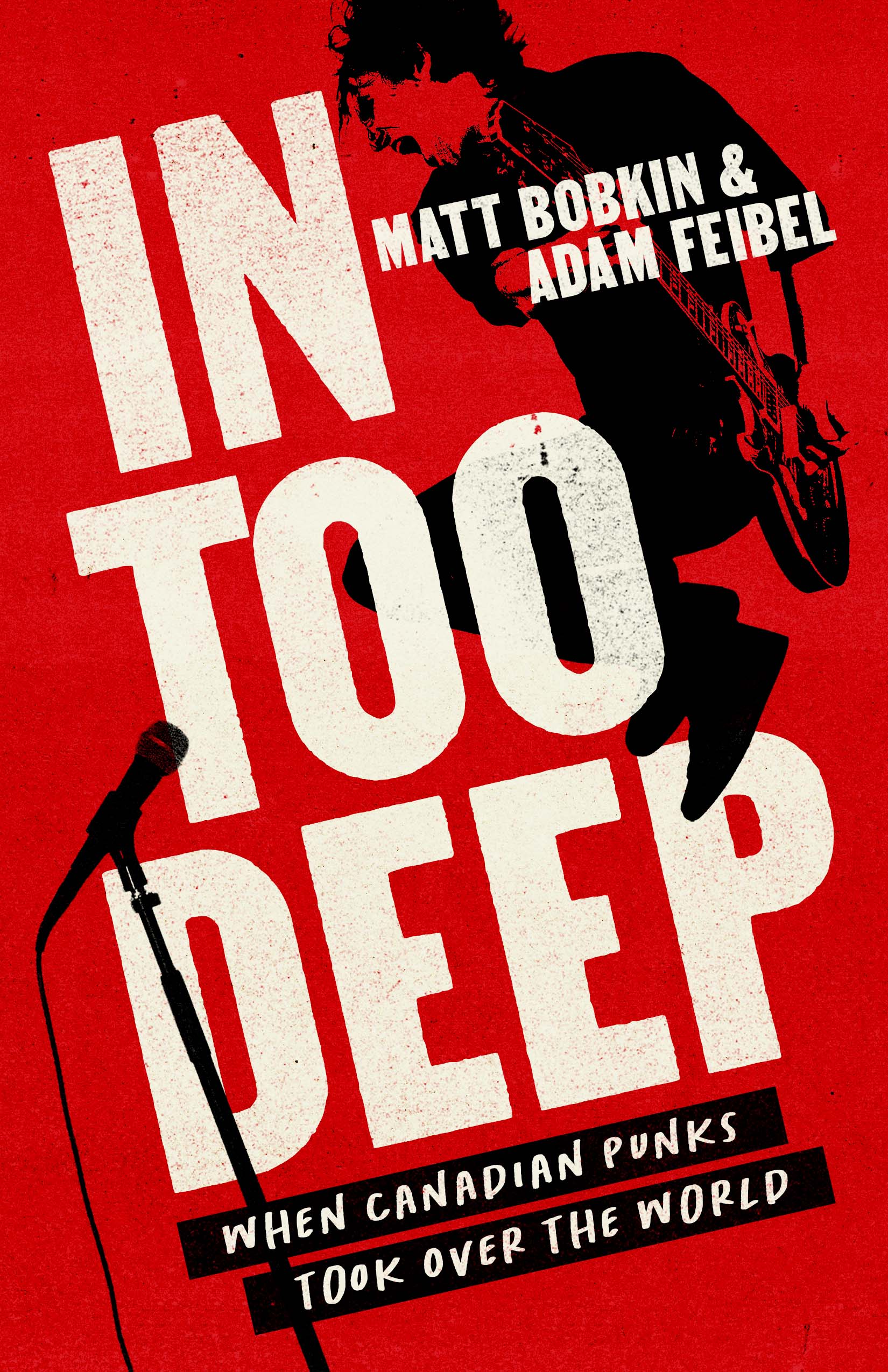


Mike Huguenor has clocked time in Shinobu, Hard Girls, and Jeff Rosenstock's band, and has two solo records of his own. Lately, though, he's been working on a book about the legacy of Mike Park's Asian Man Records. Elvis Is Dead, I'm Still Alive is a comprehensive history of the prolific San Jose-based DIY label, whose output includes Alkaline Trio, Less Than Jake, Bomb The Music Industry!, Joyce Manor, and countless more. The book arrives on Clash Books next year, and today we're doing a cover reveal and sharing an exclusive excerpt. Dive in below.
When it seems you’ve reached the absolute end of Lawrence, KS, keep driving and you’ll come to a graveyard.
Actually, it’s two graveyards. Memorial Park and Oak Hill, respectively, one on either side of the single-lane road. Once you’ve reached the graveyards, it will definitely seem that you’ve gone too far. But you keep driving.
As you pass empty fields and railroad tracks, all signs of civilization begin to recede. For a stretch, it seems there’s nothing at all. Then, you see it.
The cornfields.
It’s September, but it still feels like summer. The corn is high. From here on, corn is practically all you can see, an ocean of leafy stalks lightly swaying together out there on the plains.
You keep driving in what now definitely seems like the wrong direction. You can’t even look at your phone to check. It’s 1992 and there isn’t a cell phone in sight.
By now, the street has morphed into an unpaved county road surrounded on all sides by corn. You keep driving. Another mile passes.
Then, just when it seems you have left all direction behind and really, truly landed in the middle of nowhere, on the right, you see it: a small cinderblock building right there in the center of all this corn.
You have now arrived at one of the most important locations in American punk music. The Outhouse.
As the Blue Meanies pulled into the Outhouse parking lot on Monday, September 7, 1992, it felt a bit like pulling into another world totally apart from society.
“It seemed like it was five miles through a cornfield,” says Billy Spunke, the band’s singer. “It was sweltering hot summertime. You’re literally driving through a cornfield and then there’s just a little opening in the middle of that field that’s this cinderblock building.”
The Outhouse.
It had no bathroom, no running water and a reputation for fights. Cobwebs gathered on the ceiling and broken glass crunched underfoot. The building’s owner was known to ride his motorcycle inside and once fired a pistol through the roof while singing in a cover band. For months afterward, rain dripped through the bullet holes. It had originally gone by the name “Past the Pavement Hall,” because it was located almost a mile past where all official roads end. Located so far on the outskirts of town, it was like a stygian realm for the residents of Lawrence, an underworld of lost souls only navigable by musicians. The perfect place for America’s punks to book shows.
Though they felt lost as they approached that day, the Blue Meanies were drawing close to something like destiny. On the bill with them were two bands they had never met before, but who, soon, would come to define the territory of their world: Skankin’ Pickle and MU330.
“That show was just pivotal,” says Ted Moll, MU330’s drummer. “That was foundational for a lot of the tours, trading shows and just lifelong friendships.”
In 1992, Skankin’ Pickle had been a band for only three years, but their name had already spread throughout the underground, along with their reputation for exciting live shows.
Like Pickle, the Blue Meanies started in 1989 and played a weird blend of punk and ska. They spent a few years gigging around Carbondale, IL, but got serious once they relocated to Chicago. From there, they began to spread across the greater Midwest and plains. By the time they met up with Skankin’ Pickle and MU outside Lawrence, they’d just released their first album.
That night, MU330 opened the show. Though none of the bands had played together before, as soon as they took the stage, Billy Spunke remembers thinking that they had found kindred spirits in this underworld.
“We knew immediately they were our peers,” he says. “It was the very early years of ska-punk, and they were doing things differently than most everybody else at the time. Each band that came on that night, it was like, these are our people.”
In the 30 years of Asian Man thus far, the label has released over 400 albums. Some could have been huge hits but were released at inopportune times. Others never had a chance. Some, Mike Park hardly remembers at all, like Mail Order Children, who released a lone 7” (Thinking Of Raising A Family, AM-031) on the label in between Alkaline Trio’s debut EP and LP. One of the members, he says, maybe helped with the website? They were from Denver. He thinks.
Many albums on Asian Man have sold through multiple pressings but never broke through to the same level of, say, Alkaline Trio or Less Than Jake. Still others reached small but dedicated fandoms, people who loved what the band was doing, even if it wasn’t represented in album sales.
In its earliest days, Asian Man was a tireless proponent of third wave ska. In addition to Less Than Jake and Slapstick, they released Mealticket (Lisa Marie, AM-10), Monkey and Unsteady (Monkey/Unsteady split, AM-32), Five Iron Frenzy (Miniature Golf Courses Of America Present, AM-23), Let’s Go Bowling (Freeway Lanes, AM-24) and Johnny Socko, whose Full Trucker Effect (AM-25) pretended to be the soundtrack to a fictional trucker movie from the ‘70s, including “samples” from the movie, like the Pulp Fiction nod “Tobaccy in Paree,” in which two truckers discuss the French word for “tobacco.”
Two of the earliest releases on Asian Man were compilations: Misfits Of Ska (AM-02) and Misfits Of Ska II (AM-06). Originally pressed by Dill, Misfits Of Ska collected 19 ska bands of the early 1990s and launched them to a wider audience—and nearly pulled Park into a courtroom more than once.
The album’s first artwork featured an unauthorized image of the Bride of Frankenstein alongside Frankenstein’s monster. On its rear, an unauthorized image of Godzilla. On the CD face, well, Mike describes it best:
“The CD image was straight up Legacy Of Brutality, ‘Misfits’ and then…of ska.”
That design didn’t last long. Shortly after sending it to the pressing plant, Park got a call from a lawyer with Caroline Records, informing him of the Misfits artwork copyright. Park promised to change the art. Then he asked the lawyer about the rumor that the Damned’s singer Dave Vanian would be taking over as vocalist in the Misfits.
“He was like, ‘How did you hear that?’” Park says. “It was gonna happen. Obviously it never did, but that’d been sick.”
This was already Misfits Of Ska’s second legal battle. In happy news, the album had been licensed in Japan. In unhappy news, it was then flagged for its unauthorized image of Godzilla. The album art would need to be redesigned (and then redesigned again).
Despite the many struggles the release brought Park, it was also crucial to the formation of both Dill and Asian Man Records. In the ’90s, comps were big business, particularly for punk labels. Fat Wreck Chords had its Fat Music compilations, Epitaph its Punk-o-Ramas, Hopeless had both the Hopelessly Devoted comps and the Cinema Beer series. In the new millennium, SideOneDummy made their name on the Warped Tour comp series.
Asian Man had its own slew of comps, including both series and one-offs. Mail Order Is Fun, Plea For Peace and Stop Racism all came out while the label was still young.
But first, there was Misfits Of Ska.
Misfits Of Ska opens with a sonic assault.
A frantic blast of trumpet and mid-range bass ricochet off a kick drum hammering at a crazed velocity. Despite many notes being played, the bassist seems to be moving too fast to actually settle on any of them. Instead of a melodic line, all these notes create a general musical direction: upwards. Something like static blasts from the guitar. As the song settles into a kind of modified hardcore, someone starts shouting about energy, getting your energy.
This is the Blue Meanies.
The Blue Meanies were originally conceived by Jay Vance, a jazz student at Southern Illinois University (who would later become the third bass player in Skankin’ Pickle). As Billy Spunke remembers it, Vance chose him as singer of the band long before he was ready for the role.
“He had been calling me on my landline, this guy Jay, calling and calling and calling. He’d heard that I used to be in a band, and would I be in his band? I wasn’t answering because I wasn’t interested in being in a band,” Spunke says. “We eventually met at a party in a ring of people. We were just chatting, and it turned out that one of those people was Jay, and then when he realized I was Billy, he was like, ‘Oh my god, you’re Billy!’”
No longer able to dodge the phone calls, Spunke agreed to sing in the band. They practiced at the very same house where they met, the home of drummer Kendall Vance (no relation). Right away, Spunke was impressed by Jay Vance’s ranging musical knowledge and skill.
“He always drove the band, and creatively he was definitely the force. He was the one that gave me the confidence to even do it,” Spunke says.
In Carbondale, they got their legs beneath them, but they were little more than a college band. It wasn’t until relocating to Chicago that they decided to take the project seriously. At that point, they drove back down to Carbondale to record their first album, Peace Love Groove.
Blue Meanies’ earliest influences weren’t far from Skankin’ Pickle’s, namely Operation Ivy and Fishbone—as well as a host of ‘70s funk that came out in the band’s bass playing. But the Meanies quickly veered from this formula. They became known as the “scary” ska band, incorporating metal, noise, and grindcore into their songs and sounding, at times, something like a ska version of John Zorn’s Naked City project. On Kiss Your Ass Goodbye (AM-045), drummer Tony Aimone’s relentless bass drum blasts are mixed at least as loud as Spunke’s vocals. “Vote No” finds the band digging deep for some of the most discordant lines ever played in ska music, building the whole song around a tense diminished chord. The group’s early, enduring song “Pave The World,” Spunke describes as “like a theater piece,” its narrative passing through a series of distinct voices.
In his interview with the In Defense Of Ska podcast, Spunke attributed the band’s increasingly dark, aggressive sound to the effects of touring life.
“Those tours were grueling,” he says. “[It] probably just made us angry and scary.”
However, their habit of jarring audiences goes back earlier. The cover of Peace Love Groove, featured a reenactment of the Beatles’ censored Yesterday And Today cover, full of raw meat and doll parts. “Grandma Shampoo,” one of the band’s first songs, bobs to a woozy klezmer, morphs into hardcore, and then ends with the melody from “Joy To The World,” all accompanying lyrics about using a grandparent’s ashes as shampoo.
“Grandma Shampoo” appears again on both albums the band released on Asian Man: the re-release of 1995’s Kiss Your Ass Goodbye (AM-45) and their live album. But before the Blue Meanies were on Asian Man, they had no record company—literally.
When the band started touring in 1991, physical press kits were essential for booking shows. An ideal press kit contained a recent CD, 8x10 press photo, the band’s bio, and whatever clippings they had to their name. Press kits stamped with a familiar label’s logo—whether Electra or Dischord—always had an advantage. For the Blue Meanies, who hadn’t yet signed with any label, it became necessary to invent one. Thus, “No Record Company.”
“We had this goofy idea to create a label that wasn’t a label, just so when those promoters around the country would get it, they’d say, ‘Oh, this band is on this label from Chicago called No Record Company.’ And there’s this fake little logo,” Spunke says.
No Record Company was, in his words, “an illusion.”
But illusions have power. Though it was not a record label (and was, in fact, an explicit statement that they did not have a record label), No Record Company did all the work of one. They created and mailed press kits to promoters around the country, printed T-shirts with the No Record Company logo on the back, even generated their own reviews and press clippings for the band.
“We just made them up. I remember one whole 8x11 sheet that was just a really good quote from some writer that didn’t exist,” Spunke says.
The writer’s name was Burnt Motor (a play on MTV’s Kurt Loder). During the Meanies’ No Record Co. days, Motor became part of the band’s imaginary team, along with Slimey Q, an equally imaginary booking agent.
It didn’t matter that all of it was made up. It worked. It was one of these press kits—filled with quotes from Burnt Motor and sent by No Record Company—that got them the gig at the Outhouse.
Out there in the cornfield, the Blue Meanies’ live set made a lasting impression on their new peers. So much so, that their first album on Asian Man would be a live album, 1998’s A Sonic Documentation Of Exhibition And Banter (AM-29). After blowing away the members of Skankin’ Pickle with their show at the Outhouse, it was only fitting to highlight the band’s potent stage power on record.
A Sonic Documentation opens with the familiar voice of illustrious Chicago painter/singer/rock star Wesley Willis. This band, he tells the audience, “can whip a big camel’s ass with a belt.” They are “Chicago’s own, the Blue motherfuckin’ Meanies.”
Like Skankin’ Pickle’s own live record, A Sonic Documentation compiles recordings from multiple live sets all around the US, this one totaling eight shows. They were all from the band’s fall 1997 tour, with venues ranging from Bottom of the Hill in San Francisco to a VFW Hall in Houma, Louisiana.
“Never being ones to do things the easy way, we decided to make a live record different from other live records,” the band writes in the liner notes.
Originally, the plan had been to record every song at a different show.
“The only problem with this plan was that we had to record a lot of shows,” they note. In the end, they (along with engineer/producer Lance Reynolds) did record roughly 30 shows, then whittled the selections down to eight of the strongest.
Back in the early days, all of these shows would have been booked by the band themselves, under the guise of one of their fictional booking agents. But after the show in the Kansas cornfield, the Meanies began working with a real, flesh and blood agent: Skankin’ Pickle’s booking agent, Rick Bonde.
“He was the guy,” Spunke says. “It was all Rick.”
Following his time booking Skankin’ Pickle, Bonde had worked his way up in the music business. Once the go-to guy for jam bands, by the mid-90s he had fully cracked open the nascent third wave ska scene, parlaying his role booking Pickle into one booking Less Than Jake, and from there to booking Reel Big Fish, Goldfinger, and Sublime.
But before any of that, Bonde had been a musician himself. He was even passionate about his status as a musician. When a friend noticed his work ethic and suggested he try managing bands instead, he took it as an insult.
“My first reaction was like ‘screw you, man.’ That pissed me off,” Bonde says. “It kinda hurt, because I considered myself like a musician first.”
But his opinion on the idea soon began to soften. When word reached him that a friend had joined a new band in the city, he followed them to practice, offering to become their manager. No one in the room understood what exactly a manager did, but they didn’t let that stop them. They said yes, and Bonde began his transition to the other side of the industry.
By 1991, Bonde had gone from managing to booking. He formed an agency with a friend and picked up Skankin’ Pickle after their fateful Slim’s show with Hobo. Then, piece by piece, he went about stitching together the network of the American third wave of ska.
Because, in 1991, it wasn’t exactly like there was a solidified scene. Sure, in the ‘80s, there had been the Uptones and Heavy Manners, but both had since dissolved. Bands like Skankin’ Pickle and MU330, Blue Meanies, Suicide Machines and Mighty Mighty Bosstones, they were all making ska-punk in their own way, but the connective tissue of a national scene hadn’t yet fully formed. When Skankin’ Pickle told Bonde they didn’t want to play 21+ shows any longer, he had to figure out how exactly to do that.
“It was all big agencies and big rock acts,” Bonde says. “We were just sort of making it up. We didn’t know what we were doing.”
There was, of course, BYOFL, Book Your Own Fuckin’ Life, Maximum Rocknroll’s handbook for booking a DIY tour.
BYOFL’s inaugural issue came out in 1991. It absolutely helped, but it wasn’t exactly equipped to handle the size of the tours Bonde was booking for Skankin’ Pickle.
“We tapped into some of those that were already doing the punk rock shows, but there were not very many,” Bonde says. “Book Your Own Fuckin’ Life made it sound like there’s all these people and you just call them. There were not.”
By its third year, even BYOFL seemed to be struggling with this realization. Issue 3, released in 1994, included a short introduction by editor Melanie Watski that begins, “I didn’t know exactly what kind of hell I was going to live through when I agreed to work on this thing. It really sucked. Sitting in front of that computer for 6 hours at a stretch trying to decipher some moron’s scrawled entry with a description that’s way too long to fit and no area code for the phone number is not what I consider to be a rockin’ good time.”
Watski recommends people stop suggesting places like Taco Bell, because “even the stupidest punk can figure out that you can eat at Taco Bell,” then ends by saying, “If there’s a mistake in your entry, sorry, but I really don’t want to hear about it. I’m glad this is all over, I never want to touch another computer again. DIY or DIE. Heh heh heh.”
Still, there were some actual people who Bonde met through BYOFL, punk promoters renting out warehouses and community centers, VFW Halls and coffee shops. Sometimes, Bonde had to talk them out of their punkest principles.
“The promoters would be like, ‘You can have all the money, I don’t care, I’m just in it for the music,’” he remembers.
It sounded altruistic, but it was really a pain in the ass.
“I was like, ‘No, no, no. Make money.’ I want you to be there so I can call you with another band, or I can call you on the next Skankin’ Pickle tour or Blue Meanies tour. I need you to be there, so let’s split the money. You make money, we make money, everybody walks away happy. We keep coming back and we’ll build it up. Then we have a scene,” he says.
One day, a DIY promoter in San Diego called Bonde and told him he should check out the new band he’d been managing. They were playing down in San Diego that evening.
It was still morning, but Bonde got on the first flight to San Diego, arriving at the venue Soma in time to catch the band’s soundcheck. Their name was Blink, though they’d soon tack a number to the end: “182.”
Impressed by the soundcheck, Bonde offered to take the band of teenagers out to dinner. Anywhere they wanted. They settled on Burger King.
“It took me $8 to wine and dine Blink-182,” he says. “That’s how I worked with Blink.”
All of it, he attests, follows a straight line from the moment Mike Park asked him to stop booking Skankin’ Pickle in bars.
“Absolutely,” he says, “you can make the line from Mike Park pushing all-ages shows, to me finding Rick DeVoe, to Rick DeVoe managing Blink-182, to me working with Blink-182. 100%.”
Elvis Is Dead, I’m Still Alive is out 5/19/26 via Clash. Pre-order it here.