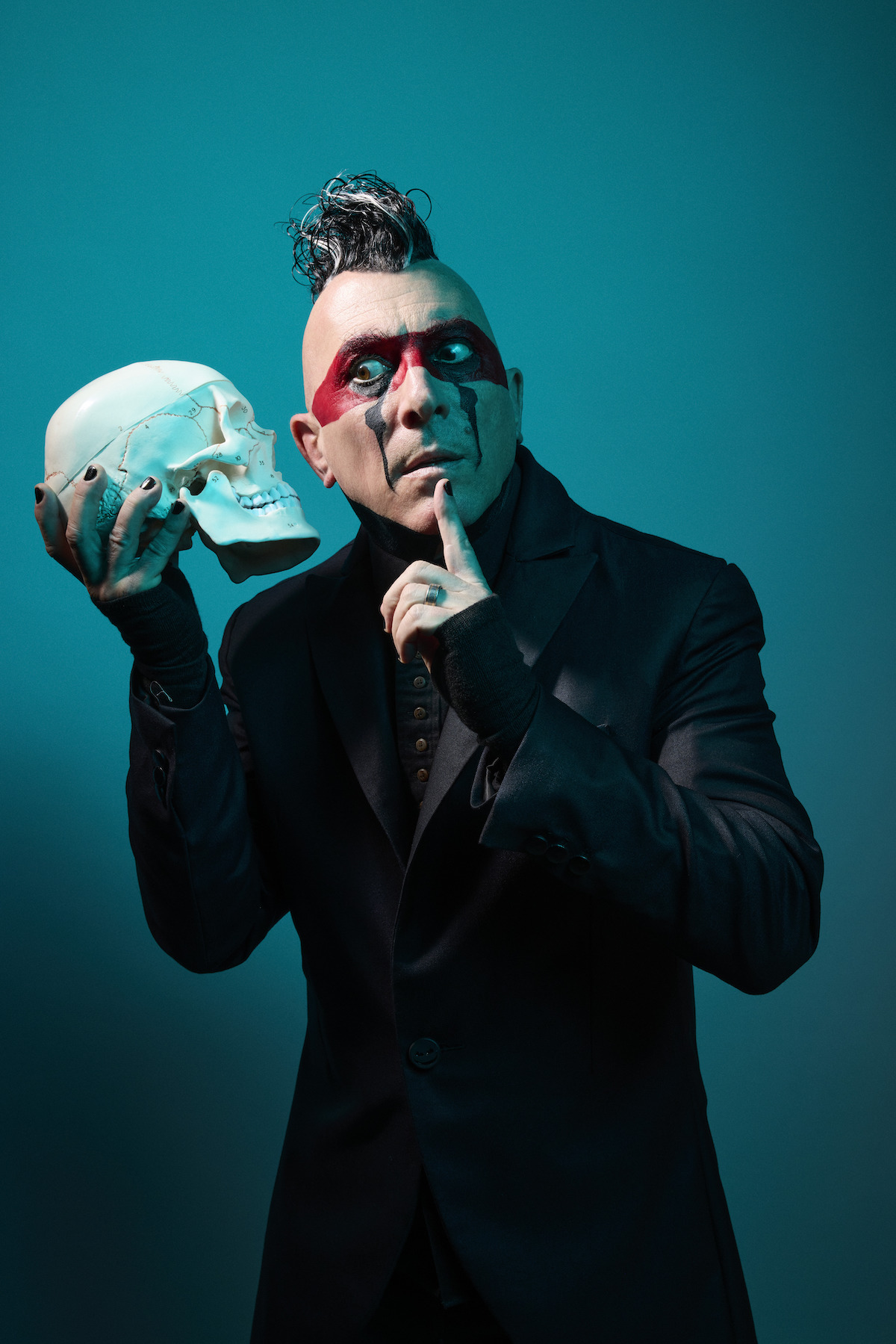
We've Got A File On You features interviews in which artists share the stories behind the extracurricular activities that dot their careers: acting gigs, guest appearances, random internet ephemera, etc.
Maynard James Keenan is an incredible candidate for an interview series devoted to the nooks, crannies, and detours of an artist's career. Keenan's own mainline endeavors are incredibly expansive. He's fronted the iconic prog-metal band Tool since 1990, the artful hard rock band A Perfect Circle since 1999, and the oft-morphing band, fashion line, and multimedia project Puscifer since 2003. He's a big-time winemaker, running Merkin Vineyards and Caduceus Cellars out of the Sedona area. Also in Arizona is his Queen B. Vinyl Cafe, a combined café/record store/barber shop. And did I mention he's a black belt in Brazilian jiu-jitsu?
Yet when we got on the phone for a We've Got A File On You a few weeks back, we barely touched on any of that, if only because Keenan's catalog of collaborations and cameos across the world of music and film is also vast. In half an hour, we covered a lot of ground yet barely scratched the surface.
The impetus for our chat was Normal Isn't, the first Puscifer full-length since 2020. Out next week, the album finds Keenan, Mat Mitchell, and Carina Round evolving the Puscifer sound yet again, incorporating more of Mitchell's ripping guitar work into the group's primarily synth-based palette. Arriving on the heels of last year's Sessanta E.P.P.P. — a collaboration between Puscifer, A Perfect Circle, and Primus tied to a tour in which all three bands shared the stage simultaneously in honor of Keenan's 60th birthday — it's proof that Puscifer continues to be a vital creative pursuit.
In that sleek but ferocious environment, Keenan rails about thriving evildoers and people trapped in information bubbles, algorithms and numerology, zealots and bungholes. He can still be a slithering snake and a roaring lion on the mic, cracking wise or striking a dead sober tone from moment to moment. One of the all-time great rock voices continues to amaze, inspire, and perplex as he enters his seventh decade.
Below, read our career-spanning interview.
Puscifer’s Normal Isn’t (2026)
You learned the production software Logic and Pro Tools while creating this album. What was the impetus for that?
MAYNARD JAMES KEENAN: Just downtime. I had some ideas that I wanted to get out, and Mat was gracious enough to be patient with me to help me unlock that level of working with Logic, just to get these sketches down. It was great. I was able to get a huge folder together. Meanwhile he’d already had a large folder of stuff he’d been putting together since 2020. So it was quite fun to dig in and see where we’d go with that, and also give him some fodder to work with.
How often are you taking on new techniques, technologies, instruments? Is it pretty typical for you to expand your way of working like this?
KEENAN: Well, as far as the digital world, yeah, this was relatively new. I do a lot of work in the winery, in the cafe, the coffee roaster. So there are things I’m taking on as far as mechanical and farming and those kind of productions, culinary. But I literally will write stuff to music, and I sing in this end of the mic, and hopefully it comes out the other end, right? But that’s it, really. So this is pretty much my first foray in really digging in myself and understanding Logic.
How did that change the creative process for you?
KEENAN: It just gave more stuff for Mat to work with. For me, it’s great. Rather than me trying to go, “It’s kind of like this,” and I’m singing into a recorder without a drumbeat or anything. It’s a more realized napkin sketch than me just describing what I had in mind.
Some of your most vicious insults are on this album, like “bunghole.” Who were you thinking of there?
KEENAN: Whoever’s a bunghole. My actual goal was just to get the word “bunghole” in a song. I think that’s kind of a bucket list thing for some people, right?
“Seven One” is the one Danny Carey plays on. It’s one of two tracks Tony Levin plays on. You’ve got Ian Ross, father of Atticus Ross, doing a voiceover. Did you set out to make that one kind of an event song? How did all those guests end up on there?
KEENAN: It was one of those songs that’s gone through quite a few evolutions. There’s actually other versions of it that are still in the file that we haven’t quite developed yet. We just had to pick one and run with it. Matt Chamberlain played on a version, and Linda Larkin, the voice of Princess Jasmine, did a voice pass on it. We’re probably going to approach somebody else for bass on it. So I have a feeling that that one’s going to go through at least two more incarnations just to reinvent it. And you know, because it was one of the very first pieces that I did in Logic, that “Seven One” vocal is from that session in like 2021, 2022.
Connections To LA Comedy Scene And Mr. Show Appearance (1995)
Although Puscifer was officially founded in 2003, the project in some ways dates all the way back to the LA comedy scene in the early '90s, and the band name famously appears with you in a sketch from the debut episode of Mr. Show With Bob And David. How did you get involved in that world? Was there a certain person or event that was like your pathway into it, or was it just so intermingled with the music world that overlap was inevitable?
KEENAN: My roommate took me out to a comedy shows, and we ended up in one in particular that was off the beaten path. A bunch of underground comics at the time that were kind of involved in stuff in their own right, but this little melting pot of sketch comedy where they were kind of working out their bits. It was pretty amazing. It was in the Hollywood area in 1994.
And being involved in that was pretty inspirational — watching them work and watching them almost in an improv way, where they had something they're working on, but then the host Laura Milligan would kind of throw out, "This is the theme for the night," and they would have to work whatever they're working on into whatever the theme of the night was. It was pretty interesting to watch those guys think on their feet and pivot.
That's interesting. I had assumed there would be some connection through your work with Green Jellÿ, with them being a comedic leaning project, but it seems like that predates you entering into that scene.
KEENAN: Yeah, Green Jellÿ was kind of its own thing, really. This was more like pro comedians who did standup and sketch comedy and were writing for various entities. Like a couple of the people wrote for SNL and some of the late night talk show hosts. So these were legit up-and-coming comedians, writers.
Voicing The Pigs On Green Jellÿ's "Three Little Pigs" (1992)
So how did the Green Jellÿ connection come about, then?
KEENAN: There was a band from Buffalo that came out [to Los Angeles], and they were kind of doing these amazing shows. And at some point there was a falling out with the band, and they were right in the middle of about to record and, Keith Matherne, who was the voice on the Three Little Pigs, all of a sudden was not in the band. And so the guy turned to me, who was standing there, and went, “Do you want to sing it?” “Sure, I'll sing it.” And that's pretty much the end of that story. I didn't tour with them or anything. It was just, I was a roommate, and they needed a vocalist.
"Know Your Enemy" (1992) And Early Jams With Rage Against The Machine
Am I right that you were kind of jamming with the Rage guys before the band came to be?
KEENAN: A little bit. I met Tom [Morello] when I'd come out to apply for a job in Los Angeles, and Tom introduced me to Adam [Jones] and these friends of theirs, Andy and Vicki, like a whole slew of people from the Illinois area. And I moved out from Boston and kind of met Tom initially. And I wasn't interested in doing any bands, but at some point it kind of came up. Yeah, we’d jam a little, but it was more like at our house and he had his guitar and I'm messing around on the bass or something. I think we had one rehearsal over at a rehearsal space, but you know, the whole Zach, Timmy C, and Brad thing, I think that was kind of meant to be. I was just a stop on the way. I definitely didn't have anything to contribute to what Rage Against The Machine became, other than being friends, and they wanted to have me on one of the songs.
Pre-Fame Band Children Of The Anachronistic Dynasty (1987)
I wanted to ask about some of your pre-fame projects like Children Of The Anachronistic Dynasty.
KEENAN: I was in art school, and there were some friends around town doing punk rock stuff. And they ended up needing a bass player, and I faked my way through playing bass for a minute. And then the singer had a freakout and left town, and I went, “I'm kind of having fun here. I don't want to stop.” So we continued and turned it into CAD for a minute. Time goes on, and I literally needed to stop messing around and get a job. So I had a friend of mine in Boston, so I moved to Boston and put the band thing behind me to work at a pet store.
How long were you working at a pet store?
KEENAN: About two years before I moved to California to work in more pet stores.
So when you moved out to California, it was because you were in the pet store industry?
KEENAN: Yep. I had no interest in being in a band. My experiences in Grand Rapids weren't great with being in bands. I was more into it than they were, I think, and — no disrespect to them — but, you know, I think I wanted more out of it. I think they just kind of wanted to have fun with their friends, and they weren’t really concerned about recording and releasing and touring. Which is, you know, that's fine. But that's what I wanted to do, and then it didn't happen, so I just kind of moved on and decided, maybe band life is not for me.
So then, what flipped the switch on that when you were starting Tool and bumping around the scene down there?
KEENAN: It just kind of came together in the right way, and then the rest is history, right? You can only run from it for so long, and then it grabs you and says, “You're gonna do this,” right?
Singing "Muhammad My Friend" With Tori Amos At Her RAINN Benefit Concert (1997) As Heard On Tori Amos: Live From New York (1998)
What was your history with her? How did you guys meet, and how'd that duet come to be?
KEENAN: Her manager and tour manager kind of knew some of our people, and that she knew she was gonna do that RAINN benefit. And so they had reached out to me to see if I wanted to contribute, which was quite an honor — to meet her, but also to help with that foundation.
Did she suggest a song to sing, or how did you settle on that song?
KEENAN: I think she did. Yeah, she was like, “This is one I'd like to have you sing on.” In hindsight, I think I didn't do as well as I wanted to on it. I wish I'd have had another chance to make that better. I think it came out good enough, but you know, I think I could have done it better with a few more tries.
What don't you like about it? You think you were off pitch or something?
KEENAN: I feel like, with time, that’s what touring does for songs. You kind of find your way with them. It's just repetition, right? With anything — cooking, martial arts, playing guitar, it's repetition. So kind of diving in the deep end, and never having been — I was never filmed for a thing before. So a lot of nerves, felt unprepared. Although I did prepare, but I just felt unprepared.
Starring As Satan In Bikini Bandits (2002) And Bikini Bandits 2 (2004) Alongside Dee Dee Ramone, Jello Biafra, & Corey Feldman
You played Satan in the Bikini Bandits movies, and then I saw another clip online where you're playing yourself in a hot tub. How did that whole thing catch your attention, and how did you get involved with it?
KEENAN: Oh, I literally don't remember. I think it might have been Josh Freese. I don't remember how we hooked up with those guys. You know, it happens as it happens. People introduce people and all of a sudden you're meeting this cool crazy cat that's doing guerilla filming. The appealing part of it to me was that mostly if you wanted to do any kind of animation or kind of filming back in the early ’90s, you needed an entire budget. You needed to get approved by some studio. There has to be catering and all this crap. And then this guy was just doing — Steve Grasse, I think his name is — when he would do commercials for Puma or Nike or whatever he was doing, he would set aside part of his profits or whatever was being paid to do these just insane projects on the side to get them done. Because that's kind of how you had to do it back then. Of course all that's changed now with being able to do stuff in Final Cut Pro. You can practically use your iPhone to make a movie now, right? But back then it was like that. You didn't see that anywhere. That was the appealing part is that he's literally doing these things full punk rock.
The approach of it appealed to you, but it seemed like the sensibility of the material is very aligned with your sense of humor as well.
KEENAN: Oh yeah, absolutely. And he definitely had vision for small parts of Philly. [Grasse ran his ad agency Quaker City Mercantile out of Philadelphia.] Nowadays you look back and go, he was a precursor for gentrification of an area. But in the instance of some of those neighborhoods in Philly, he really did save them.
"Bring Me The Disco King" With David Bowie & John Frusciante For The Underworld Soundtrack (2003)
So staying in the movie business, but on the soundtrack side, you worked with David Bowie and John Frusciante on the Underworld soundtrack. Bowie has been in the news due to the anniversary of his death. What stood out to you about working with him?
KEENAN: Well, I actually worked with Danny Lohner. Danny Lohner was friends with Billy Howerdel, through the connection with Nine Inch Nails. Billy used to tech for Nine Inch Nails, so I met Billy Danny Lohner. I know Lohner was the one who was putting all those people together for those scores and soundtracks. And so I met those people through Danny. And at that point I didn't actually meet David, I just was singing a song at Danny's house. I met David later, but it was kind of a fun project and a fun way to put the work together.
So how did you end up meeting him later? Was it something related to the movie or completely separate?
KEENAN: No, it was just, you know, similar label, Virgin Special Projects. Nancy Berry was the record company president, and Billy had worked with David at some point, probably as a tech. So there's casual connections and casual meetings.
I assume that was back when Nine Inch Nails and Bowie were touring together.
KEENAN: Yeah, and Trent worked a lot with David.
Covering Wings' "Silly Love Songs" With Replicants (1995)
You covered Wings’ “Silly Love Songs” with Replicants, the cover band with former Tool member Paul D'Amour and members of Failure. Did you choose the repertoire on that one, or did they ask you specifically to sing “Silly Love Songs”?
KEENAN: I was a guest on that. That was them having fun, doing a thing, and then they asked if I would sing on a song. And it was pretty cool the way they were set up. I think it was ProTools. They were working in a house somewhere, I can't remember, in LA somewhere. That was fun.
It’d be interesting if they could do another album. I know they were a short-lived project, but it would be a fun thing to bring back.
KEENAN: Yeah, that would be up to them.
Cameo In Crank: High Voltage (2009)
The guy you play, with the shock collar for his dog, is that a character that you invented? A role you auditioned for? How did that come to be?
KEENAN: Again, Danny Lohner was working with those guys, I think it might have been for scoring or something. And Danny's like, “You wanna come do this thing? We're gonna do it downtown at the park.” I'm like, “Sure.” So I came up with my character and showed up with it.
So you did get to create the character.
KEENAN: Yeah, yeah. Other than them saying, “You're a dog walker.” That was all I was given. So I just showed up and this is it. Danny and I are a couple, and we're walking our dog. This crazy Jason Statham character’s trying to steal our shit.
Oh, is Danny Lohner the other guy there with you?
KEENAN: Yes.
OK, so it sounds like he's been sort of a connection for a bunch of projects.
KEENAN: Yeah, he's as crazy as I am. Maybe more.
Guesting On Deftones' "Passenger" (2000)
This is one of my favorite guest appearances you’ve done. When did you become aware of Deftones?
KEENAN: Oh man, you would have to ask Chino [Moreno] how that came up. I literally don't remember how we met other than maybe friends of friends, you know? Maybe I went to a show in Phoenix or something. But yeah, I'm not remembering how I actually met those guys. But somehow they needed someone to help them — you know, writer's block or whatever — and I kind of came in as some pseudo-producer to just kind of help him break through that. But you know what, the results were all them. Whatever I did to nudge him, I think maybe I could take credit for helping nudge, but then the floodgates opened and that album's pretty amazing.
Welcoming Guy Fieri And Sammy Hagar To His Vineyard For Rock & Roll Road Trip (2019)
What was that experience like?
KEENAN: Guy, what you see is what you get. He literally is that nice guy. You know, he's a little goofy dude, but what you see is what you get. Because he's kind of goofy, you kind of want to hate on him a little bit, but then you meet him, you're like, “This guy's really nice.” He's a fucking good dude. So it was actually a pretty positive experience.
Yeah, it feels like he kind of used to be a punchline, and people have developed a level of respect for him over time.
KEENAN: If you spend any time with him, you can't — you're a dick if you hate him. He's just a nice guy.
Sessanta Tour And EP With Puscifer, A Perfect Circle, And Primus (2025)
Bringing it back around to the present, more recently you've had the whole Sessanta project. It felt like a cool expression of this community that you've had for a long time. That was a 60th birthday thing for you too. Why did you choose to celebrate it in that way?
KEENAN: Mat and I had some ideas about how to put a tour together. We'd always mentioned that it's strange to go out — you see a festival show or a show where there's like three bands on, and it's so disconnected. This band goes on and then they go off, and this next band comes on. They’re not, you know, “Van Halen and Dokken, touring together.” No, they're just, it's two bands. They just happen to be on the stage at different times. It's not a community thing. So it's kind of forcing the issue with — you'd see all three bands and watch them interact in that kind of community. We put it together — presented by Puscifer Entertainment — and Mat was kind of the architect for that whole production along with Sarah Landau, our lighting director. So it was pretty, pretty cool. It took a lot of rehearsals. It took a lot of massaging. And it definitely takes the right three bands to make it work.
Normal Isn't is out 2/6 via Alchemy/BMG. Pre-order it here.