
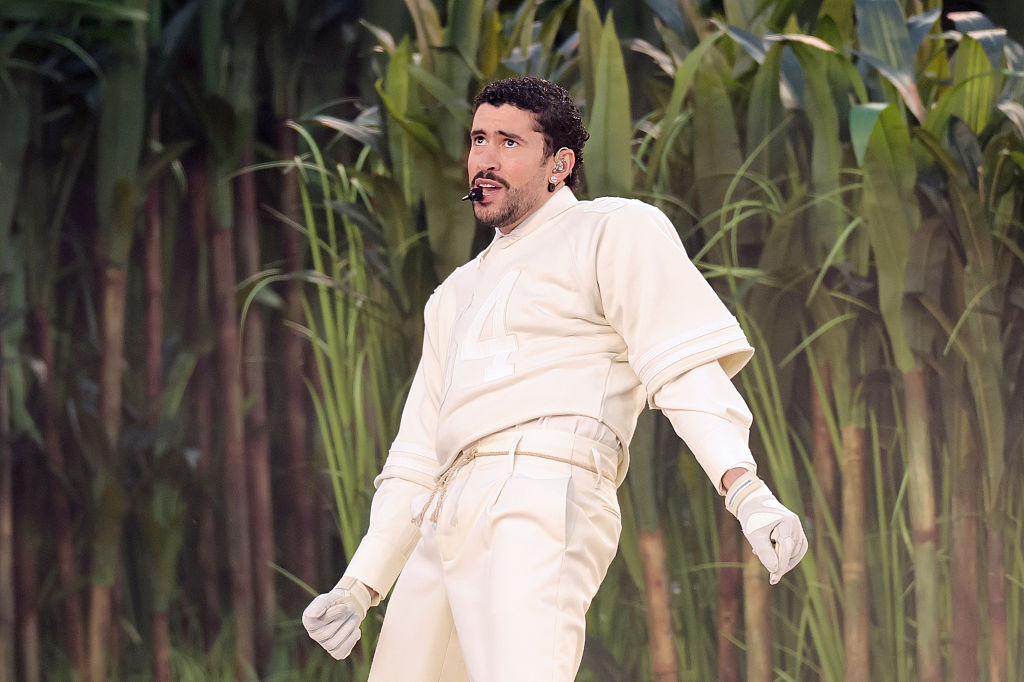
Bad Bunny's jersey said "Ocasio." On Twitter, at least some handful of people got performatively upset about that. For months, these people had been ready for the Puerto Rican star to make a grandstanding political statement at the Super Bowl, and they thought that they saw it before the performance even started. At least some number of fuckheads just assumed that the jersey was an endorsement of Congresswoman Alexandria Ocasio-Cortez, one of the right's favorite punching bags. These people missed the most obvious fucking thing: It's his name. Bad Bunny's government name is Benito Antonio Martínez Ocasio. Duh.
If you were looking for a political statement in the Zara cream-on-cream football jersey that Bad Bunny wore while performing, it wasn't the name. It was in the number on the jersey: 64. In September 2017, Hurricane Maria hit Puerto Rico and ripped through the island. Newly elected president Donald Trump downplayed the toll of the tragedy, and the Puerto Rican government played along, claiming that the hurricane only killed 64 people. In real life, the death toll was likely well into the thousands. Bad Bunny hasn't confirmed that the "64" on his jersey was any kind of protest statement, and you have to really get into the weeds to find one. But if you're looking, it's there.
Or maybe it's not! The absurdly low Hurricane Maria death toll is one theory about the 64 jersey. There are plenty of other theories online. 1964 was reportedly also the year that Bad Bunny's mother was born. The 64th Congress granted citizenship to the people of Puerto Rico. Bad Bunny's late uncle Cutito played football, and he wore the number 64. Online, different people have offered different explanations for the number. I like the theory about Hurricane Maria, but it's really just one theory. The number wasn't an outright statement of protest. We don't have a concrete answer on what it signified, and maybe we never will. (UPDATE: On Monday afternoon, Bad Bunny confirmed it was a tribute to his uncle.) That's how Bad Bunny's Halftime Show mostly worked. There were layers of meaning everywhere, and plenty of them didn't have fixed meanings. If you just wanted to have fun watching an enormously popular artist perform some music, then you could do that. If you wanted to look for evidence of culture war, you could find that, too
The Super Bowl Halftime Show is the biggest platform for any music artist on the planet. NBC's early estimate is that 135.4 million watched Bad Bunny's performance, which would make it the most-seen Halftime Show of all time. Despite Turning Point USA's competing counter-programming featuring egregiously lip-syncing headliner Kid Rock, even Trump apparently watched the Bad Bunny performance, since he immediately jumped on Truth Social to complain: "Nobody understands a word this guy is saying, and the dancing is disgusting, especially for young children that are watching." (Now he's worried about children.)
It's such a drag to have to frame Bad Bunny's joyous, elaborately staged Halftime Show in culture war terms, but the culture war stuff has been inescapable since Bad Bunny was announced as the headliner. Various Trump functionaries immediately started complaining and promising to dispatch ICE agents to the Super Bowl. Bad Bunny himself barely engaged with any of that. Winning a Grammy one week before the show, he did pointedly say "ICE out," which is now the default mainstream position of most Americans. Last night's performance happened to occur after months of ICE's murderous Gestapo tactics being plastered across our collective social media feeds, and the resulting widespread horror and disgust seems like it could lead to an actual realignment in US politics.
In this climate, a Bad Bunny gig becomes a political act simply by existing. Bad Bunny did not put on a protest performance. Virtually nothing about his 13-minute set was explicitly political in anything but the vaguest ways. It was all in the subtext. And there was so much subtext. Since last night, social media accounts have been publishing deep semiotic readings of the performance, catalogues of the Easter eggs that viewers might've missed. (This one was especially helpful for me.) As you might expect, it's a lot deeper than the 64 on Benito's jersey. The cultural references were woven deeply into the show: The fields of sugarcane, the piraguas stand, the CGI-cartoon avatar of the endangered Puerto Rican crested toad, the Toñita cameo, the sticker with the light blue Puerto Rican flag that represents the independence movement.
Watching the show in real time, I probably picked up on a few references, but I definitely missed a ton. When Puerto Rican star Ricky Martin showed up on one of the Debí Tirar Más Fotos artwork chairs, looking and sounding eerily fantastic, I had some idea what his presence represented. Virtually every Halftime Show has its celebrity cameos, and Martin was the key figure in the Latin pop boom of the late '90s. He got famous in the US by singing in English, and here he was, triumphantly belting in his native tongue. He sang Bad Bunny's "Lo Que Le Pasó a Hawaii," which is specifically about protecting Puerto Rican culture by resisting statehood: "I don't want them to do to you what happened to Hawaii."
As a sheer aesthetic experience, Bad Bunny's Halftime Show was a whole lot of fun. It wasn't perfect. Bad Bunny was doing some vocals live, which is cool. He hit all his marks, but he sounded a little shaky here and there. He's not a virtuoso vocalist or dancer, the way some past Halftime Show performers have been. The structure of the ultra-choreographed spectacle is closer to Broadway than to even the mostly highly produced stadium show, and it doesn't allow for the same moments of blazing individual artistry that Prince famously brought to his performance in 2007. The show was geared to the TV cameras, not the people in the stadium, who were probably all watching the screens anyway. (Lots of regular stadium shows mostly work like that, too.) But as sheer dizzy spectacle, it was a beautiful thing to witness.
I don't know how anyone pulls this off. You have a few minutes to put a complete stage set on this field, and then you have a few seconds to get rid of it. In this case, the sugarcane plants were all people in costumes, sprinting onto and then off of the field. In that hyper-compressed, split-second environment, Bad Bunny went strutting through all those human fields, leading something that felt like a party even though it had to be intricately planned down to the last detail. There was a running storyline about Bad Bunny handing off a ring to some guy, who then proposes to his girlfriend, and then they get married while Lady Gaga sings a salsa version of "Die With A Smile."
The wedding was apparently real — two fans had invited Benito to their wedding and he offered them this televised spectacle instead. Gaga, seven days removed from losing out to Bad Bunny in the biggest Grammy category, was visibly delighted to be there. Afterwards on Instagram she wrote, "I wouldn’t miss it for the world." (I don't know if she needed to be there, but it was fine.) Before Gaga, the intro to "EoO" included a nod to "Gasolina," the 2004 reggaeton smash from Puerto Rican rapper Daddy Yankee.
A whole lot of this stuff was just fun to watch. We got a phalanx of ridiculously sexy dancers, a Spike Lee double dolly shot, and a porch full of Latin celebrities. The music moved fluidly from Bad Bunny's old reggaeton party music to the more historically minded tracks from DtMF. Bad Bunny crashed through a ceiling, stagedove off a rooftop, and climbed a telephone pole. The set pieces kept coming quickly enough that I had a hard time processing all of them. There was plenty of symbolism mixed in with the spectacle. A bunch of dancers fell from the telephone poles, metaphorically shocked by Puerto Rico's still-malfunctioning power grid. But then they went scrambling right back up like it was Cirque Du Soleil. The statements never interfered with the partying.
El hecho de que Benito que cantara el apagón en las caras de los gringos fue asombroso pic.twitter.com/m3rwglKRaL
— ♡ (@weltitaaa) February 9, 2026
At the end, the statements and the partying merged into a joyous whole. A troupe of flag-bearers ran out, and Bad Bunny called out, "God bless America!" Then, he shouted out every country in North and South America, proclaimed that "we're still here," and spiked a football in the end zone — something that neither of the teams managed to do during the first half of the actual game. This wasn't an attack on anyone. It was a statement of joy and pride and solidarity, and the only people who took it as an attack are the ones who don't think other people should get to feel and express those things.
Bad Bunny sends a message at the Super Bowl:
— Headquarters (@HQNewsNow) February 9, 2026
"God Bless America"
"The only thing more powerful than hate is love" pic.twitter.com/mJSsAZctE7
Maybe the whole show was as political as you wanted it to be. At one point during the performance, a couple of guys grinded on each other. It was a brief shot, not more than a second or two, but I saw plenty of people talking about it as some kind of cultural landmark. At another point, Bad Bunny handed a Grammy to a delighted little boy. Over on Bluesky, I saw a bunch of people immediately speculating that the boy was Liam Conejo Ramos, the little kid from Minneapolis with the Spider-Man backpack who was freed after being abducted and imprisoned by ICE. Well, no. It was just a child actor. People wanted it to be that kid because they wanted an explicit statement of opposition. It wasn't that type of party. It didn't have to be that type of party.
By now, the Super Bowl Halftime Show has become its own beast — a fast-forward all-sensation display from a current artist at the top of the game. We've now had two back-to-back years of big-time zeitgeist kings, Kendrick Lamar and Bad Bunny, giving symbolism-rich spectacles within days of their triumphant Grammy nights. I don't know if this kind of things is sustainable. At a certain point, these Halftime Shows are going to get too complex for their own good. It just hasn't happened yet.
For the most part, last night's Super Bowl was some grim television. The game itself was a grinding, defensive slog, and its outcome was a foregone conclusion. Plenty of people have already pointed out that guys named Drake have now been kicked into the dirt two Super Bowls in a row. (The rapper Drake lost his million dollar bet, too.) The ads were full of already-rich celebrities adding to their money piles by shamelessly shilling for AI companies. I kept watching to the end, but I was pretty checked out before the third quarter ended. Right in the middle of all of it, though, Bad Bunny put on this brilliant burst of life. I don't really mind that Benito Antonio Martínez Ocasio did not burn Donald Trump in effigy up there, and I don't really care where his performance fits in the grand history of Super Bowl Halftime Shows. He put on for himself and his island, and he made me feel something. That's more than enough.