
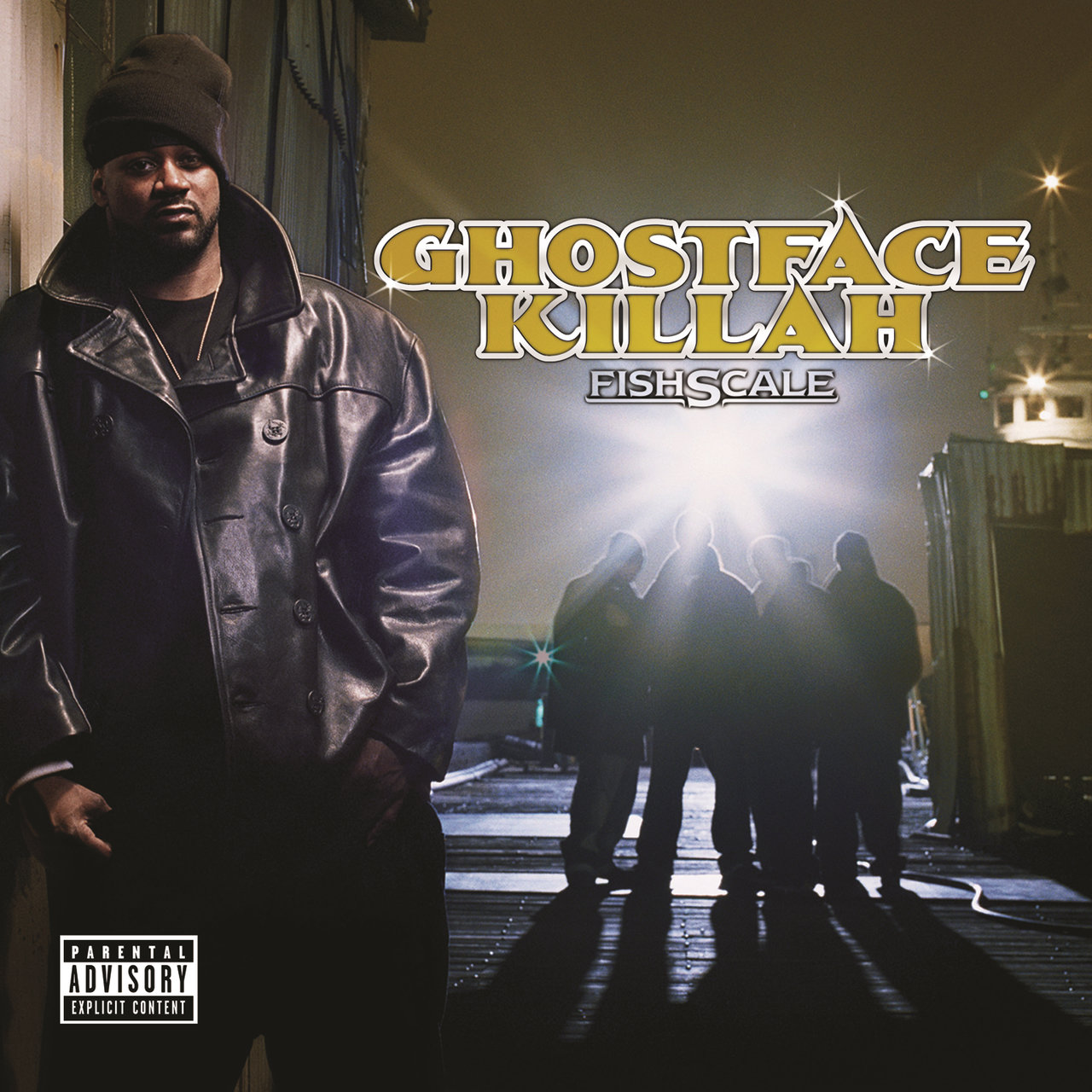
- Def Jam
- 2006
One chilly night in January 2006, I went to Ghostface Killah's "Back Like That" video shoot. The surviving Wu-Tang Clan members had just announced plans to get back together for their first tour since Ol' Dirty Bastard died a year earlier, but the chaos surrounding various Wu-Tang members' overlapping resentments and loyalties and money squabbles still roiled in public. I'd been working at the Village Voice for less than a year, and I wanted to talk to as many Wu-Tang guys as I could for a feature on the tour. I think I ultimately got to five of them, plus assorted associates. It wasn't easy. With Ghostface, I spent hours and hours at a video shoot before he gave me a 10-minute conversation.
In a way, the "Back Like That" video shoot, which went down on the roof deck of a Jersey City apartment building, was a gift. Someone at Def Jam knew where Ghost would be, at which time, and they could just send me there instead of trying to arrange a meeting that might never happen. A little while earlier, a friend flew to Miami, where Ghost was living, and spent an entire day in the lobby of Ghost's apartment building, waiting to interview him for a XXL profile. Ghost never materialized, and my friend later found out he was out of town that day, so the writer had to fly back to Miami again to do the interview for real. And anyway, Def Jam thought they had a possible hit in "Back Like That," a song with more commercial potential than anything that Ghost had ever released. They put real muscle into promoting that song, and I got to see the machinery up close.
Video shoots are a drag. Everyone there is bored and busy at the same time. The whole enterprise is expensive, and it's not guaranteed to make any real impact. People are stressed that they might fuck something up and cost someone some money. At the same time, they're all hyping each other up, reassuring each other that they're in the process of making something big. "Back Like That" is a sleek, classy story-song about a specific situation: Ghost cheats on his girlfriend, so she gets revenge by hooking up with one of his street rivals, and he gets upset at her betrayal even though he knows he's at fault, too. But its big selling point was its Ne-Yo hook.
At the time, the R&B newcomer Ne-Yo was just starting to get a push from Def Jam. Not long before, he'd written "Let Me Love You," a #1 pop hit for the teenage star Mario. Soon afterward, Ne-Yo would score his own #1 hit with "So Sick." Everyone involved wanted some of Ne-Yo's hitmaking juice to rub off on Ghost, and I heard guys on set speaking about the success of "Let Me Love You" in excited tones. Ne-Yo himself was there all night, extremely polite and quiet except when the cameras turned on and it was time for him and Ghost to jump up on concrete flowerpot risers and strike poses with the New York skyline behind them.
The guys in Ghost's Theodore Unit crew — Ghost was part of Wu-Tang, but he had his own crew, too — were less reserved. At one point, they grabbed my tape recorder and announced that I should interview them, and I had a great time talking to those guys. They would rap into my recorder even when I told them that I couldn't post the audio or anything. It was a video shoot! They'd rap to whoever! They were fired up! I wish I still had the tape of Trife Da God talking about "Village Voice, top choice, keepin' it moist." Dave 1 from Chromeo was there, too, waiting for his own Ghostface interview. When he introduced himself, I was like, "Aw shit, you're the guy who does rap reviews for Vice!" I didn't put together that he was the Chromeo guy until much later. If I remember right, he just talked to Ghost about food, and his interview was better than mine.
"Back Like That" was supposed to be a hit, and Ghostface Killah wanted a hit. In interviews, he'd talk about how his career wasn't going the way he thought it should. He didn't see himself as the discordant, absurdist art-rap hero that people like me loved, or at least he didn't see himself that way all the time. He saw himself as a mainstream star. Considering the jagged electricity of his style, he got a lot closer to stardom than anyone might've guessed. He was a crucial part of the Wu-Tang Clan when they were a cultural phenomenon. Ironman, his first solo album, went platinum. Supreme Clientele, his second, went gold. But the two LPs that followed that didn't sell as well. Ghost had sample-clearance issues and singles that wouldn't get regular radio rotation. He jumped to Def Jam, and it didn't have an immediate impact on his sales. The Wu were receding culturally. New York rap in general was receding culturally. Ghost wanted to change that trajectory, to make an impact. But then he went and made an album like Fishscale anyway.
You could hear "Back Like That" as a record-label concession — the one obvious single candidate that'll get the A&R people off your back and allow you to make whatever weird shit you want on the rest of the album. I don't think it was that for Ghostface, though. For one thing, "Back Like That" is a layered, detailed story-song, and there are a lot of those on Fishscale. For another, Ghost said for years that he wanted to make an R&B album. (When he finally did it with 2009's Ghostdini: Wizard Of Poetry In Emerald City, it wasn't what anyone wanted.) So I think "Back Like That" is just one of the many multitudes that Ghostface Killah contains. So many of the others appear on Fishscale.
Consider the opener. "Shakey Dog" is a mini-masterpiece, a breathless robbery narrative that absolutely nobody else could've pulled off. It's total Scorsese shit, in that the act of listening to the song feels almost as hectic as the bloody shootout that Ghost describes. Ghost's voice always had a strained, urgent register, and he's in breathless mode all though "Shakey Dog," making digressions like his a mini-biography of a dangerous old lady in the building being robbed: "She paid her dues when she smoked his brother-in-law at his boss' wedding/ Flew to Venezuela quickly when the big Fed stepped in." Sound effects erupt out of the funky-ass sample-based beat while Ghost howls about a bullet ricocheting off a Frigidaire and a pitbull ("bighead Bruno with the little shark's teeth") rushing in to attack. Certain shards of phrasing always stick with me: "The kick in the four-fifth broke a bone in her wrist." I can't concentrate on anything else when "Shakey Dog" is on. It's too intense of an experience.
Fishscale is full of similar slice-of-life stories, most of which are way lower-stakes. On "Beauty Jackson," Ghost finds himself enraptured by a woman at a bus stop, and she seems interested in him, too. But when she sees his gun, her face falls, she departs on the bus, and the song abruptly ends. On "Big Girl," Ghost feels a sudden rush of protective paternalism toward three coke-sniffing women in a club, telling them to get their lives right without considering the fact that he's the guy supplying them with the coke. "Barbershop" is mostly a skit about the titular establishment, full of overlapping dialougue like an Altman film, but then it suddenly turns into a song for about 45 seconds so that Ghost can snap into rapper mode and lambast the barber who's fucking up his haircut: "Ahh! Didn't I tell you not to touch them sides? I'm goin' bald on top!/ You lucky you cool, I'ma let it ride!"
On "Whip You With A Strap," Ghost falls into a nostalgic blissout while remembering getting beat up by his mom and then gets offended when he decides that kids today won't get that same constructive abuse: "Nowadays, kids don't get beat, they get big treats/ Fresh pair of sneaks, punishment's like 'Have a seat.'" He sounds like he envies them, but he doesn't have it in him to criticize his mother. Later on, he goes into empathetic freakout mode on "Momma," laying out all the reasons for her alcoholism: "She lost her first child in '74, and that lead to nervous breakdowns/ Bacardi Dark, she downing it raw."
The Ghost of Supreme Clientele was all abstract linguistic play. The Ghost of Fishscale, by contrast, is rooted in real-life situations, but he comes at those situations in such oblique ways that it comes out sounding avant-garde anyway. Ghost holds the weight of four synagogues. He's tapping dustbones out with star-itis, like he fucked Céline Dion. He's James Bond in the Octagon with two razors. He muffles motherfuckers up like Meineke and writes a thousand-bar verse that all rhymes with "E." His man has the rap sheet that's outweighing two elephants. This is architect music, verbal street opera.
Even the grounded version of Ghost still takes off on flights of fancy. Near the end of Fishscale is "Underwater," one of the straight-up weirdest songs that Ghostface ever wrote. He's lost under the sea, so he just keeps swimming. He sees mermaids with Halle Berry haircuts, rays of light that resemble live fireworks, Spongebob in a Bentley coupe bumpin' the Isleys. The phrase "rubies, diamonds smothered under octopus" will live in my head forever. The mermaids lead Ghost to "the world's most bangin'-est mosque." I went to a Def Jam listening party for Fishscale. Ghost wasn't there, but he sent in a DVD where he explained every song before it played over the giant studio speakers. When he got to "Underwater," he just described it all very plainly and calmly, as if this was a normal concept for a rap song, and it sounded like he was hallucinating. Then the song played, and I felt like I was the one hallucinating.
The beat on "Underwater" came from MF DOOM, a natural Ghostface ally who seemed to occupy a completely different universe in 2006. DOOM had four beats on Fishscale, and they all came from his Special Herbs beat-CD series. Those tracks were DOOM at his most chaotic and unresolved, and they brought the best out of Ghost. On the incendiary posse cut "9 Milli Bros," Ghost reunited the entire Wu-Tang Clan to delivery fiery, unhinged verses over a DOOM track that sounds like it's falling apart in real time. It's one of the group's last truly great on-record moments, and it didn't happen on a RZA beat. DOOM's hazy organ loop also enlivens another posse cut, "Jellyfish," that's just Ghost and his friends rhapsodizing about the women they're fucking — Trife bragging about bagging a part-time fashion designer who works for JetBlue, Cappadonna losing his mind about leg muscles and deep dimples. (The triumphant reemergence of Cappadonna, who'd been driving an unlicensed cab in Baltimore just before Fishscale came out, was one of many things to love about the album.)
Fishscale should've led to more collaborations between Ghostface and DOOM. For a while, it seemed like that would happen. Ghost and DOOM appeared together on the cover of Mass Appeal, hyping up a collaboration that maybe would've been known as DoomStarks. It never happened, and DOOM is gone now. Another first-time Ghost collaborator was gone by the time the album came out. A month and a half before the release of Fishscale, J Dilla's instrumental tracks for "Whip You With A Strap" and "Beauty Jackson" came out under different titles on his Donuts album. ("Whip You With A Strap" was "One For Ghost.") Dilla passed away three days after the release of Donuts, and he got a proper send-off when Ghost emoted all over his instrumentals.
It's hard to reconcile the Ghostface who would make "Back Like That" with the one who would do crazy things to beats from MF DOOM, J Dilla, and '90s hero Pete Rock at a moment when those guys were nowhere near rap's mainstream. But the chaos surrounding Ghostface always animated his music. Nothing made sense, so everything made sense. A few months before Fishscale came out, I saw Ghost play the best live rap show I've ever seen at BB King's Blues Club in Times Square. The audience was loud and rowdy, and they literally booed opening act Swollen Members offstage. Ghost and his Theodore Unit guys hit the stage with combustible energy, and they never let up. Every once in a while, another Wu-Tang legend would materialize up there, as if they'd been beamed in from the Starship Enterprise, and then they'd be gone again. That rowdy bedlam energy doesn't always translate on record, but it sure did on Fishscale.
There's one moment on Fishscale where Ghostface's feverish artistry and his commercial ambitions really seemed to converge. "The Champ" sounded like a hit from the moment that I heard it. Just Blaze, all over the radio at the time, delivers a screaming-horns beat that sounds like how it must feel to have adrenaline injected into your ear. When the Rocky samples in between the verses wouldn't clear, Just just did his own versions, impersonating Mr. T and Burgess Meredith in ways that should've earned him cartoon voiceover work.
Ghost attacks the "Champ" beat with terrifying hunger, howling about his Godzilla bankroll and his terrycloth Guess shorts. In the process, he takes a stray shot at the snap music that was also all over the radio at the time: "My arts is crafty darts, why y'all stuck on 'Laffy Taffy'?" Fabo's feelings were hurt. At the Fishscale listening party, someone immediately asked if we could hear "The Champ" again, and we might've listened three times in a row before moving onto the rest of the LP. "The Champ" never came out as a single, so it never became the hit that it should've been. A few months ago, though, "The Champ" randomly soundtracked an Amazon Prime ad. Ghost never lived up to his own commercial ambitions, but now "The Champ" is commercial in the most literal sense.
Funny thing about the "Back Like That" strategy: It kind of worked. Fishscale debuted at #4 on the album chart, higher than any Ghostface album since Ironman. "Back Like That" reached #61 on the Hot 100 and #14 on the R&B chart, higher than any other Ghostface song in either case. Kanye West rapped on a remix when that meant something, and that remix came out as a bonus track on consecutive Ghostface albums. I saw the "Back Like That" video on BET a lot. The song basically did what it was supposed to do. But Fishscale never sold like the first two Ghost albums. Instead, Fishscale had to make do with critics'-favorite status.
Critics'-favorite status is not nothing. When Fishscale came out, I was part of a little mini-generation of young bloggers who'd grown up on Ironman and Supreme Clientele and who were thrilled to hear Ghostface doing something that weird and potent at that point in his career. Older critics decided that they were into it, too. Lots of great rap records came out in 2006, but none of them got anywhere near as much critical love as Fishscale. On that year's Pazz & Jop poll, Ghost's album came in at #3, with only Bob Dylan and TV On The Radio ahead of him. Critics had always liked Ghost, but even Supreme Clientele, his masterpiece, only made it to #14 on Pazz & Jop, behind Travis and Steve Earle and whatnot. I still think Fishscale is maybe the third- or fourth-best Ghostface album, but it's the one where critical consensus finally rallied around him. I remember interviewing Method Man, the first Wu-Tang crossover star, around that time and him being grumpy that Ghost was getting more attention than the rest of the group.
Ghost used the momentum as well as he could. The companion-piece album More Fish came out at the end of 2006, and I think the listening party for that one was the first time I ever heard Amy Winehouse's voice. A year after that was Big Doe Rehab, an extremely solid Ghostface album that didn't get the same critical hosannas as Fishscale. Ghost never scored another chart hit after "Back Like That," and I'm not sure he tried that hard. After more than a decade of calling himself Tony Starks, he filmed a cameo for Iron Man in 2008, playing what appeared to be a friendly sex trafficker in a purple bathrobe. His scene got cut before the film reached theaters. The Marvel Cinematic Universe would be born without Ghostface Killah.
These days, Ghostface Killah is widely acknowledged as one of the all-time greats for reasons that have very little to do with Fishscale. The Wu-Tang Clan are nominated for induction into the Rock And Roll Hall Of Fame, and Ghost will soon rejoin them for their second farewell tour in two years. When Ghost plays solo shows nowadays, he mostly does Wu-Tang's '90s classics on his own. Supreme Clientele 2 came and went without much notice last year. Fishscale 2 will probably never come out, and that's fine. Maybe Fishscale was a blip — the moment when people who read too much Pitchfork caught up to Ghostface, after the rest of the world had moved on. But listening back for the first time in a while, I'm struck by how vivid and inventive the whole album is. There were plenty of reasons that writers and Chromeo frontmen would work extremely hard to talk to Ghostface Killah, and you can still hear all those reasons at work on Fishscale.