
We've Got A File On You features interviews in which artists share the stories behind the extracurricular activities that dot their careers: acting gigs, guest appearances, random internet ephemera, etc.
At long last, Broken Social Scene are back. Remember The Humans, the Canadian music collective's first album in nine years, will finally see release this Friday. A month later, they'll launch a tour that will take them across North America and Europe this year.
The new record finds BSS reunited with producer David Newfeld, who worked on their legacy-securing classics You Forgot In People (2002) and Broken Social Scene (2005). There are contributions from longtime affiliates such as Leslie Feist, Lisa Lobsinger, and Hannah Georgas. The lineup is as sprawling as ever, a mixture of core members and contributors in the band's orbit. But if there's a face of the band, it's Kevin Drew, the perpetually shifting unit's closest thing to a frontman, who co-founded Broken Social Scene with Brendan Canning way back in 1999.
Drew has done a lot, both inside and outside the bounds of Broken Social Scene. There have been movie soundtracks and acting cameos, collaborations with living legends, releases obscure and era-defining. In an extended video chat last month, we touched on many of those moments. Anecdotes abounded, including ones featuring Leslie Feist, Gord Downie, Zach Galifianakis, Nigel Godrich, Cillian Murphy, Hal Willner, Eric Bana, Lou Reed, Andy Kim, and more. But first, we dug into the latest collection from the band that changed Drew's life. Read our edited conversation below.
Remember The Humans (2026)
The time between Broken Social Scene albums has been getting longer each time. Why did this one take nine years?
KEVIN DREW: It wasn't supposed to. We don't do that on purpose, but I think there's a lot of life that gets lived before the band… We were never really a traditional band because so much of this project lives in the aspect of not being able to control it. People seem to take their time when they walk back towards what we're doing. You need those moments to sort of build your own little fort where you put posters of yourself on the wall, you hide your narcissism from the outside world, and you sit at the altar of “I can do whatever I want.” The problem with that is, it gets boring fast, and the melodies aren't as good. So eventually, we all have to get back together and realize that, even though we're reluctant at times to admit it, we have a chemistry that is irreplaceable.
Is there a certain time frame that you would say you were working on this album specifically?
DREW: We started in late June of 2023. And then my mom died. And then I released a little solo record. And when my mom died, I kind of just lost… it took a few months, and then we cruised back into David Newfeld’s studio. We got together and jammed, and we said, “We'll go over to Newf’s,” and that was only for a few days. It was about the spring of 2024, after David Newfeld’s mother died, that we thought, “OK, let's start getting serious about making an album.”
And we were really shooting for 2025. But yeah, you know how it goes. And we're not the band that goes in for two weeks. We go in and out, and we knew we were sort of dealing with a vending machine of emotion with a lot of these songs. David was so kind to us, just let us find what we wanted. And there were times where we were all so far apart that people were starting to send in ideas, and I said, “No, I don't want ideas. I want us in a room.” And then [Newfeld] slapped my hand, saying, “You've got to let everybody just give in whatever they want. You never know what we'll get out of it.”
So it was a very interesting way of returning. ‘Cause when we started, everybody had to be there. You know what I'm saying, Chris? Everyone needed to be, “I was there when that got put down,” and, “I was there, and I had a say." To the point of now, where people sort of call in, “Do I need to be there? It seems like you guys are doing great.” It's interesting when you need it, it has to be your signature. And when you want it, there's a difference to that. You don't have to have a say about what compression is being used on a high head or a snare. There is this trust in what people are doing. And we knew with getting back together with Newf that his childlike innocence towards sound was gonna just take over the whole entire project, which it did.
How did you decide to work with him again?
DREW: Well, I moved out of town and moved close to him. We were discussing it before the pandemic hit, that maybe we'd get back together and do a couple of songs. And then when we started to hang out again and befriend each other after 20 years... We always stayed in touch. But you could tell that maybe we just wanted to see if that chemistry was real, and it was. And there's something where you also are not allowed to choose who you have chemistry with, and I think this is what is so huge about heartache, right? And heartbreak. The heart wants what the heart wants, and a lot of times it's with tough consequences and sad outcomes.
With David, though, all of us were coming in from all different perspectives now and different belief systems, and all kinds of music that everybody listens to. We knew that we were going into an analog world, which seemed like the right decision to make with him. Being part of that analog tradition and making albums, it seemed like that was a good way to approach something with blood and something that sounds real and something where it matters at a time where the AI conversation was just becoming so much… it was getting boring.
Yeah, that makes sense. I'm very sorry to hear about your mom.
DREW: I appreciate that. How about you and your family? You still have your mom?
Yeah, I do. I'm real lucky. Both of my parents are still alive, and my wife's parents as well. And everybody lives around this same area, so we get a lot of family dinners, a lot of babysitting. So it's good.
DREW: I mean, honestly, you talk about all these achievements in your life. I get emotional talking about my mom. My mom got sick, and it kind of ruptured our family in a way, especially — it was dementia. And it gets so hard. So I just celebrate those who still have their families, and I celebrate those who go through that.
And when David's mother died, there was a tragic part to it that was really incredible that I was able to be there and to hold his hand and listen to the love and respect. Mothers, for a lot of us, they were our first sleeping bag. They were our drum machine, you know? We have this saying, my partner, my wife said, “It's your first rhythm, you know? It's the first time you hear heartbeats, and it's the four on the floor — or the [makes two quick thudding sounds], as Patrick Swayze would say.
So I think, there's this aspect to this — because Brendan Canning then ended up losing his mom, as well as Evan Cranley losing both his parents right around the ending of this process. And you come to this point, Chris, where you deal with some loss, and then once it opens it up, it just keeps coming. And it comes with the age. It's the story of where you're at, and it's inevitable, and it's part of life, but it's sad, man. It's sad, and that sadness does make you harden yourself.
So one of the aspects to this record was people saying, “Oh, we hear so much youth.” And it was because you still have that in your music, but in your life, when you were a kid and you hurt yourself, you would wail. You would cry out loud. But when you're older, you just try to keep it in. You try to not cry too hard. And there’s something about accepting the loss of others that's just so difficult.
Do you feel like these songs, then, involve some of that kind of wailing and letting it out, in that more childlike way? Or are they an attempt to hold it in?
DREW: I think anytime you walk into a room with a band, you subtract 10 years because there's such an immaturity to the lifestyle. But I do think all the songwriters, all the singers, Leslie Feist, Andrew Whiteman, Lisa Lobsinger, Hannah Georgas, myself, Ariel Engle — that's six of us, wow. We all came at it with lyrics that were all cohesive, though we never spoke to each other. But you do realize you are living in a time that's very similar. And when you're an organism, you can branch out, and you can have your stems break free, but you always have a feeling of you're thinking and feeling the same things.
And I think I say this to the times of now, especially, “How are you sleeping?” I've been saying this in the interviews. We have so much going on, and so much information, and so much hurt out there, that it's tough. And even putting out this record, we're so happy to be putting it out, but there's also this feeling of “How do we continue?” And I think we just rely on the people for that, and we rely on the shows and the aspect of getting everyone in a room and trying to remind ourselves that we can sing songs together. We can play songs together. We can celebrate together without being naive to all the pain that is around us, in a certain sense. It's to honor that.
You mentioned the desire for this to be analog, and obviously the title, Remember The Humans, it's easy to interpret that in the context of all the AI stuff too. Is that correct?
DREW: Yeah, Charles Spearin titled it and framed it in a manner of just kind of a joke, in the aspect of You Forgot It In People, and us coming back with Newfeld. And he said, “Well, the AI record of You Forgot It In People would be Remember The Humans. So it stuck with us. And then also, once you start feeling that saying out and you put that poster on your wall, it's true how much we've forgotten, even more so when we titled that record back in 2002.
Now, that's a generational thing. I'm not talking about the kids, the youth, the ones out there who are leaving their phones at home, buying four-track machines, jamming with their friends. There's a good generation coming up who have forgot fucking nothing. But when we speak to the times of the neurological candidates of what we see is true, I always have to remind myself — and I say this a lot — I forget that it's an algorithm directed towards me. I think this is world algorithm news. And we're constantly getting tricked now more than ever, into thinking this information is for us. And the punk rock of it all is, it's crazy, but it's just turning it off.
Yeah. Brick is such a popular product now that just denies you access to your phone.
DREW: Does it? What's it called?
It's called Brick. It's a little device that you put on your phone. I haven’t used it myself, I’ve just seen people talking about it. And I think it's, of course, another service that you have to subscribe to. But yeah, it bricks your phone basically. It makes it so you only have access to it certain times of day.
DREW: I love that we would pay for that. Because it is an addiction, right? We are an addictive society right now, now more than ever. Wow, I gotta check that out. Thanks for that hot tip.
Tell me about “Not Around Anymore.” Is that an anti-nostalgia song? It's the lead single and the opening track. Why is that the opening statement for this project?
DREW: I don't know if I can speak to that for everyone. The feeling of it was a great opener. The aspect of when you get asked, “What is that?” there's certain opinions and views from others about shedding of skin. I always say, “Giving up to move on,” and the idea that there's so much that just isn't here to help us. And what I think is signature for this band, and just returning with David Newfeld, where we did always have synergy as a band and a producer, was the joyousness in the aspect of giving up, in the aspect of things not working out, in the aspect of some sort of personal suicide to remain trying to figure out how to move forward.
We've always been a band where we love to sing about all the aspects to survival within one's heart, survival within a community, survival within the ageism and classism of what's before us, but never really thought about it. It just keeps coming to us without much — because it's a very, I think, simplistic topic. But there's no “us versus us” inside of any of it.
So “Not Around Anymore,” though — if you were to read it lyrically on its own, it could possibly read as something dismissive and negative. We loved the balance of the actual groove, the music, the horns, and the joyousness around actually celebrating. It's gone away, and it's called the times, and where are we going next? We've got to give that up now.
I know you're probably excited for people to hear a lot of the material. You're releasing it as a body of work. But is there a particular song that you're really excited to be out there or for people to hear?
DREW: I'm really excited for Lisa Lobsinger's song [“Relief”]. Lisa wrote a song in a meditation, thinking she was humming a Broken Social Scene song and went to find it and couldn't. So she did this recording of it and told us that story and sent it to us, and immediately we said, “We wanna do this. We want you back.” And it really opened our hearts immensely to the aspect of we hadn't had Lisa around in a while. But she's such a huge core of what we're about, and all these women in this band. As you grow up as men in a world of sort of chauvinism and egotistical mirror partying, it's always been lovely to have such forces that we do from the female side.
Lisa came in at a time with us where she had to represent Emily Haines, Amy Millan, and Leslie Feist. And it was very, very tough shoes for her at first, but we all became very protective of her and very much let her be her own person with us, while we were touring for about six, seven years together. And some of the greatest times I had with Lisa. And for her to come back, obviously, everyone has their own stories of what they've gone through in their lives. It made us very sentimental, and I'm very proud that she found the strength to say, “I wanna come back in and do a song,” and wrote it, and let us take it and put a little bit of our little signature “Hey oh, hey ha.” I'm very excited for people to hear that one. I haven't listened to it since we handed in to get mastered.
Oh man, I understand that not listening to your stuff once it's done. I get that you gotta listen to it so much just to get it mixed and stuff. But back when I had my shitty college band, I definitely was listening to us all the time. I was like, “Oh my God, this rules.”
DREW: And that’s the best thing for you. I always tell people, “Don't hold back if you love what you do. Listen to it 19 times in a row. Because it helps you build — it makes you want to share it with people too. You wanna say, “Hey, oh my God, I love this so much.” And especially if you're in a band, it's a lot easier to do that than sort of an acoustic solo record. But that's a good thing that you felt that. There's a lot of shame around loving what you do, or you're supposed to act as if you don't, and all these technical aspects to what the cool kids tell us. But the only honest people anymore on this earth are losers. The rest of them, I'm like, “I can't trust you.” But losers are real, and they're gonna tell you how it is.
The lineup has evolved a lot over the years for Broken Social Scene, but I was still kind of startled at how many people were in the current band photo. How do you keep your Broken Social Scene membership updated or whatever? Is there an initiation process, or…?
DREW: I think the one thing that has kept us going is the fact that we just keep gathering people. And then people leave, and then they come back, and then we gather new people, and they leave and come back. We do have a “you're always welcome” policy to everyone. And that policy is what maybe confuses and holds us back at times when we're trying to move throughout the world or get this thing financially off the ground. But the other part to it is there is really strength in numbers, and there is something to be said about friendship right now, more than ever. Friendship is a protest that we can own and we can get behind in the world we're living in.
So, in our tiny little way, the more people we have, the stronger it shows how you have to keep going and continuing. And you do have to compromise, and you do have to have compassion, and you do have to be an empath in a world of sociopaths, the ones who are usually the most successful, the ones who have the great seats and tell you what to do, what to eat, what to wear. That's not the world that we're gonna be living in 10 years from now. You have to remember, friendship matters and empathy matters. And when I put a whole bunch of people in a photograph, and I see just this giant chunk of faces, I'm like, “Well, that's just some friends who are able to still do this and who are truly grateful and know that they're privileged at the same time in doing so.”
Fucked Up’s “Do They Know It’s Christmas?” Remake Feat. Andrew W.K., Bob Mould, David Cross, Ezra Koenig, GZA, Kevin Drew, Kyp Malone, Tegan & Sara, & Yo La Tengo (2009)
Do you remember that?
DREW: I don't. I do, but I don't. OK, but I love Fucked Up, so keep going.
Was that something where people contributed remotely, or did you…
DREW: My memory, you know… One of the things that happens with dementia in your family is you start to worry. Because I call people now to say, “Were we…?” But then suddenly I'll know exactly what theater I was at and who I was with when I saw Lost Boys in the theater. The mind is such a crazy, crazy thing. But no, I was just saying, imagine you could go and pay and say, “I'd love to have my memories from ’04 to 2010.” Wouldn't that be incredible?
Yeah, it's probably gonna happen. But I mean, I feel like that's a Black Mirror episode or something.
DREW: But it would be a Black Mirror episode where I suddenly go, “Oh my God, I participated on ‘Do They Know It's Christmas?’ with Fucked Up!”
Pre-Broken Social Scene Band KC Accidental (1998-2000)
Post-rock was in a really exciting place at that time. How did you get swept up in it?
DREW: I was a big Tortoise fan. I was a big Drag City fan. I was a big Ninja Tune and Mo’ Wax fan. The mid-’90s just changed everything. Dropped all the rules. All the majors were sort of going into this folded-napkin version of what music was from the beginning. Which was incredible, the first half of the ’90s. But the last half, through the mainstream, it wasn't really working unless it was boy bands or sort of jock rock, and just sort of the singular here and there, the Björks, the Holes, the PJ Harveys that cracked through that shit. Hip-hop was super, super, super cool, though. That was really gaining traction, and the Beasties came in, and Tribe came in, and De La Soul, and that was awesome.
But there was suddenly this notion of instrumental music. And near the end of the ’90s, I was extremely obsessed with that. And I met Charles Spearin at a music school, and I was 19 and he was about 22, I think. I came up to him because I heard he's a fan of Tortoise, and he invited me to see his band Do Make Say Think. And I went and saw them. And the fact that they were making this instrumental, and they were a band — I tagged Charlie and said, “Listen, I've got a bunch of — let's just get your 8-track, and we'll go to my parents' basement, and we'll make a record.” And that's what we did.
And then we proceeded to just do these jams with people and really lean into that instrumental world. And all the while, Do Makes were just going upward. And Godspeed You! Black Emperor was going upward. And I knew I had different chord structures and different ways that I wanted to make instrumental music. But I also did tag those guys. I tagged James Payment. I tagged Justin Small. I grabbed a lot of musicians that I loved on our second KC Accidental record, which we eventually put into one. But it was through that that I started to realize I loved making music with a community of people and all different kinds of people and people who aren't just in one world. I would force some people into positions where they didn't understand why it was instrumental. And it started to become very fun for me. And that's sort of how Brendan Canning came into my life, because he heard those recordings and asked to come over, and that's how we started Broken Social Scene.
I give a lot of props to Do Make Say Think. I give a lot of props to Charles Spearin, a lot of props to the record label at the time that put us out. This guy Joe English had a record label called Noise Factory Records, and Toronto was at a time where people were intrigued by Mogwai. They were intrigued by Low. They were intrigued by Aphex Twin. They were intrigued by Slowdive. They were intrigued by Stereolab. They were intrigued by, again, the Beasties, Tribe Called Quest, De La Soul. It was Ninja Tune, you know, DJ Vadim, DJ Shadow, DJ Food, Kid Koala, Chemical Brothers, the Orb. It was fucking Dirty Three, my favorite band. It was crazy, man. It was just like, you go to a record store and you walk out with a stack of CDs like this. And you were working to pay your really low rent, eat some falafels, and buy records. That's what you were doing in the mid-to-late ’90s.
The song “KC Accidental” on You Forgot It In People, was that one that had started out as a KC Accidental song and kind of been grandfathered in? I always wondered what the connection is.
DREW: Right after we started Social Scene, we made Feel Good Lost. Out of the two records, KC Accidental and Feel Good Lost, we felt the Social Scene stuff was more KC Accidental-sounding. But Brendan and I had Broken Social Scene going. We had started doing shows with others that were very different than what Feel Good Lost was. And we wanted to honor that KC Accidental was a huge part of what Broken Social Scene You Forgot It In People was about. And that riff was a Charles Spearin riff.
So, strangely enough, I don't know how. I think this was the point back in the day, we were challenging each other. But people were really wonderful, and still are to this day, just about ideas and song suggestions and album titles and artwork. And we were really cohesive in that way. I'm not sure how we snuck that song title in and it stayed. And for us, it sort of represents Charlie and I, our history together before Brendan came in and started this throuple. But it also works so well for the name. It somehow works for that song. I can't explain how bizarre stuff, when it lines up, but that's kind of where it happened, I suppose.
“You In Your Were” Video With Leslie Feist & Zach Galifianakis (2014)
I saw you just had Zach on your SiriusXM show. How did you guys become friends?
DREW: I made a video that was 13 minutes long. It was a short film called “The Water,” from Leslie Feist's record, The Reminder. And I had met Cillian Murphy in 2005. And when I saw him again in 2006, I said, “Hey.” Leslie had said, “I want you to make a video.” Not the first. Not “Feel It All” or “My Moon, My Man” or “1234.” She said, “But I'll save you a song.” And I said, “Could I do ‘The Water’?” And I thought of her and Cillian because they both have the same eyes.
So when I saw Cill again, I went, “Leslie Feist, are you a fan?” He said he was. He was wonderful. “I want to put you guys together, and it's all about pulling his mom out of the water after she's died for many years. And the father has to, you know, this mystical aspect that they have to trade the mom for the dad.” And went deep in the realm of that. And we went and shot it. Les paid for it, which was just such a true, amazing thing for her to do. She wanted to support. All I ever wanted to be was a movie director. Honestly, this whole thing, KC Accidental was to do music for film.
And it was Evan Cranley from Stars and Brendan Canning who said, after Feel Good Lost, he said, “You should sing on this. Your J Mascis, Neil Young, Kermit The Frog thing, you know? With the taste of New Order.” So that's what I did when we started playing and writing You Forgot It In People. I started singing, but really what I wanted to do, it was both. I wanted to direct films. So Leslie wanted to help support that, and she funded me making this short film.
And then when it came out, I had a bunch of press like this, and someone said, “You're going to do an article with this gentleman, Zach Galifianakis. Do you know who he is?” And I didn't. And they said, “Look him up.” Well, I lived in a place where I didn't have internet. I know, it's crazy. But I forgot about the interview. So about 10 minutes before the interview, I ran downstairs to my neighbor and knocked on the door and said, “Can I just go on your computer really quickly?” And they didn't really know me that well. I said, “Please, I got to look at this guy.” So when I looked him up, what I found right beforehand was him and Will Oldham singing a Kanye West cover on a farm by a tractor. And that's all I had in my ammo.
And I went upstairs, and we were supposed to be on the phone for half an hour. We stayed on the phone together for 1 hour and 45. It was wonderful. And I remember he had a delivery of manure to his farm, and he just said, “Hold on, I got some manure.” I'm like, sure. And I talked to him, I said, “What's going on with you?” He said, “I got this Disney movie with gerbils.” And I went, “OK.” And he said, “But my friends and I, we made this cool film, it's gonna be good. It's filmed in Vegas, and we're trying to find our buddy, it's called The Hangover.” And I said, “Great.” And I went on opening weekend, a few months after that interview. And I wrote him and said, “I'm gonna go see your film,” and he said, “Please enjoy it.” And by that Monday, his life had changed. And then I met him in person. And his wife — not at the time, but now — Quinn Lundberg. So it's about 2008, November, and we became friends.
And when that solo record came out, I asked him, “Will you be in this video?” And I asked Les as well, and once again, a director that I love, my friend Samir Rehem. We went down, we did all favors. Everyone was so sweet. Even the extras came for bus money and just to hang out with Zach and Leslie. Not me [laughs]! And we put it together. And these are favors that your friends do for you. Zach was in his prime. The day before, he interviewed Obama. So he said, “Yeah, I interviewed the President of the United States. Now I'm doing your little indie rock video.” But that's friendship.
And I'm grateful to my friends who have exceeded my level of success, but still brought them with me, and I try to do the same. Everyone's trying. There's a lot of good people out there that are grounded in themselves who've done very well, and I use them as an example, to show others that you can have this and not have to go into the blender of bullshit to get it.
That video, even though it's comedic in nature, the parts of it where it's just you and Leslie kind of singing together in the ballroom, I remember when it came out, I got kind of emotional when I was watching it. I was like, “Oh my God.” Because I did the whole reading about Broken Social Scene on Pitchfork like everybody else when I was in college, and you were a big band for me when I was in college. And then all of a sudden it's like… At that point in time, I might have my timelines off, but I felt like she hadn't really been part of the picture for Broken Social Scene for a while. And so it just felt like this special thing, like, “Oh my God, Kevin and Leslie together again.”
DREW: We dated, and it didn't work, and it broke my heart in places I didn't even understand I had inside my heartbeats. So that was also sort of a return, and you can see the love I have for her in that video. And I recently attended her birthday, and I spoke about the ones — because I've seen so many fall in love with Les, because it's just inevitably, like breathing air. If you stop breathing air, you can't live, and if you don't fall in love with Leslie, I'm not sure you've lived.
So it was also sort of a return to our friendship after some years. And just having her on that, singing, “I never got it, but you remember all that you could,” was not lost on me. Because we both really struggled with trying to keep relationships together. But because we live this life of one foot in the door and one foot out the door, it was very, very hard on us. And when you have a society that sort of builds up how you're supposed to be with someone — as you know, there's a traditional aspect to forever, that if you don't follow in those rules, then there's a lot of guilt and shame and chitchat, and you feel that. You feel like, “Something's wrong with me.” But really at the end of the day, there's nothing wrong with you in the aspect of having an extreme amount of passion for what you do and how you do it that it's hard to have a partner. It's hard to have a relationship. So I shared that, not only with others, but I shared it with Les because I actually also went through it with her.
So, you know, my sword for Leslie has always been pulled out of stone, you know? Always. And when she decided to come and just sent us a song — and we're just friends now, I see her now and again, and we have quick little conversations. Like I said, I got a torch for all my friends from the era of when things were hard and we did so well. But that song of hers on this album where she's singing about “What Happens Now,” in the vocals, the way that they mixed them and recorded them, it sounds like she's drowning, but yet very confident in how she's drowning. That really, really landed for me as we were finishing the record. It really made a lot of sense, and I was proud to have her not only on the record, but with a song that has nothing to do with a single, nothing to do with a marketing campaign, nothing to do with taking her name and being like, “Look at what we've got.” It was a blood puddle anthem, and it's for those who want to listen to the record.
Getting Killed As The Mayor Of Toronto On Law & Order Toronto: Criminal Intent (2025)
How did that come to be?
DREW: I knew the director, and he called me and said, “I want you to be in this. You die at the beginning, and I need a mayor of Toronto.” And back in the day, people would be like, “Oh, he's the mayor of Toronto.” And I thought, “Oh, that's OK.” I find acting very hard and painful. I've done it a few times, and it's quite difficult. But he said, “No, no, no, let me give you the script.” And my lady Rachel, I said to her, “Read this and tell me.” I read it, and I said, “Do you think I should do this?” And it was the year anniversary of my mother's death, and the character's name was my mother's maiden name. So then I thought, “Oh my gosh.”
So I went through not much of an audition process, just chatted with the producers. They were so great, and it was a lot of fun. It was strange, but it was a lot of fun. And to die right at the beginning, I think, on a Law & Order episode, is truly an honor. I enjoyed it. Once I died, I thought, “Bummer, I would have loved to have been on this as a recurring character."
It sparked an interest in future acting roles?
DREW: Yeah, you know, I try to stay open to it. Right now, it's really dawned on me that the connection with the people and the audiences and the music, we always think, “What could have been?” or “What would have happened if I did this?” We have our list of things where the blueprint of regret can haunt us if you let it. But I'm very happy with my life, and I think being able to be onstage and have the instant gratification of feeling a connection with thousands of people is something that I'm sure, if I had something else, I'd be craving that. So you go with what you can do, right?
Covering Joy Division's "Love Will Tear Us Apart" In The Time Traveler's Wife (2009)
How did you end up in that movie?
DREW: We had met the director, Brendan and I, at a dinner in LA. And he suggested it, and it just seemed like a song that couldn't be covered. Yet we were going to be the wedding band, and the director was a very sweet, nice dude. And so we said yes. And it was shot in Toronto. We didn't have to do much, just go down there.
And that was where we ended up meeting Rachel McAdams, who's obviously a hero of this country, let alone with so many of us. And Eric Bana and his wife, they were so sweet. Every take, in between takes, Eric would walk back over to where the band was and ask about our instruments, and we stayed in touch for a while. But it was just a great crew of people that brought us in, and the director was just this lovely guy. And again, an opportunity to look bloated on the big screen.
You don't look bloated.
DREW: Oh good, thank you. You know what, that was the other thing. We got to eat with the crew. We got to eat with the cast. I love being on film sets. Do you ever get on film sets?
No. It sounds like a cool place to explore and get to see the magic happening and all that.
DREW: The one thing I will say about Law & Order, the DOP Johnny, he passed away. It was heartbreaking, and I didn't realize in doing so that that was the last time I was going to see him. We had done a bunch of music videos together back in the day, like the “Cause=Time” and “Almost Crimes.” And when we got on set, he took such good care of me and made me feel so — he would always come and tell me what was going on. ’Cause you're on a television set, and you're outside in the fucking sun dying, and no one's really telling you what's happening. But Johnny would take the time.
Yeah, just under a year later, he passed away just from, I can't even remember. Might have been a heart attack or something. So I look at that moment as this last time I was able to spend with this guy, not even knowing it. And these are the reasons why when you say yes, you can gather more award-winning memories, because it's just an onslaught.
It's so easy to say no, though. ’Cause it's like, “I need some time at home,” or whatever.
DREW: I was going on tour, so I gave them specific instructions. And of course they didn't pay attention to them. So I had to call them up and go, “This is the only way this is gonna work.” And one day, I had a scene change quite drastically, and this key grip came up to me and went, “Who are you?” I said, “What?” He goes, “Who are you?” I’m like, “What do you mean?” He said, “How the hell did you change the whole entire schedule?” And I went, “Guest appearance, man. Guest appearance.”
So he did not know the band.
DREW: He didn't know. I just said, “Look, sorry. When I told him I could do this, it was in a very small window.” I was leaving for Ireland the next day. But they were great. I mean, Toronto is such great, great, great — the film scene here, in terms of the crews and the studios, they're fantastic. And just winning that Oscar, Frankenstein. It’s great people. So I love hanging with the crews on the set, and I know a lot of them, and I've seen so many people and friends of mine come through doing films.
Neil Young Tribute At The Vancouver Olympics (2010)
DREW: That was my friend who passed away, April 6, 2020, Hal Willner. He produced that. That's where I met him. He was one of those people that comes into our lives, and he changed them. It was an incredible two nights. We had two days of rehearsal and two nights in the Vancouver Olympics. Neil wasn't there, but I was on stage with Lou Reed, James Blood Ulmer, Elvis Costello, shared a duet with Julie Doiron, and then the band was the backup band for a lot of people. The list was huge, and the people we met there and just being in Hal Wilner's world is what kept me being with him. And throughout the years, Hal would bring us in on all kinds of incredible things and ask me to host things. I encourage you to look him up.
Oh no, I'm familiar with who he is.
DREW: Oh, OK, great. So this was my friend who died of COVID. Because we were very close, and Hal was close with a lot of people, and my heart broke that day. Because we were talking about working on a Mary Margaret O'Hara record just two weeks prior, and I got the call from Leslie Feist, and it was one of those movie moments of “No, no, no, no, you're wrong.” And then she said, “OK, I'll go back and ask again.” And then I started calling him and it would go to his machine. And then she called back and said, “No, I'm so sorry to tell you.”
It gets me emotional just thinking about it. I just couldn't believe it. I've lost people in my lifetime, but there's all kinds of phone calls. There's the expected phone call. There's the phone call you wanna get. And then there's the out-of-the-blue phone call. And they all hit you differently. But when the outcome is the same. It's hard.
Producing Man Machine Poem For The Tragically Hip And Gord Downie's Solo Albums Secret Path & Introduce Yerself (2016-2017)
Maybe this is the time to talk about Gord Downie then.
DREW: That was the expected phone call, but that was tough.
I imagine, getting to work with him so much at the end of his life — especially being a Canadian, considering the stature that he has in Canada — it must have come with a certain amount of pressure, getting to have this crucial role in his legacy there at the end.
DREW: It's interesting because I did two records with him solo, and one with his band. It was with his band where there was that pressure. And he wasn't sick at the time, but he gave you the pressure. The band was amazing to work with, and Gord's always amazing to work with. But together it was this — you had to go on a ride to get the results. And I loved the record we made as a band. It's not talked about a lot. They made a doc; they just went right over it. And it's a record that's worth speaking about. But the one who would have spoken about it the most is dead.
He has a few “last records,” by the way, which is a good thing for all of us. But yeah, it was one of those privileges that at the time, you're just trying to get it done and honor him, so that you can immortalize him in that moment. And that's what I kept reminding him as we were working. Because the news just kept getting worse, and I just said, “We're not here to save your life, we're here to capture how you feel about people.”
But, no, I miss him dearly. I don't have people like that in my life, you know? Recently I got to hang out with Eddie Vedder for a night, and it really brought back that idea of the older one looking out for you who's done it all, who has this huge level of success, and how they led the troops of their own people inside their music. And Gord was very gracious, letting me — ’cause we sort of had a falling out around the time of making the [Tragically Hip album]. It was just difficult with him and his band. The band were lovely. I enjoyed it immensely. He just was tough during that process. And then being able to come back and put things right and make this album with him, it was wonderful.
It was hard. It was a hard feeling to be excited for people to hear it because you knew if that was the case, that he would be gone. So as much as I loved all the work we did, and as much as I wanted to just stand at the top of the mountain and say, “Listen to what we did together,” I also didn't because I didn't want him to leave. And if I could have not ever put that record out and he'd still be here, well, that would have been incredible. So it was just such a strange ride of emotion.
And also, it's a friend of yours who, when he got diagnosed, became Elvis Presley in Canada because nobody wanted him to leave. The whole entire country went into some serious mourning. And the ownership around him was what I witnessed, especially from checking it out from his kids' point of view. That was very, very, very tough on them. I used to always say to them, “Your father's blood is running through your body, not through anyone else,” you know? “As much as it feels like they're taking him away from you with all their memories and stating all these things and everybody coming in, that's not the case. He runs deep inside of you. You are the closest one to him.” I had to keep saying that because there was this bizarre feeling of no one wanting him to leave, and it was a national feeling. I’ve never experienced that or seen that in my life.
What you said about when you were with Eddie Vedder and losing these guiding light type people, looking out for you type people, it seems like some of it is just a function of getting older. It’s interesting, as you get older, maybe the expectation is that you become that person for someone. But then, you can still feel like, “OK, well, I can try to lead someone else, but who's going to be leading me?”
DREW: It's true. You know, my father is still around. I've got great — Andy Kim is a gentleman in my life. Look him up. He wrote “Sugar, Sugar” with Jeff Barry, and he's had so many hits. That's the guy who I'm trying to make sure lives forever because, with Hal leaving and Gord leaving, in terms of my musician elders, I just have Andy left.
And the thing with going over to Vedder's house, it was all for this amazing film we did called A Matter Of Time, and for his wife and his cause, Venture Into Cures, and helping this disease EB [Epidermolysis Bullosa]. So the whole thing around it was incredible, and just sort of saying, “Oh, we'll go over to their home after with some friends and have some olives and celebrate.” But when it was the end of the night, where I was kicking it beside him, that I felt, “Wow, I just don't have these dudes in my life as much as I would love it.” Because there's this relation to the aspect of trying, and the trying from my elders is what I find the most educative part of it all.
I've owned a label for years. I've tried so hard to get people to do well. I've tried to put people in rooms with others. I've obviously been beat down by the business of it all, and I've been lifted up by the business of it all. But at the end of the day, helping people — and that was something Gord really left everybody with, when he was splitting — it's just a very simplistic way to say, “It's not about you; it really is about helping others.” And that's the most gratifying feeling you get. You have to understand empathy. You have to have an understanding. It's huge.
Compassion is something that is being replaced with defensiveness. We need to remember that musicians and music and people with voices, it goes beyond the narcissism of “who, what, where,” and it really relies on “why.” Why is because melody helps us get through hard times. Singing a song gratifies your entire being. It gives you a place of comfort when you turn on the news or you go outside and you see that it is fight or flight everywhere we turn.
Guesting On DJDS’ “New Grave” With Wet’s Kelly Zutrau (2018)
I'm always curious about how those kinds of collabs come together.
DREW: I was living down in LA. I was being a hard partner to my partner that I was dating at the time. I was not having a good time in Los Angeles, and going over to those guys' places, listening to their jams — I sang in a bunch of them, would go on the rooftop with them. You know sometimes when people are gonna come into your life and get out of your life, but it's always really great to honor the fact that you did it. And I just have nothing but love and respect for those two.
Working With Nigel Godrich And Writing The Songs For Crash And The Boys In Scott Pilgrim Vs. The World (2010)
DREW: That was Ohad Benchetrit, Brendan, and myself. And Charlie, I think? Yeah, we wrote all those tunes. I got to sing on one of them. I was the one that went, “So sad!” But then I thought, “Why don't we get the actual actor?” because he lived in Toronto. And then Brendan and I went down to England and, and wrote with Nigel [Godrich] for some of the soundtrack. We were hired to write underneath Nigel, which was wonderful. There's a great anecdote where, it's Nigel Godrich, and he was coming to town. Edgar [Wright, director] and him wanted us to do the music for Crash And The Boys. And I agreed to do it if Nigel let us go into a hotel room with a four-track, which he said, “No, no, no.” And I was trying to get him to produce it.
But then we befriended each other, and actually, we still are friends to this day. I dearly love him. And there's another guy that's been great to have in your corner to just talk shop about life in general, music being probably the least that we talk about. When I first met him, we were playing Shepherd's Bush in London, and someone said, “Nigel Godrich is at the show.” And we knew that he was going to be a huge part of this Scott Pilgrim project, and that's why Edgar sent him to come and see us. So I ran upstairs to the VIP room. And I didn't know what he looked like, ’cause this was still at a time where what people looked like was not really of your concern when you loved their art.
So I was in this really crowded room, and I was walking around. “It was a good show,” “Good show,” just like, “Thank you. Hold on. Thank you. Hold on.” And this guy comes up to me and goes, “Hello, I just wanna say, it's such a great show.” I said. “Thank you, man.” He goes, “Can I talk to you?” I say, “Just a second. I'm just looking for someone.” He goes, “Well, I'm Nigel.” And I turned and I went, “How old were you when you made OK Computer?” That's the first thing I said to him, and he responded, “24.” And I said, “Oh my God, motherfucker.” And we didn't look back from there.
So with the soundtrack, he had great people coming in, and he was writing all the music. He called me and he said, “Kev. They're using Feel Good Lost as a template.” I said, “OK.” He said, “So I feel like you should come down because I don't wanna try to remake your music. Why don't you just come and we'll write it together?” And he said, “And bring Brendan if you want.” I went, "I don't know if I wanna bring Brendan. I wanna have this moment with Nigel." And then I thought about it. I thought, “You know, it will probably… I should bring Brendan.”
So I told Brendan. I said, “Hey, look, will you come down with me? They want Feel Good Lost. And Brendan said, “Sure, OK.” And he brought his girlfriend at the time. And I just thought, “Oh, great.” And sure enough, the first night we get there, Joey Waronker’s on drums. Tom, his bass player, just an incredible player. And we have this jam, it's amazing.
We all go out and eat, and those guys leave, and it's gonna be Nigel and Brendan and I. We go in, and we watch some cues, and I line up a bunch of things. The first thing I do, he goes, “It's kind of a little trite.” I went, “OK.” Then I line up some other stuff, and he's like, “I'm not sure.” I said, “Well, Brendan?” Then Brendan stepped in, and Brendan and Nigel wrote [laughs]. I thought, “Oh my God, if I didn't ask Brendan, I would have bombed!” So lesson learned.
We actually ended up doing some great stuff together, but it was really cool to see how Nigel and Canning really locked into a zone. Drew, his engineer, lovely guy. Once that barrier was broken — because there was a lot of pressure on him to get this stuff done — then we were able to get into the good stuff. But I was certainly not opening the doors. It was Canning that opened the doors to all the creation starting to flow.
So don't keep Nigel Godrich to yourself. Rule number one.
Performing “Sister OK” With Andy Kim On Letterman (2015)
DREW: I played Letterman a lot, and Hal's wife, Sheila Rogers, was there, and another great booker whose name is escaping me. Obviously, I know Hal's wife just due to the aspect of his memorial, and I write her from time to time. I haven't spoken to her in a while. But they really liked the story of Andy and I, and they liked the story of this record. It was an underdog record.
Andy and I were thinking about trying to do some remix records like Bill Laswell did with Miles Davis and Bob Marley. I said, “Why don't we find your old tapes? We'll take them, and we'll loop them, and we'll delay them, and we'll have some fun.” But it became clear that he wanted to go into some new material. I had just sort of stopped with Social Scene, and people said, “What are you gonna do?” I said, “I think I'm gonna go and make an Andy Kim record.” They couldn't quite understand what kind of career move I was making. But Andy at this point had become someone that I just wanted to spend as much time with as I could, and he taught me in life, when it's not about a career, that's usually where the great things happen.
So I started to play him songs that I was writing, and he drank them up in a way where, how could you not want to be beside someone that loves not only your work, but you, so much? So I had a wonderful experience with Ohad Benchetrit and David Hamelin and Andy Kim and myself making his record. When I went in and did “You In Your Were” on Letterman, I pulled the bookers aside and said I might have this happening. At the time, it was just coming out that David Letterman was retiring. So I was just trying to put it in their ear. And what a thing they did. They booked us.
We played it. I was able to grab some incredible musicians that had never done the show from Toronto, and we all went down, and it was a real celebration. But it was a testament to Andy. We went to the Brill Building, we went and did radio stations with some of these DJs that were playing them back in '68, ‘72. I said to him, “Why? You've written one of the greatest pop songs of all time. What is possessing you to still work?” He said, “I just love the playground, and I wanna be a part of the playground.”
You realize that never leaves you. As an artist, you still always wanna be a part of something. Ageism is real, and I'm experiencing — because I'm a Canadian artist, and that stuff exists big time in this country — but it's only a state of mind. Right? It's really interesting when you realize, wow, so much about everything you do is just a state of mind. Andy's really someone — you learn about in Hal Ashby films, but when you have someone in real life teach it to you, it's incredible. It's amazing.
“Anthems For A Seventeen Year Old Girl” (2002)
There was already a whole Billboard oral history of this song, but in the time since that came out, I think we've posted at least three more covers of that song by Yeule, and Ian Sweet, and Maggie Rogers with Sylvan Esso. And Toro y Moi interpolated it. So it's become a standard, almost. Do you have a sense of why it's caught on like that in recent years?
DREW: I think it was the trans community that really got behind it with the film I Saw The TV Glow. They really put that into the map of the word viral, which is a word that we didn't really know of. And anytime there's anyone using a song of yours to describe a way that they're feeling, or to say, “This is emotion that we can't speak of,” it's probably the greatest gift that you'll be given as an artist.
This is a song where Emily Haines and Jimmy Shaw from Metric — look, without Emily, what song would be there? And then you have Jessica Moss coming in on the violins. We really crafted that tune — and I sort of watched it happen. I mean, one of my greatest successes ever is a song that I didn't write. And what I do every night is I honor that. Because so much of what you're doing here is you are a messenger of other people's thoughts, feelings, interpretations of how they see things.
Art, if it has rules, you're gonna lose. Again, I told you, if you're controlling your life, you're not living your life. So when that started to happen and we started to see all those covers… I don't believe in awards because I've won some and then I haven't. I don't believe in award shows because I believe that competition creates a divide. But if you can have the people tell you that they love and respect something that you've been a part of, or your friends have done, that's the greatest award there is.
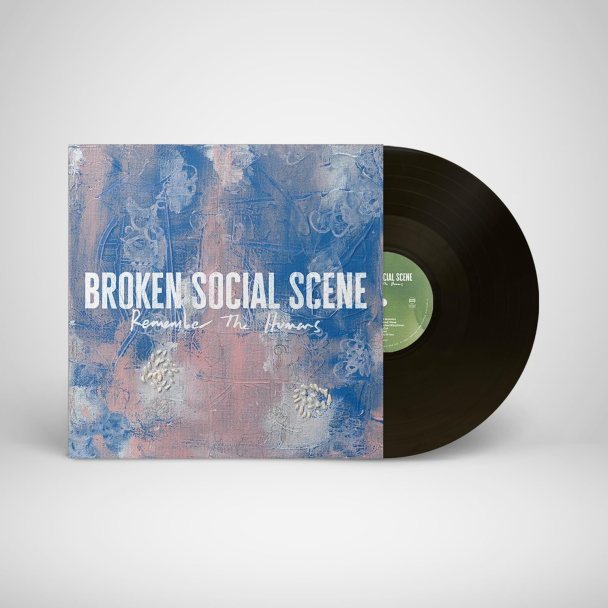
Broken Social Scene - Remember The Humans [LP]
Remember The Humans is out 5/8 via Arts & Crafts.