
March 1, 1997
- STAYED AT #1:1 Week
In The Alternative Number Ones, I’m reviewing every #1 single in the history of the Billboard Modern Rock Tracks/Alternative Songs, starting with the moment that the chart launched in 1988. This column is a companion piece to The Number Ones. The column is now biweekly, alternating with The Number Ones on Mondays.
I saw Live twice in the '90s. My story is not unique. Live played a great many shows during the '90s. They toured hard, and they ended up on a lot of festival bills. If you were even halfway interested in alternative rock during that decade, and you were at an age where you were going to see live music, and maybe even especially if you were at an age where you were starting going to see live music, then you could've easily seen Live multiple times. You could've seen Live multiple times without even intentionally going to see Live. You could just be at a music festival, and bam, there's Live. My two accidental Live music-festival experiences were four years apart, and they were very different from one another.
The first time I saw Live, it was summer 1994, and I was 14 years old. Live had just landed their first alt-rock chart-topper with "Selling The Drama," but they weren't really famous yet. They played early in the afternoon on the main stage at Peter Gabriel's WOMAD Festival, which had all these international musicians whose names didn't even make it into the show's newspaper listing. Live were big enough to be in the newspaper, but they were on the bill below Gabriel, Midnight Oil, and Arrested Development. Fruitopia sponsored this festival. I saw the slam poet from the beginning of Higher Learning perform in a tent. This was my second concert ever, and it was the most 1994 thing you can imagine.
I only have hazy memories from Live's set that day, but I remember them as gawky and earnest collegiate types. Live were from right up the road in York, Pennsylvania, so the Merriweather Post Pavilion show was basically a hometown gig for them. But they didn't walk out onstage like local heroes. Instead, they were almost aggressively nondescript. I knew a couple of studious, serious older kids from Boy Scouts, and Live reminded me of those guys. They didn't sound anything like They Might Be Giants, but they came off like guys who loved They Might Be Giants. I liked them.
In 1998, I saw Live at the Tibetan Freedom Concert. They were the same band, but those earnestly nerdy collegiate types were gone. Once again, Live were onstage early in the afternoon, but this time, they were on a bill with the heaviest hitters of that moment: the Beastie Boys, Pearl Jam, the Red Hot Chili Peppers, Radiohead, R.E.M. Live sold more records than lots of the other bands on the bill, but they didn't have the same cultural gravitas. Frankly, they were lucky to be there.
The band's name makes photographic evidence of this show difficult to Google, but my memory is that Ed Kowalczyk came onto that stage rocking a shaved head, some leather pants, a chain wallet, and one of those sheer red clingy see-thru longsleeve shirts. This guy believed his own hype. He thought he was a rock star. Later that day, the show got shut down because someone in the crowd literally got struck by lightning, not even during "Lightning Crashes" or anything. (My friends were worried about me when they heard about it on the radio because they figured I'd be the tallest one there and thus the most likely to be hit by lightning. But no, I didn't get hit. I was fine.) Most of the acts whose sets were canceled on that day were rescheduled for the next one, but the storm meant that I didn't get to see Beck or Kraftwerk or Patti Smith. One of my biggest takeaways was, "Damn, and I had to sit through that Live set, too." They sucked.
In between those two live Live experiences, the band's Throwing Copper album blew the fuck up and sold eight million copies. Live went from WOMAD Festival opening-act status to full-on arena headliner. In an attempt to build on that success, they flew to Jamaica, rented a house, and sat around getting fucked up and brainstorming. Then they went off and made Secret Samadhi, a pretentious and self-serious disaster of a follow-up record. It sold way less than Throwing Copper, and Live pretty much ceased to be a remotely relevant presence. They had radio success after Secret Samadhi, but when they played the Tibetan Freedom Concert in 1998, that was probably the last moment that they might be invited to play something like that. It was all downhill from there.
Naturally, we're here to talk about the first single from Secret Samadhi, an album that I'd managed to blissfully avoid hearing in full until this very moment. Whoof. Yikes. What a fucking bore. This record was considered a crushing commercial disappointment at the time, but still, two million Americans paid actual money for that. Napster happened for a reason.
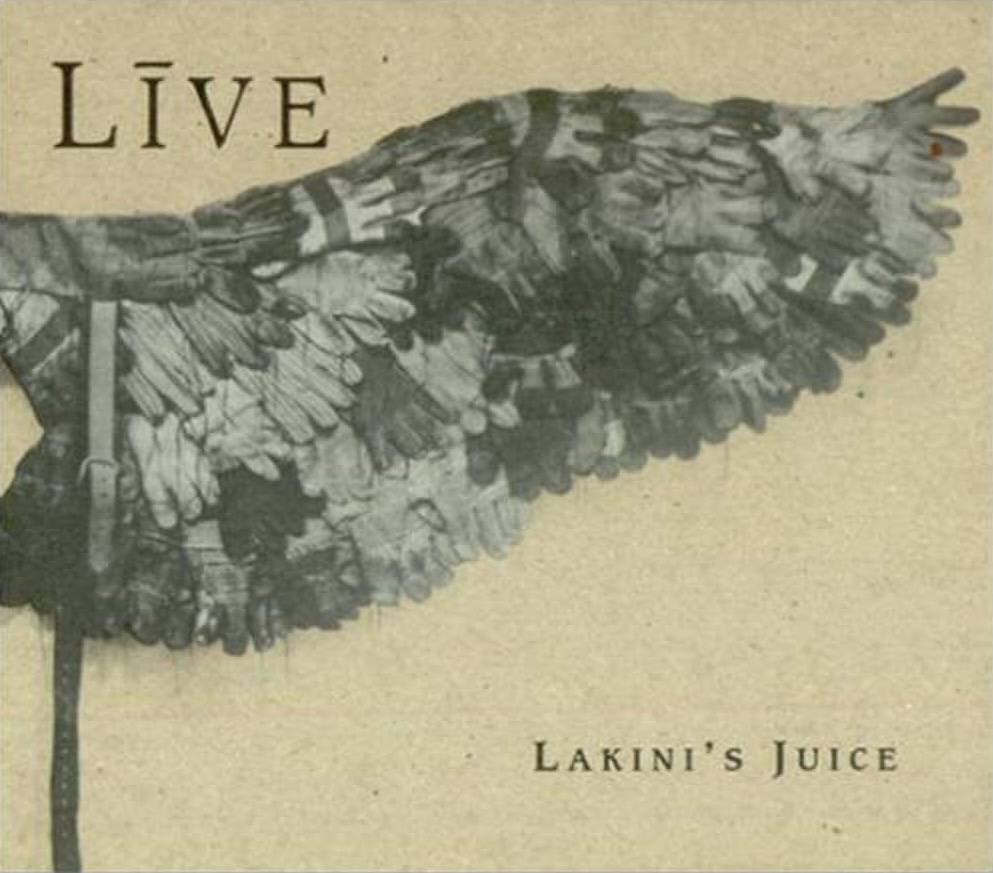
Live introduced Secret Samadhi to the world with a song called "Lakini's Juice." The most notable thing about "Lakini's Juice" is the fact that it's called "Lakini's Juice." That is a very mysterious and memorable title! I don't know if it's a good title, but it sticks with you. It sticks with me much more than the song itself, which is not remotely memorable. That's one of the good things about it. I'm glad it's not memorable. If I did remember the song, the memories would not be pleasant. What I'm saying is: It's butt. This song is butt.
Let's get into this title business. Lakini is some kind of Hindu goddess, but she's not one of the main ones. When I try to Google her name, the first thing that comes up is "Lakini's Juice." Some articles about Live claim that Lakini is the Hindu goddess of destruction, but no, that's Kali. As far as I can tell, "Lakini" is not some alternate name for "Kali." Instead, Lakini rules over the Manipura chakra, which has something to do with yoga and tantra. I don't know what her juice is, but the Manipura chakra is right behind the stomach, so maybe it's, like, digestive fluid? Bile? Ed Kowalczyk did sing a lyric, on a very popular song, about a placenta falling to the floor, so this does not seem outside the realm of possibility.
But of course, we're not supposed to know what Lakini's juice really is. We are dealing with poetry here. Ed Kowalczyk himself evidently isn't entirely sure what "Lakini's Juice" is about. There's at least one lyric on "Lakini's Juice" that suggests the titular juice could be river water, a recurring lyrical image for Live. There's also this line: "More wine 'cause I got to have it/ More skin 'cause I got to eat it." So maybe the juice is wine? Or... skin?
We must also consider the song's most quotable lyric: "I rushed the ladies' room/ Took the water from the toilet/ Washed her feet and blessed her name." There's not really any setup for that part. Kowalczyk does identify whose feet he's washing or whose name he's blessing, nor does he explain why he would do such a thing. It that supposed to be romantic? I simply cannot fathom what's happening there. In any case, there's a non-zero chance that Lakini's juice is toilet water, which raises more questions than it answers.
But those lyrics don't come from the chorus of "Lakini's Juice." The chorus is mostly just Ed Kowalczyk howling the phrase "let me ride." Like he was Dr. Dre. Like he was Montell Jordan. "Let me ride" could conceivably mean a bunch of things, but most of those things are sexual in nature. It follows that Lakini's juice is also somehow sex-related. So there we go. Mystery solved. Kowalczyk is simply inventing groundbreakingly pretentious new ways to sing about fucking.
Samadhi, by the way, is a state of mental tranquility, assumed through meditation. From the very first Live album, Ed Kowalczyk was sprinkling his lyrics with vague references to Eastern mysticism, but he really went nuts on that shit on that shit with Secret Samadhi. He went nuts on all kinds of shit. He sang about being full of "laughing gas and ennui," and he really made a meal of the word "ennui," stage-whispering it like "ann-yah-whee!" He speak-sing rambled accusatory opacities: "She picked you from a lineup in downtown Philadelphia with a cigarette in your mouth and Henry Miller in your back pocket, you little fucker!" This guy was feeling himself.
Live had recorded their two previous albums with former Talking Heads multi-instrumentalist Jerry Harrison producing. For Secret Samadhi, they went a different direction, co-producing themselves with Jay Healy, an engineer who'd worked on big records from Cher, Whitney Houston, Billy Joel, Bruce Springsteen, and Mariah Carey. He'd also engineered for alt-rock bands like R.E.M. and the Replacements, but he didn't really have any production credits. My guess is that he was willing to stay out of Live's way. If they wanted to put detuned guitars and extraneous strings on their lead single, then Healy was going to help them do it.
That's what they did, anyway. "Lakini's Juice" is a big fucking mess. I already spent several paragraphs making fun of the lyrics, which could not possibly be stupider or more leaden than they are. If the lyrics were the only issue, I would still make fun of them, but I could get past it. The song, however, begins with Ed Kowalczyk growling those lyrics, with stick-up-his-ass intensity, over a grinding and downtuned riff from guitarist Chad Taylor. I can't get past it. It's like Taylor heard the first Korn album and decided that he could do that. He could not do that. (Korn will never appear in this column, surprisingly enough. They never even really came close. Their highest-charting Modern Rock single, 2002's "Here To Stay," peaked at #4. It's a 6.)
When Kowalczyk completes his awkwardly barked-out first verse, the strings come in. I know what the strings are supposed to do. They're supposed to give this song a certain majestic weight. Basically, Live were trying to make Led Zeppelin's "Kashmir," another bloated rock song with a dubious fixation on Eastern mysticism. But "Kashmir" has the advantage of being an all-time banger. "Lakini's Juice" is simply not that. Here, the strings clash horribly with the scrunge of the riffage, which makes the whole thing sound even uglier and more unwieldy. Live existed before the grunge explosion, but "Lakini's Juice" sounds just like the hamfisted post-grunge butt-rock that took over the radio a few years after the single's radio reign. I guess that means "Lakini's Juice" was ahead of its time, but only in the worst possible way.
Now: I love a crescendo, and "Lakini's Juice" has a couple of those. When the chorus hits and Kowalczyk bellows about letting him ride, the guitars and strings finally lock in and do something that makes sense together. It's cheap power-chord mush, but it's effective. Kowalczyk really can yowl, and that's the part where he finally sounds like he's being euphorically swept along in a surging tide, which is how he sounds when he's at his best. The song's final minute even convincingly rocks, and that probably elevates the rating at the bottom of this page by a full point. But the build is so grating and unpleasant that the number is still quite small.
I guess this is where we talk about the "Lakini's Juice" video. Director Gavin Bowden had already done the Butthole Surfers' "Pepper" clip, and his work will appear in this column again. He was a professional, anyway. He and Live clearly thought they were saying something with the "Lakini's Juice" video, but I'm not sure they worked out quite what it was. A middle-aged bald guy in a bow tie builds sculptures out of what appears to be lard while a bunch of people mill around a locker room in their underwear, holding tickets with numbers. They pair off and get busy, having implied sex on a bed in the middle of the room, while everyone watches.
It looks like amateur porn, but it's probably supposed to say something about society putting us into arbitrary groupings, etc. The guys in Live sit around moping, fully clothed, so we get that they're not enthusiastic participants in this butcher-shop orgy or whatever. They disapprove. When the video ends, it's Ed Kowalczyk sitting on the bed next to one of the women in the room. His shirt is half-buttoned, and his eyes are glazed. It's a textbook example of that moment's fake deepness. Somebody wanted to make a flagrantly horny video, but they didn't want it to be as cartoonish as "Cherry Pie," so they went with this instead. Personally, I prefer sincere horniness to horny sincerity. The best thing I can say about it is that Kowalczyk had finally cut off his stupid bald-head ponytail.
Secret Samadhi came out in February 1997 and debuted at #1. "Lakini's Juice" didn't really have legs as a radio song, but it got the bump from the previous Live album. It managed a solitary week at #1 on the Modern Rock chart and went #2 Mainstream Rock. Years later, in a Rolling Stone feature on the band's bitter dissolution (a subject we'll get into below), Chad Taylor said, "All these people were like, ‘You can’t call the song "Lakini." You can’t name the record Samadhi.' Then the worst thing that could possibly have happened to our egos happened: It came out and debuted at #1. In my mind, as a pretty young guy, I was like, 'Well, the world can just fuck off because you’re wrong.'"
The world was not wrong. Secret Samadhi earned dismal reviews and did not sell anywhere near as well as Throwing Copper. Follow-up single "Freaks," which is just as absurd as "Lakini's Juice," peaked at #13. Later in 1997, Live reached #3 with "Turn My Head," another truly overblown track from the LP. (It's a 4.) Secret Samadhi ultimately went double platinum, so it wasn't an outright disaster. But the moment was over. Live were never going to become rock titans.
Live hung around for a bit. They got back together with producer Jerry Harrison on their 1999 album The Distance To Here, and their absolutely absurd single "The Dolphin's Cry" peaked at #3. (It's a 5, which counts as a bounce-back for this band.) That was Live's last top-10 hit on the Modern Rock chart. The Distance To Here went platinum, though, and a few of its follow-up singles charted.
At some point, Ed Kowalczyk got all buddy-buddy with trip-hop auteur Tricky, who appeared on "Simple Creed," a track from Live's 2001 album V. (It peaked at #18. For his part, Kowalczyk appeared on Tricky's 2001 single "Evolution Revolution Love," which peaked at #35, giving Tricky the only Modern Rock chart hit of his entire career. Not his best work, in my opinion.)
In 2004, Live released a greatest-hits album, and they included a grunged-out cover of Johnny Cash's "I Walk The Line" as a bonus track. A year later, American Idol contestant Chris Daughtry basically covered Live's cover of "I Walk The Line" and passed off the arrangement as his own idea. Daughtry fessed up to biting Live, and the band didn't bear him any ill will. Eventually, Live and Daughtry performed "I Walk The Line" together, so don't worry about any Live/Daughtry beef. It's been squashed. (Daughtry's only Modern Rock hit, 2007's "It's Not Over," peaked at #17.)
But you know what hasn't been squashed? The intra-Live beef. Those guys hate each other. The members of Live all grew up together York, a place that they immortalized as "Shit Towne." You'd think that their shared experiences might bond them, but that's not what happened. Over the years, Kowalczyk gradually wrestled control of the band, and of the publishing royalties, away from his childhood friends, and Chad Taylor particularly resented it. In 2009, the band agreed to take a hiatus. Kowalczyk went off to make a solo album, and the other guys got together with a couple of Candlebox members to start a new band called the Gracious Few. Those two ventures were not particularly successful.
In the years after Live's peak, Chad Taylor developed a drinking problem and got involved with business partner Bill Hynes, a deeply sketchy figure who'd already been convicted of felony check forgery and who would later face a whole raft of criminal charges. In 2012, Taylor put together a new version of Live with the other two guys but without Ed Kowalczyk, replacing him with Chris Shinn, the son of the owner of the Charlotte Hornets. At one point, they sued Kowalczyk for touring as "Ed Kowalczyk of Live."
In 2016, Ed Kowalczyk reunited with the other Live guys, and they headed back out on the road together. Things did not go smoothly. In the aforementioned Rolling Stone piece, drummer Chad Gracey accused Taylor of sleeping with his ex-wife and of punching bassist Patrick Dalheimer's wife in the face; Taylor denied both accusations. In 2022, Kowalczyk kicked Taylor out of Live in an Instagram post, writing, "As of last evening, I own 55% of Live. Chad Taylor is fired. He will never stop the music again."
Soon afterward, Kowalczyk also fired both Gracey and Dalheimer. Kowalczyk basically staged a hostile takeover of his own band. Live still exist as a touring entity, and Kowalczyk and his ex-bandmates figured out an agreement where the other guys would get a portion of the band's performance fees. Also, Gracey got into QAnon stuff, and he sued both Taylor and Dalheimer. Rock 'n' roll, baby.
Earlier this year, the other three Live members, having settled whatever lawsuits they had against one another, got together to hit Ed Kowalczyk with a cease and desist letter, announcing that they were removing Kowalczyk from the board of the company that controls Live's intellectual property and that they were terminating Kowalczyk's rights to use the Live name. But Kowalczyk is still touring with his version of Live, and he claims that his ex-bandmates' legal action has no merit. The matter remains ongoing. Even if you never really liked this band, they've gone out in about the most depressing way you can imagine. A lot of '90s alt-rock bands ended because people died young, and the Live saga somehow feels more depressing than any of those.
If I were to see Live today — they've got shows coming up in Pennsylvania and South Africa later this year — I doubt that what I'd see would have anything to do with the versions of the band that I saw in 1994 and 1998. I'm not saying that just because there's only one original member left in the band. I'm saying it because there's no way anyone associated with Live could possibly believe in their own relevance today. That's long over. Live had their moment, and their moment definitively ended around the time that they released "Lakini's Juice." The only thing left to do is to squabble over the crumbs.
GRADE: 3/10
BONUS BEATS: There's something beautifully absurd about the idea of Live performing a song as clownishly self-serious as "Lakini's Juice" on Saturday Night Live, a show ostensibly dedicated to intentional comedy. But it happened! Here they are, playing that song on a 1997 episode hosted by fellow toxic cautionary showbiz tale Chevy Chase: