

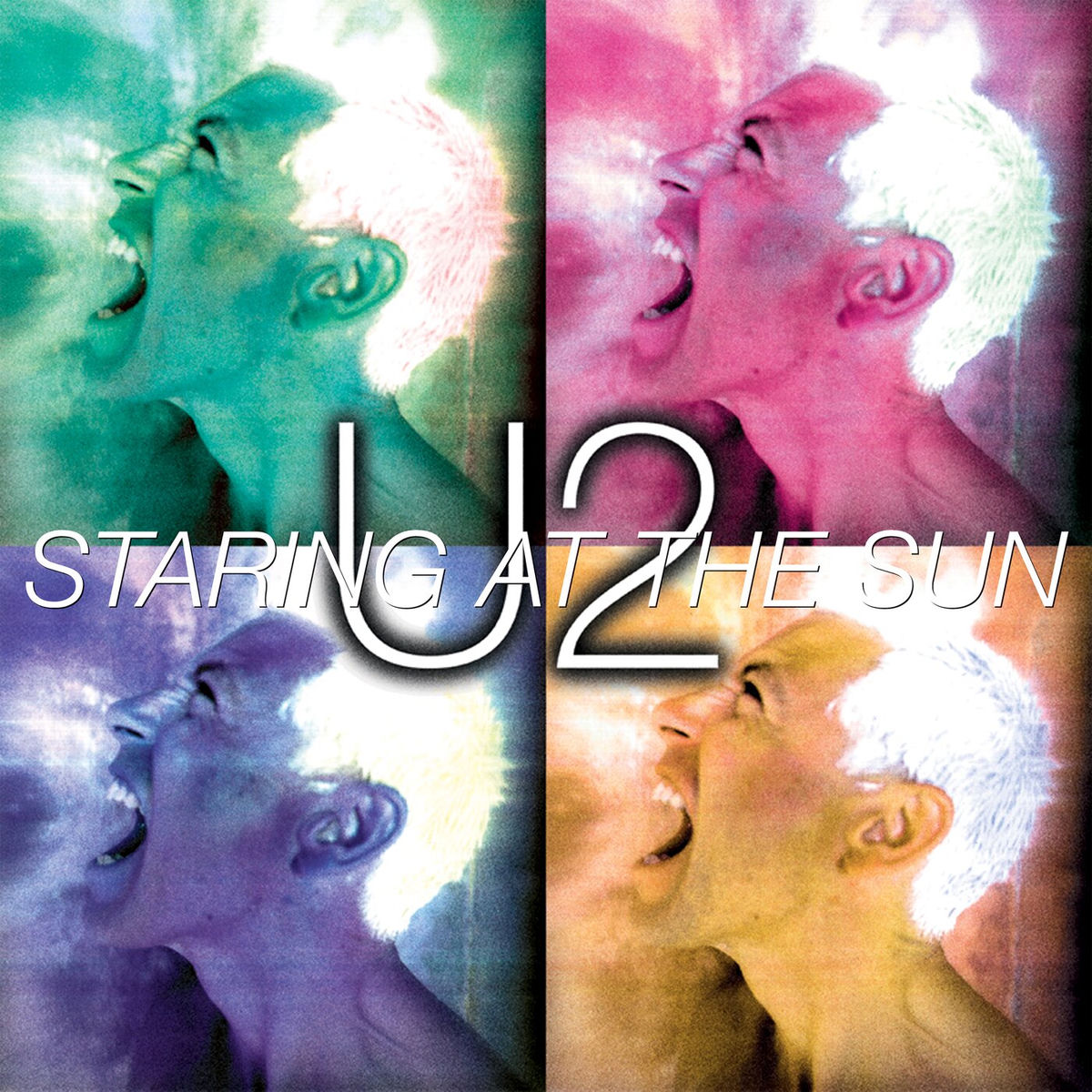
April 12, 1997
- STAYED AT #1:3 Weeks
In The Alternative Number Ones, I’m reviewing every #1 single in the history of the Billboard Modern Rock Tracks/Alternative Songs, starting with the moment that the chart launched in 1988. This column is a companion piece to The Number Ones. The column is now biweekly, alternating with The Number Ones on Mondays.
Pop happened because U2, like a lot of aging rock bands, got sick of the sound of rock bands. It's an old story: A hyper-serious, messianic guitar band ascends to the absolute heights of what such a group can represent, and then they decide that they'll have to become a completely different thing in order to further transcend. When you reach that stage, it's not just that you need something new to jolt yourself back into a stage of total excitement. It's that you believe the entire world needs that jolt, that you need to figure out how to supply it.
While U2 worked on their 1997 album Pop, getting club producer Howie B into the mix and messing around with rave-style drum loops for the first time, the great rock writer Ann Powers went out to Dublin to interview them for a SPIN cover story. The Edge, a man who famously plays the guitar, told Powers, "The sounds that a guitar is capable of creating are at this point cliché. The challenge is to find things you can do with the instrument that are not already used up." Bono agreed: "We're actually trying to make a kind of music that doesn't exist yet. That is a terrifying place to be."
Thus: Pop, a messy and expensive-sounding record full of synths and loops and disco howls and carefully textured swoonery. That's the version of U2 that we heard on "Discothèque," the first single from Pop, and it's the one that held the the PopMart tour-announcement press conference in a K-Mart lingerie section and then used a gigantic malfunctioning disco-ball lemon as the tour's key prop. But even when they got as far as they could into postmodern showmanship, U2 couldn't quite shed their sincerity. Maybe that's why the biggest song that they made in that moment is the one that sounds most like an Oasis ballad.
Today, Pop is generally remembered as one of the great follies of U2's storied career, not least by the members of U2 themselves. The general consensus is that U2 got too far up their own asses and had to strip everything back and rediscover who they were. But Pop has its share of self-important sensitivity, and the narrative never really takes "Staring At The Sun" into account. "Staring At The Sun" is a big, heartfelt ballad, and U2 already had plenty of those in their catalogue. But "Staring At The Sun" doesn't work quite the same as those past U2 ballads. Instead, it seems designed to function as an acoustic-guitar campfire singalong — something like "Wonderwall."
This gets a little complicated because Oasis were explicitly aiming to achieve U2 status when they made Be Here Now, their own overproduced, commercially disappointing big-statement 1997 album. Around the time that Oasis hit their peak, Noel Gallagher became friendly with Bono, who attempted to take Oasis under his wing at least once. Liam Gallagher, on the other hand, talked shit about U2 at every opportunity, a neat little summation of the attitudinal differences between the two Gallagher brothers. In June 1997, Oasis actually opened two Oakland shows on the PopMart tour. In that SPIN story, the Edge admitted that he wasn't sure that his 12-year-old daughter would like Pop very much: "Actually, she seems to be into Oasis."
As far as I know, nobody in U2 has ever said that they were trying to bite Oasis when they made "Staring At The Sun," and nobody in Oasis has ever accused U2 of ripping them off. Still, the two bands were certainly aware of one another, and their ambitious tendencies must've led them into some level of competition. You wouldn't hear "Staring At The Sun" on the radio and confuse it for an Oasis song, but it's got the general grandeur, the strummy guitars, the yearning chorus, and the vaguely psychedelic sensibility. If U2 weren't specifically attempting to make an Oasis song, they must've felt at least some subliminal urge in that direction. It's the one Pop song that directly echoes Britpop.
U2's "Staring At The Sun" isn't the best song with that exact title; that distinction belongs to the one that TV On The Radio released six years later. Lots of other songs are called "Staring At The Sun," too. It's a pretty obvious metaphor. There's this giant shiny thing up in the sky. It makes all life on earth possible, and it looks beautiful. But if you ignore your self-preservation instincts and look directly at that thing for too long, you burn your eyes out and go blind.
U2, much like Oasis, prefer to write lyrics that seem vaguely meaningful but that generally aren't about anything concrete that you can identify, and "Staring At The Sun" mostly fits the bill. Plenty of what that Bono sings on that song is both clumsy and opaque: "Intransigence is all around/ Military's still in town/ Armor-plated suits and ties/ Daddy just won't say goodbye." But the chorus is plain enough. The world, then as now, is absolutely fucked in a million ways, and it'll drive you insane if you think about it too hard, so you just live your live as if all these nightmares don't constantly threaten your existence. Bono's not the only one staring at the sun, happy to go blind.
Bono and the Edge wrote "Staring At The Sun" together, and they had at least some of it done before U2 got to work on Pop. Maybe that's why the song never goes all-in with digital trickery. The drums don't even show up on the track until it's nearly a minute in, except in the form of some little clicks that you can hear under the guitars. When they arrive, they sound processed and possibly programmed. Where many of the songs from Pop went for electronica gloss, the funky pulsations on "Staring At The Sun" are mostly subtle. On the third verse, the riffs mostly fade out, giving way to a fuzzed-out bassline and a few clicky notes. It sounds cool, but it also stretches the song out longer than it should probably be. When the chorus comes back around and the guitars crash in again, it's a relief.
The whole point of "Staring At The Sun" is that chorus. Bono mostly sounds like he's murmuring nonsense, killing time until he gets to wail out the part that everyone knows. His voice sounds great throughout. He hits graceful little falsetto parts, floating prettily and effortlessly until it's time to belt. But this is absolutely one of those songs where you might attempt to sing it at karaoke before realizing that you don't even know the cadence of the verses.
The chorus is also where Edge's guitar fully flares up, doing anthemic twinkly underwater notes. I think the song might work better if he went for the full echoed-out wall-of-shimmer church-bell approach that he employed all through the '80s, but he was trying to get away from that sonic trademark, to become known for something else. In any case, "Staring At The Sun" still works well enough without Edge sounding like Edge. It's a big, solid song — not one of U2's best, but nowhere near one of their worst, either.
Now that I think about it, "Staring At The Sun" sounds like a lot of other stuff, not just Oasis. If you tweaked a few things, it could be "Black Hole Sun"-style Soundgarden power ballad. If you tweaked a few others, it could be the Wallflowers, with those high Edge notes rendered in steel guitar. In the way that it builds quiet little trip-hop textures into its reassuring grace, "Staring At The Sun" also might've anticipated some of the sleekly sophisticated adult-contempo hits of the early '00s. Maybe it's the secret missing link between Oasis and Dido.
By most accounts, U2 knew that "Staring At The Sun" was the biggest commercial play on Pop, though they didn't release it as the first single. Five years earlier, U2 held "One" back through the early stages of the Achtung Baby album cycle, and then that song became an inescapable smash when they finally unleashed it on the world. Maybe U2 figured that the same thing would happen with "Staring At The Sun." It did not. The song reached #3 in the UK, but it didn't do anywhere near as well in most of the world. On the Hot 100, it stalled out at #26. But American rock radio loved "Staring At The Sun," and the song almost pulled off the same hat trick as "One Headlight" before it. "Staring At The Sun" went #1 Modern Rock, #1 Adult Alternative, and #2 Mainstream Rock. I definitely heard the song enough to get sick of it.
U2 might've been sick of it, too. The single came out the day before the PopMart tour kicked off in Las Vegas, but when U2 tried to play that song at that show, they fucked it all up and had to restart it. They just couldn't get the tempo right. I've seen a million bands make the same mistake at a million shows, but I've never seen that happen at a stadium. As the tour wore on, U2 stopped playing the album version of "Staring At The Sun," figuring out that it worked a lot better with just Bono and the Edge on acoustic guitars, unaccompanied. As with "Discothèque," U2 remixed and partially re-recorded "Staring At The Sun" when it appeared on a greatest-hits album a few years later. They thought they'd rushed Pop so that the album would come out before the tour started, and they wanted a do-over.
U2 are among the defining bands of the alternative rock radio format, and they've never disappeared from those stations. But after "Staring At The Sun," U2 went seven years without topping that chart. Pop went platinum only once, which was pretty bad for a U2 album. The next two singles didn't do anywhere near as well, with "Last Night On Earth" peaking at #11 and "Please" getting stuck at #31. On the 1997 Pazz & Jop poll, Pop came in way down at #31, with the odd couple of the Prodigy's The Fat Of The Land and Patti Smith's Peace And Noise tied above it. (Pop did, however, place one spot ahead of Built To Spill's Perfect From Now On, which is crazy.)
It wasn't like U2 stopped being famous or successful, though. The PopMart tour went all over the world, taking up a full year of the band's lifespan. Something like four million people went to see U2 on that run, which means the tour did significantly better than the album. In September 1997, U2 played Sarajevo, staging the city's first large-scale concert since the end of the Bosnian War. U2 were already way too big for a relatively unsuccessful album to ding them too badly, but they knew that they needed to change course.
In 1998, just after the PopMart tour wound down, U2 released a best-of collection of their '80s work, which served as a nice little reminder of what the band once was. The band re-recorded "Sweetest Thing," a 1987 song that originally appeared as the B-side on their "Where The Streets Have No Name" single (and on the Scrooged soundtrack), as a bonus track. The song's new version didn't really sound like '80s U2, but it had an unforced charm that felt pretty far removed from Pop. (That "Sweetest Thing" re-recording peaked at #9. It's an 8.) Two years later, "The Ground Beneath Her Feet," a one-off song for the Wim Wenders movie The Million Dollar Hotel, peaked at #20.
In 2000, U2 decided that they wanted to be U2 again. The quote that everyone repeats is this: "We're re-applying for the job... The job is the greatest band in the world." That's something that Bono told the crowd when U2 played a secret show at London's Astoria in 2001. U2 had just reunited with their old producers Daniel Lanois and Brian Eno, and they'd made All That You Can't Leave Behind, an album that leaned into vast and life-affirming melodies rather than dance beats. The Edge even brought back the echo-drenched guitars. The world received All That You Can't Leave Behind as the return to form that U2 intended. Lead single "Beautiful Day" was an international hit that became one of the band's biggest songs. On the Modern Rock chart, though, "Beautiful Day" peaked at #5. (It's a 9.)
With All That You Can't Leave Behind, U2 effectively reestablished themselves as grand-scale populists. They were done messing around with experimental side-quests, with trying to make the kind of music that didn't exist yet. Instead, they made U2 music. This was what the world wanted from them. All That You Can't Leave Behind lost the Album Of The Year Grammy to the O Brother, Where Art Thou? soundtrack, but two of its singles, "Beautiful Day" and "Walk On," won Record Of The Year in back-to-back ceremonies. (On the Modern Rock chart, "Walk On" peaked at #10. It's an 8.)
On the 2000 Pazz & Jop chart, All That You Can't Leave Behind came in at #7, between D'Angelo's Voodoo and Yo La Tengo's And Then Nothing Turned Itself Inside Out. It went quadruple platinum — the best sales for any U2 LP since Achtung Baby. The album's feeling of tender optimism seemed to gain even more cultural weight after 9/11, and U2 threw themselves into the collective mourning. U2 played three straight shows at Madison Square Garden in October 2001. They did the Halftime Show at the 2002 Super Bowl, with the names of people who died in the attacks projected on a screen behind them.
But even with all the love that came their way, none of the band's All That You Can't Leave Behind singles topped the Modern Rock chart. U2 certainly kept themselves in alt-rock rotation, and three of the album's singles reached the top 10. (The fun, overdriven "Elevation," the third, peaked at #8. It's an 8.) In 2002, they reached #14 with "Electrical Storm," another bonus track from another best-of collection. Nevertheless, this aspiring "greatest band in the world" version of U2 didn't make the kind of music that could conquer alternative radio in its butt-rock era. They'd have to wait a few more years for that. U2 still had one more chart-topper left in them, and we'll see them in this column again.
GRADE: 7/10
BONUS BEATS: In 1998, U2 guested on the 200th episode of The Simpsons. Here's the scene where Homer Simpson, running against Steve Martin for the Sanitation Engineer seat in Springfield, interrupts a PopMart show:


