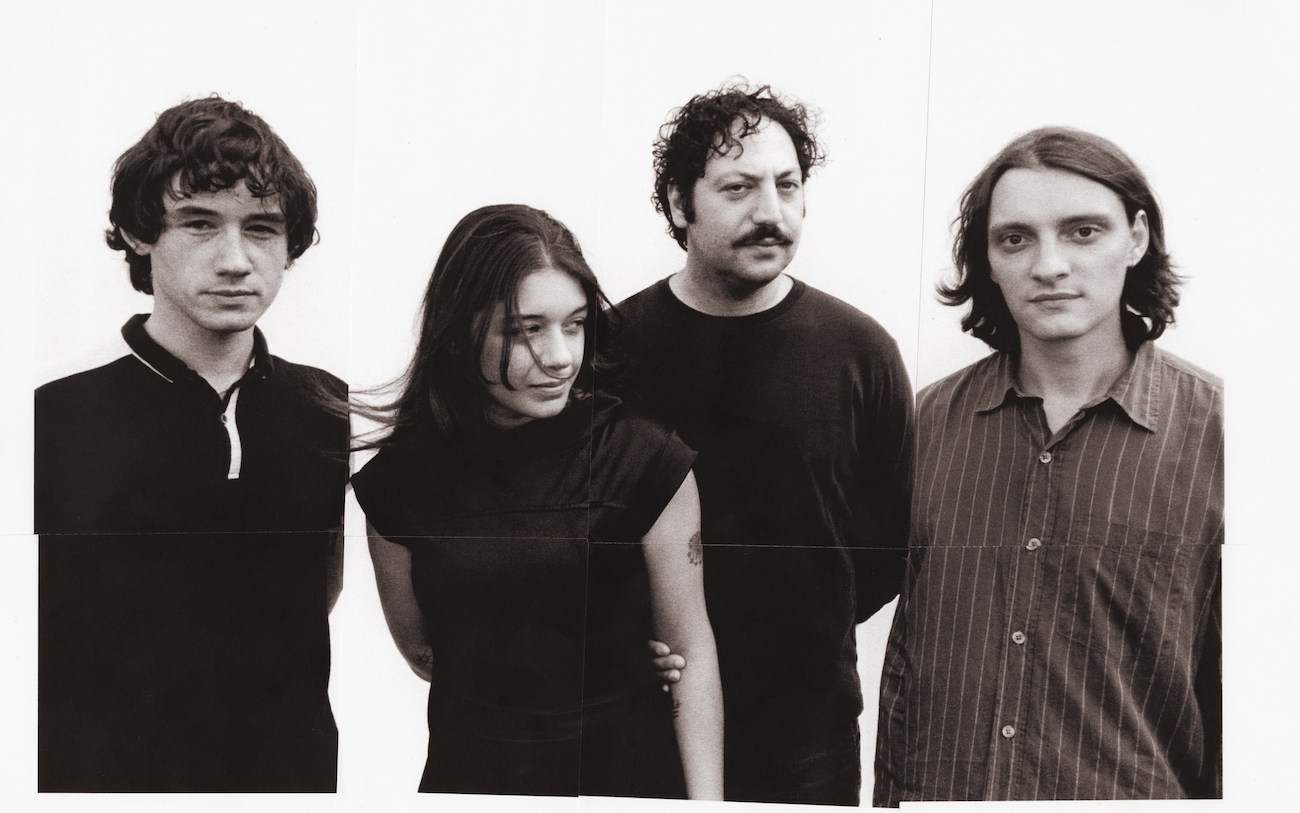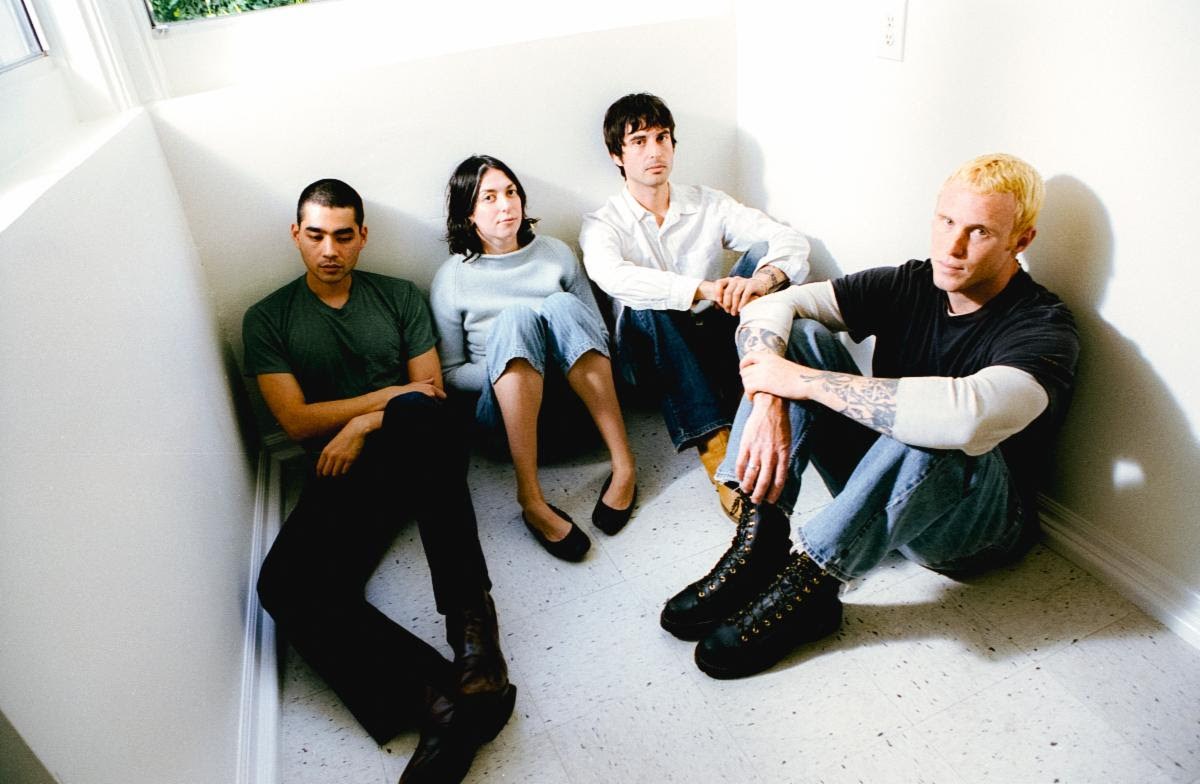

Don Caballero are back. Earlier today, the Pittsburgh instrumental band that co-pioneered and later perfected math rock during their original ’91-2000 run, answered fans’ longstanding prayers by announcing an upcoming reunion of their Y2K-era lineup. A couple weeks ago, as the members geared up for a busy 2027, including a stop at Primavera Sound, they sat around bassist Eric Emm’s home in a pastoral Connecticut suburb, swapping quarter-century-old tour stories.
There was the time in Atlanta when drummer Damon Che threw a cymbal stand into a venue wall, making a sizable hole. The owner, who also happened to be the soundman, proceeded to heckle them throughout their set.
“‘That was a good song,’” guitarist Ian Williams recalls him saying into a mic fully audible to both band and audience. “‘Too bad you guys are assholes.’”
Then there was the LA festival when they went over their allotted set time. Stagehands tried to cut them off, but the band refused to stop playing, leading to a surreal sonic pileup.
“They made Granddaddy go on right next to us as we were still playing,” Williams continues. “They turned the PA off, but we just kept going and people were furious at us and screaming.”
In the fall of 2000, not long after the events described above, and just a month after the release of American Don — their wondrous, Steve Albini–recorded fourth LP, which wedded crystalline guitar loops and ingenious future-prog riffs to Che’s thunderous yet supple drumming — the band imploded. (The final stressor: a harrowing van wreck en route from Toledo to Detroit, during which two separate 18-wheelers slammed into their vehicle after they skidded out on an icy interstate.)
In revisiting the chaos that seemed to hover over the project, eventually fracturing their musical and personal bond, the members can now see the humor in it all.
“There was always a comic element to our doom,” Williams says.
“It’s some funny shit,” Emm concurs.
Even Che, the group’s sole remaining co-founder and most reserved member, can be seen cracking the faintest hint of a smile.
After the breakup, Williams and Emm, who played together in the avant-rock band Storm & Stress before and during their shared time in Don Cab, remained friends. But for close to 20 years after that ill-fated 2000 tour, Che was estranged from his ex-bandmates. Williams went on to launch Battles, building on the loop-driven approach of American Don, while Che later relaunched Don Cab with new musicians. (When the two bands briefly crossed paths in 2007 at Austin’s Fun Fun Fun Fest, Williams recalls Che sending an ironic air-kiss his way.) Starting in 2008, Emm kept busy with beloved indie-pop outfit Tanlines.
Relations began to thaw in the late 2010s, when the ex-bandmates connected on an email chain about licensing one of their songs to a movie, then continued corresponding about an in-progress documentary and book on Don Cab’s history. It was on subsequent Zoom calls that, Che says, “We realized how much we missed each other’s company.”
“It’s the people who you knew in your twenties, which were formative years,” Williams says, “and having those people back in your life was satisfying.”
A key development was that Che had gotten sober in the interim. He’s the first to credit his heavy drinking as a major contributing factor to the volatility of the American Don era, saying, “Alcoholism is a constant roadside IED.”
After their years out of touch, Emm was pleased to encounter a much-evolved Che.
“You could see when we started doing video calls and stuff,” he says. “‘Oh, Damon's got a different aura.’”
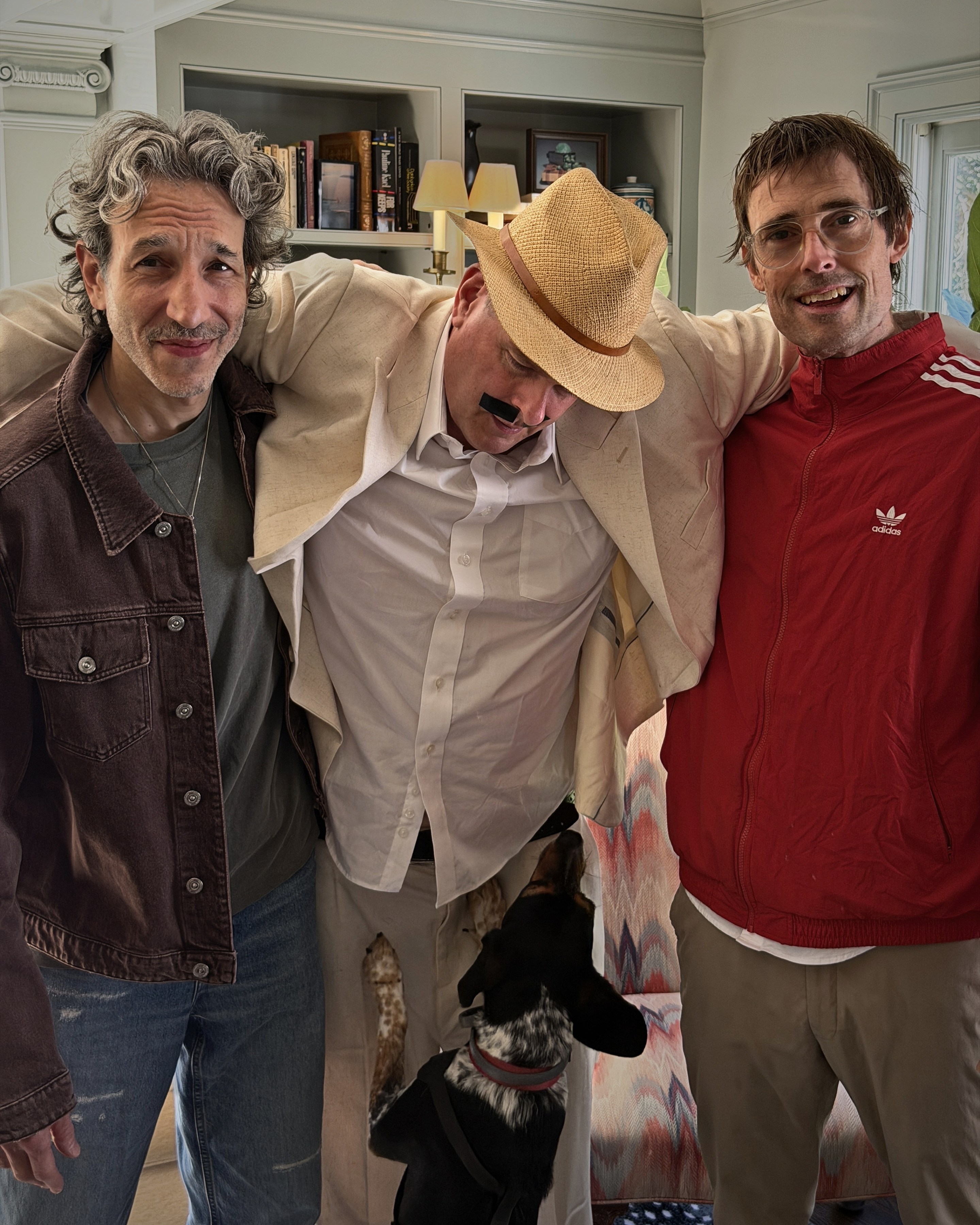
An Instagram photo showing the American Don lineup happily reunited at a 2025 New York show by Che’s current band Yesness tipped fans off that the lines of communication were open. When we visited the band in September, the easy camaraderie within the band these days was palpable, as the three fiftysomethings sat in Emm’s quiet, light-filled library with Che’s beagle mix Harvey slumbering peacefully on the couch next to the bassist.
One lingering sore point was American Don itself, which, despite its now-classic status, some in the band were never happy with. Live, Williams and Emm had performed the songs by stacking up layers of loops. But when they showed up to track at Albini’s Electrical Audio facility — where Che had pushed to record because of its newly built Studio A, which yielded the album’s massive drum sound — they realized that their pedals only had mono outputs. In order to realize the immersive stereo blend heard on the finished record, they had to resort to overdubs.
“This shift allowed for some magic moments of improv,” Emm wrote of the recording process in the liner notes to a recent 25th-anniversary reissue from original label Touch and Go, “but once the album was done, we felt the overall effect was a bloated sound and sluggish performances.”
(A live-in-the-room version of the album’s tracks, recorded after the original sessions by Albini’s close colleague Greg Norman, is included on the reissue as True Live Tapes.)
At first the three were happy just to be back in touch, but the idea of playing again soon arose.
“I didn’t want to play again for a while; we were just friends,” Williams says. But as the notion of a reunion came up repeatedly, he continues, “I saw it in a way that could be interesting.”
“I was really happy with where we were as a band musically, although I think that that record was an imperfect record and it didn't quite capture what we were at that point,” he adds of American Don. “So it felt like a chance again to sort of revisit that moment and try it again.”
Emm felt a similar desire for a do-over.
“I think somewhere there's always been like, ‘Well, I don't want to live the rest of my life with that unsatisfying ending,’” he says.
For fans who might be wondering about the status of guitarist Mike Banfield and bassist Pat Morris, original members who departed the band before American Don, they aren’t part of the current reunion plans. But both remain on good terms with the Don Cab camp, and Che says it’s not out of the question that they might participate in future activity: “That’s like a to-be-determined kind of thing, possibly.”
In a strange cosmic coincidence, Don Caballero have convened during the same week that the subgenre they will forever be associated with is enjoying a surreal moment of mainstream exposure, thanks to the Tonight Show debut of costumed Canadian sensations (and fellow 2027 Primavera Sound performers) Angine de Poitrine, who took loop-driven math rock viral earlier this year.
“I saw a clip from it,” says Emm, who caught the duo live in LA last month. “It was like, ‘Canadian math-rock duo Angine de Poitrine makes their debut on the Fallon show.’ It’s the highest, I think, visibility math rock has ever been.”
Che sees the odd convergence as a plus. “If they want to bring a whole bunch of water into the harbor, it's going to lift our little boat up, too,” he says.
“I think their outfits are clever,” Williams adds.
For Don Cab, looping was originally a way to cope with Banfield’s 1999 departure. Then based in Chicago, Williams, Emm and Che were uncertain about the idea of continuing as a trio until they tried playing around with a Boss DD-5 delay pedal that Che had.
“I asked him to bring the pedal to the next practice,” Emm recalls. “We started jamming on it, and I remember looking around at each other and being like, ‘Something's here.’”
Tortoise’s John McEntire tipped Williams off to the Akai Headrush, a pedal that could hold a loop of up to 12 seconds. (Che would later contend that the device “saved Don Cab.”)
At the time, the band relished and embraced the relatively primitive technology.
“There was no quantizing or synced stuff,” Williams recalls. “Sometimes it's crooked and sometimes you reset it or sometimes you don't. Damon could always actually adapt to whatever imperfect loop you play and it didn't really seem to matter.”
“They take on a life of their own,” Che adds of the band’s use of loops. “The first loop could be a little bit awkward or cattywampus, not quite perfect. And then an additional loop will snap it into a different shape, and then a third loop, the same maybe.”
Even under controlled studio conditions, you can hear the loops interweaving in beautifully disorienting fashion on American Don tracks like “Haven’t Lived Afro Pop” and “Details on How to Get ICEMAN on Your License Plate.”
“It had gotten to this point of, the metal influences were gone, and I think the guitar was doing this post-blues, non-rock style — maybe like Steve Reich tumbling patterns — and it was taken out of time signatures,” Williams says. “To me, it was more pulse-based music, and Damon could be in whatever signature, and it didn't matter as much. It was just a flow.”
Picking up on this slippery rhythmic quality of the American Don material, Albini himself referred to the idea of “ones all over the place,” which became one of the track titles. Emm came up with many of the others, tapping into the comic absurdism that had been present since the band’s early days (their band name itself came from an SCTV character) but also drawing on real life.
Of “You Drink a Lot of Coffee for a Teenager,” he says, “I definitely saw a teen with one of those giant Starbucks [cups].” And he reveals that one of the album’s most memorable titles, “Fire Back About Your New Baby’s Sex,” sprung from a tabloid story then making the rounds about Madonna denying reports that claimed to confirm the sex of her unborn baby.
“It was taken directly from Inside Edition or one of those shows,” Emm recalls. “The headline was, ‘Madonna Fires Back About Her New Baby’s Sex.’ I could only hear the poetry in it.”
The band still stands by its quarter-century old goofs, a comic sensibility that’s been just as influential on later math-rock bands as Don Cab’s music.
“I’m not crazy about ‘ICEMAN,’ but ‘You Drink A Lot Of Coffee For A Teenager’ is still funny to me,” Che says. “‘Let's Face It Pal, You Didn't Need That Eye Surgery’ is hilarious.”
Savoring the creative chemistry they share, musically and otherwise, while they still can is an overarching theme in the members’ decision to reunite.
“The Albini thing, I think we were all very shocked that he died, and so young,” Emm says. “We couldn't have expected that. And there's probably some element of that in why we're doing this now. We're seeing more and more people who we knew and know and grew up with are going away.”
“We’re healthily in the window of, ‘If you do want to do this again, you might want to get motivated soon-ish,’” Che adds.
“I wouldn’t want to do it when I was too old,” Emm continues. “It’s pretty athletic music.”
If Angine de Poitrine’s viral success is any indication, there’s a healthy appetite these days for the athleticism that was always at the heart of math rock.
While acknowledging their connection to that lineage, the band have a complex relationship to the style, which as Williams points out, originally grew out of a sort of detente between punk and prog that happened around the turn of the ’90s.
“It was like, healing the wounds of the divisions of the ’70s: ‘Yes is no good, but we like the Sex Pistols,’” he says with a mock-grandiose flourish. “And a generation later being like, ‘Ah, it's OK. We can all be friends.’”
As he points out, Don Cab’s own focus on prog-like rhythmic adventurousness was relatively short-lived, reaching an apex on their second LP, 1995’s Don Caballero 2.
“Don Caballero 2 was math rock; we were doing the time signatures,” Williams notes. “Then to me, [1998’s] What Burns Never Returns was beyond math rock. It started to go into riffs that didn't line up with the other riffs. And then American Don went further with that and just things became more and more unconnected. So it was only a very narrow window of time I ever thought we were a math-rock band.”
By the same token, the members are clear-eyed about the fact that they’re likely stuck with the term.
“I don't think there's any escaping Don Cab's relationship to that,” Emm says. “No reason to deny it. Sure, call us the fathers of math rock, at this point.”
Near the end of our chat, as the three prepared to head down to Emm’s basement studio — where those vintage Headrush pedals and the Che’s massive mid-’80s Pearl Export Series drum kit awaited them — to rehearse the songs that helped define the subgenre, Che just has one more stipulation to make regarding the term.
“We did participate pretty heavily in whatever the collective genres were that ended up being called math rock, so it's not inappropriate, I guess, to call us math rock,” he concedes. He asks only that it not be lazily applied to any of the members’ other musical projects, past, present or future.
“If I start a rockabilly band,” he says, “I don't want to hear word one about math rock.”