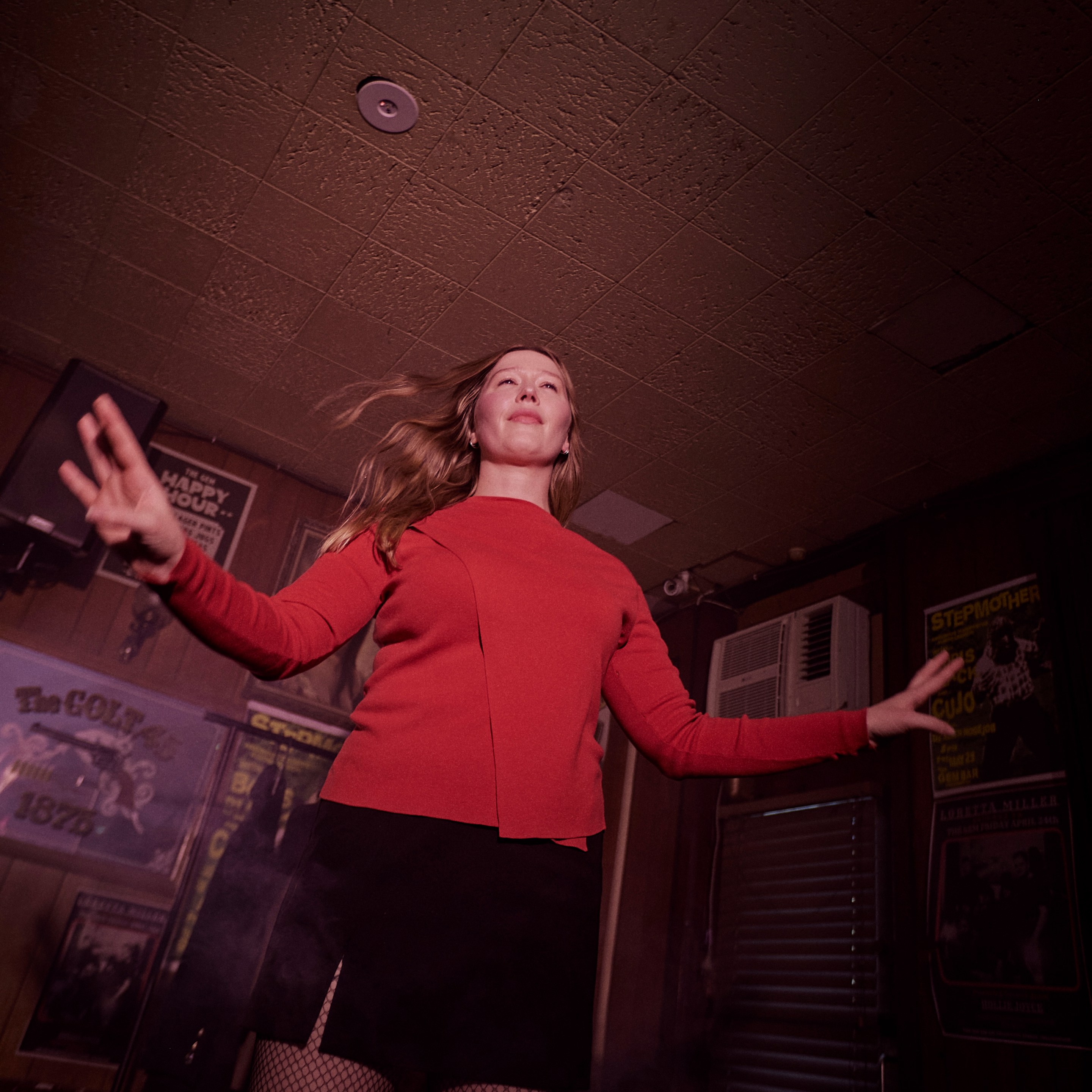

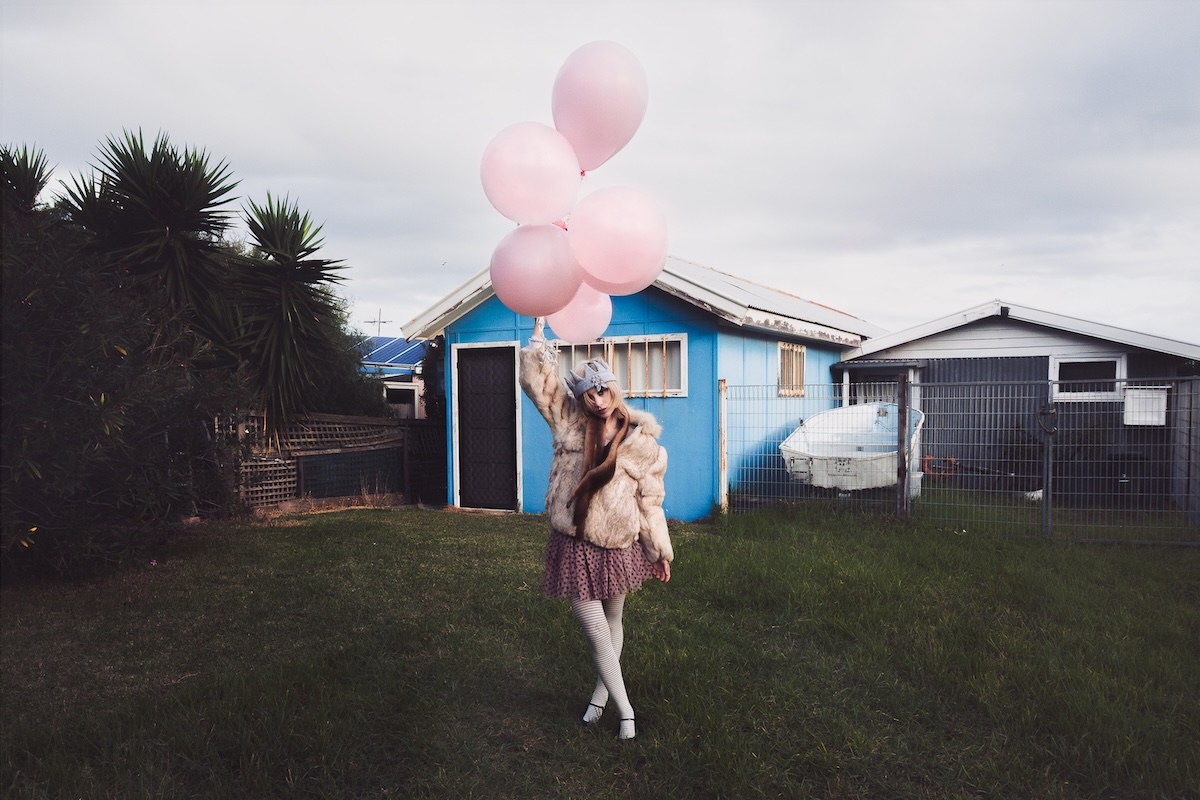
The glockenspiel makes it sound sweet. But the unease that Melbourne alt-pop musician Daine contemplates on their debut album In Endless Awe & Agony — the flattening of culture, class competition’s chokehold on creativity, battling subconscious desires — is not an easy pill to swallow. “I’m not really a person/ I’m a product of profit/ And I’ll eat you for it,” they sing during the chorus of the thorny single “Product Of Profit (P.O.P).” Synths hum underneath them, while drums steadily carry their docile vocals. But a teetering glockenspiel continues to imbue the track with a sentimental twinkle even when their voice begins to curdle into an acidic scream during the chorus. It’s like watching someone dawn a Pan Am smile while wielding a knife.
I’m initially supposed to meet with Daine to chat over lunch, but our meeting shifts to a Zoom call as they recover from a cold. They’re resting up for their listening album party later at the Carriage House in lower Manhattan: "I've got to lock the fuck in and pretend like I'm totally fine." They say this in a chill manner, excited to see their friends but bummed they won’t be able to give them full energy. It feels like a symbolic starting point for our conversation which evolves from the difficulty of working in this industry, being at the forefront of a business, and shifting through a business that is bloated with both artificiality and existentialism.
The Filipino-Australian artist began releasing music in 2020 when they were a teenager. They’ve worked with Bring Me The Horizon’s Oli Sykes, Ericdoa, and Ninajirachi, and had support slots for Yeule, 100 Gecs, and Charli XCX. Their 11-track album, which was worked on with former boyfriend Curtis Pawley, Armlock’s Simon Lam, and Darcy Baylis, is a way to understand the industry they’ve maneuvered the past several years. They describe it as a "Jungian individuation arc" in which the creative process allowed subconscious meditations to reveal themselves.
In Endless Awe & Agony touches on the interlacing of pleasure and violence and the hard truth that nothing lasts. It’s complicated and strange, same with the sonic mirrors of Midwest screamo, the Pixies, Alex G, Soccer Mommy, Architecture In Helsinki, and Hello, Goodbye. It’s the sound of plushness and loaded guns. The result is something that pendulums between dangerous, comforting, and enticing.
“I think there's a good balance of indulging the fantasy of, 'Hey, this is fun and cool,' and romanticizing the glitz and glamor, but while also there being a level of irony and space for the listener to be like, 'Is this wrong? Is is it wrong that I fuck with this and that I aspire to this lifestyle?'"
Listen to In Endless Awe & Agony and read our chat below.
How has the lead up to the album been so far?
DAINE: It's been really busy. It's been a lot of fun. It's my first time doing an album rollout, so I didn't realize how much pressure it would be. I also think it's something that's really hard to explain to people around you. You know what I mean? Friends are just hitting me up and asking me for shit as normal, and I'm not able to respond the way that I want to because I'm so emotionally drained by the process. I didn't realize how resilient and impressive pop stars are. They are truly doing something that is extremely difficult and takes a lot of character strength to show up every day and be that polished. I don't know. I never realized that. I feel like there's an idea that pop stars have the dream life and that everything's easy for them. Now I'm like, "Oh my fucking god!" Like every pop star that has ever been is a trooper, an actual trooper, someone who is in a high pressure CEO type of job. It's just not something that's talked about.
No, 100%. I think about it every time I interview someone. If I was on the other end, putting out or talking about my art and self constantly, or sometimes forcing a conversation. It seems so exhausting.
DAINE: One million decisions in a day.
Do you see yourself as a pop star or a pop artist?
DAINE: I think in many ways, yes. I don't really know. I feel like that title has just been handed to me, and I guess it kind of makes sense.
I feel sometimes being categorized as a pop artist can grant you so much freedom in that you can enter different spaces, but at the same time, there are limits or at the end of the day. You're expected to be a product for an audience versus fitting into a community or something with like certain genres or other sounds. In some ways you could see it as the ultimate freedom, and in other ways it can be like a big cage.
DAINE: Any job where you are commodifying yourself front and center as the main product is a cage, but I feel like music and modeling and being an influencer are really the only careers that that applies to, and it's really fucked up because how do you separate what you're doing for the company? Because at the end of the day, it's a multi million dollar company that you are the head director of. But not only are you the head director. If anything goes wrong with the company, or whatever you're solely responsible in the public's perception. You know what I mean? Which is really scary. Every major artist project is a multi-million dollar company with tons of different people working on it, and tons of people are responsible, and tons of people have to show up to work every single day to make it happen. It can't be a one-man show, and so many people put their entire life's work into working on someone else's artist project, but at the end of the day, the artist gets all of the praise, but it's not even worth it because the artist gets all of the responsibility and all of the pressure and all of the hate. What a fucked-up deal.
You entered the industry very young. Were you aware when you first started making music or making art that this experience was what you were signing up for? Now that you're established and putting out a debut, how do you find balance? Have you had conversations with yourself about how to balance the joy of it, while also being aware that it’s this big industry that's monstrous in a lot of ways? That's what the album feels like it's touching on in some ways.
DAINE: Yeah, definitely. The album helped me understand how I felt about certain industry things and stuff that was subconscious to me, and I didn't realize that I had these feelings about the industry. So it was really useful in that way. But I think definitely as a young person — well, as actually a literal child — I didn't know what I was signing up for. I think signing to a major label as a literal minor is something that has shaped me in a lot of ways. I'm glad I had the experience because being thrown in the deep end is definitely conducive of growth. But I think it also sort of stunted my artist development in some ways, because I wasn't having the normal progression of a slow development of things where you unlock things on the way. It was just like, "Okay, this is happening now." Like, "Let's go." But it's been great because now in my mid-20s I have been able to be more normal and work with an indie label. I've worked so many different jobs now and had all those normal early adulthood experiences that I should have had when I was 18, and it's made the art feel a lot more honest and undiluted because there's not as many industry factors, not controlling it, but influencing it. There's less voices, and I'm able to hear myself more clearly now.
Can I ask what kind of jobs?
DAINE: I did coat check at a club for three years. I was doing a lot of babysitting last year. That was my favorite job. I did a call center for a little bit. This is the first year I've not had to work a job, and it's been great. Also I live with my parents, so it's great.
I feel like it is so important for creativity in a way, or at least for me, it feels inspiring and healthy, balancing real life versus the fantasy of an artist.
DAINE: It gives you the character development, but it definitely was not conducive to making music for me. I think my music was so shit because I had to work a job. You know what I mean? It made me realize that it's really a game of privilege, which is another thing that I touch on the record. These nepos are able to get so far ahead because they have the time to sit around and make music. They have the time to navel gaze and think about their feelings and unpack things and go to the studio. I didn't have the fucking time or money to be in the studio, really. And also I was exhausted. When you're in debt and you’re working a shit job and you hate your life, you don't really feel like being creative, at least for me. Maybe I'm just not built for it. I'm sure people typically use music as their outlet, but for me it was like, "Damn, what the fuck? I wish I had rich parents so I could go make music." I’d be like, "I don’t feel like making music now because I hate everything."
You mentioned that writing this album helped you have a lot of realizations about the industry. Did you have an idea or concept on what you wanted your debut to be, or did it just happen within the process of creating?
DAINE: I really had no idea. I went into making my album pretty terrified. I didn't feel ready at all, but I just sort let my subconscious speak. Every session I didn't really know what I was gonna make, and pretty quickly, a path revealed itself. A lot of the songs are extremely different, but I feel like there is sort of a throughline there with a lot of it. I think I was quite disconnected from how I was feeling. In a way, the record kind of saved me because it gave me a better understanding of what was going on in my head. If you're given a blank slate and you see what comes out, it's probably going to be a pretty accurate reflection of your inner thoughts, desires, your struggles. So in that way, it was like a very yeah, it was a Jungian individuation arc.
That specific phrase (“Jungian individuation arc”) was mentioned in a press release. I'm really curious what you mean by that. I know bare minimum stuff about psychology. Does a lot of psychology influence your creative output?
DAINE: Not really. I connect with Jung on a philosophical and symbolic level, but I think modern psychology is a bit like barf and vomit. Jung believes that the most dangerous type of person is someone who's creatively inhibited or blocked, and that's because their subconscious is hidden from them. In Jungian psychology, they believe that your subconscious is what is ruling your life and what's destroying your life, and individuation is the process of integrating all of the parts of the self. You can look up a diagram of the self as the subconscious and the ego and whatever. Through being creative, you're able to see in real time the different parts of the self. It is a real psychological exercise to create something, and that's why it's a healing process, and that's why if you don't do it, you're probably a dangerous person.
Yeah, yeah, yeah. That's really interesting. I wrote something in my notes app about "a dream becoming a challenge to the ego." This album really feels like that. I don't know if you have any thoughts on this cultural moment where I feel there's a lot of pop artists and this conversation about being authentic and having more insightful or straightforward lyrics.
I do think it's interesting when it happens in pop music, because it’s like, "Oh, is this actually authentic insight, or are they presenting to the world some sort of authenticity?" It's interesting thinking about creativity and the ego and how you don't really know how violent your desires can be in a way.
DAINE: Yeah, that last bit I feel is very thematic to my record [laughs]. Who knows what's authentic and what's not, but I think what's happening in the zeitgeist right now is that people are enjoying this stream of consciousness, really simple, direct writing. I mean, Charli's new record definitely has that feeling. Because we don't need to reinvent the wheel. We honestly need to go backwards. Everything is a bit too much, with AI and shit. People just want to feel human, and I think that that's long overdue. Too much polished or fancy writing, it's just more layers to disconnect from the audience, so I think that's what's happening right now.
Going back to the thought of violence and desire, I want to know more about the sound and production choices. There's this balance of monstrosity and delicateness. There's a sweetness to the melodies or I don't know if it's a xylophone or —
DAINE: The glockenspiel!
And there's also just a lot of screaming, and also references and lyrics to weapons. I'm curious if that was intentional? If that's an accurate read?
DAINE: No, that's definitely an accurate read. This sounds crazy. I wish I could be like, "It was all intentional," but I feel like none of it was intentional. I knew I had things that I wanted to say, and they revealed themselves to me in the early stages. But it was extremely day-of, stream-of-consciousness writing, which is why I think it's interesting that certain symbols kept recurring. It's, again, pretty Jungian shit. There's definitely that industry voice, that ambition, that violence and hunger that is maybe more connected to the animal self. I wasn't aware of that voice in me, but I think that comes from a child that is hurt in the entire process, and I think that's where the sweetness element comes from. When you listen in full, there's multiple characters that are multifaceted that you can sort of see peaking their head out throughout the record.
Do you see this album as a representation of your entire self and those characters are the different facets or different layers, that Jung talks about, or you actually see them as different characters, and this isn't necessarily you at the center?
DAINE: I think it was a real exploration and exercise that speaks to a certain period in time. It's a representation of my psychological architecture at that point in my life. So there are the real different aspects of myself, but also of culture, because there's also, in Jungian psychology, there's the collective unconscious. So I think I'm also speaking to things that are extremely relevant culturally and that a lot of people are feeling, and it's a reflection of the world. It really is a time and place piece. I think it will last because I feel like it’s quite accurate and like it's very current.
When was the album completely finalized?
DAINE: I think I finished it in March.
Of this year?
DAINE: Yeah.
You wrote most of it within the studio, or you wrote songs leading up to it, and then demos, and then finalized it within the studio?
DAINE: I started a couple demos in Melbourne, in the studio, with producers, and then we took them to LA, and I polished them with two of my close collaborators and one of my best friends with some co-writing and stuff. We spent 30 days straight in the studio every single day, without fail, to tie it all together and make it into an album. What I brought to LA in February didn't really look like an album. We made it into a record extremely quickly. But it was a lot of work.
Was there a song on the album that changed your understanding of what your artistry is, or your sound, could be moving forward?
DAINE: Mmm, no, because they're all really different. I don't know. “PQC” is pretty revolutionary to me because that was something, I've never made anything like that before; I've never heard anything like that before. That was a really, really special moment. So actually, I think yeah, maybe “PQC.”
And that was the first song that you guys made?
DAINE: We had the idea. That was the first idea that I had, but I didn't know that it was going to be the inception point for an album. I just thought it was like, oh, this is some shitty random demo I made like with my ex-boyfriend, whatever, who cares. But it was gold.
There's a few lyrics on the album that reference time and looking back to the past or only being able to find comfort in the past, and then there's another lyric, “Living in the echo of us,” from “Love Love (Love Love).” Do those lyrics register in your brain differently after writing this album with someone that you were in a relationship with, and now you're not romantically with them anymore?
DAINE: Um, not really, because — I initiated the breakup, so I don't really... [laughs]. It's a beautiful record. His contributions were fantastic. Thank you, Curtis. Great guy. Um, but yeah, I don't really care. And I think most of the lyrics at that time were more talking about the death — not death, but the flattening of culture, and how, in the past, things were a bit more defined. Gen Z is chronically addicted to nostalgia because we don't really have an idea of what our potential future could be. Everyone's pretty doom-and-gloom about the future, and Gen Z is the first generation that doesn't have a specific aesthetic. Millennials were the last generation to have a specific look and aesthetic. So Gen Z are constantly replicating whatever millennials did or whatever came before that. So we're always living in this past, which is sort of what I was nodding towards.
It does almost feel like every generation grows up feeling like there's no hope for a future. And it’s exponentially gotten worse over time. But I keep thinking also about the ‘70s and the Sex Pistols screaming, "No future, no future," and how that's evolved throughout the decades. But I agree with what you're saying that the culture has flattened or the identity of a generation has been lost. Because I don't know if there's just not enough faith in humanity and too much power has been given to technology.
DAINE: It’s definitely that. But millennials have millennial optimism. That's what we're trying to emulate. They thought that their future was going to be better than their parents. So RIP.
I’d love to hear more about the song “God Figure,” that’s one that really stands out to me.
DAINE: I was in the studio in Melbourne, with Simon [Lam] from Armlock, and I'd just read the second chapter of Bad Behavior by Mary Gateskill, and I was like, "Oh my God!" And I was in my feels about that. It's a book that has a lot of S&M vibes to it, and it had me thinking a lot about power dynamics. I think I'm definitely a person who loses myself in relationships a lot, and I don't think I was speaking to a current experience at that time, but it’s definitely still real because I think it's more how I lost myself in previous relationships, but more so, I think I was trying to like get inside the book and write something that felt quite Gateskill to me.
I love that. I haven't read her work in years, so this is a good reminder to revisit.
DAINE: It's so good because it's so easy. That book specifically, each chapter is a different story, so you can just pick it up, put it down, pick it up, put it down. There's no pressure.
I'm curious if there are any other non-music inspirations or influences for the album?
DAINE: Oh yeah, Mary Gateskill for sure. Oscar Wilde, I think particularly on “White Collar,” I wanted to paint this picture of indulgence and privilege in a very Picture Of Dorian Gray, but what if it was in 2026?
Yeah, I love that. Fuck yeah.
DAINE: I love that book so much. Just how power and hedonism and narcissism has such a grip on people. So definitely Oscar Wilde as well. Um, and the Bible. “Wishing Well" and shit, it’s kind of Jesus-y.
Another thing that I was thinking about was the idea of being a pop star and then also as someone who is a Catholic or Christian and spiritual person, I feel like that can sometimes be put at odds with each other. I wonder if you have any thoughts on that tension, I imagine that tension kind of inspires your songs?
DAINE: It's a unique place for sure. In a way, it feels quite unholy or perverse to be a pop star, that you you are selling yourself to the world, and if you know you're feminine, it feels very sexualized, and then you're rewarded for sexualizing yourself.
Totally.
DAINE: That can definitely spark some Catholic guilt. The whole job sparks Catholic guilt. It's a capitalist business. I'm running like a corporation. There's people on payroll. To me, that's like Jesus is flipping tables over money. We're not supposed to be doing — and it's also competitive. I don't think art should be competitive. I touch on that in “White Collar.” I say, “They're hunting for sport and claiming it's for art,” because I noticed that a lot of people in this scene, these LA nepos, do this as a sport. They do this with their friends as a sport. They want to get ahead. They want to be on top. They want the numbers. They want the accolades. But it's not like — maybe it is an artistic expression too. But they could be doing anything fucking else, but they’re doing art as a sport. I'm saying it's cooked.
Yeah. Are we supposed to get mad at the people that have bad intentions, or mad at the people that are born into certain livelihoods? Your song advances the conversation around it. A lot of people are throwing that term around as a buzzword instead of actually engaging with why it's an issue.
DAINE: Yeah. When I posted these statistics on my second Instagram account — it's a really hard conversation. I feel like the general consensus is like, "Oh, it doesn't matter if someone's nepo. Like, they make good music. They make good music." I think it should be more nuanced than that. Are we fucking serious? Like, are we serious?
Top selling musicians are six times more likely than the public to have attended private schools. Young adults from working class backgrounds are four times less likely to work in creative industries compared to their middle class peers. Fewer than one in 10 arts workers in the UK have working class roots. So when I'm like, "I'm sick of nepos," it's not that they're bad. It's not that they did anything wrong. I feel like there are not many people who have normal life experiences and, sure okay whatever, their lives are probably normal. Whatever, okay, your parents are rich, whatever. I'm talking went to shitty public schools, have had to work jobs, have had to juggle jobs and creativity and real life, and the exhaustion of all of that, and still made it through.
On a logistics level, music career and not having rich parents, it just doesn't slot together. Which is why I understand that I have so many different allegations that everyone thinks I have rich parents. These things don't work together, but it has to be a combination of luck and resilience and all these other things. So it pisses me off when people like, "Nepos are good." Like sure, maybe they are, but like I'm interested to know a few more people that aren't.
In Endless Awe & Agony is out now via Pack. Records.