

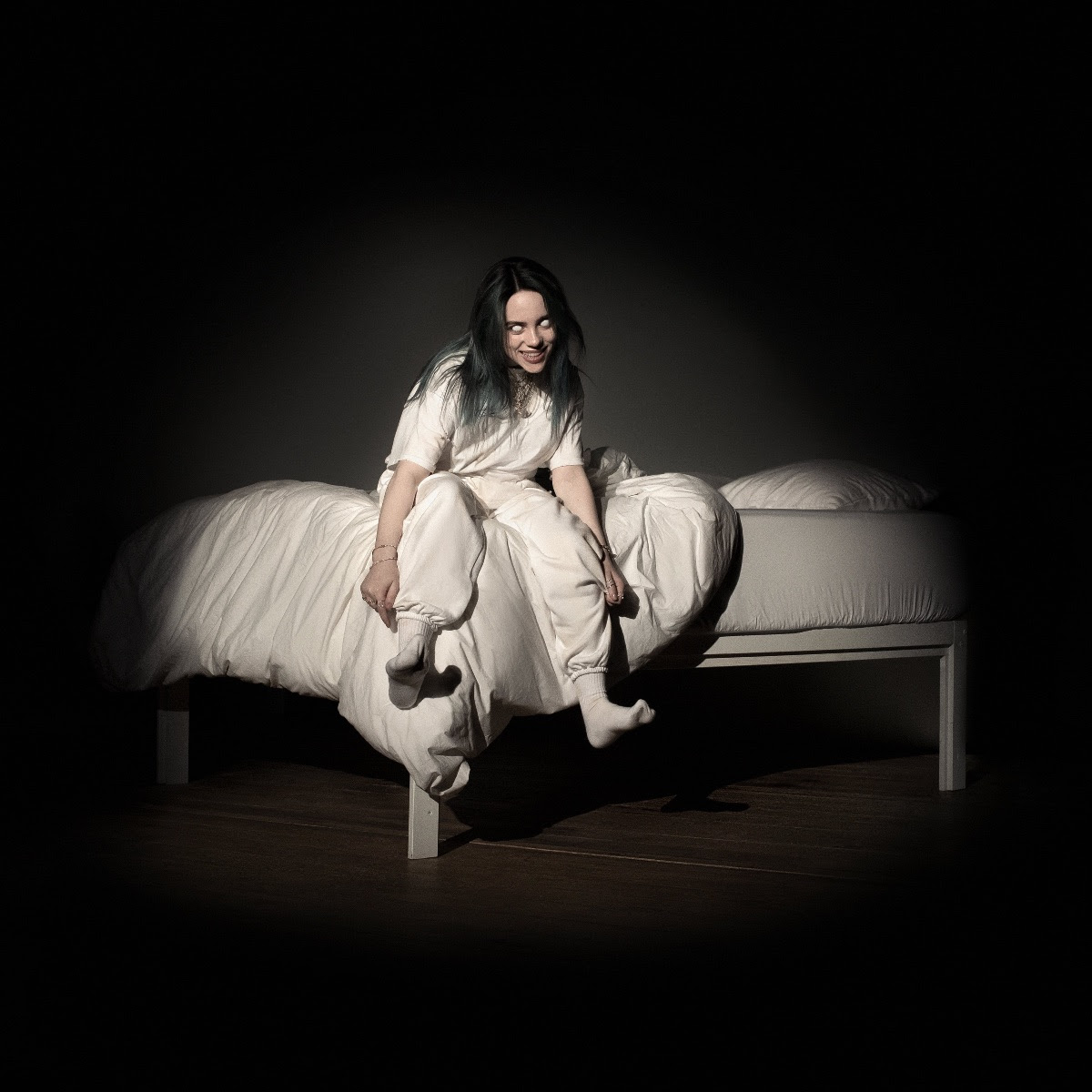
"I have taken out my Invisalign, and this is the album!" Billie Eilish announces at the outset of her debut album. The 17-year-old singer then collapses into hysterical laughter with a male cohort -- presumably her older brother, a fellow musician named Finneas O'Connell who's been her close collaborator ever since she made waves with debut single "Ocean Eyes" three years ago. It's an inauspicious way to be begin a collection of dark, stylish, futuristic pop music, but it also makes perfect sense. Eilish is a new kind of pop star for a generation born beyond Y2K, and her first LP evokes teenage living in all its modern complexities.
When We All Fall Asleep, Where Do We Go?, out tomorrow, captures an unmistakably adolescent frame of mind, a headspace where goofball playfulness and maudlin brooding coexist. It is peppered with punchlines and inside jokes, but also extreme melodrama and abundant cool-kid posturing. That much will be familiar to anyone who's lived through high school. Yet Eilish also exemplifies some of the unique aspects of being a teenager at the end of the 2010s. Or at least, as someone well into my mid-thirties attempting to wrap my mind around what it's like to grow up today, her album feels like a prism for understanding an era when kids aspire to make a living as influencers, age-old binaries are disintegrating, and communities are constantly ravaged by mass shootings and suicide.
It also makes good on the promise her career has been hinting at. Eilish has concocted one of the last great pop statements of the decade, a natural culmination of many currents from these past 10 years. I have sometimes scoffed at Eilish, never denying her talent but viewing her through a condescending, parental lens. The more extra she's become, the stronger my inclination has been to dismiss her as a kid playing out her undercooked idea of maturity, heavy on artifice and shock value but light on perspective. Her outrageousness still makes me roll my eyes, but writing her off as a magnetic persona with precocious inclinations is not so easy anymore. Her aesthetic is refined, her songs compulsively listenable. She's no longer a phenomenon coming up from behind -- she is here, fully formed, ready to dominate.
"If you still don’t know who Billie Eilish is, there’s a good chance you are old," wrote Meaghan Garvey in a recent Fader cover story. She's not wrong. Thanks to his teenage daughters' obsessive fandom, even Dave Grohl knows Eilish is taking over. She's doing it quickly, too, both by music-industry and human-life standards. Billie Eilish Pirate Baird O'Connell was born to actor-musician parents in December 2001, three months after 9/11 and 12 years after Taylor Swift. She was only 13 when she and Finneas repurposed one of his old band's songs into breakthrough single "Ocean Eyes," 14 when the song blew up on SoundCloud, 15 when Interscope released her debut EP, 16 when her discography topped a billion streams across all platforms.
Her youth comes through in the Fader feature, as do her distinct sensibility and knack for provocation. Eilish films herself dancing to Mac Miller and Anderson .Paak's "Dang" in her Highland Park backyard while wearing what Garvey calls "comically oversized Dsquared2 sneakers, shoes you can picture Goofy wearing were he a hypebeast." Those Invisaligns feature prominently; we're told she got the orthodontic retainers the same day she did a fitting for Chanel, and that they prevented her from eating a bag of Takis. Eilish raves about the newfound freedom afforded by a driver's license, describes a childhood immersed in homeschooling and contemporary dance and the Los Angeles Children’s Chorus, and laments the struggles that have dogged her since the dawn of puberty. On the cover, she appears with a plastic bag over her head bearing the logo of New York streetwear brand Alife.
yes ❣️ https://t.co/5XEyRHYJlK
— halsey ? (@halsey) March 26, 2019