
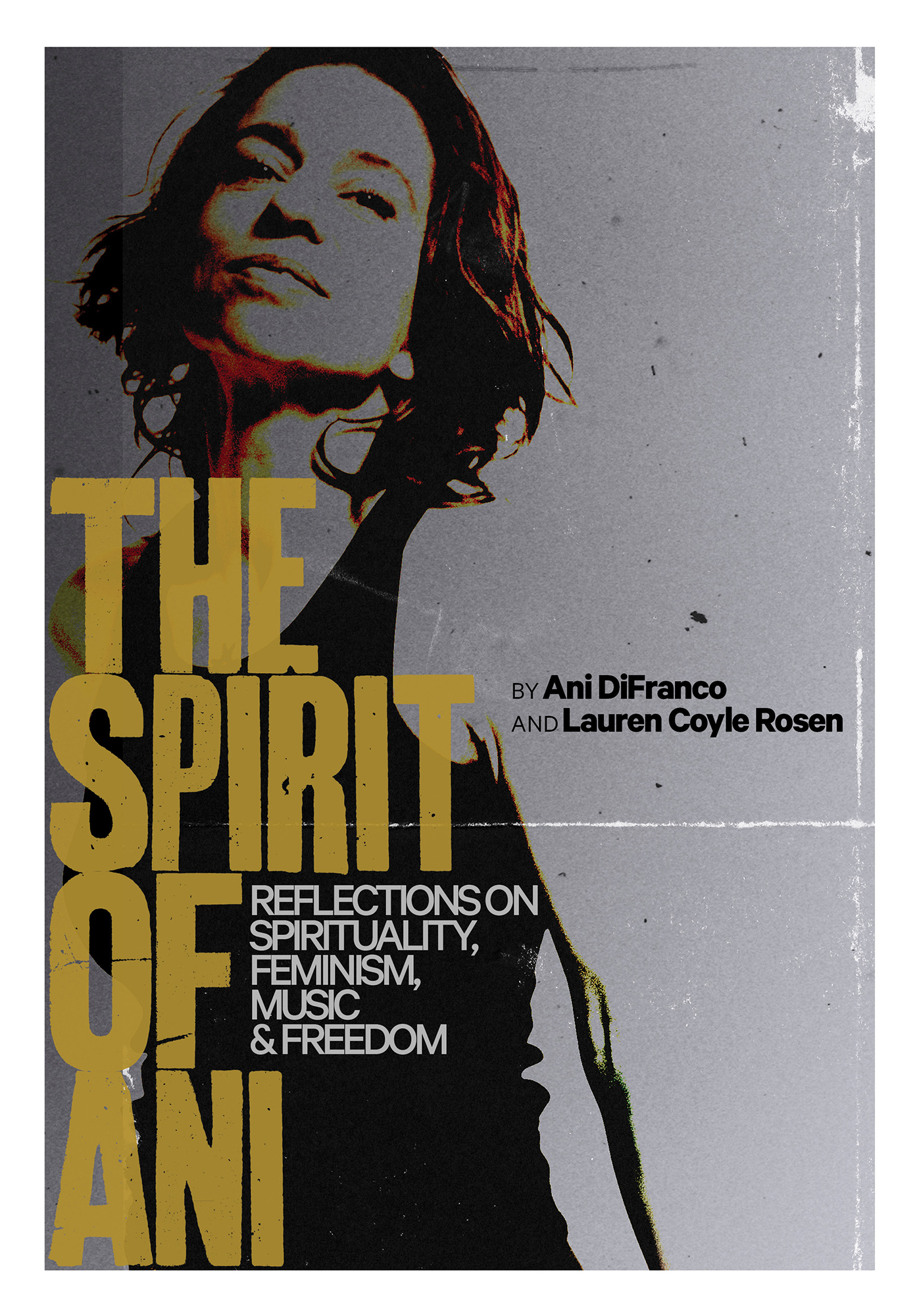
Tomorrow, Ani DiFranco's new book The Spirit Of Ani hits the shelves. Following her 2019 memoir No Walls And The Recurring Dream, The Spirit Of Ani finds the legendary musician and activist in conversation with cultural anthropologist Lauren Coyle Rosen.
"Lauren wanted to talk about my creative process and, more specifically, about its spiritual dimension — and so we did," DiFranco explains. "I hope this book with be of some use to other seekers on the paths of feminism, spirituality and creativity."
Below, read an exclusive excerpt in which they discuss #MeToo, the music industry, and how the topics play a role in her music.
***
LAUREN COYLE ROSEN: I was just thinking back to your first records as you were speaking, and I absolutely get that sense from them. You just let it all out. Your song “Out Of Habit” [from her first album, Ani DiFranco, released in 1990] just started playing in my mind, as well as “Every State Line” [from the 1992 album Imperfectly] and “Hide And Seek” [from the 1997 album Living In Clip]. These songs so straightforwardly spoke of pain and things that often people will withhold from others, and sometimes even from themselves, from their own conscious awareness.
It does feel like powerful catharsis, to hear you play and sing these songs. They are also like an empowerment medicine, which perhaps is almost incidental to the act of getting it out of you and into the song that you’re then offering to the world. I think people, especially women, receive that as an empowerment tablet. You’re showing that, not only is it okay to talk about this stuff, but it’s okay to sing about it on stages in front of large audiences or on records released to the world. Like, next time you’re wondering why a woman seems angry or upset, maybe you could check this out.
ANI DIFRANCO: Yeah, when the #MeToo movement came to the fore, my immediate sensation—I mean, now it’s so much a part of the lexicon that I associate it with itself—in the beginning, I had this really strong association with how many times I’d heard those exact words from other women. I was a little ahead of that wave that’s thankfully cresting, where women’s stories and female perspectives are becoming undeniable in a broader way. I was engaging in the task of calling out the patriarchy in the early nineties, and yeah, just talking about what it’s like being a girl, or a young woman, and hearing overwhelmingly from other young women, “Oh my god, thank you, thank you, thank you. Oh my god, me too.”
COYLE ROSEN: You mentioned before that in your childhood you felt like learning to read people—their body language, their thoughts—was a safety mechanism, maybe even first and foremost. Maybe that was part of your inbuilt security system, while making your way in the world as a teenager and getting emancipated, or emancipating yourself, I should say. And then, perhaps this played into your going out in the world as an artist and declining all of these offers from people who were offering you record deals. Instead, you created Righteous Babe Records, and you stayed with that. I’m wondering if there was a deep intuitive aspect to that. Were there, in your gut-brain, alarm bells going off?
DIFRANCO: Right. I mean, I had a relationship with my gut-brain that was ongoing and close and important, so when I walked into whatever situation—x, y, z—you know, the record company office—the gut was telling me all sorts of things, like it was doing at all times, to keep me safe, from as far back as I could remember.
When it comes to my head-brain, I feel like I am in the habit of processing things twenty years after the fact. I will wait at least that long, sometimes. I think that’s sometimes how long it takes to feel like you’ve exited whatever the situation was and are truly safe. For people who have never been molested or raped, for instance, it’s absolutely logical to say, “Well, if she was raped or whatever, why didn’t she say anything for twenty or forty years? That seems kind of suspect.” If you’ve never been there, that’s a completely logical suspicion. But for those who have experience with the survival technique of suppression—of suppressing something until you’re in a safe enough place in your life that you can actually psychologically and physiologically look at it—you understand entirely.
People have literal amnesia of traumatic events because sometimes that’s the only way to survive and keep going, psychologically. If you don’t have the right support for healing, time is what it may take to get yourself all the way to a safer place, a place where you might be able to let that demon out of its cage and face it. Those survival techniques are very, very common, but not known to everyone or understood by everyone. I believe they may be known, most broadly, by women.
COYLE ROSEN: Your “Out Of Range” song [on the album of the same name, released in 1994] keeps playing on top of this conversation we’re having. I always had a visceral reaction to this song—this sense that the intensity of emotions or ingrained patterns can fade, you just have to drive out of range, so they don’t keep hold ing the same kind of grip over you. And with this deep feeling or reaction to your music, it’s not just what you say; it’s also the energy that comes through what you’re saying. You say it with such truth and conviction. With such power, and in such a straightforward manner: “This is what it is.” The truth vibration that cuts through what I call the bullshit chatter in my mind or in my emotional field, even. You write with great conviction of your self-empowerment, yet you are also very vulnerable and open about your ambivalences. Even in “Out of Range,” you sing:
and i try
to draw the line
but it ends up running down the middle of me most of the time
So, you said that it often takes you about twenty years to start really processing things that have happened. Do you sometimes look back at songs like that—maybe ones that came through you in a semi-altered state—and now they resonate with your processing of things from the past? Do they reveal or disclose things to you that perhaps you didn’t fully see or recognize at the time, almost as though your spirit or another consciousness was speaking to you, through you? Do you think your soul was speaking to you about things that you would later come to see, like turning over stones, in a conscious way?
DIFRANCO: Yeah, I think there was a lot of messaging myself back and forth through time. At the time of the writing, it’s not necessarily about consciously processing something. It’s more about unlocking the subconscious and finding homeostasis through that release.
COYLE ROSEN: Yeah, I was just thinking about trauma, how usually when people narrate trauma or when they give accounts of trauma, it’s tricky to fully register it in the so-called secular rationalist legal system, right? Many psychoanalysts or psychologists or others who specialize in understanding trauma will say that the truth—if it comes to the conscious level for the person who suffered the trauma—comes in shards. Temporality is nonlinear in the experiencing, remembering, narrating. The account, if it has veracity, is going to come in jagged bits and parts that don’t add up because that’s how people can deal with it on a conscious level, with remembering and narrating. It reminds me of what the psychoanalyst Jacques Lacan said, in one of his multitudes of oracular aphorisms: “Every truth has the structure of a fiction” [from his Seminar on the Ethics Of Psychoanalysis, Book VII, 12].
I think that, oftentimes in art, it’s not necessarily that it is fictional, but the truth is embedded in these representational forms that may be shard-like, nonlinear, uneven, partial. The art doesn’t have to align, necessarily, with so-called real-world facts. For example, I was struck by how you were saying in your memoir that the song “Shameless” [on the Dilate album, released in 1996] was written from a space of longing for your first husband, before you married, when you were both involved with other people. You sing:
i gotta cover my butt cuz i covet another man’s wife
And I never knew that the song was about a guy because there was that decoy of another person’s wife.
I was also just thinking about your writing on difficult things in general. Maybe it’s sometimes easier to depict them in fictional or semifictional surface forms, even as you are delivering the truth vibration of it, the authentic essence of a song. In this vein, I thought of your mentor and friend, the poet Sekou Sundiata, who would tell you to forget about the facts and just tell the truth. I remember you said that you drew upon that wisdom in your poems and songs.
DIFRANCO: Well, if I could just pause for one second, on that song lyric from “Shameless,” just to drill down. It wasn’t that I was disguising the literal facts of the scenario in a metaphor or, you know, only able to approach the truth in shards. My using that phrase, “coveting another man’s wife,” is a biblical reference. What I’m doing is I’m trying to talk on many levels about the fact that, in patriarchal religions, adultery is a sin because love and possession are inextricable, and to make matters worse, of course, it’s the male who traditionally possesses the female. Within this sort of patriarchal Christian society, there have been a lot of allowances made for the male sex drive and the natural state of polygamy for a male, but not so for the female. So, in that song, I’m not only trying to say that I’m in this tricky situation by being in love or in lust with somebody who has a partner, but that there’s almost no way of navigating it well, in a society that sets us up for failure [laughs]. I just happen to be writing about all that without letting gender dictate what I can say or how I can say it, or how I can play with metaphor.
I think when we are young, most people are naturally promiscuous—naturally polygamous and exploratory. But we are instantly found in this structure where we have to deny and suppress that. Or compartmentalize it in some way. And then we become villains when we fail to do so. Most people, when they’re young, break up with people by cheating on them. It’s rarely, you know, I feel as though I don’t want to be monogamous any longer, so I’m going to use my words first and set up a new dynamic, because, of course, these things are very fluid and malleable, and we are free and empowered and equal. This whole society is built on patriarchal religions which are antigay and anti-woman. The society exists within thought frames that are narrow and specific. So our natural animal sex drives are trying to manifest in impossible situations. That’s why I used that biblical phrase, because we’re still living, we’re still answering—on a daily basis, all of us—to a book that was written by and for straight men, a long time ago. Referencing the Bible is a way of referencing the broader social context in which the whole individual love-triangle thing is happening. And how that context can inhibit creative solutions and understanding, and good outcomes.
COYLE ROSEN: I was just thinking about your song “Adam and Eve” [also from Dilate]. That just started playing in my mind as well. The lines:
but i know it’s cuz you think you’re adam and you think i’m eve
It feels like the same kind of thing.
DIFRANCO: Yeah, I was a little distraught at the time of writing that song [laughs], but I think, again, I was trying to push against the whole society based on a book which is, by and large, simply codified patriarchy, to my mind. So again, it’s a female trying to say, “I’m not just a character in your story. I have my own story.”
COYLE ROSEN: And now I’m thinking of your song “The Million You Never Made” [from the album Not A Pretty Girl, released in 1995]. When you were resisting all these dudes who were trying to get you on their labels or whatever, in their beds or what have you, did you feel that you could read their minds and intentions? Would you get the gut knowledge and then say no to them? I remember from your memoir that you almost signed with a couple guys in the early days in New York, and then you just said no. You just knew. Do you think that was telepathic?
DIFRANCO: Yeah, intuitive. The telepathy plays into the intuition. I think just being in touch with: how does something feel in my body? Just feeling that heaviness when I envisioned myself moving into that world of shiny commercial maneuvers—the magazines and the videos and dressing up for the Grammys—not that that’s a given or anything, but that was sort of literally what people would say: “I am going to make you a star. We’re all going to make tons of money.” And I think you don’t have to go very far to see that, after that moment, that’s exactly what they did. Just not with me.
COYLE ROSEN: How do you mean?
DIFRANCO: It was super hard for me for a bunch of years because people who didn’t know when or how I started would ask over and over and over again if Alanis Morissette was an influence on me. Especially outside of the United States. Everyone spoke about me as an offshoot of her, because she was considered one of the first outspoken women—showing her anger in this new way, singing from a female point of view, putting a hand up to a lot of male behavior, this kind of thing—that they’d ever heard. They just didn’t happen to be tapped into the subculture I existed in. So they compared me to her, and then to this one, and then that one. It was very humbling to just sit there and say nothing. I would say nothing because it’s really not important who came first or whatever, except to our egos, which are really not important at all [laughs].
The way capitalism works, if they can’t sell you, for whatever reason, they’re going to sell something like you. Like Elvis Presley selling rhythm and blues. They’re going to find the thing to capture and sell because they see a market for something. So they were watching this thing happen around me, and they began to see a market for a new kind of feminist perspective in music, or a queer perspective or whatever. Even people I knew, who cared about me, would say, “This movement is going to get packaged and sold, so are you really going to forego being that guy?” I guess, for me, the answer was yes, because when I pictured trying to operate in and become myself in that music-biz world, I felt a heaviness in my body. I felt aversion. I felt sadness and anger. I felt I could see that future. I could see the ridiculousness of me trying to play that game. And I could see wanting to shoot myself in the head like Kurt Cobain. I could feel in my gut how wrong it would be.
And then, you know, there are other things that, fundamentally, when I’m around political activists who are changing things for the better—when I’m around, you know, my folk community, the “uncool” cultural wing of the Pete Seegers and the Utah Phillips, I feel drawn. I feel inspired, I feel hope. I feel a sense of purpose and of possibility. On a super-simple level, I was working with the binary forces of attraction and aversion. That’s what guided me.
COYLE ROSEN: You felt like it would be soul-sucking to be in these boxes and forms of contractual obligation with a mainstream record company?
DIFRANCO: Yeah, like I can choose to surround myself with people who inspire me and feed me energy and inspiration, or who suck it out of me. So, what is it worth?
The Spirit Of Ani is out 3/3 via Akashic Books. Pre-order it here.