September 1, 1990
- STAYED AT #1:2 Weeks
In The Alternative Number Ones, I'm reviewing every #1 single in the history of the Billboard Modern Rock Tracks/Alternative Songs, starting with the moment that the chart launched in 1988. This column is a companion piece to The Number Ones, and it's for members only. Thank you to everyone who's helping to keep Stereogum afloat.
On September 10, 1988, the day that I turned nine, Billboard announced the debut of a brand-new chart, Modern Rock Songs, which would keep track of the college and commercial stations that were playing left-of-center rock music. That announcement was on the front page of Billboard that week, and another story, on a group who would become hugely important to the direction of those radio stations, ran on the second page. (It was really the fourth page, after a two-page spread for the Summer Olympics album with Whitney Houston's "One Moment In Time.") The second story told of certain retailers who refused to stock Nothing's Shocking, the first studio album from "highly touted underground LA rock band" Jane's Addiction because the cover art showed a sculpture of two conjoined naked women.
Jane's Addiction frontman Perry Farrell made that sculpture, and he claimed that it was a vision that came to him in a dream. In the Billboard story, Farrell dismissed any controversy that might come along with his art: "They're asking me if I would consider another cover, which I would not do... If McDonald's doesn't want my artwork, who the fuck cares?" But that artwork caused some chain stores not to stock Nothing's Shocking and others to bury it deep on their shelves. The story quotes one retail exec, who says, "It's the second-most-repulsive cover I've ever seen." (He doesn't name the most repulsive cover, which I would very much like to know.)
This little bottled controversy was par for the course for Jane's Addiction. They were an unlikely major-label prospect: four hedonistic neo-hippies with serious hard-drug habits who treated Led Zeppelin and Bauhaus as if there'd never been any distinction between those sounds. But Jane's signed for a whole lot of money, and they quickly became a headache for Warner Bros., their label. Jane's Addiction made music that could've been commercially massive -- at least if there was any established market for a sound that fell in between formats, which there was not. Even the college-rock stations, the ones tabulated in the new Billboard chart, didn't fully embrace Jane's Addiction. Perry Farrell didn't help anything, consistently tripping himself up while loudly and pretentiously declaring the supremacy of his artistry.
Decades later, we know how the story turned out. Jane's Addiction never became a commercial juggernaut in their day, and they self-destructed before their alternative-nation vision took America's youth by storm. But that storm did happen, and one of its primary institutions was the Lollapalooza tour, co-founded by Perry Farrell to showcase a bigger and more universal vision of left-of-center music than what those modern rock stations played. By all accounts, the members of Jane's Addiction were, in fact, unbelievable pains in the ass, and their many reunions have been nearly as chaotic as the band's initial run. But they changed things, whether through vision or accident or some combination of the two.
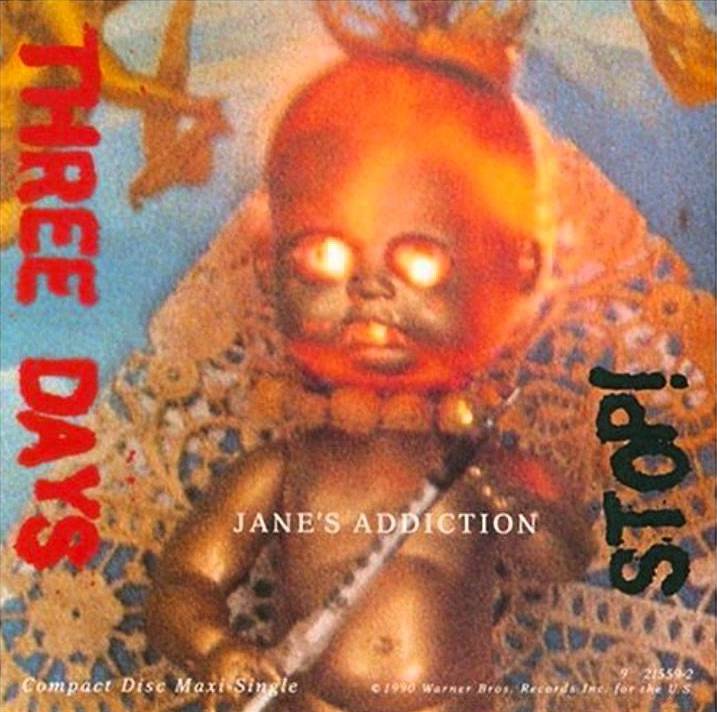
You can hear a whole lot of that roiling inventiveness at work on "Stop!," the first single from Jane's Addiction's sophomore album Ritual De Lo Habitual. It's a song without structure, one that careens haphazardly between nasty riffs and hazy motifs, and its lyrics are about nothing and everything. The energy can barely be contained. Jane's Addiction were barely hanging on when they recorded "Stop!," but it sounds like a band that's just starting to discover some mysterious, allusive new thing.
Perry Farrell, the oldest Jane's Addiction member by far, was born Peretz Bernstein in Queens, moved to Miami, and eventually found his way to Los Angeles. His father was a goldsmith who may or may not have been mob-connected, and his mother died by suicide when he was very young. For a while, Farrell, whose stage name is a play on the word "peripheral," was a late-'70s California beach bum, and he found work as a club singer who did Mick Jagger and David Bowie impressions. Farrell got very into the early British goth bands, and he answered a newspaper ad from a couple who was trying to start a group like that. That's how Farrell became the singer of Psi Com, a goth trio that released one EP before breaking up in 1985.
Psi Com's biggest moment came when they opened the Gila Monster Jamboree, a now-famous mushroom-fueled guerrilla concert out in the Mojave desert. Sonic Youth, Redd Kross, and the Meat Puppets played that show, too. I bet that was fun. When Psi Com fell apart, mutual friend and future Geraldine Fibbers leader Carla Bozulich introduced Farrell to bassist Eric Avery. Farrell and Avery started jamming together. Farrell already had dreadlocks and piercings, and he nurtured an image of himself as a shamanistic pagan type. He was, by all accounts, a magnetic figure.
It's hard to discuss Jane's Addiction without going overboard in describing Perry Farrell's visionary charisma or his sketchy hucksterism. Farrell had an important hand in shaping a lot of music and culture that I love, but I doubt I'd be able to withstand five minutes in a room with him. When Jane's Addiction started, Perry Farrell was the person in charge of an art-freak group house that served as a squalid drug den. Farrell had a heroin habit of his own, but he was mostly capable of functioning through it. Many of his friends and associates died of overdoses, including the teenage girl who supposedly inspired Ritual De Lo Habitual. Really, it's a minor miracle that all four original Jane's Addiction members are still alive.
Eric Avery hadn't been a fan of Psi Com, but that was fine with Perry Farrell, who wanted to make something more explosive than that band's arty-droney style. Avery's younger sister was dating Stephen Perkins, a kid from the San Fernando Valley who'd played drums in a metal band called Dizastre. Perkins brought along his Dizastre-guitarist friend Dave Navarro, who'd been playing with Perkins ever since they'd both been in high school marching band. Navarro's mother was murdered by her boyfriend when Navarro was young; he and Farrell had similar formative traumas. Farrell and Avery played a few early Jane's Addiction shows -- wild DIY affairs in the greater Los Angeles area -- with different lineups, and Perkins and Navarro saw them and loved them. In 1986, the two of them joined the band, and the classic Jane's Addiction lineup clicked into place.
All four members of Jane's Addiction had different backgrounds and were into different things, and that's a big part of the group's secret sauce. In an analog world stratified by subcultures, they were the gatherers of the tribes. Over a couple of years, Jane's developed a legendary live reputation, pulling goths, punks, metalheads, surfers, and other miscellaneous freaks together at their shows. The sportos, the motorheads, geeks, sluts, bloods, wastoids, dweebies, dickheads -- they all adored Jane's Addiction. They thought Jane's were righteous dudes.
Jane's Addiction had peers. The Minutemen were pushing their art-punk in far-out directions, and other bands like Fishbone, Thelonious Monster, and the Red Hot Chili Peppers made their own willfully eclectic funky-punk collages. But those bands didn't have Perry Farrell, who never let his thin, nasal bleat of a voice prevent him from carrying himself like peak Robert Plant. Perry Farrell was determined to go far in life, and that's what he did.
Farrell's girlfriend Casey Niccoli styled him, giving him an apocalyptic court-jester vibe. She essentially worked as Jane's Addiction's creative director through their entire run. The band put on big, chaotic happenings, and they wrote songs that documented their fucked-up surroundings. Farrell developed a persistent habit of whipping his dick out onstage.Eventually, Jane's became the house band at an infamous LA club night called Scream. Inevitably, Jane's attracted record-label attention. There's a famous story about Jane's Addiction's mostly one-sided feud with Guns N' Roses, who were tearing up the LA club circuit at the same time and who used the same practice studio. GN'R signed a massive deal with Geffen. Warner Bros. wanted to sign Jane's, but Farrell wouldn't agree unless the band got at least as much money as Guns N' Roses. As usual, Farrell got what he wanted.
Jane's Addiction came up with a funny way to market themselves. After signing to Warner, they released their real debut album, a self-titled live record that they taped at the Roxy in LA, on the small punk indie Triple X. The idea was that this would help them build their credibility, and it mostly worked. The album also included early versions of a bunch of songs that would come out later. "Stop!" isn't on the live album, but Jane's recorded an early demo of that song in 1987.
In 1988, Iggy Pop took Jane's Addiction on their first tour. I just saw a calendar from Hammerjacks, the legendary Baltimore metal club, that lists them as "James Addiction." From there, Jane's toured with goth acts like Love And Rockets and Peter Murphy -- both segments of the defunct Bauhaus. Jane's recorded Nothing's Shocking with producer Dave Jerden, recruited because Perry Farrell liked his work as an engineer on David Byrne and Brian Eno's album My Life In The Bush Of Ghosts. The final album is a gorgeously blurry psychedelic mess. It sounds huge.
Warner Bros. had a tough time selling Nothing's Shocking. The cover art kept the album out of a lot of stores, and MTV rejected the video for the titanic "Mountain Song" because Casey Niccoli appears topless in it. Perry Farrell pointedly refused to make commercial choices, but he was not averse to making money. Tensions arose in the band early, partly because Eric Avery once drunkenly hit on Niccoli and partly because Farrell demanded the vast majority of the publishing rights to Jane's Addiction songs, leaving his bandmates with paltry shares. Some critics loved Nothing's Shocking, but many thought that the band was full of shit.
Modern rock radio didn't care about "Mountain Song," but it did take to "Jane Says," the one strummy acoustic ballad from Nothing's Shocking. "Jane Says" still gets ton of radio rotation, and the song annoyed the absolute fuck out of me as a kid. I know that people in the mini-generation older than mine regard "Jane Says" as an untouchable classic. I certainly have every second of it committed to memory, and the song's portrait of addiction is convincingly desperate. But I've never shaken the impression that it sounds like a self-important version of Jimmy Buffett trying to hold a fart in. In any case, "Jane Says" became Jane's Addiction's first modern rock hit, and it peaked at #6. (It's a 6.)
Even without much industry support, Nothing's Shocking became a word-of-mouth sensation, selling a few hundred thousand copies. Jane's Addiction toured pretty steadily -- impressive, considering the number of drug problems within the band -- and made big impressions on a lot of people. Green River, the pioneering Seattle grunge band, broke up shortly after playing a show with Jane's Addiction, and that show is part of the reason that Green River ended. Half of Green River hated Jane's Addiction, and the other half was mesmerized by their theatrical rock-star moves. The first half of Green River went on to form Mudhoney, and the second half eventually started Pearl Jam. (Mudhoney's only Modern Rock chart hit, 1992's "Suck You Dry," peaked at #23. Pearl Jam will eventually appear in this column.)
One of the major inspirations behind Ritual De Lo Habitual was Xiola Blue, a drug-addicted LA scenester who was born Lisa Chester. Perry Farrell met Blue when she was as young as 13, and he wrote a song about her when he was still in Psi Com. A few years later, Farrell, Blue, and Casey Niccoli had a three-day lost weekend where they did a lot of drugs and had a lot of sex. Blue then moved to New York and died of a heroin overdose at the age of 19. Farrell's artwork of the three of them together became the Ritual album cover. Her family was understandably furious.
The story of Xiola Blue is terribly sad and also deeply sketchy. Some of it, I'm assuming, is a time-and-place thing. I don't know whether Farrell was exploiting Xiola Blue or whether they were a couple of fragile souls whose lives intersected; I wasn't there. But it's one of many reasons that I can never fully get behind the Jane's Addiction myth. That band did a lot of shit that would not fly today. Farrell was awfully free with his use of the N-word, too, even though he used it in solidarity rather than derision. That guy seems like an absolutely nightmarish hang. I get the absolute worst vibes from him. Still, I cannot deny what Farrell and his bandmates did on Ritual De Lo Habitual.
Once again, stores refused to stock the LP -- because of nudity, not because of Xiola Blue's family's objections -- so Farrell agreed to an alternate cover that simply showed the text of the First Amendment. Correctly, Farrell guessed that the cover art would become a news story and that most people would want the uncensored version.
"Stop!" is the opening track from Ritual De Lo Habitual, and it's a hell of a way to start an album. Before the song even begins, Cindy Lair, a friend of the band, addresses the audience in broken Spanish. (Lair really speaks Spanish, but Perry Farrell, who does not, wrote the words.) She says, "Nosotros tenemos más influencia con sus hijos que tú tiene" -- or, roughly, "we have more influence on your children than you do." Then she yells the band's name, a monster guitar riff comes in, and Farrell, with echo all over his voice, wails, "Here we go!" It's such a rush.
In 2015, Perry Farrell told Rolling Stone that "Stop!" had an environmental message and that the song was inspired by the stoner-favorite 1982 documentary Koyaanisqatsi: "The world is going faster and faster; we’re chopping down all the trees and overrunning the planet, and I just have to go 'Stop!' But nobody’s gonna stop!" But when Farrell sings that the world is lit to pop and nobody is gonna stop, he doesn't sound scared of it. He sounds invigorated. He sounds like he wants to ride the wave of chaos.
"Stop!" itself is a wave of chaos. The song doesn't really have verses or choruses, though Farrell does repeatedly yell that nobody is gonna stop, no. Instead, the song goes rushing off from one euphoric moment to the next. The meat of the track is a funky churn, with Eric Avery hammering out an infinite-repeat prog-burble bassline while Dave Navarro does unhinged wah-wah shredding over it. When Navarro and Avery lock into a riff together, it's a choppy, spacey earth-mover with a bit of cow-punk scuzz and a whole lot of Hendrix.
As the song goes on, the band finds different groves. They slow into a trippy lurch, while the echo on Perry Farrell's voice gets even thicker. Then they speed up again, and Navarro blazes out the kind of solo that Eddie Van Halen might play if he was on mushrooms and convinced that demons were chasing him. Farrell throws shots at the enemies of progress -- "farm people, book wavers, soul savers" -- before the music drops out and he harmonizes breathlessly with himself, talking about turning off that smokestack and that goddamn radio. Then, before you know it, it's over.
"Stop!" is four minutes of your life, and it feels both much shorter and much longer. The song's messiness is its point. The grooves are mighty, but they never settle. The funk-squelch element sounds silly now, but it's the fun kind of silly. Perry Farrell's lyrics aren't linear, but when you're entering that kind of untethered, loosey-goosey territory, you don't want anyone linear. You want a guy who sounds like he's blissfully riding a cloud of madness, and that's exactly how Farrell sounds. "Stop!" is just fun and exciting, and it makes me want to run around and throw things at the ground. It made me feel the same way in 1990.
Casey Niccoli directed the "Stop!" video, filming the band at a private show for a few hundred people in some far-flung California location. A shirtless Perry Farrell wears some weird Peter Pan-looking shorts-with-tights situation. Dave Navarro, so smacked-out that he could barely stand, could pass for a Turnstile member today if he didn't have those dreads. Everyone in the band is gorgeous, and the show looks like a total party. Mystiques have been built from less.
Perry Farrell co-produced Ritual De Lo Habitual with Dave Jerden, and the band wasn't in good shape when they cut the record. As cohesive as they sound on "Stop!," the band members recorded their parts separately, and some of them weren't even speaking to each other anymore. Dave Navarro's heroin habit was getting so bad that he often couldn't function, and Eric Avery had gotten sober, which meant that he had a difficult time around the rest of the band. Still, when the album came out, it was an immediate success. It went top-20, and the band went off on a tour that lasted more than a year.
All that touring spelled the end of Jane's Addiction, but Ritual De Lo Habitual kept growing. "Stop!" was a hit on modern-rock radio, but it didn't cross over. Another of the album's singles became a much bigger hit. Jane's Addiction didn't stay together for long after "Stop!" reached #1, but we'll see them in this column again soon.
GRADE: 9/10
BONUS BEATS: There aren't too many instances of people covering or sampling "Stop!" Maybe the song is too busy, too chaotic, and too tied to one specific band. If you were going to cover a Jane's Addiction song, it's not the one you'd pick. "Stop!" doesn't even show up on soundtracks very often, and the few big instances -- episodes of The Boys and American Dad -- don't seem to be online in embeddable form. This is all a very long way of explaining why the one Bonus Beat that I've selected for "Stop!" is a damn 2019 live cover from the jam band Umphrey's McGee. I don't like having to type the words "Umphrey's McGee," but I guess that's the job. Here it is: