
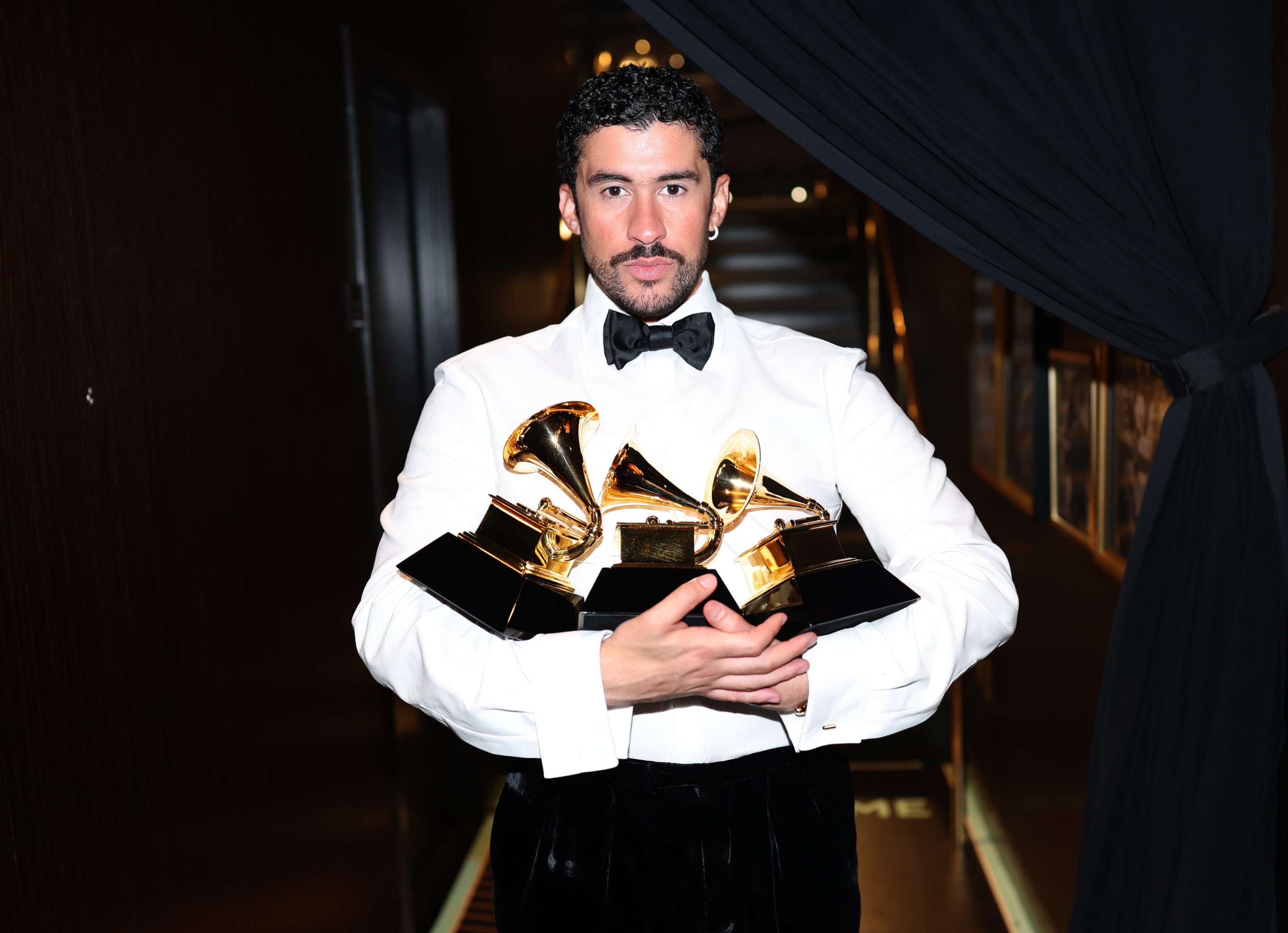
Does any of this matter? For most of this year’s Grammys telecast, I could not shake the feeling that no, it really doesn’t make a difference who wins these trophies — maybe in terms of opening doors for certain artists or shifting the music industry’s tectonic plates, but not in the grand scheme of human life. When you zoom out that far, I’m still skeptical that glitzy awards shows helmed by bougie gatekeepers carry any cosmic relevance. But when the time came to bestow Album Of The Year upon Bad Bunny, it felt significant.
The cynical take, one sure to be parroted by many today, is that the Album Of The Year triumph of DeBÍ TiRAR MáS FOToS represents one more hollow gesture from showbiz liberals — a way for the music industry establishment to celebrate its own enlightenment, honoring a Puerto Rican superstar at a time when the president’s murderous goon squad is aggressively targeting Hispanic people without regard for legal status, constitutional rights, or common decency. Maybe that’s indeed what happened. Maybe this was simply a high-profile rebuke of Donald Trump, and maybe there’s a lot of self-satisfied back-patting going on at the Recording Academy right now. But the voters’ motives are beside the point when the results ring this true.
Bad Bunny gets emotional after winning Album of the Year at the #GRAMMYs. pic.twitter.com/geLCUaJfHl
— Pop Base (@PopBase) February 2, 2026
The Grammys never matter until they matter. And in that moment, out of nowhere, they seemed to matter a lot. Watching Benito Antonio Martínez Ocasio overcome with emotion at the news of his victory, were you yourself not struck by some acute sensation? This felt like a rare instance of a stodgy old institution living up to its purpose, acknowledging a career-defining masterwork by a generation-defining star. DeBÍ TiRAR MáS FOToS is a rare achievement, a pop album rich with cultural history yet immediate in its pleasures. Critics far more conversant with Puerto Rico than me have marveled at the album’s many layers of reference and homage, but even the most ignorant among us can appreciate the way these songs weave together the past and present into something timeless.
The stakes of Bad Bunny’s win seemed so high partially because of cultural context that has become impossible to ignore. The people onstage last night certainly didn’t ignore it, and good for them. There is never a shortage of crises to be up in arms about during these awards shows, but some years the world’s horrors are merely a dull hum in the background of the proceedings. This was one of those years when the official business of the Grammys took a backseat to the unavoidable realities of life.
In the past, the show has sometimes been consumed by the unexpected death of an icon: Whitney Houston in 2012, Kobe Bryant in 2020. This time, the specter looming over the ceremony was ICE and its ongoing threat to the American populace. ICE OUT pins abounded, from the Biebers on the red carpet to Carole King presenting Song Of The Year. Speech after speech centered on support for immigrants, be it Olivia Dean highlighting her own family history, Billie Eilish declaring, “No one is illegal on stolen land,” or SZA asserting that we are under God’s authority, not the government’s.
As these sentiments accumulated, the Grammys continued to hand out awards and host performances, cognitive dissonance be damned. Though still safe and self-consciously respectable at its core, there were times when the show seemed to have finally moved past some of its worst tendencies, when the stink of the stuffy Ken Ehrlich era was growing less pungent and the current generation seemed to be on the right track. Few would mistake this procession of industry-anointed movers and shakers for the vanguard of modern music, but for an institution tasked with celebrating the best of the mainstream, the Recording Academy could do a lot worse (and often has).
The winners made some kind of sense, from charming Best New Artist recipient Olivia Dean to a pleasingly loopy Lola Young accepting Best Pop Solo Performance for “Messy.” Even if “Luther” and its parent album GNX do not represent the peak of Kendrick Lamar’s artistry, they’re exactly the kind of zeitgeist-defining behemoths the Grammys were invented to recognize. As for the performances, starting with the surprisingly rocking Rosé and Bruno Mars duet that opened the show, they were often rousing. Sombr capped off the Best New Artist nominees medley with the world’s most electric MGMT karaoke. Justin Bieber’s literally and figuratively stripped-down “Yukon” was a stunning act of Frank Ocean worship. Lady Gaga and Tyler, The Creator channeled their wildest ideas into popcorn entertainment. Though a bit muddled and meandering, lengthy medleys spotlighting Grammy world’s future (all eight Best New Artist nominees) and its past (a behemoth, ever-unfolding In Memoriam segment) reflected a genuine love of music.
Justin Bieber giving us all the chills with “Yukon” at the #GRAMMYs ? pic.twitter.com/twK5LXncoA
— currently obsessed with ALAMAT!!! (@justfangirlie) February 2, 2026
We’re a couple years into this positive trajectory now, but the Grammys are still gonna Grammy sometimes. Relegating so many categories to the pre-show in favor of more awkward banter from outgoing host Trevor Noah is a misallocation of resources; how cool would it have been to see Nine Inch Nails win their first Grammy in 30 years, or the Cure/Kehlani/Turnstile/Clipse/FKA twigs/Tyler Childers win their first ever? Bringing Mars back for a second performance was excessive and on-the-noise. Awarding Song Of The Year to Eilish’s “Wildflower,” an unremarkable 2024 track that left little to no imprint on the past year, was self-parody from a voting body that can’t seem to resist showering this young woman and her brother with statuettes. To Eilish’s credit, rather than making the moment about her, she let the real world come crashing into her little kingdom.
But no one verbalized the night’s anti-ICE consensus more powerfully than Bad Bunny. During his first trip to the podium to accept his Grammy for Best Música Urbana Album, pop culture’s most prominent Latin American ambassador seized the opportunity to say his piece: “Before I say thanks to God, I gotta say ICE out. We're not savages. We're not animals. We're not aliens. We are humans, and we are Americans.” He went on to urge those standing against hate to do so with love. It was a reminder of how gracefully he has navigated his ascent, strengthening his ties to his homeland with this love letter of an album and its accompanying San Juan concert residency even as he is welcomed into the monocultural roles like SNL fixture, Grammy royalty, and Super Bowl halftime headliner. He’s doing it on his own terms, on the grandest scale.
To wit, when Benito accepted Album Of The Year, he did so almost entirely in his native tongue — a fitting gesture given that DeBÍ TiRAR MáS FOToS is the first all-Spanish album to claim the award. But he pointedly pivoted to English long enough to dedicate his win “to all the people that had to leave their homeland, their country, to follow their dreams.” It was the kind of refreshingly humane message that has been in short supply in America lately. In a venue where politics is often just another form of pageantry, those words played less like an attempt to score points and more like a poignant outpouring from someone determined to make the most of his platform. Amidst so much unrelenting bleakness, that kind of beacon matters more than some committee’s verdict ever could.