

The alto saxophone has long been the instrument of choice for many of jazz's most forward-looking players, composers and conceptualists. Charlie Parker, Ornette Coleman, Eric Dolphy, Anthony Braxton, John Zorn, Greg Osby: all alto players, all musicians who stretched the boundaries of jazz at times to the breaking point.
At the same time, some of jazz's greatest populists have also been alto players, like Louis Jordan, Johnny Hodges, Cannonball Adderley, Lou Donaldson, Hank Crawford, and David Sanborn. All these men understood that if you meet the people where they are, they'll carry you on their shoulders.
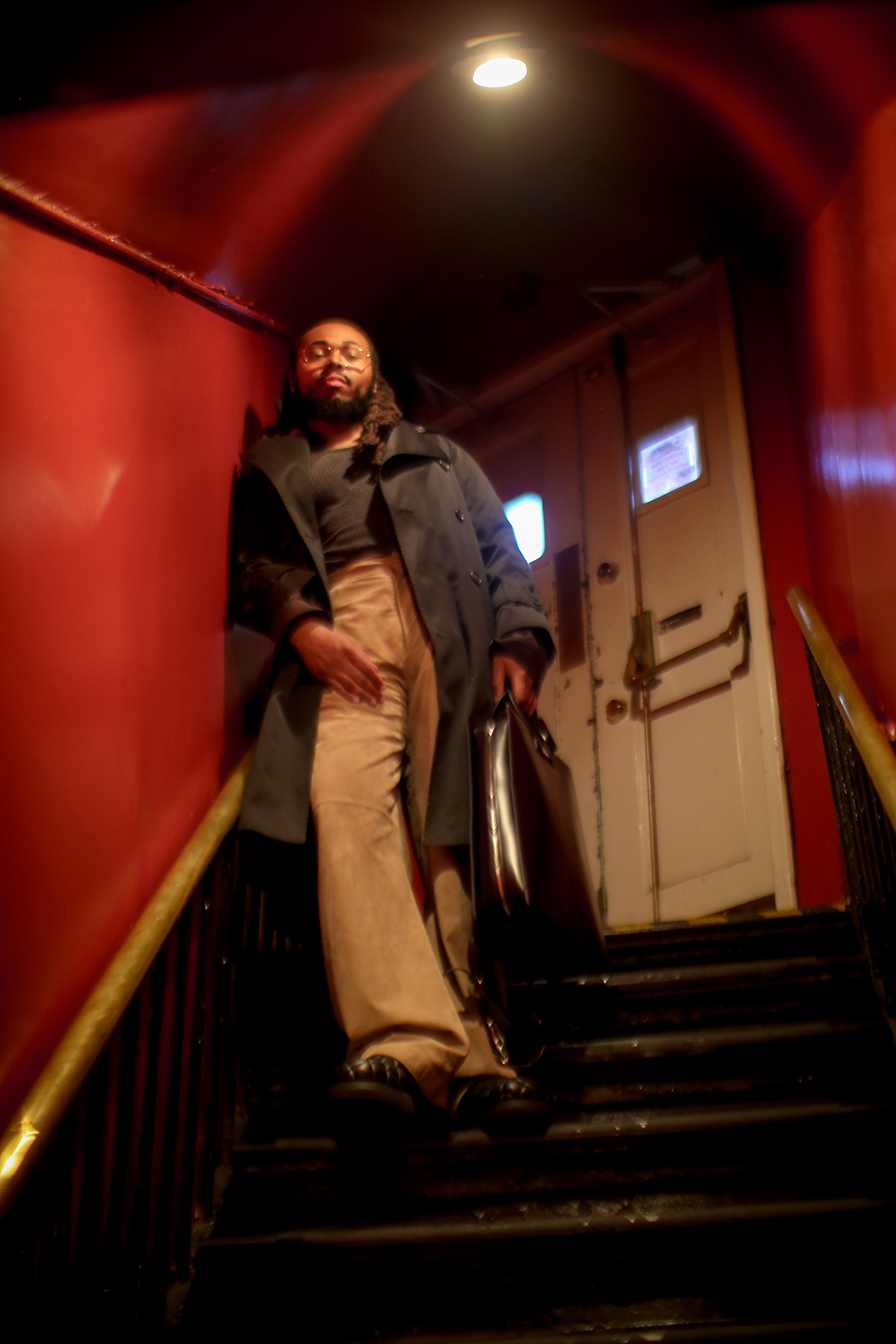
Immanuel Wilkins seems poised to become the alto player of the moment. (His only real competition for the crown, if we even want to express it in those terms, is Lakecia Benjamin, who's been covered in this column before.) He's a fascinating blend of the two lineages I described above, a creative thinker and rigorous composer and arranger who also has a deep feeling for the blues, gospel, and jazz at its most house-rocking and ecstatic.
Since signing with Blue Note, he's released three studio albums as a leader — 2020's Omega, 2022's The 7th Hand, and 2024's Blues Blood — and appeared on records by vibraphonist Joel Ross, drummer Johnathan Blake, keyboardist James Francies, and many others. He's also a member of the all-star group Out Of/Into with Ross, keyboardist Gerald Clayton, bassist Matt Brewer, and drummer Kendrick Scott.
Now, he's documenting his own long-running quartet, a group that features pianist Micah Thomas, bassist Ryoma Takenaga, and drummer Kweku Sumbry, in an exciting trilogy of live releases.
Live At The Village Vanguard Vol. 1, out now, contains four long tracks recorded at the legendary NYC club last May: a version of "Warriors," from Omega; a radical reworking of Alice Coltrane's devotional piece "Charanam," from her 1981 self-released cassette Turiya Sings; and two previously unrecorded pieces, "Composition II" and "Eternal."
There are two more volumes coming, the second in April and the third in May. Each of those contains all new music, except for a version of "Grace And Mercy," also from Omega, on Vol. 2. Others who've chosen to use the Vanguard's stage to capture new music on tape in the past include John Coltrane, Ambrose Akinmusire, and Gerald Clayton, so there's a history of this type of project, but that didn't make the prospect any less nerve-racking.
"We have been playing a lot of new music," Wilkins told me by phone from the road. "Some of it we've been playing for maybe just like a year on different gigs, and some of the stuff we've been playing since we first started playing as a band, but never recorded. The part that was scary is recording at the Village Vanguard; I think the space itself just demands so much, and I think it's such hallowed ground and such a revered venue to play at that there's that pressure... I think that sort of historical precedent and pressure was a whole lot and was super stressful for all of us, but also fun. And look, we're honored to be in that lineage of people who have released live records at the Vanguard, but also it's pushed us to make sure that we're putting out a product that's actually worthy of that title."
They recorded over the course of two nights, Thursday and Friday, capturing about four hours' worth of music; three hours' worth is preserved across the volumes, but no one set is presented from front to back. "I kind of picked and chose," Wilkins says, "and tried to make a flow for the album's sake. But a lot of the songs we did record back-to-back. There are some songs that go straight into each other, like 'Ring Shout' and 'Composition IX' [on Vol. 2], those are from the same night. They kind of flow into each other."
Ultimately, he wanted to balance an immersive live feel with something that stood up as more than just a pure document, and that influenced the sound of the record, which isn't bootleg quality by any means, but has real rawness. "I wanted it to feel as live as possible, and what I mean by that is both in the recording process — like, there's a lot of room sound... but then also in the amount [of material] I released. I wanted it to feel immersive, and I want it to feel like you came to a week at the Vanguard. Like, what would it sound like to really live in this universe for a long period of time?"
The music definitely has the intensity that can only be mustered by a hard-touring unit onstage. Of the 13 tracks spread across the three volumes of Live At The Village Vanguard, only three are shorter than 10 minutes, and "Composition IX" lasts nearly 24. And while Wilkins takes plenty of fiery solos, he also gives the band a lot of room to run. There are long stretches where this is basically a piano trio album.
"For my other records, I feel like I've put out really well packaged and contained pieces of work," Wilkins says, "where it all feels like songs and like music, you know? And this record, I feel like you get to really experience the logic of the band, and what it sounds like for us to be unleashed or just kind of playing in a room. I felt like it was important for us to document that; we don't really have too much recorded evidence of us, like, reaching for something without any sort of preconceived ideas of what we're going to do or with any sort of regulations to the performance. I think you're kind of seeing the most free version of the band."
While the compositions are all his except for "Charanam," Wilkins wants to be clear that the other players aren't there just to execute his ideas. "I've always tried to encourage everyone in the ensemble to make it feel like it's their own, you know, and we've been playing together at this point for seven or eight years... there's trust that comes with time, and then there's also... it doesn't necessarily feel like I need to ever — I don't have any ownership over the music, you know? I think that's really important as an improviser or as a musician, playing with other people — we don't own anything, it's really the music kind of [taking] shape as it wants to take shape and especially when you're being vulnerable with four people over the course of eight years, it's like there's trust... it doesn't become anybody's show, you know?"
It's particularly interesting to contrast this vibrant, anything-goes version of Wilkins on record with his studio albums, which — Blues Blood in particular — are meticulously crafted and designed to exist as much more than the documentation of a performance. He credits some of his early mentors with encouraging him to see the studio as a creative tool, more so than many other jazz musicians.
"I actually got that advice from on my first record from Jason Moran and from Kendrick Scott. They both were like, 'Man, make it sound like you're in the studio. Make it sound like a record; lean into the studio magic. Don't be afraid of messing with some stuff.'" This mindset allows him to understand albums as self-contained artistic statements, not just collections of his most recently written tunes.
"I want to make artifacts," he says. "I want to make stuff that isn't a thing replicating a thing. I want to make the thing, you know? There is a world in which recording can be a replication of what it means to hear it live, and I think that's a little less interesting than making the thing itself. We always say [in jazz] that recordings are never like hearing the band live, and I think that leaning into the recording process means that no, that thing is actually a singular thing, and then the live performance is a singular thing, and that's also why I felt super liberated to make the Village Vanguard recording feel like a voice memo, almost, where there's so much room sound, there's so much audience in it... I really was like, man, I actually want this to just feel like the room, because I have so many recordings where I'm so careful about each sonic thing, you know what I mean?"
TAKE 10
Pat Metheny - "Don't Look Down"
For several years now, Pat Metheny's been leading an evolving band called Side-Eye, which is basically his version of an organ trio. It originally featured James Francies on keyboards and various drummers including Marcus Gilmore, Anwar Marshall, and Nate Smith. (I interviewed Metheny in 2021, and we talked about the band.) He's just released the first Side-Eye studio album, featuring a new version with Chris Fishman on keyboards and Joe Dyson on drums. Metheny is a really creative, somewhat weird guy, and this is much more than an organ trio record. Fishman plays piano, synth, and organ, and on "Don't Look Down" there are wordless, possibly synth-created, backing vocals that give the music a weird kind of breathiness. Metheny's own playing is very much in a traditional "jazz guitar" mode; he's not veering off into sci-fi synth territory, which makes me happy, as that's my least favorite side of his music. (From Side-Eye III+, out now via Uniquity/Green Hill.)
Jeremy Pelt - "Fathers And Sons"
Trumpeter Jeremy Pelt has been leading bands with musicians younger than himself for a while, but on this album he's working with one contemporary (pianist Orrin Evans), one youngster (keyboardist Lasse Corson), and two veterans: bassist Buster Williams and drummer Lenny White. The album is entirely made up of new original music, and while it's entirely instrumental, the track titles show that Pelt, as always, has things on his mind: "Manifesto," "For The Culture," "Brothas On The Corner," "Fathers And Daughters," "Fathers And Sons." (Pelt has one son and two daughters.) He clearly views jazz as Important in an "uplift the race" sort of way, but he knows what century he's living in, so this is modern music, not a re-creation of 1960. He's a powerful trumpeter with the grace and lyricism of Woody Shaw, and a gift for strong melodies and compelling arrangements. Listen when he speaks. (From Our Community Will Not Be Erased, out now via HighNote.)
Adam O'Farrill - "Herkimer Diamond"
Trumpeter Adam O'Farrill is a part of a lot of amazing bands, including those led by vibraphonist Patricia Brennan, guitarist Mary Halvorson, and keyboardist Hiromi, but he's also a leader. His last album, 2024's For These Streets, was like a classic-era Wu-Tang album in that it brought in guest appearances from players he'd worked with elsewhere, including Halvorson, Brennan, and drummer Tomas Fujiwara. The band on Elephant, on the other hand, is a brand-new quartet featuring keyboardist Yvonne Rogers, bassist Walter Stinson, and drummer Russell Holzman. Their self-titled debut album is full of tunes that have the relentless energy of minimalism (or disco), laid over tick-and-thump drumming and adorned with smeary, electronically warped horn lines from the leader. "Herkimer Diamond," as seen in the video above, features an almost drum 'n' bass rhythm and fascinatingly off-kilter, but also quite romantic, playing from both O'Farrill and Rogers. Elephant is a band to watch. (From Elephant, out now via Out Of Your Head.)
Walter Smith III - "Casual-Lee"
In 2018, tenor saxophonist Walter Smith III, then signed to Whirlwind, released Twio, a disc featuring bassist Harish Raghavan and drummer Eric Harland, plus a couple of guests – bassist Christian McBride and fellow saxophonist Joshua Redman. Now, Smith is on Blue Note, and he's recorded Twio Vol. 2, on which the rhythm section is Joe Sanders on bass and Kendrick Scott on drums, and the special guests are bassist Ron Carter and tenor saxophonist Branford Marsalis, who's heard on this ripping version of the standard "Casual-Lee." Smith is a clean, polished player in the modern style, but he's got some Texas tenor deep in his musical DNA — I interviewed him about a decade ago and he shouted out Arnett Cobb, who was one of the paradigmatic hard-blowing Texas saxophonists. On "Casual-Lee," Smith and Marsalis (one of his earliest influences) go back and forth in a friendly but competitive fashion over a dancing beat. (From Twio Vol. II, out now via Blue Note.)
Espen Berg - "What A Wonderful World"
Norwegian pianist Espen Berg, who also works in trio and other group contexts, seems to be making a move to fill a slot left empty after Keith Jarrett's retirement from public performance. The Kempen Concert, recorded in November 2024, is his fourth fully improvised solo release, following 2022's The Trondheim Concert and 2023's The Nidaros Concert and The Hamar Concert. Like Jarrett, his solo piano music is a blend of classically derived romanticism and occasional rhythmic passages, but unlike Jarrett he doesn't bleat like a goat while he's playing, and he seems to welcome audience response. This performance consists of five movements over 70 minutes, followed by two encores, the second of which is a version of the standard "What A Wonderful World." This isn't the most viscerally exciting album in this month's column, but it's quite beautiful at times and there are worse ways to spend 85 minutes. (From The Kempen Concert, out now via ACT.)
Harriet Tubman & Georgia Anne Muldrow - "Flowers"
Harriet Tubman – the trio of guitarist Brandon Ross, bassist Melvin Gibbs, and drummer JT Lewis — create music I find difficult to describe, and that's the whole idea. (Full disclosure: both Ross and Gibbs have released music on my label, Burning Ambulance.) In the most reductive terms, it's dubby psychedelic rock fueled by improvisation. And when they bring jazz players into their zone, the results can be amazing, as on their 2017 album Araminta with Wadada Leo Smith, or 2011's Ascension, with Ron Miles on trumpet and turntablists DJ Logic and DJ Singe. Their latest album is a collaboration with jazz-funk priestess Georgia Anne Muldrow, and it's a dreamlike collection of jams featuring some of Ross's most traditionally guitar solo-esque playing over deep grooves from Gibbs and Lewis. Muldrow's contributions are more nebulous; her voice is fed through effects, and her lyrics are disjointed phrases, but the result is mesmerizing. (From Electrical Field Of Love, out 3/27 via Pi Recordings.)
Mark Turner - "Supersister"
Zenlike tenor saxophonist Mark Turner (that's only half a joke; he's a practicing Buddhist) has been recording a lot the last few years, often in collaboration with trumpeter Jason Palmer. This is the third album by a quartet featuring Turner, Palmer, bassist Joe Martin and drummer Jonathan Pinson, and you can definitely hear that the four of them have settled into a deep creative relationship. They're hewing to traditional dynamics — Palmer and Turner handle the melodies, and take turns soloing — but the freedom granted to Martin and Pinson keeps everyone on their toes at all times, elevating the performances into the stratosphere. "Supersister" is the album's final track, and by far its longest at over 12 minutes, so of course that's the one they made a video for. The bassist and drummer kick it off with a supple, shifty groove before the horns enter and things really get rolling, never letting up. (From Patternmaster, out now via ECM.)
Shabaka - "Marwa The Mountain"
Shabaka Hutchings is playing the saxophone again! He put the horn down a couple of years ago to explore the world of flutes, and released some really interesting music that way — the EP Afrikan Culture, followed by his last album Perceive Its Beauty, Acknowledge Its Grace. On those records, though, he was working with a small pool of collaborators. Here, he's all alone. According to the press material, he made the record while traveling, using whatever instruments he had on hand and production tools probably contained within a laptop. There are programmed rhythms, looping structures, dreamy synth interludes, and on the album's final track, "Eyes Lowered," he raps, kinda. But "Marwa The Mountain" is the most exciting track, for me, because he's back on tenor, blowing hard riffs like he used to with Sons Of Kemet and The Comet Is Coming. I think this is gonna be a polarizing record, but I'm into it. (From Of The Earth, out now via Shabaka Records.)
Dave Adewumi - "Is"
Dave Adewumi is a fast-rising star trumpet player. He's already recorded with fellow trumpeter Dave Douglas, pianist Jason Moran, and vibraphonist Sasha Berliner, among others, and now he's stepping out on his own with a really interesting band: Joel Ross on vibes, Linda May Han Oh on bass, and Marcus Gilmore on drums. The album, which was recorded live at Ornithology in Brooklyn in 2024, is being released via Giant Step Arts, a nonprofit run by the photography team of Jimmy and Dena Katz, as part of its Modern Masters and New Horizons series. Adewumi has been working with trumpeter Jason Palmer, and that makes sense, as they seem (to my ear) to have a similar approach to the horn, extremely technically skilled with extraordinarily precise articulation and a flair for melody, which you can really hear on "Is" and every other track from this record. Remember Dave Adewumi's name. (From The Flame Beneath The Silence, out 3/27 via Giant Step Arts.)
Irreversible Entanglements - "Don't Lose Your Head"
Have Irreversible Entanglements gone soft? When the quintet — trumpeter Aquiles Navarro, saxophonist Keir Neuringer, bassist Luke Stewart and drummer Tcheser Holmes, with poet Camae Ayewa up front — first manifested on record in 2017, they were terrifying. The first track on their self-titled debut album, "Chicago To Texas," opened with a martial drum solo, calling the assembled to attention, before Ayewa's verses assaulted the listener with images of lynching, of prison rape, of infanticide to avoid enslavement.
They made two more albums — 2020's Who Sent You? and 2021's Open The Gates — along with scattered single tracks, live recordings, and whatnot, and gradually their music expanded. The raw free jazz-plus-poetry of the debut was transformed through electronics, more open compositional strategies and an embrace of the potential of the recording studio, and their albums began to exist as not just documents but statements. When they announced that they'd signed with legendary jazz label Impulse! for their fourth full-length, 2023's Protect Your Light, it made both professional and artistic sense.
That album, recorded at the legendary Rudy Van Gelder studio in New Jersey, was both a more concise — eight tracks in 45 minutes — and a more optimistic, bright-eyed statement than any they'd ever made before. The music bounced and wiggled, and Ayewa's lyrics were about love, freedom and dancing. She hadn't suddenly decided the world was a wonderful place; she had simply decided to engage with the joys and glories of human existence. You can't live on pure righteous rage 24/7; sometimes you've got to dance, kiss your loved ones, feel the sun on your face. As she and the guest vocalists sang on the title track, "Protect your light/ Protect your life."
The group's second Impulse! release, Future Present Past, is the next artistic step after Protect Your Light. It's awash in electronics and dubby effects, horns and rhythm instruments floating in and out and around like jungle animals crying at you from trees, and a pair of guests — Helado Negro and MOTHERBOARD — are so frequently present they're basically full bandmembers.
The track titles reflect the group's focus, which is on collective work and a kind of ultimate positivity. The album begins with "Juntos Vencemos," which translates to "Together We Win," and as the album progresses we are told "Don't Lose Your Head," "Vibrate Higher," "Hold On," "Keep Going," and it all concludes with "We Overcome." And "Panamanian Fight Song" feels like the entire album in miniature, as Ayewa's lyrics incorporate many of these track titles into a kind of steely-eyed manifesto.
"Don't Lose Your Head" reflects the optimism of the entire album, albeit filtered through a warning you might receive from your mother, or an elder: "Don't lose your head/Messing with the gods," Ayewa and MOTHERBOARD sing over a pulsing bass line, clattering drums, and a mantralike horn line. It's a good single, but you've really got to hear the whole album. (From Future Present Past, out 3/27 via Impulse!)
OUTWARD BOUND
God damn. These kids are killing it.


