
Sonny Rollins has died at 95. An absolute legend, he was the last man standing from his generation of bebop and hard bop players, and even though he retired from live performance several years ago due to illness, he remained a standard to live up to.
I had the privilege of interviewing Rollins twice, in 2009 and 2010, and the impression I got was of an extraordinarilly humble man. When I asked him how he avoided relying on stock phrases when improvising, he said, “I’m not that skilled a musician... it takes a certain skill to be able to play the same way every night. That takes skill. And I don’t have that skill, I can’t play the same thing every night. So it’s just my lot in life that I’m going to change, and what I play isn’t going to be the same.”
Although he struggled with drugs in his youth, Rollins was very concerned with his mental, emotional and physical health later in life. He was mostly a vegetarian (“I do eat fish and yogurt, and other than that, vegetables”), practiced yoga and was deeply spiritual, which fed into his musical practice as well. He claimed to leave his body while improvising. “I remember that I used to be able to float,” he told me. “I would be meditating and my spirit or my soul, my mind, whatever you want to call it, would float up to the ceiling and sort of float around. I mean it was an exhilarating experience. So there’s a lot of ways to leave your body. But when I’m playing, I leave my body in the sense that when I’m really in the middle of a solo, I try to forget all the things I’ve learned about the music, I try to forget where I’m at, the audience, everything. Be oblivious to everything. So I leave my body in that sense, and the music is playing me. I’m not standing up there thinking, ‘Lemme play this next, and I’ll play this after that.’ I’m not doing that at all. I’m just there, and the music is playing through me, so to speak.”
I saw Rollins live twice — once at Tramps in the late 1990s, and again at his 80th birthday concert in 2010, at the Beacon Theatre. That night, he was joined onstage by Ornette Coleman; the two men had been friends for decades, and used to rehearse together in the 1960s, but only appeared onstage together that one night. Just seeing the grin on his face when Ornette walked out was worth it all, but hearing them play together for more than 20 minutes was literally a once-in-a-lifetime experience.
If you’ve never explored his catalog, it can be tough to know where to start. He recorded for many labels from the 1950s to the 2000s. If I had to pick just a few starting points, I’d recommend Saxophone Colossus and Freedom Suite, both from 1957; Our Man In Jazz, from 1962; Alfie, from 1966; and 1975’s Nucleus. Each is very different from the others, and putting them all together will give you at least the beginning of an idea of the breadth of this man’s achievement. Sonny Rollins was one of the greatest to ever put a horn to his lips, and he’ll be missed.
***
“You have to remember that the trumpet is a mean instrument, the meanest there is. It’s a damn monster. Sometimes I feel like throwing it out the window, it’s such a beast. There are times when it treats you so sweet and nice that everything comes out just perfect. Then you come back to it the next night, rub your hands together and say to yourself you’re going to do it all over again. You pick up the horn, put it to your chops, and the son of a bitch says, ‘Screw you.’” — Roy Eldridge
“Some days you get up and put the horn to your chops and it sounds pretty good and you win. Some days you try and nothing works and the horn wins. This goes on and on and then you die and the horn wins.” — Dizzy Gillespie
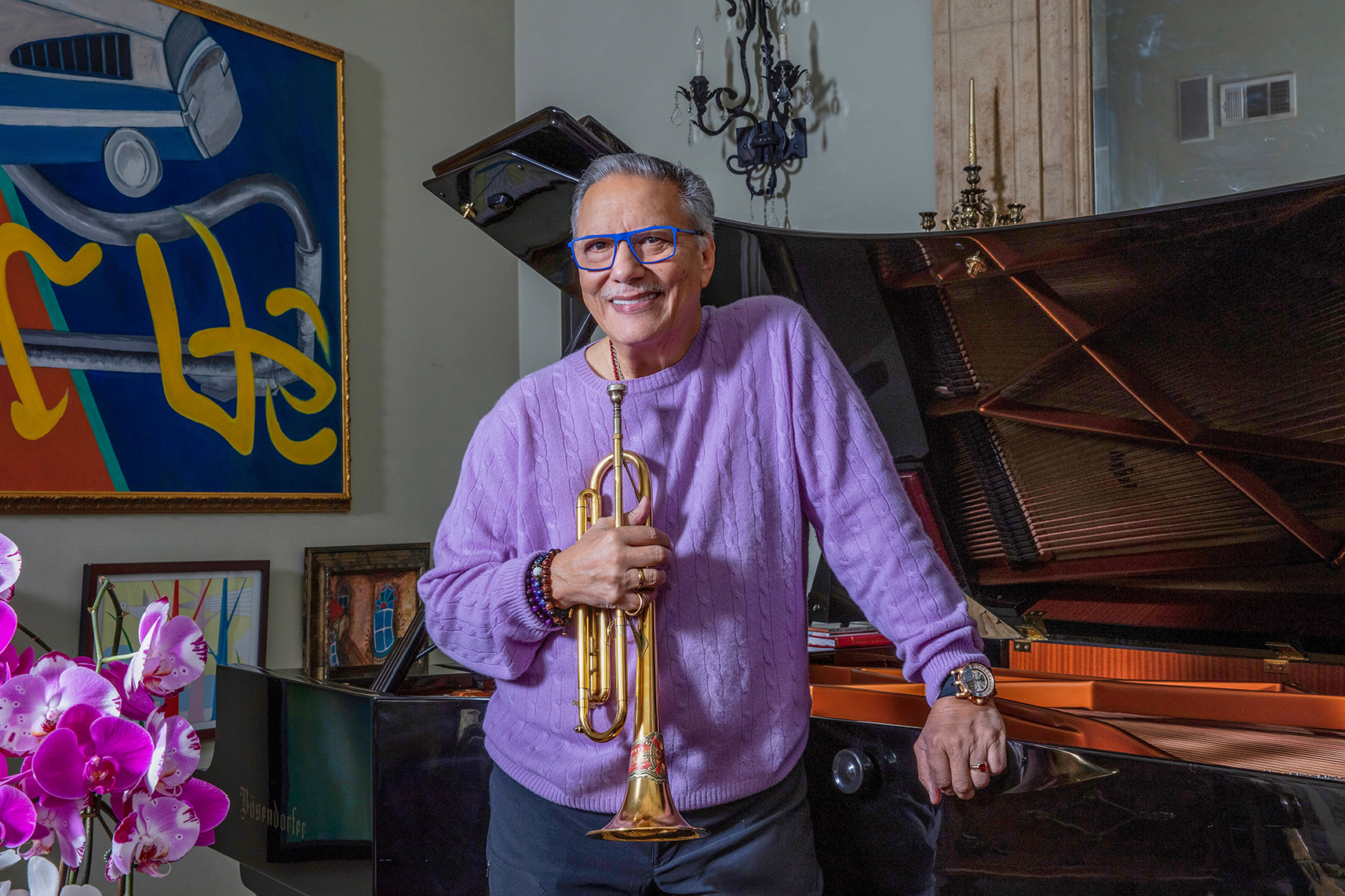
Arturo Sandoval is a trumpet legend. He began his career in his native Cuba, as one of the founding members of Irakere, a legendary Afro-Cuban jazz-funk group that evolved out of the Orquesta Cubana de Música Moderna in the early 1970s. After recording several albums with them, he went solo in 1981 and made friends with fellow trumpeter Dizzy Gillespie, a relationship that ultimately led to the second phase of his life and career.
In 1989, Gillespie invited Sandoval to be part of the United Nations Orchestra, and during a world tour, brought him to the US embassy in Athens, Greece, where he defected. Sandoval became a US citizen in 1998 and has lived in Florida ever since. He’s won an Emmy and a Grammy, was a Kennedy Center Honors recipient in 2024, when that still meant something, and received the Presidential Medal of Freedom from Barack Obama in 2013.
Growing up a jazz fan in Cuba, where American culture was banned after 1959, was a challenge. “I listened every day from Monday to Friday on the shortwave [radio] the Voice of America,” Sandoval told me. “There was a program there called the Jazz Hour, the host was the great late Willis Conover, and I never missed any of those programs. And by the way, when I was in my obligatory military service, a sergeant caught me in the corner of the barracks listening to that and they put me in jail for three and a half months because I was listening to the voice of the enemy.”
This deliberate cultural separation even filtered through into Irakere’s music. Sandoval told me, “One of the things that’s so funny, man... in the beginning of Irakere we weren’t allowed to use the cymbals on the drums, because they said that sounded too American. We had to change the cymbals and put cowbells and all the things [for] that reason, you know, but at the end we masqueraded bebop and jazz [on top of] a Cuban rhythm, an Afro-Cuban rhythm or whatever. But in the end, when we improvised something, that was 100 percent jazz, but with a different rhythm.”
Sandoval’s music has spanned a broad range ever since, from the Latin grooves of Irakere to classical to flame-throwing bebop. He’s recorded tribute albums to Clifford Brown and Gillespie, as well as a particularly astonishing album discussed below. He wrote the music for a movie about his own life (Andy Garcia played him) and has scored numerous other films, including two directed by Clint Eastwood.
His latest album, Sangú, is his 49th by his count, and it marks a departure even from the wide range of sounds he’s explored in the past. It features his touring band, with no special guests, and was executive produced by his son, Arturo Sandoval III, and his daughter-in-law and manager, Melody Lisman.
“When the pandemic started I was like everybody else, couldn’t get out of the house,” Sandoval told me. “I was there for probably a little more than two years, and then I was so frustrated about it. And I said, I have to do something because I don’t want to be sitting here and doing nothing.” He began writing new music and posting videos online. Eventually, his son and daughter-in-law came to him and said he should pull a new album out of all that material. What surprised him was that they wanted to produce it. “They are not musicians. They have no experience in music at all and I said, ‘Oh, you want to produce that?’ They said, ‘Yes, we want to,’ and then they picked out 100 [tunes]... and said, ‘You have to listen to these 100 and then pick out 12 of them to redo again, and that’s gonna be the album,’ and that’s what we did.”
Sandoval was skeptical, but quickly came around. “I was impressed about the concept they had, they had a clear idea exactly what they wanted and how to do it, and it was the first time in my life ever that someone told me what to do, how to do it. ‘Play faster, play slower, play higher, play lower.’ Oh my goodness. I said, What the heck is this, man? Okay, but by the end me and my band, everybody was impressed because every time they made a comment or suggested something, it made a lot of sense and the final result, I think is — it’s a good album.”
It’s also a relatively short album. Those 12 tracks fly by in just 42 minutes. Almost all of them are in the three-minute range, and they’re fierce exercises in groove, with a tight rhythm section (Lisandro Pidre on keyboards, William Brahm on guitar, Maximilian Gerl on bass, Daniel Feldman on drums and Samuel Torres on percussion) supporting Sandoval and three additional horns: Michael Tucker on tenor sax, Bob Sheppard on alto and baritone saxes and flute, and Paul Nowell on trombone. The range is exciting: “Azulito” is a mellow, swinging jazz piece, while “Babalu Ayé” is a pulsing Afro-Cuban groove that features Sandoval’s vocals, “With The People” is a funky strut reminiscent of Earth, Wind & Fire, and “Days In The Sun” rides an Afrobeat rhythm with stinging guitar.
If you’re wondering what the title means, it’s a joke rooted in Sandoval’s thick Cuban accent. “I was 40 years old when I got to the US and I never took a lesson or anything or class or whatever and I had to figure it out by ear, you know, how to understand the language to express myself,” he explains. “So when we tried the first tune we played it back, we listened to that and I said, ‘Oh man, it sounds good,’ and then they started laughing, my son and his wife, and they wrote it down SANGU with an accent, sangú.”
Sandoval’s solo on Sangú’s opening track, “Scat,” features a piercing high run — something of a trademark of his. He’s long been renowned for his command of high notes, and at 77 the ability hasn’t left him. I asked him for his secret, and he said “There’s only one way. Discipline, consistency, passion, and more discipline, because you cannot take for granted anything, especially with a trumpet. It doesn’t matter what age but of course in the late 70s it’s even more demanding [of] that kind of discipline, you know.”
He pivoted quickly, though, and pointed out that he’s much more than a high-note player. “To be honest, I’m gonna tell you something — that always kind of pissed me off when the people always made that remark about my high notes and said, ‘Man, damn.’ That bothered me a lot because I can play pretty too, you know? When I play a ballad you hear a lot of heart there, a lot of feeling, a lot of sentiments, and I do prefer that somebody mention that instead of the freaking high notes.” (For the record, “New Paradise” and “Red Trumpet” on Sangú are beautiful ballad performances.) “I know, you know, it’s okay. All those [things] belong to the music. It’s a matter of how you use it, when you use it as an effect or something. But I’ve been practicing all my life like crazy. Because I believe it’s two ways to play an instrument. You play what you can or you play what you want, and I want to belong to the second group.”
He told me about his 2003 album Trumpet Evolution, on which he displayed the true range of his abilities by paying tribute to players from across the jazz spectrum and even classical players like Maurice Andre, Rafael Méndez, and Timofei Dokschitzer. “I did like 20 tunes there, imitating 20 different trumpet players in different genres from the beginning of the 20th century to today... I did King Oliver, Louie Armstrong, Miles, Clifford Brown, Clark Terry, Dizzy Gillespie, you know, 20 of them, and that’s my testimony of my respect and admiration for all of them, but also, modesty apart, it’s my demonstration that I listened to all of them and I picked up a lot of things from all of them and I was able to do it.”
Sandoval has been touring around the world for five decades, playing everywhere from jazz clubs to concert halls. And last month, he appeared at Coachella, a guest of Karol G, having played on the song “Ivonny Bonita” from her latest album, Tropicoqueta. “She called me out of the blue... we played two Sundays, April 12 and 19, and a couple of days before we did a rehearsal and then we met. But for the album she called me and said, ‘I would like you to play one tune with me on my new album,’ and I said yes, okay. I did it, and then later on she called me and said, ‘Man, I would like to invite you to play that tune with me in Coachella.’ I said wow, you know for a 77-year-old man it’s something unbelievable, because I never even thought about or dreamed about to be at Coachella, you know.”
TAKE 10
Kazuki Yamanaka - “Flare”
Alto and soprano saxophonist Kazuki Yamanaka’s third album is a collaboration with three players decades older than himself: pianist Russ Lossing, bassist Cameron Brown, and drummer Billy Mintz. It’s a collection of mostly gentle, drifting compositions with an almost chamber jazz feel – when you see track titles like “Inner Space,” “Finding Peace,” “Humanity,” and “Divinity,” you kinda know what you’re gonna get. There are a few pieces with a different energy, of course. “Amalgamator” is a freely improvised workout that never rises to a full scream, but twitches and writhes with a nervous energy, everyone seeming to dance around each other without ever collaborating. And “Flare,” the track streaming here, has a bouncing, swinging energy and a hypnotic melody that draws you in — Lossing takes the first solo, laying notes down like he’s assembling a mosaic, before Yamanaka takes over, keening and murmuring to himself over just bass and drums. (From Humanity, out now via Whirlwind.)
Jeff Parker ETA IVtet - “Like Swimwear (Part Two)”
Guitarist Jeff Parker’s ETA Ivtet — with saxophonist Josh Johnson, bassist Anna Butterss, and drummer Jay Bellerose — could probably release every one of their trance-inducing live shows on short-run vinyl and digital downloads, and people would buy them, turning them into the Grateful Dead of L.A.-based post-jazz in the process. This album was recorded live at Lodge Room in Highland Park last August, and consists of two long tracks, the 23-minute “Like Swimwear” and the 20-minute “Happy Today.” The former is immediately about groove, while the latter takes a while to get going but eventually settles into a mantralike zone, with Parker and Johnson repeating the melody back to each other as Butterss throbs in the middle, occasionally grabbing the bow to raise the energy level just a little. As you can see in the video, the crowd is gathered tight around them, whooping and hollering and loving every note. (From Happy Today, out now via International Anthem/Nonesuch.)
Altin Sencalar - “In Walked Horace”
Trombonist Altin Sencalar has been making an album a year for Posi-Tone since 2023. This fourth release is a Latin jazz date featuring trumpeter Alex Norris, Sharel Cassity on alto and soprano saxes and flute, Michael Dease on baritone sax, Art Hirahara on piano, Boris Kozlov on bass, Gary Kerkezou on drums, and Alex Acuña on percussion. “In Walked Horace” is a tribute to the late pianist and composer Horace Silver, one of the greatest hard bop players and bandleaders of the 1950s and 1960s. It’s a romping, uptempo party of a tune with a big, hooky melody — the kind of thing Silver specialized in — that allows Sencalar and Dease to engage in an extended back-and-forth, as the rhythm section of Hirahara, Kozlov, Kerkezou (a hard-swinging drummer I wasn’t familiar with until now) and Acuña assemble a tight, supple groove. It’ll have you bouncing in your chair. (From Natural Rhythm, out now via Posi-Tone.)
Joe Lovano - “Lady Day”
Joe Lovano’s been recording for over 40 years, and has over 40 albums to his name as a leader. I’ve only heard a small fraction of his output, but I’ve always liked what I’ve heard; he’s a thoughtful, soulful saxophonist with a great deal of tenderness and romance in his playing. His latest album introduces a new band with guitarist Julian Lage, bassist Asante Santi Debriano, and drummer Will Calhoun — yes, the guy from Living Colour. This is an ECM release, so Calhoun doesn’t get to explode the way you might expect, but there are a couple of intense tracks, like “Fanfare For Unity” and “The Great Outdoors.” This version of Wayne Shorter’s “Lady Day,” originally recorded on his 1965 album The Soothsayer, gives you the general flavor of the album. It’s a tender ballad with a beautiful melody laid out by Lage and extrapolated upon with grace by Lovano. (From Paramount Quartet, out May 29 via ECM.)
Kasper Bjørke Quartet - “Passage III (slow days of togetherness)”
I don’t quite understand why Danish electronic musician Kasper Bjørke calls this ensemble a quartet. There are more than four people, and the membership has changed on each of its three albums. The first two, 2018’s The Fifty Eleven Project and 2022’s Mother, were on German electronic label Kompakt, and sounded more like ambient post-classical. This time out, Bjørke and Claus Norreen are on synths; Anna Roemer plays guitar; Oilly Wallace plays saxophone and flute; Malthe Kaptain plays trumpet and flugelhorn; and Katie Buckley plays harp. It’s a nine-track suite, all named “Passage,” with parenthetical subtitles like “(slow days of togetherness)” or “(listening to lullabies while holding hands)” or “(watching you quietly eat an apple in the shade)”, and if you think this probably sounds like a cross between the Floating Points/Pharoah Sanders album Promises and a three-hour YouTube video intended to align your chakras, you’re absolutely right. And it rules. (From Passages In Time, out now via Sensitive Records.)
Vladislav Delay Quintet - “twelve”
Finnish electronic musician Vladislav Delay, who often works solo but has collaborated with reggae legends Sly & Robbie and trumpeter Nils Petter Molvaer (together on the same album!), and was a member of the Moritz Von Oswald Trio, has assembled a group for this record that includes Maria Bertel on trombone, Lucio Capece on soprano and slide saxophones and khene (a bamboo mouth organ from Laos), Max Loderbauer on piano and synth, and Derek Shirley on bass. Delay himself contributes squelchy electronics, harsh programmed beats, and produces it all. The music ranges from keening drones with occasional sub-oceanic bass booms (“fourteen”) to Pan Sonic-esque minimal techno beats with horn moans (“thirteen”) to massive electronic roars (“three”). This track, “twelve,” features staccato horns, sounding slightly warped by electronics, over a heavy bass pulse from Shirley. The electronics wobble, clang and crash like giant gongs fed through a pedal; it’s disorienting, but beautiful. (From VD5, out now via We Jazz.)
Chris Potter - “Osawatomie Brown”
Saxophonist Chris Potter’s no stranger to themes and concepts; his 2013 ECM album The Sirens was inspired by The Odyssey. His latest release, Alive With Ghosts Today, is a suite of compositions inspired by the story of abolitionist John Brown and his raid on a federal armory in Harper’s Ferry, Virginia. In addition to Potter on tenor and soprano saxes, the band includes Zekkereya El-Magharbel on trombone, Rane Moore on clarinet, Sara Caswell on violin, Bill Frisell on guitar, Burniss Travis on bass and Nate Smith on drums. According to the press release, that unusual combination of instruments was meant to suggest “a small-town band with limited resources but deep character.” But this doesn’t have the loose, ragged-but-right feel that description implies; these are tautly arranged pieces with the groove and vibrating energy of a 1970s Lalo Schifrin movie score. Frisell’s guitar has real sting, and Potter lets rip throughout. (From Alive With Ghosts Today, out now via Edition.)
Matthew Stevens - “Who Does She Hope To Be?”
I first noticed guitarist Matthew Stevens as a member of trumpeter Christian Scott’s pool of collaborators; they played together for more than a decade. His work with saxophonist Walter Smith III on the three In Common albums also impressed me a lot, but I’ve never heard anything he’s recorded as a leader until now. This record, his fourth under his own name, features a slew of guests, including vibraphonist Joel Ross, saxophonist Josh Johnson, drummer Terri Lyne Carrington, and fellow guitarist Jeff Parker. Johnson, Carrington, and Parker are all heard, alongside keyboardist Chris Fishman and bassist Kyle Miles, on this version of Sonny Sharrock’s beautiful ballad “Who Does She Hope To Be?”, from his 1991 album Ask The Ages. The guitar work is the focus at first, of course, and the way Stevens and Parker play together is beautiful, but Fishman’s squiggly synth solo takes the piece in a fascinating direction midway through. (From Matthew Stevens, out now via Candid.)
Olivia Murphy Jazz Orchestra - “Honey Thieves (Part 1)”
Big band music fascinates me because it seems like such an impossible thing. To write so many parts, create such intricate arrangements, and then conduct the whole thing — it’s a lot. So even when I’m not super impressed by the results, I’ve got nothing but respect for the effort. Olivia Murphy wrote and arranged all but one of the tracks on this record, and conducted a 16-member ensemble (plus two vocalists, and a synth player on one track). The music isn’t big band in the Count Basie/Duke Ellington sense; it’s avant-garde large ensemble music in the Carla Bley/Maria Schneider/Darcy James Argue sense. Two vocalists, Becca Wilkins and Rebecka Edlund, whistle and coo and recite poetic lyrics as the ensemble slowly comes together behind them over the course of the first few tracks. By “Honey Thieves (Part 1),” the third track, the music is in full bloom. (From Fateful Birds & Fledgling Stories, out now via Olivia Murphy.)
Tyshawn Sorey - “Abstrusions”
Tyshawn Sorey is many things. He’s an amazing drummer, capable of extraordinary sensitivity and a thunderous attack worthy of death metal (he’s a fan); he’s a composer whose works encompass solos, duos, chamber pieces and pieces for large ensembles; and he’s a skilled interpreter of other people’s music. He’s made an album for John Zorn’s Tzadik label on which a chamber music group performed a scored piece, and he was charged with improvising his own part; recorded a triple CD with an eight-member ensemble that was like a cross between an orchestral work by Anna Thorvaldsdottir and an Art Ensemble of Chicago record; and composed pieces for others to perform.
The range of his activities raises questions about Sorey’s philosophical and conceptual relationship to jazz. He plays on conventionally “jazz” albums all the time, recording with Vijay Iyer, Roscoe Mitchell, saxophonist Angelika Niescier, guitarist Lage Lund, saxophonist Steve Lehman, and many others. But when he records as a leader, his albums often seem to stand one step to the left of “jazz” as it’s commonly understood. Either because of the instrumentation or the compositional forms (his first album, That/Not, includes a track called “That’s A Blues, Right?”), he always seems to be questioning the accepted rules, often from a “Well, why can’t you do X and still call it jazz?” angle.
In recent years, he’s been addressing the jazz tradition explicitly, in fascinating ways. Between 2022 and 2024, he formed a trio with pianist Aaron Diehl and various bassists — Matt Brewer, Russell Hall, or Harish Raghavan — and released four albums of reinterpreted standards. (One of these, the triple disc The Off-Off Broadway Guide To Synergism, also featured alto saxophonist Greg Osby.) On each, he took a mix of well-known tunes and relative obscurities and spun them around, flipped them on their heads, and extended them to radical length: a 20-minute version of “Three Little Words,” a nearly 14-minute “Angel Eyes,” a 15-minute version of McCoy Tyner’s “Peresina.” Often, he’d slow the pieces down to the pace of a Morton Feldman string quartet, forcing/allowing Diehl to play every note of the melody practically on its own, impressing on the listener the importance of deep focus. The message was, This is serious, beautiful music and it is worthy of your undivided attention.
His latest release, an equally sprawling interpretation of Max Roach’s 1968 album Members, Don’t Git Weary recorded live at the Jazz Gallery, is another deep interrogation of the music and its meaning. He juggles the track order so the title piece now closes the show, with a stunning guest appearance by vocalist Fay Victor, and stretches the music out as always. The original album ran just 31 minutes; Sorey’s version is three times that long, requiring 2 CDs and 95 minutes to make its full statement. The band includes Adam O’Farrill on trumpet and electronics, Mark Shim on tenor saxophone, Lex Korten on piano, and Tyrone Allen II on bass, and there are plenty of traditionally jazz-coded solos, but many of them seem to function as fanfares or overtures rather than outgrowths of the compositions. I wonder what Max Roach — who very much wanted jazz to be recognized as the serious, challenging music it is — would have thought of this radical reinterpretation of his album. (From Members...Don’t!, out May 29 via Pi Recordings.)
OUTWARD BOUND
Giant Reps:
@jbysax This is definitely the craziest one yet ? I took on the most feared jazz tune “Giant Steps”… and if you know, you know—say that name to most musicians and they’re running the other way ? But I figured why not take it a step further and play it while squatting? ??? Memorizing the melody alone was already a challenge, not gonna lie… adding squats on top of that made it a whole different beast ? But we got it DONE ???? . . . #playingsaxwhilesquatting #multitasking #fyp #jbysax #jbysaxent
♬ original sound - jbysax