

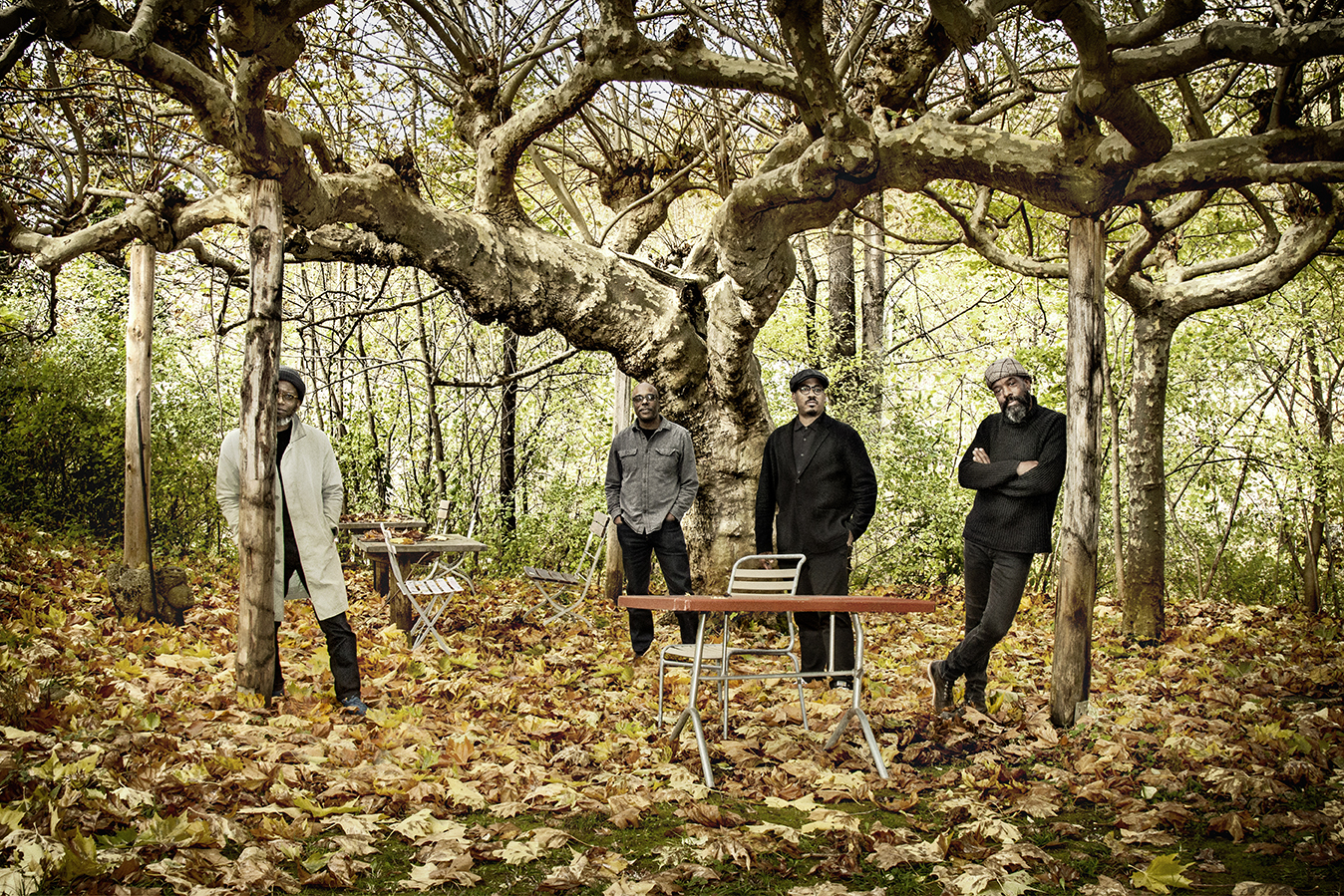
James Brandon Lewis gives the impression of being wise beyond his years, but he’s got just as many questions as anybody else. The son of a minister, he grew up in Buffalo, NY, and attended Howard University. After graduation in 2006, he moved to Colorado, where he spent several years as a gospel musician. In 2010, he began attending CalArts, studying with Wadada Leo Smith, Charlie Haden and others, and releasing an independent album, Moments. After receiving his MFA, he moved to New York and began working with Matthew Shipp, William Parker, and Gerald Cleaver, among others. He released Divine Travels in 2014, and hasn’t stopped moving since.
Lewis’ discography is broad, and scattered across multiple labels, from the major imprint Okeh to tiny European indies. He changes personnel often, bringing his saxophone into all sorts of contexts. But since 2018, one of his strongest creative relationships has been with drummer Chad Taylor.
“I first saw Chad Taylor playing with Cooper-Moore in maybe 2014,” Lewis recalled in a 2021 interview with Troy Collins. “Anyway, we began collaborating after I did arrangements of Coltrane tunes for a solo saxophone marathon in Philly some time ago, and then decided to use those arrangements for our duo, which we recorded as our first album Radiant Imprints.”
That album, recorded in January 2017 at Park West Studios in Brooklyn, was released the following year. In its wake, the two performed in Austria, recording the album Live In Willisau, which included a version of “Willisee,” a piece from the 1985 Dewey Redman/Ed Blackwell album Red And Black In Willisau.
“My love for the duo recording Red And Black by Dewey Redman and Ed Blackwell, as well as Chad Taylor’s love for that recording, sparked our own duo and further cemented our dedication to the depth of exploration of the duo format,” Lewis told Collins. He added, “Chad has a high level of melodic lines via the drums and it inspires me. Also, his use of mbira adds to his overall artistry in very dynamic ways. His versatility in knowing many musical genres allows me to draw from multiple influences within my own experience, giving me ultimate freedom.”
In 2020, Lewis invited Taylor, bassist Brad Jones, and pianist Aruán Ortiz to join him in a new quartet project. The goal with this band, separate from all his other groups, was to explore a set of compositional principles Lewis refers to as Molecular Systematic Music. In a 2020 essay, he explained the theory behind it: that the sum of what a musician has heard in their life is the DNA of what they will play on their chosen instrument. “MSM offers musicians a way to discover their own musical DNA by examining their prior musical experiences, yielding a chart in the form of a ‘molecule’ which may then be used to generate ideas for composition and improvisation.”
Over the course of five studio albums and a double live CD, Lewis has used the theories of Molecular Systematic Music to compose more than 40 pieces, some of which are clearly linked (there are compositions simply called “Per 1” through “Per 7” on the group’s first four studio albums) but all of which fit together somehow, forming a single body of work.
“I think that for the quartet specifically, outside of all my other groups, there’s clearly a language that we’ve built over time,” Lewis told me recently, while on tour with the Messthetics (guitarist Anthony Pirog plus bassist Joe Lally and drummer Brendan Canty, both ex-Fugazi). “And I’ve never really shown them. Chad’s seen the molecule, and seen how I’ve been building the music over the years. But Aruán and Brad, I just kind of like... I still write in Western notation for the group.”
Lewis explained the molecule to me as a set of 17 six- or seven-note scales. “But it's not modal music. It’s not even coming from that perspective. Basically, I built a molecule for myself years ago that draws inferences between molecular biology and music nomenclature. And then basically [serves] as a structure mapping engine, an analogy or metaphoric concept where you have two things... and then you keep drawing inferences between the two until they become one.” He says that even five albums deep, he’s still only scratching the surface of MSM’s potential, that his system is “built in a very specific, idiosyncratic way, and really most of the albums only cover maybe one of those, or maybe two or three of those scales. So it’s really... a life’s work, really, how I’m building on it.”
The latest quartet album, Omni, is something of a musical sequel to their 2024 release, Transfiguration: “I’m now using the other, what you would call in the context of my system the negative space, which is the other six notes [of a 12-tone scale]. So it’s really catering to this idea of atonal music, but it’s my own take on it. So it’s not like Schoenberg or nothing like that. It’s just, I devise these formulas and then put [them into] call-and-response or cadence structure. Like if you listen to ‘Line Upon Line,’ that’s pretty much what would happen at church, except I play the tone row at the beginning, like an intro.”
Indeed, “Line Upon Line” begins with a 12-note ascending scale, played passionately, like a fanfare. But the piece that follows uses those twelve tones as a framework for a passionate free jazz blowout in the spirit of Albert Ayler or David S. Ware. “It’s just like church, just like Black church,” Lewis says, “where like you hear the rhythm section is responding to the sermon, but I had to make it like kind of like this. But it’s still, you know, oscillating between these two six-note structures and they keep answering back and forth. Same thing with ‘Testify.’ It sounds like a blues. It is a blues. But that wasn’t necessarily how I thought about it conceptually, really... pretty much all of the tunes center around this idea of playing around with 12 tones without an exact tonal center, necessarily.”
The idea of combining 12-tone music — albeit without explicitly drawing on Schoenberg — with the hard-charging rhythms of gospel and the blues is fascinating, and the actual execution is breathtaking at times. There’s a classicism to the music on Omni; the first time I heard “The Sermon,” it stuck in my mind like it was something I’d heard before. With its shuffling drums and Jones’s bouncing bass line, and Ortiz’s heavy piano chords anchoring it, the tune has the melodic strength and deep, soulful feel of an Art Blakey track.
Lewis says, “That was another compositional exercise where when you hear me go; that’s me playing, that’s me relinquishing the system and just using my musicality, like hearing my melodic line and cheating. I’m almost like going against the problem, you know, of trying to [say], oh, it needs to be 12 notes. And then I’m just singing my way through that. So that was a line that I sung... I chose to go against the compositional game that I set up for myself and just went to my intuition. Like, what was I hearing and singing through — which I do often, I sing through some of my problems to get away from the compositional exercise.”
Lewis is very conscious of the quartet as a vehicle for things he doesn’t do with any of his other bands. “I compartmentalize these groups... when I first formed [the] quartet, I was thinking that I just needed a level of maturity. That’s why everybody in the band is older than me — it’s really helped me playing with them... I mean, they kick my ass on my own music and I’ve improved and gotten better.” Thus, each album to date has not only been a refinement of the central idea, but also a showcase for a particular side of the quartet’s music. For example, while their debut, 2020’s Molecular, established their voice, the follow-up, 2021’s Code Of Being, emphasized strong melodies, and 2024’s Transfiguration was focused on ballads and more meditative moods, and 2025’s Abstraction Is Deliverance was a collection of passionate, mantra-like free jazz pieces that seemed to draw a line between Coltrane and Ware. And Omni is almost a suite; Lewis says it’s “a continuation of what I did with Transfiguration, but then also including elements of... not necessarily thinking about spiritual jazz, let me just say that I’m not thinking about any of that kind of vibe, although I was thinking about the structure of a service.”
The question of what counts as “spiritual jazz” is a vexing one. People who use the term only seem to mean it to refer to non-Western forms of spirituality. Jazz that’s overtly influenced by gospel doesn’t count, in their books. It’s impossible for me to understand how an album like Lewis’s For Mahalia, With Love (a collection of gospel tunes associated with legendary singer Mahalia Jackson, released in 2023 with his Red Lily Quintet) is anything but spiritual jazz in the most overt form, but maybe some critics have an internalized self-loathing attached to Christianity that causes them to shy away.
“I think that that’s been purposeful,” Lewis says. “It’s like when I meet someone and they tell me why they’re not playing music anymore. It’s because they started on the clarinet and had a bad teacher. That doesn’t mean the clarinet’s a bad instrument. It just means that you had a bad experience. And I think a lot of times, not just in religion, but I think a lot of times we cut ourselves off from principles that are universal. You know, like I think that somehow over time, it’s become this bad thing, the whole idea of loving thy neighbor or, you know, concepts that we can all get behind. But then a few bad experiences kind of put a mask on all of the good things. I think it’s exciting. Like, when I was a kid, I thought it was exciting to read Wayne Shorter thinking about religions and [getting] involved in Buddhism. I thought all of that was fascinating because I saw myself in my heroes. This idea of questioning, what is our purpose? What is the greater meaning of life? What does that look like from day to day? And I think that a few bad individuals over centuries, you know, when you think about the wars that have happened because of Christianity... there’s many things that have happened that contribute to people saying, well, this is not this. I think they don’t want it to be... for instance, it’s easier for some people to deal with the word ‘creator’ than it is for them to deal with the word God.”
Omni is practically a concept album, and as Lewis says it has the structure of a service: the track titles, in order, are “Omnipotent,” “The Sermon,” “Fire In My Bones,” “Testify,” “Omniscient,” “Call To Worship,” “Line Upon Line,” “Spirit Of The Living God,” and “Omnipresent.” This is a religious statement on par with John Coltrane’s Meditations — a 1965 album whose two side-long suites bore the titles “The Father And The Son And The Holy Ghost/Compassion” and “Love/Consequences/Serenity”) — or the work of Charles Gayle (another Buffalo, NY native, and a big influence on Lewis). But it’s powerful enough that even a nonbeliever can listen to it and just be swept away by the force of his tone, and the grand, swelling interactions of one of the best small jazz groups of the 21st century operating at the peak of their powers.
TAKE 10
Eric Harland - “Nascente”
Back in 2010, drummer Eric Harland — known for his work with Chris Potter, Charles Lloyd, and others — formed a band called Voyager with Walter Smith III on tenor sax, Taylor Eigsti on piano, Julian Lage on guitar, and Harish Raghavan on bass. They released a live album, then followed that up with 2014’s Vipassana. They made one more album, 13th Floor, in 2018, then went their separate ways. Now, Harland has returned with Vipassana II, but the only other member of Voyager present is Raghavan. The new band features Ben Wendel on tenor sax, Gilad Hekselman on guitar, Big Yuki on keyboards, and Keita Ogawa on percussion, and the music is more airy, drifty electronic funk than jazz. There is one pretty hard-swinging tune written by Ben Wendel, but “Nascente,” a version of a 1981 song by Brazilian artist Flávio Venturini, is so soft and tender it almost seems to dissolve on contact with air. (From Vipassana II, out now via Ropeadope.)
Miles Okazaki - “Boomtown Girl”
Guitarist and composer Miles Okazaki thinks a lot about composition; he’s recorded every Thelonious Monk piece for solo guitar (and performed them all at this year’s Big Ears festival). This album is a set of rigorously arranged works for a 10-member ensemble that includes saxophonists Caroline Davis, Anna Webber, and Jon Irabagon; trombonists Jacob Garchik and Kalia Vandever (who appears three times in this month’s column, so keep your eyes open); pianist Matt Mitchell; bassists Chris Tordini and Hannah Marks; and drummer Dan Weiss. Half of those players (Davis, Webber, Irabagon, Garchik, and Mitchell) appeared on Okazaki’s last album, 2024’s Miniature America, but the music here is very different; that one had vocalists. At times it creates the illusion of spontaneity and abandon, but every note has been placed with the care of someone making a mosaic. Keep that in mind when you listen, and you’ll be even more impressed. (From Boomtown, out 6/26 via Pi Recordings.)
Micah Thomas - “Interface”
Pianist and composer Micah Thomas has assembled a killer band on his second solo record: He’s joined by alto saxophonist Immanuel Wilkins, trombonist Kalia Vandever (more about them below), bassist Thomas Morgan, and drummer Lesley Mok. This is a crew whose work, on their own and in others’ ensembles, stretches the boundaries of acoustic jazz to incorporate everything from gospel to modern classical to avant-garde electronics to dreamy pop. And Thomas is using all of them to the fullest extent of their capabilities, as this album’s compositions jump from squalling, blatting free jazz (“Logic”) to almost chamber music-style harmony exercises (“O”). Most of the pieces leave a lot of space for phrases and ideas to register in the listener’s memory before the band moves on; “Interface,” superficially a ballad with Wilkins and Vandever performing a kind of romantic pas de deux, plays out like the musicians are trying to teach you the song. (From Lucid, out now via Micah Thomas.)
Lakecia Benjamin - “Flame Keeper”
Lakecia Benjamin’s latest studio album is almost overstuffed with guests. Trumpeters Terence Blanchard, Sean Jones, and Chief Adjuah are there; vocalist Tarriona “Tank” Ball and Bilal there; drummers Kassa Overall and Jeff “Tain” Watts are there. But “Flame Keeper” might be the album’s most surprising track, just because of the combination of players. Benjamin is on alto sax, Chris Potter is on tenor sax, and there are three keyboardists: Hiromi on piano, Oscar Perez on Fender Rhodes, and Miki Hayama on synths, with Richie Goods on bass and Jonathan Barber on drums. And the track is a serious jam, built around a squiggly synth-funk groove atop which Benjamin and particularly Hiromi take absolutely ridiculous, wave-your-hands-in-the-air solos. Honestly, it’s kind of surprising that Potter is just there to harmonize with Benjamin on the choruses. (Don’t worry, he gets a solo spot on another track, “Dream Breaker.”) But this is a serious burner. (From We Dream, out now via Artwork.)
Kalia Vandever - “Waiting”
I’m used to listening to trombonist/composer Kalia Vandever in relatively traditional small group contexts: their 2025 album Another View featured guitarist Mary Halvorson, bassist Kanoa Mendenhall, and drummer Kayvon Gordon. But Vandever seems to alternate band albums with solo releases, of which this is the second, following 2023’s We Fell In Turn. The pieces on this short record (seven tracks in just 27 minutes) are not just trombone improvisations; they’re carefully assembled pieces that feature gentle, wafting horn melodies but surround them with pink keyboard haze, emotional piano, and Vandever’s subdued, almost Sade-like vocals. “Waiting” begins with cloudy, reverberant trombone that seems shadowed by ghostly choirs, single notes moaning out like a besotted whale calling to its mate through the ocean’s depths. At the halfway mark, the horn floats away, leaving sampled echoes behind, as deep synth booms echo and Vandever begins to sing amid the shimmer. (From Mana, out now via International Anthem.)
SML - “Roundabouts”
SML is a quintet made up of saxophonist Josh Johnson, guitarist Gregory Uhlmann, synth player Jeremiah Chiu, bassist Anna Butterss, and drummer Booker Stardrum. Everyone but Butterss and Stardrum doubles on electronics of one type or another, though, which gives their music a slightly mysterious, “Who made that noise?” sort of feel. Their previous albums were recorded live, but subject to rigorous editing and post-production; Butterss told me earlier this year, “I like a kind of tightly curated record... You kind of get in, get out — show the idea but kind of leave everyone wanting a little bit more, and then they can come to the live show.” Well, this album consists of two extended live improvisations with no editing, recorded at a three-night residency at LA club Zebulon in December 2025, and it kinda reminds me of early ’70s Can, with a saxophonist popping in and out from time to time. (From Spontaneous Music Live, out now via International Anthem.)
Your Brother’s Keeper & Gary Bartz - “Cauldron”
Back in 2020, alto saxophonist Gary Bartz, who’s become something of a patron saint to the new school of spiritual jazz players, made a collaborative album with the UK group Maisha. That crew, led by drummer Jake Long, included trumpeter Axel Kaner-Lindstrom, keyboardist Al MacSween, bassist Twm Dylan, and percussionist Tim Doyle. Somewhere along the line, Maisha lost two founding members, saxophonist Nubya Garcia and guitarist Shirley Tetteh, and changed its name to Your Brother’s Keeper, and now they’ve recorded with Bartz again. Their first collaboration was a one-day direct-to-disc session; this is a much more studio-centric project, with lots of synths and dubby production effects applied to the horns. On the opening track, “Cauldron,” Bartz’s horn is caressed by soft chimes and droning, wavering synths, before Dylan and Doyle launch a looplike, trancey bass and percussion rhythm. Then the other two horns come in with an almost Afrobeat-like melody and we’re off. (From Where Rivers Meet, out now via Brownswood.)
Patricia Brennan/Sylvie Courvoisier - “The Time We Spent”
When two people who are genuine masters and pioneers on their instruments collaborate, the results can be extraordinary. Vibraphonist Patricia Brennan has been stretching her instrument’s expressive capabilities through the subtle and creative use of electronics for several years now; in 2025, she played on a half dozen albums, in the process revealing herself as being to the vibes what Mary Halvorson is to the guitar. Now, she’s joining forces with equally adventurous pianist Sylvie Courvoisier (who made an album, Bone Bells, with Halvorson last year) and the music this duo is creating is as stunningly creative and beautiful as anything either of them has done in the past. The album title, Talamanti, is derived from a Nahuatl word, tlamantli, describing things that resemble one another while still remaining distinct, and indeed the way each player’s notes ring out on “The Time We Spent,” it becomes all one breathtaking thing. (From Talamanti, out 6/26 via Antlia.)
Alden Hellmuth - “Face The Wall”
On her second album, alto saxophonist Alden Hellmuth is joined by bassist Logan Kane and Miller Wrenn, and drummer Justin Brown, as well as various guests: Yakiv Tsvietinskyi plays trumpet on one track, Paul Cornish plays piano on another, Sharada Shashidhar adds vocals to another, and Caleb Buchanan plays guitar on one. Some of the music is highly abstract, while other pieces are clearly carefully composed. “Face The Wall,” the first single and closing track, features just the core group, but they’re going off. The instrumentation — alto sax, one bassist plucking and the other bowing, and pounding drums — mimics what Ornette Coleman was doing when I saw him at Carnegie Hall in 2003, and this group, at least on this piece, is almost as aggressive as that one was. Brown’s performance reminds you that he plays with trumpeter Ambrose Akinmusire, but also in Thundercat’s band, and was a member of the hardcore punk quartet OFF! (From Tether, out now via Leiter.)
Nduduzo Makhathini - “Unembeza”
I’ve been listening to South African pianist Nduduzo Makhathini for close to a decade now. I first encountered his music on 2017’s Ikhambi, released on Universal South Africa. But I soon discovered that Ikhambi was his eighth album; he’d released seven discs independently, beginning in 2014 and running the gamut from conventional small group sessions (Mother Tongue, Listening To The Ground, Sketches Of Tomorrow, Icilongo: The African Peace Suite) to a solo set, Reflections, to Inner Dimensions, an album composed for a piano trio and an eight-member vocal ensemble. (Those early albums are all available on Bandcamp. Check them out.)
In 2020, Makhathini signed with Blue Note, and seemed to start over. His debut for the label, Modes Of Communication: Letters From The Underworlds, was a direct continuation of Ikhambi. Its 11 tracks, sprawling out for 75 minutes, blended spiritual jazz (and gospel) with African rhythms and lyrics in English and Isizulu, sung by Makhathini himself and his wife Omagugu. It thrilled new fans, but as a listener familiar with his work, I wanted more. The follow-up, 2022’s In The Spirit Of Ntu, was a more powerful and conflicted album, emotionally raw at times and even aggressive; his piano playing sounded less like McCoy Tyner and his early mentor Bheki Mseleku and more like Randy Weston or even Matthew Shipp. That was followed by the 2024 trio disc uNomkhubulwane, an 11-track suite divided into three movements.
Makhathini’s fourth Blue Note album is even more of a family affair than his previous work. It’s built around his current working trio with bassist Dalisu Ndlazi and drummer Lukmil Perez, but it was co-produced by his son Thingo, and features Omagugu on vocals on several tracks. DJ and producer Black Coffee, flutist Shabaka Hutchings, trumpter Robin Fassie, guitarist Keenan Ahrends, drummer Ayanda Sikade, and two other singers, Thando Zide and Muneyi, also show up here and there. The tracks run the gamut from spiritual jazz pieces that are almost hymns to electronics-tinged experiments and more. But this piece, “Unembeza,” is a straight trio number, a gentle melody that reveals the gospel music at the heart of much of his work (Makhathini is a traditional healer but also a Christian believer) and also maybe a little bit of Keith Jarrett? It’s beautiful stuff, from a thrillingly wide-ranging album. With the recent passing of fellow pianist Abdullah Ibrahim, it seems like Nduduzo Makhathini is the most prominent South African jazz musician at the moment, and an album like this will only help cement his status. (From The Myth We Choose, out June 26 via Blue Note.)


