
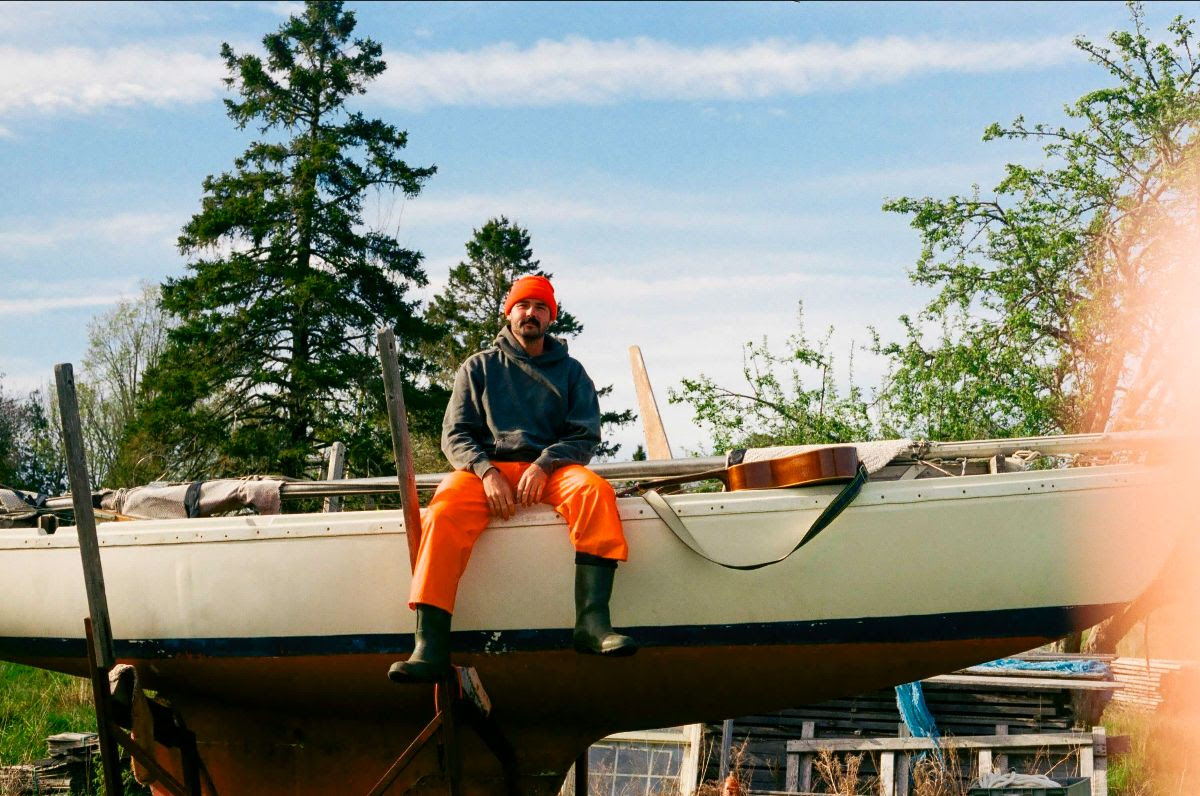
Deloyd Elze plays "not a lick" of fiddle, but he's practicing on a newly acquired instrument when we connect via video chat. "It's a learning curve for sure," says the singer-songwriter and producer, real name Jacob Henry Allen. "I'm honking and sawing."
Allen was born and raised in Jacksonville, Florida before heading off to college at Berklee in the 2010s, much to his own surprise. These days he's posted up in Los Angeles, where he's created two tremendous EPs pursuing a sound he calls "digital twang," situating country singer-songwriter fare within experimental soundscapes. If noted Bon Iver fan Zach Bryan went deeper down the 22, A Million rabbit hole, he might emerge with something like 2024's A Horse Called Proletariat and this year's Nellene. Or maybe if Sam Hunt got way into Califone, or if Fust went full Yankee Hotel Foxtrot?
Amidst flickering, deconstructed backdrops, Allen pours his heart out and pays tribute to those who came before him. That can mean beloved bygone relatives like his grandmother, whose middle name gives Nellene its title, and his great grandfather, the source of the Deloyd Elze alias. And on the mirage-like love song "George Jones," a duet with Angela Autumn, the forebears honored are some of the iconic couples of country music history.
At this late date, the idea of combining country music with abstract digital production is not as outrageous or unexpected as it used to be. There's precedent for this stuff. Fortunately, Allen's work is arresting for reasons that go beyond the novelty of a country singer who likes to mess around with Ableton. He sings with a charming conversational drawl and writes with an eye for resonant detail, and the production lends his songs an otherworldly aura. If he ever masters that fiddle, the next project might be too beautiful to bear.
Below, dig into Allen's work as Deloyd Elze and read our conversation.
Why the pseudonym? Is it a way to stand out, or is it about separating the creative persona from the person?
JACOB HENRY ALLEN: When I first got started doing this project, I'd had a band before. And I'd always liked the idea of operating creatively with a layer, mostly just because it feels nice to separate the two in a creative sense. You can take creative liberty. Whenever I write stories or lyrics, sometimes it's nice to take myself out of the equation, almost view it as an omniscient perspective. Like, a “Don't let the truth get in the way of a good story” kind of deal, where you're not trying to be fictitious or lying, but there's an element of “What's the best way to tell this story?” or “What's the best way to describe this emotion?” And just from personal experience that is how I found that I like to write.
Deloyd Elze isn't my real name, but it was my great grandfather's name. And so the band I had before was a band called Cavediver, one word. And I had put out a record that I'd made, a bunch of songs that I had collected over four years of life. I put that record out, and then all of a sudden another band came out called Cave Diver, with a space. And it was a superstar band. It was members of, like, Deafheaven and some other people. I was like, “Well, I cannot beat this.” And they were also in LA, so it got real confusing. I mean, not for them, for me.
I had already emotionally and spiritually separated myself from that project, and I had started on what is now the Deloyd stuff and knew that I wanted to call it something different. And I felt the family name was really interesting and really special, and the music also felt more, for lack of a better term, personal. It felt I was finally making music that I had always wanted to make. It felt an actual representation of myself. I didn't really want to go by my actual name, and so I asked my mom, “Do you think the family would care if I went by Deloyd's name?” And she's like, “No, I think they would actually be really touched if you did.” So I got the thumbs up.
Nice. So how was the Cavediver music different from what you're doing now?
ALLEN: Those Cavediver songs were probably made anywhere from 2019 to maybe 2021. At that time I was working a bunch of odd jobs. I wasn't really pursuing music as a career, for lack of a better term. I was more doing it when I had the chance to, ’cause I was working a lot, and my life looked a lot different. I was working at this ferry called the Catalina Express [in Long Beach], who I feel a lot of people know from Step Brothers, going to the Catalina Wine Mixer. I'd worked there for about two years, and I was a deckhand. Essentially there was a fork in the road. Like, the trajectory of that career was you deck so that you can drive. And a lot of people were like, “OK, so you're going to get your captain's license, you're gonna start second hopping,” which essentially means you're a captain, but you're there as redundancy. You're there to do maintenance and make sure everything's all working. And then, eventually, to drive, which is a good job in that industry.
So I wasn't really focused on music. I wasn't really focused on operating as a musician. And then I went through a pretty tumultuous breakup, and I had a moment where I was like, “What am I doing with my life?” Like, you know, you wake up one day and then all of a sudden you're like, “Oh wow, I spent two years doing a thing that I don't actually really…” not that I didn't care about it, but I was like, “This isn't what I want to be doing.” So I moved up to LA, ’cause I was like, “Oh man, I don't have anything going on here.” And the Cavediver project was essentially like, OK, I have all this music that's been written, and I feel I just need to wipe the slate clean. I just need to get this out of me, and not be too precious about it, so I can start from square one.
And then, in tandem with that, I had moved to LA. I was fully ready to move to New York, And I ended up staying at this house in Boyle Heights with another friend of mine, Estelle. She helped me finish that record, and my other friend Aaron helped me finish it. I think in a way I had to clear that space in order for a new thing to come in, and that's eventually what led to doing this project.
What about this music that you're making now feels more personal to you?
ALLEN: My experience of writing, I feel like it's a lifelong pursuit. I've been making music probably since I was about 18, and I think it's taken this amount of time and life experience and technique and figuring out what actually is my take. What does Jacob via Deloyd actually sound and feel like? It takes a long time. I think it'll take my whole life to answer that question. But this was the first time in my life that it felt — it's almost undescribable, but it's just a gut feeling. It's just like, “Oh, this is what I needed to be making at this moment.” And I had to have all these things happen to get to this point.
At that time I had primarily been recording myself via Logic, and then Aaron [Kennedy], who's a really close collaborator of mine, I'd been seeing him do all this really interesting and really compelling stuff in Ableton. And I was like, “Hey, how are you doing that?” And he gave me a lesson essentially. When it comes to writing, I have a very short attention span, so he gave me, essentially, a cheat sheet. He was like, “Here's how you set up a track. Here's how you record. Here's how you do all this stuff.”
At that house I had this garage that we had converted into a studio. It was essentially still a garage, had all the knickknacks and stuff of a garage, but it just had a desk in there that had a monitor and a couple of speakers. I felt my writing got more in tune with myself, and then there was this new implementation of trying to capture it, and it just was a perfect intersection. And the very first thing that I ended up writing for the project was a song on the first EP called “God's Cruel Joke.” I just put the guitar in open D, and I just let the computer [record], and I was just playing random stuff.
And so I came up for air and I was like, “OK, I've got about 30 minutes of just a jam. Let's see if we can try to make something out of this.” And so I started arranging all these different parts, and I was like, “OK, I feel this is something to work with,” and just started writing. I have another really good friend of mine named Seamus Guy who's a fiddle player, and he's one of my favorite musicians and writers. So while I was sitting down there, I was like, almost like, “What would Seamus do?” or “What would Seamus write?” And so I just started singing, and I was shocked. I was like, “Oh my gosh, this feels really good.”
And I did some drum programming, and then did some other random stuff, and I sent it to Aaron being like, “Hey, I just made this in Ableton, which is really new for me.” And he was like, “Dude, what the hell, this is really cool. What are you doing right now?” And I was like, “Nothing.” He's like, “Do you want to come over?” And so essentially we finished the song. Probably about 90% of the song was made in one day. It was made in probably about a span of four to six hours, and it became the keystone of that first EP. It was like, “OK, if we can at least try to get stuff to feel as good as it was when that was made, then we're in a good trajectory.”
A lot of it is just like, what's that saying? It's like, inspiration comes to those who are working or who are sitting at the desk. I feel in a really weird way, writing and any creative pursuit, it feels like there’s these threads that come down. And you can grab the thread, and you can either hold on to it and then it will leave and go to maybe somebody else, or you can sit there, grab the thread, and actually yank it down and be like, “OK, I'm gonna take this idea.” I feel a lot of it is — not luck, but it's something to that caliber.
The new EP is called Nellene. Who or what is Nellene?
ALLEN: My grandma's full name was Margaret Nellene Williamson, and she was the daughter of Deloyd Elze Williamson. I think now it's been maybe two years, but she passed away. And at that time, I had finished Proletariat, and I'd had it named, but I hadn't figured out what the artwork and stuff was going to be. And I ended up going back home for the funeral, and to dig the grave, and the whole nine. She was my second mom growing up. And it really hit me and my sister and my mom really hard.
For the funeral service, part of the thing that we were going to do is go through all of her photos and make a photo slideshow. And I ended up finding that photo of her on this horse. That first photo of the EP is her when she was probably about 12 years old, and she's found a horse that's 16 hands high. And It was weird. The name of the first EP was A Horse Named Proletariat, and I was like, “This is crazy.” I don't know, it felt very — too much to call it coincidence. And she had all these really amazing photos of throughout her life. She had passed, and so I was still processing and grieving, and started to write the second EP, Nellene.
She was pretty instrumental in my life as far as me pursuing music. The guitar I play now is the one that she got me as a graduation present from high school. There is so much stuff that's tied into her. The last song on that EP is called “Queen Of Spades,” and it was very much written for her. It was a grieving song. It's been, to me, a way of honoring her and her life and her family. Yeah, it's just a bunch of things happening at the same time. I took her dad's name for this project, and then, as the last gift before she left, she was like, “Here's all this beautiful art.” And I even had, my mom had a book of her poetry and stuff. So I still have that. I can go back and I can read her words. She passed away in May, and the January before, I went down to Florida. She was going through chemo and stuff, and my mom and my stepdad had had this trip planned because my stepdad had just gotten done with a battle with cancer. And so I basically was like, “Hey mom, you go on this trip with my stepdad because you guys just went through the serious thing, and I'll go home and I'll help take care of grandma.” And while I was there, I got to just talk to her, and I have all these voice memos of me just having conversations with her. All the family history and stuff. So I have all that stuff to pull from if I ever want to hear a voice.
To me, Proletariat started the sentence, and then Nellene finished the sentence. And it seems to me they existed in the same world as far as when they were written and how they coexist together. It felt like my abstract way of trying to tie all these things together, as far as my family name and losing her and starting this new project. It was almost a birth, you know, a death and a rebirth cycle, all in the same thing. That's been really wild to tie it all together.
Tell me about your history with George Jones.
ALLEN: I'm a late bloomer to George Jones, if I'm being completely honest. When I was growing up, the country music that I was exposed to was ‘90s and 2000s country music that was on the radio station. And I always knew I liked it, but I think I was in denial about liking it. I think at that time, country music wasn't really cool. And I'd gone and done my research on all the old heads, the Guy Clarks and the Blaze Foleys and John Prines and Johnny Cashes. But I hadn't really gone farther back than that, to the traditional ballad singers.
And my friend Seamus actually turned me on to this podcast [Cocaine & Rhinestones]. It's made by Tyler Mahan Coe, and he does all these really interesting deep dives into different time periods of country music. I love it because he does three episodes that are just on Tammy Wynette, and then three episodes on George Jones, and three episodes that's their lives together. And it was a springboard. It was like, I think there was something about having the context of what was going on in both of their lives at the time that made me wanna listen to the music. On “The Race Is On,” there's a story that Tyler tells about specifically that take where they had been running it and running it and running it, and this one was the closest one you could get ’cause the melody and the lyric was so moving. It was a constant moving target. But he slurs a word, and he was so mad about it. I forget who's the one doing the session, but they're like, “No, nope, that's it,” and that's the take that you hear because he only beasts like one word in it. And it started a whole new hyperfixation and eventually led to me writing a song called “George Jones,” which is really funny.
Yeah, Cocaine & Rhinestones was my deep-dive intro to all that music too. I actually saw George Jones once at a festival, but I was too young and stupid to appreciate it at the time.
ALLEN: I don't know if this is because of writing a song about the guy or anything, but it feels like — obviously he's now passed, but there seems to be, all these things keep popping up that have a tie to him. Like, have you ever seen a documentary made by Les Blank about Leon Russell called A Poem Is A Naked Person?
I have not.
ALLEN: It's a really, really amazing documentary. It's tangentially about Leon Russell, he's definitely the thing, but I think in the whole documentary, there's maybe two interviews with Leon, and they're not even filmed, necessarily — you don't ever see Leon and Les talking, you just see all these beautiful prelapse of Oklahoma sunsets and the sun hitting the water. But in the documentary, Leon's doing a record at this really amazing studio called Bradley's Barn. And he's doing a take. And afterwards he looks at the camera, he's like, “It's hard to sing when Judge George Jones is sitting in the control room.” And the next shot you see he's just there hanging out. And at one point, he's been cruising on a couple of Bud heavies, and he's sitting down, he's got a guitar in his hand. They're like, “Oh, George, play something, play something,” and he just starts playing “Take Me,” and it's ridiculous. It's one of those things where the way he sings is so evocative. I know he had a whole career where he's writing for a bunch of different people. But he had this amazing ability that he could really embody something and make you feel like, “Oh my gosh, this person is a conduit. Just his tone and his playing and his ornamentation that he does when he sings is so wild.
A lot of mainstream country songwriters now will throw in these references to classic artists, almost like they’re telegraphing the connection or asserting the lineage, even though some of them don't necessarily feel or sound very much they're part of the same lineage. Like, “Hey, look, you can tell that I'm country because I'm referencing it.” And it's interesting, you referencing George and Tammy and Johnny and June in this song, it doesn't come off that way to me. Obviously, there's an element of lineage in your work. You've just been talking at length about how this project ties into your own history and honors previous generations of your family. But the name drops here don't come off to me the same way that they do in a Music Row, rubber-stamped country song. Does that make sense?
ALLEN: Yeah, and I'll take it as a compliment. It's funny, I think when I was writing it, not that I wasn't conscious of what I was doing, but to me that song is more about the almost sick to your stomach feeling of being incredibly enamored and in love with somebody. I mean, obviously Tammy and George, George was a pretty complicated individual, right? Like, I don't want to mince words about it. He could be a bastard sometimes. But there's almost this element of, you see these people and you can see the passion that they do have towards each other. There was a reason why it was magnetic.
That song, again, there's a confluence of things that are happening at the same time. My buddy Aaron had tickets to see this instrumentalist out here, this guy named Ryan Richter, and he's an amazing guitar player and has done a bunch of lap steel and pedal steel work on other people's records. And he was doing a show at the Philosophical Research Society. And it was, I think, a four or five-piece. It was him playing electric, a pedal steel player, drums, bass, I think piano, if I'm remembering correctly. But the thing that I was taken aback by was he was doing all these really classic country harmony moves, and he was doing it in a way that didn't feel forced. It didn't feel like somebody who's like, “All right, we're gonna do the walk up,” classic either gospel or country move. And it hits your ear in a way, you're like, “OK, well that feels pretty.”
I don't know, the way he did it was compelling. And I was pretty inspired by that. Most of the songs I think on the new EP, maybe besides “Dog Will Hunt,” are pretty straight down the middle. It's maybe three chords. And I had just moved into this apartment in Hollywood, which is a whole story in and of itself. But I was trying to record music in this apartment. And I think I was maybe two days into living there, and I didn't know how loud I could be. And I had gotten this Chase Bliss Blooper pedal, and that started off the whole thing. But I was really quiet when I was playing and singing it. And then I'd had all this backlog of useless information on George Jones and Tammy Wynette. And I was still very, very madly in love, and I started just — you know, everything just poured out at once.
And I looked at it, and I was like, “Is this too much?” I guess on paper this shouldn't work, and it felt like it was working. And I remember I had a couple friends come over just to visit. This is a couple days after I'd made the song. And they both were like, “Dude, I think this is my favorite thing you've ever made.” And it was really strange. I feel like, especially with country music, there's all this — it's been going on, I think, since the inception of the genre — but there's almost a level of what you're talking about where people are referencing the old heads or the homage before them is like an authentication of “What I'm doing is authentic.”
And that's been going on since probably the ’50s. Especially in that ’60s era, there was the Nashville Sound. There's the big strings, there was the major production. But at the same time California had its own — the Bakersfield sound was coming out. And people were like, “Well, that's not country music, that's honky tonk.” But now everyone plays a Telecaster because Buck Owens was the one who pioneered it. And he's coming from there. Merle Haggard's coming from there. And so I feel like, I don't know, it's interesting to be in the position where it's like, “You know what? What I'm doing, or what at least I think I'm doing, is in that same vein, even though some people probably won't think that it is.”
I wanna go back in time. You're a teenager in Florida. What made you decide to apply to Berklee?
ALLEN: When I was in high school, my momma essentially told me, “I don't care what you do, but you gotta go to school.” ’Cause her mom went to school, but I think she was one of maybe two that went to school, and then my mom was another one of the only ones in her family that went to school. And it's coming from that older generation where college was viewed as a way to give you tools and give you an experience that could maybe hopefully set you up later down the line. I feel now that's not so much the case anymore.
But I applied. I knew I wanted to do music, but I didn't even think about school. I didn't think about [studying music] as an option. And my mom was actually like, “There's a school, it's up north. It's crazy expensive, but I think we can figure out some ways maybe to make it work. But you got to audition. and it's not a guaranteed thing.” And so I applied to two schools. I applied to Florida State. They only had a classical program and a jazz program, and I was like, “I don't know anything about jazz. I know about fingerstyle guitar, so maybe I could do the classical program.” And I didn't even get accepted. Like, not even the college of music, I didn't even get accepted into the university, if that tells you anything about what my grades were.
And I remember we drove down to Orlando from Jacksonville for the Berklee audition. I was like, “Well, if this doesn't happen, I'm not going to school,” or at least I'm not for a while, or I'll probably just go to a state school. And I was writing at that time, even though it was all, now being 10 years down the line, it's really, really bad.
But I remember I walked into this really cool studio, and I was super fish-out-of-water. I'd gone to these blues camps. They taught you how to, like, play Muddy Waters and play Buddy Guy. And I had some training, so they were like, “OK, can you improvise?” I was like, “Yeah, sure, I can do blues. You want to do blues in A?” And they're like, “All right, cool.” And then they did some ear training stuff, which I had none at the time. And then they're like, “Well, what is it that you want to do?” And I was like, “Well, I really love to write, and I really love to make songs.” “Well, play us something.” And so I just started playing and singing, and they're like, “All right, yeah, that's really cool.”
It was the first time in my life that somebody told me that songwriting wasn't just a hobby, it was a skill. And it's an important thing that gives value to the world. And it blew my mind. I applied and actually ended up getting a songwriting scholarship from the school. Not the whole [tuition], but it helped a lot. And then we had to figure out some interesting ways to get the FAFSA. But yeah, it was crazy. I think if that hadn't happened, I probably would have stayed in Jack. I probably would have still done music, but it was something where I didn't know what I didn't know. I think the other part about it for school was that I was surrounded by so much music that wasn't just in Jack. It was the first time in my life I ever heard funk music, I ever heard jazz music, ever heard experimental stuff, ever heard indie rock. I was still pulling from my mom and dad's catalog, which was ’60s and ’80s music. So yeah, it definitely rocked my life.
What does that entail, studying songwriting at Berklee? Are they trying to teach you different classic styles, or how to fit into a certain mold? Or is it an independent study vibe?
ALLEN: It really depends on the person and it really depends on what the route is that you're trying to go for. What they try to do is they try to break it down in the most logical sense, where they're not teaching you how to write a song, they're showing you examples of, like, here's different form styles, here's a verse refrain, here's a verse, a pre-chorus, a chorus. What are the elements that quantify that? It's not that it's not fun, but it's like, here's colors to paint with. It's then up to you to decide what palette you like. But I would just equate it to somebody who's going to school for fine art, right? They're not gonna teach you taste. That comes from you. They're just gonna give you all the parameters and different abilities to use that to your discretion.
And then there's a classic, here's here's how to — if you want to be a songwriter in LA or in Nashville, this is what potentially your day-to-day might look like. And also putting you in situations where it's like — they would have us go and do co-writes with other people for a class, essentially, and that's very much now I think how at least the Nashville scene is like. You get paired up with strangers, and it's like, “All right, so I guess we're writing a song today.” Not that I'm not opposed to it, but I think for me, writing has always been less about the craft and more about the expression.
So you feel like you got something out of it. Beyond being exposed to all this other music, you got something from the classwork itself?
ALLEN: I think what I got out of it was an ability to have thick skin. Especially in that age range, being 18, 19, everything feels so dire, right? And so you're writing these things that are coming from you, and then you're having to show them in class and having people critique it and rip it open. And realizing that you really just have to trust your taste, and you have to trust your gut. And sometimes, especially in this context, some people just want to hear themselves talk. And that you have to navigate when people are at least in a critiquing situation that some people have something really worthwhile and constructive to say, and you have to wade through it as far as picking out, “I do agree with that, I don't agree with that.”
I would say the other part of it that was really worthwhile is I made some of my best friends, and it was the first time in my life that I was around people who viewed music as a viable path for life rather than doing it as a hobby. It was really powerful to be around a bunch of people who felt as strongly about music as I did and were like, I don't know what I'm going to do, but I know it's going to be this.” And it's going to be hard, but that's the whole point, because I think if I wasn't doing this, it would be a disservice to myself and I would just be miserable.
I mean, there are a bunch of things that I feel — the Western version of Western education towards music is a really interesting one because the way that the structure is, it's more competitive than it is collaborative. There's a lot of kids, and there's money tied into it, so it's like these kids are almost trying to prove their worth by how much they know. And it can create a really unhealthy dynamic of kids just beating themselves up because they're not the best. And that's not the point. The point is it's expression in community. It's not supposed to be like, “I am the best shredder at tenor saxophone.” Because at the end of the day, that could open doors. But it's more about why you're doing it, not how you're doing it.
So it's a complicated thing. And too, there's this level of it, it feels gatekeeping in a way. And especially because money is the barrier to entry. Just because you went there doesn't really necessarily guarantee you anything. And I've noticed this about myself: I don't usually like to lead with that when I meet people because I don't want anybody to feel like, if I walk into a room and they know I went to Berklee, then it means that they have to prove themselves. No, we're just meeting each other where we're at. And God knows I sound like shit all the time. I'm not going to be some genius. And see, I feel sometimes people from that school can be a little like — they just feel they're owed something.
So it's complicated, right? But in the same breath, some of my best friends and some of my closest collaborators are from that neck of the woods. So yeah, it exists in my head as two different things. I can see it for what it is, and I can also try to be self-aware about it.
You've done two EPs now. Obviously the one just came out. Do you have touring plans? Recording plans? What's coming up?
ALLEN: Would you believe me if I told you that we just finished a record?
I would.
ALLEN: Yeah, we did the full-length Deloyd record at Deloyd’s house in Cairo, Georgia. The intention behind it was that, before he passed, I think in the late ’80s or almost early ‘90s, the last two years of his life, he built this two-bedroom farmhouse out in the middle of the sticks. It's got a barn. It's got this little smoke shack that's out the back that was a barbecue pit with a concrete floor that's framed on all sides. And we made the record there.
At the biggest, it was probably about 15 to 20 people who were commandeering Deloyd's house. And then across the street, my great uncle Papa Joe has a house. Papa Joe's is where we would sleep and hang out, and then Deloyd's house is where we were doing all the recording. We just finished it. It's getting mixed right now. And I'm thinking, if everything goes according to plan, which is — you know, if you want to make God laugh, tell him your plans — hopefully the first single come out in September.
Me and a friend of mine, Laney [Tripp], are planning this DIY run in June through the South and up into the Northeast. We're playing a show June 20 with Shallowater in New York, which I'm really excited about. And then we're doing Green River June 21. And that's all the big ticket items. That's all the winner winner chicken dinners.
When you were recording the album, were you with friends from out in LA? Your crew that you work with out there?
ALLEN: Yeah, I took all these people to the podunk house. It's the intersection of fuck and all, but I love it.
Nellene is out now via Concord. Buy it here.