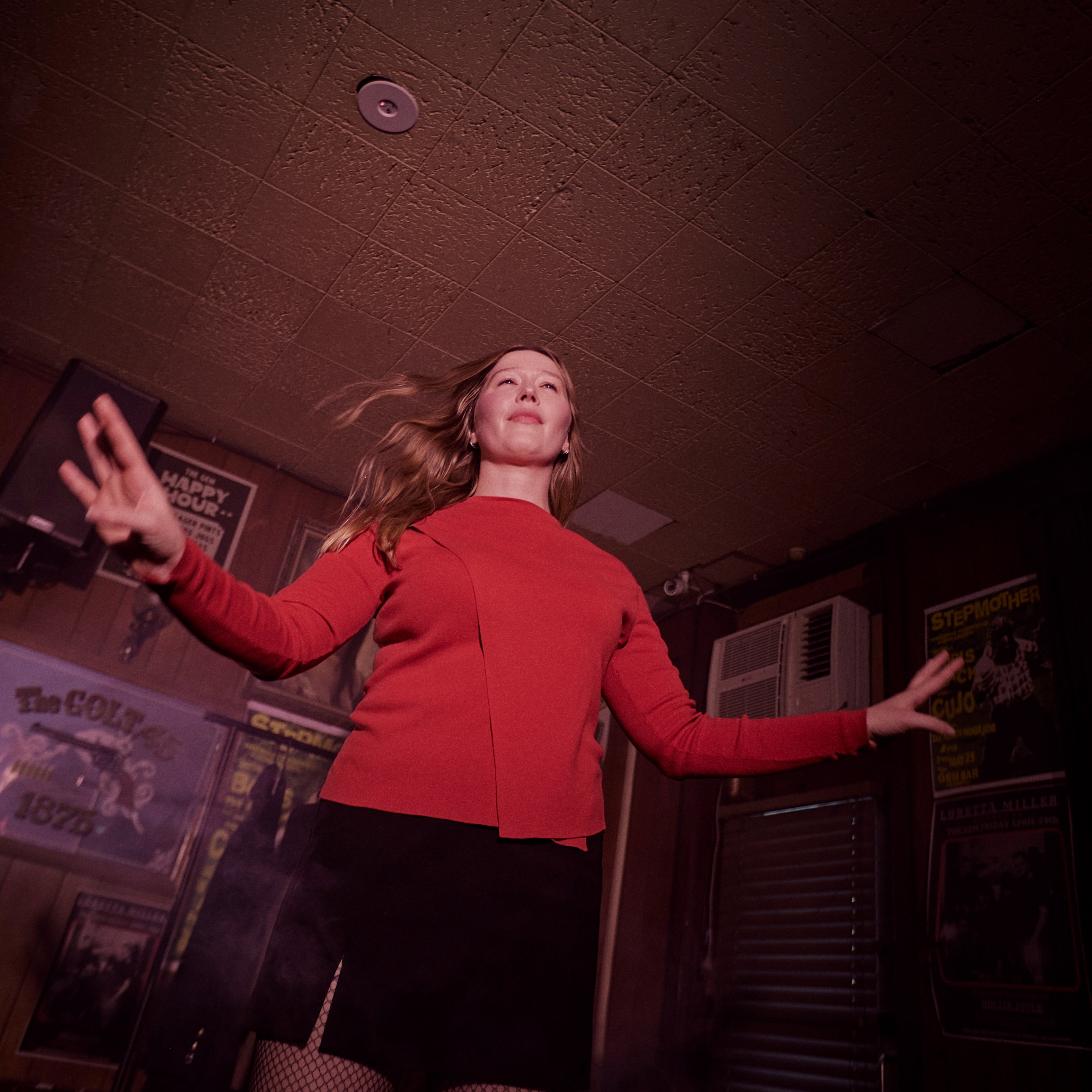

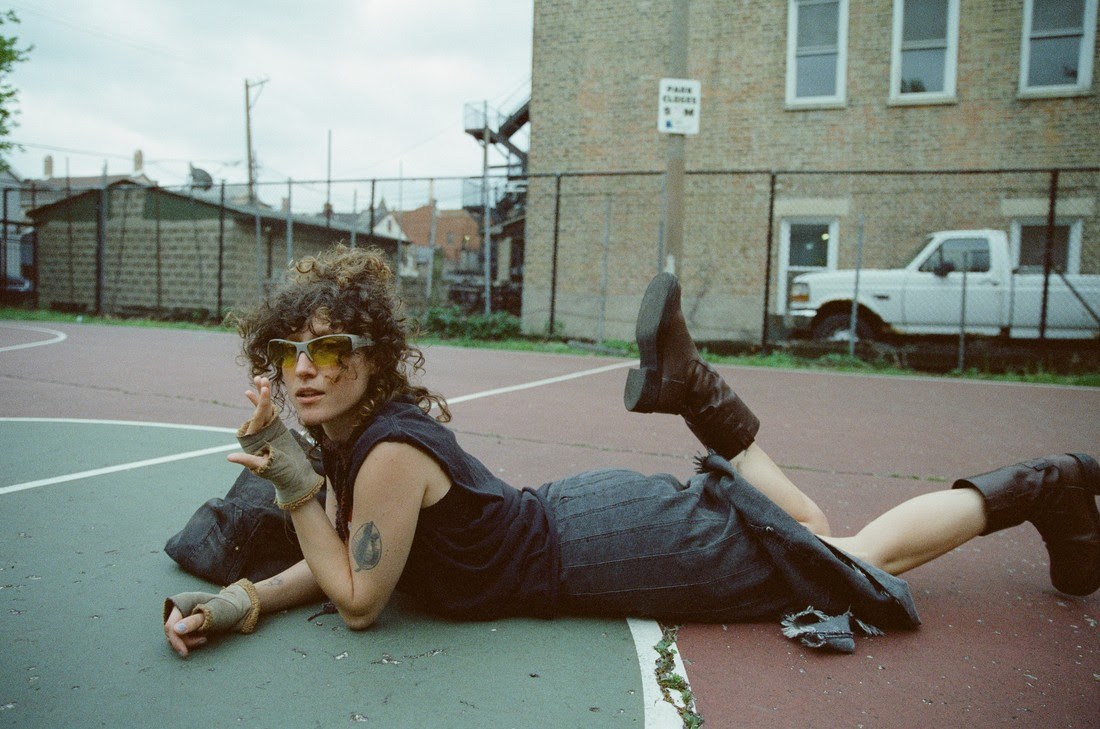
Things haven’t gotten easier for Squirrel Flower’s Ella O'Connor Williams, and that’s not a bad thing. I first interviewed Williams over six years ago, as an Artist To Watch, before she became an established Chicago-based musician, put out three albums on Polyvinyl Records, and led an important boycott against one of the industry’s biggest music festivals. As a musician, her writing has only gotten stronger, her voice more dynamic, her vision more expansive. But in terms of artistry, not much has changed. That’s a good thing. Williams continues to be a fierce songwriter, documenting the spaces and landscapes she moves through and moving her spirit in return.
I’m not trying to over-romanticize Williams. But there are some artists whose interviews feel as moving as the music they make. Williams falls into that rare category. Her new album out today, Say A Prayer To The Gods Of Getting Going, is sprawling and still. Within its 11 tracks are endless roads that nurture solitude; thirsty concrete and thirst for connection; the core tension between feeling immortal and sensing your human fragility, standing before the tongue of a swallowing horizon.
Making art, especially in our optimizing world, can be a selfish act. Say A Prayer, and our conversation around it, reveals Williams as an artist in service to something else — to the landscape that inspires her songs, the communities she gives back to while on the road, and even the songs themselves. “It almost feels like some divine message to myself from some other place, and that's how that song felt,” she says at one point, explaining the significance of the album’s cornerstone “Highway Woman.”
When I ask if she has a creative routine, she responds yes and no. She understands the purpose of continuous creation, but can’t force the songs into something they don’t want to be. “You have to respect the song as an entity, as a sentient thing,” she says. And this is not easy. Although Say A Prayer sounds as natural and unfiltered as a gust of wind, Williams details how strenuous the process was.
“We don't fucking do it because it's easy. We do it because it's hard and it's painful and that's not a bad thing. It's not a bad thing to feel discomfort and to work through things,” she says, when our conversation detours into an aside about creative compulsion. She recalls the quote from Suno CEO Mikey Shulman, who said in a podcast interview last year, that “it’s not really enjoyable to make music now,” later implying that ease — specifically AI-enforced ease — could be the remedy. Talking to Williams, I’m reminded that joy, growth, and love don’t work that way either. Neither does the collision of tectonic plates that makes beautiful terrain. There is value in struggle, especially when it results in music that sounds seamless.
Below, read an edited conversation about the songs on Say A Prayer To The Gods Of Getting Going, family ancestry, and why Williams believes that service to art, not art alone, is what changes the world.
A lot of your albums detail physical landscapes or what you see on the road. Do you have certain emotions that you associate with certain landscapes, or certain landscapes that are more inspiring creatively?
ELLA O'CONNOR WILLIAMS: The first time I was really struck by a landscape and wanted to capture it with music was when I moved to Iowa. Being from the East Coast, I'd never been in a place that felt so expansive, and it scared me at first. I felt I would get this sense of vertigo walking around. I could fall off the earth because everything was so spacious. I went to school in a pretty rural area, and the streets were so wide, and you look down them, and you see forever. It really scared me at first, and then I grew to really, really love it. I remember, when I first moved there, thinking that I need to capture how this makes me feel with sound. That’s how this project of Squirrel Flower developed. I wanted to make music that was really spacious and slow, and to show people back east what it felt like for me to be in the Midwest. That landscape is the first one I wanted to put into sound.
I always feel really drawn to painting portraits of places through my music. “Say A Prayer To The Gods Of Getting Going,” the title track, I wrote when I was in the middle of the desert in southern New Mexico, getting this feeling of looking out — it makes Iowa feel like nothing in terms of the expansiveness. I remember looking out in the desert, you can literally see 500 miles away, and you're seeing all of these different mountain ranges, one after the other. I remember being able to feel all of time at once, like past, present, and future in the land there. Sonically, when I wrote that title track, I was trying to capture how that felt, capture this feeling of ancient rocks, and looking at things that are so so old and will also be there for so long, feeling very much a part of it, but also very very small compared to it.
I love that. The landscape itself not only dictates what you're singing about, but also the way it sounds.
WILLIAMS: Very much so. With “Helicopters,” that song is very much about Northwest Indiana and the drive from Chicago to to the Dunes, to Gary, Indiana. That is such a drive of industry, but also beauty. There's this weird, sublime quality to it, like you're horrified by all of the factories, but it's also really beautiful. I wanted to capture that sonically through crunchy guitar and feedback and tension.
What are your thoughts on album construction? Did you have an idea of how you wanted to form this collection after Tomorrow's Fire?
WILLIAMS: I didn't have any idea. The process of this record for me was very harrowing, actually. It terrified me. I had all of the songs, but I had no idea what the final thing was going to be until it was finished. I had 30 songs recorded, but I felt like I didn't have a record. It could have gone so many different ways, stylistically. At the end of the day, I knew that I wanted to make a voice-forward record, and make a record that showcased the sound of my voice in a more natural and dimensional way. I wanted it to not sound like a studio. Sometimes you listen to music, and you can hear the studio sound. I wanted that to not exist. I wanted it to sound like a performance straight into the ears and the brain. Like seeing a live show, I wanted to capture that kind of energy and intimacy.
I didn't have a goal going into writing. The songs showed me what the album was about, which is always what happens. I write and I write and I write, and then I find the throughline after the fact, as opposed to having a goal and then writing songs to fit that goal. Which doesn't feel very respectful of the songs. You have to respect the song as an entity, as a sentient thing.
In the past I've always tried to keep a level of distance between me and the content matter of my songs. Maybe because I was listening to a lot of Joni Mitchell through the writing process. Hejira was the record I was listening to. She’s very unafraid and, I guess, confessional. Even though I kind of hate what that word has turned into because it's a dig almost — you know “a woman singer-songwriter confessional-like songstress.” It pisses me off when people say that sometimes because it feels loaded with misogyny, and it sometimes feels like the existence of confessional songwriting, that's all people can think about and feel from music, and they're not thinking about the sonic elements or technical elements. Something about Joni Mitchell that I love is it has both. She's embodying — she's making incredible music, but also opening her soul through it, and not shying away from that. I felt more emboldened to be honest in my writing, be simpler and clearer and write about my love life or my personal life, I guess, and not worry about that detracting from the validity of the rest of music.
When you say this record is more intentionally vulnerable, what changed?
WILLIAMS: It's less how I wrote the songs and more just how I was thinking about it, because my music has always been really vulnerable [laughs]. I think maybe in talking about it, I've tried to shy away from that fact. Yeah, I don't know. I think my previous music maybe was vulnerable, but not in an intentional way. This record was more intentional with the vulnerability.
What do you expect or would want listeners to take away, if anything?
WILLIAMS: I would love for people listening to the record to feel they can be more free in their living and loving and just going through the world, because that was my own journey through the process of making the record. I was not keeping myself in a box in any way. It would be a beautiful thing for my music to help someone else know that they also don't have to keep themselves in a box, and they can be expansive and be different things at once, and even contradictory things at the same time. The hope is that they can listen and find pieces of themselves in my truth and see reflections and echoes of themselves of their own lives in my art.
How did you narrow it down from the 30 songs?
WILLIAMS: I remember I was talking to a friend, actually exactly a year ago. I played this festival in Orcas Island in Washington, and there was this band. Do you know Thomas Dollbaum, New Orleans-based musician? I was talking to one of his bandmates about the record because at that point I was still kind of deep in the process, and I asked them, "What do you think makes a good record?” And they said something like, like playfulness and stylistic variety. And I was like, you know what? I feel the same way. I think cohesion is kind of overrated, or stylistic cohesion. If I listen to a record and every song sounds very similar to the next song, it all blends together in a way that is not really pleasant for me as a listener. The challenge is always exploring different sonic realms while still keeping the throughline of my sound.
“Fought A Hornet” was a standout in the writing process for me too. I was in Vermont staying in an off-grid cabin that my friend lives in, and they allowed me to stay there for a week or so. I didn't see anybody for a week. It was very very isolating — I had never experienced that level of isolation before. I would just stoke the wood stove and make it 115 degrees in there, and drink red wine and read Rilke. My grandfather, who's passed, I had his classical nylon string guitar with me, and one night I just searched medieval guitar tuning, and I found this guitar tuning, and I wrote that song. I think of that song as my homage to my grandfather a little bit, because he was an early musician. When I was writing that song, it felt medieval and very different from anything I'd done before. So I was in a feverish state when I wrote.
Something I thought was so cool reading about the recording process was that you also made a lot of the album with your family — your brothers and dad are featured.
WILLIAMS: As soon as I recorded the demo, I sent it to them, and I remember my dad and my older brother specifically were both like, "Wow, this is really beautiful." I think I only sent them the guitar part that I had written, because with that song I wrote the guitar part first, which isn't typically how I write. My dad, he's a musician too, and during lockdown, when I was living with my parents, I would wake up every day and my dad would be playing the Bach cello suites on his acoustic bass guitar. That kind of music is really really deep in me, and I wanted to explore different ways of playing guitar.
But yeah, my family was a huge part of the process of the record. Kind of every record I make, I'm sending them a lot of my demos and asking a lot of them in terms of opinions and emotional support because I turn into a menace. I don't know. The creative process is not easy. Of course there's massive reward but you have to crack yourself open and it's really hard.
And it never gets easier. It's weird to think about how you keep doing the same thing, even though it's really painstakingly difficult.
WILLIAMS: Well, it's because we have to. We're compelled to. There's a deep need to do it, even if it is painful and challenging. In the context of that random AI music exec who was like, ‘Now making music can be easy.’ We don't fucking do it because it's easy. We do it because it's hard and it's painful, and that's not a bad thing. It's not a bad thing to feel discomfort and work through things. The state of society is so much about how we can feel the least amount of discomfort, and how can we make things as easy as possible? It's always at someone else's expense, of course, and it's at the expense of our own sense of being alive and being human.
Having to take time to work through something and having to reckon with the darker parts of your own self through creation, I welcome it. I welcome all of it. It is really challenging, and especially this record, the process was pretty hard for me. I didn't really have any external pressure, in terms of the amount of pressure I was putting on myself to make it perfect, but I had a lot of internal pressure to make it exactly how I had envisioned, and I did. I did end up doing that, but it took a lot out of me. It's worth it in service of the art and in service of having the experience of something being challenging and still doing it.
Was there a realization, a moment, or a song that felt like you were coming out on the other side of all the pressure?
WILLIAMS: “Highway Woman” was that song for me, which was later in the process. I really needed to hear it when I made it. In retrospect, that song is about the process of the record and my life while I was making it. That wasn't my intention in writing it. I was just writing it and not thinking. I don't know if you feel this with your writing, but sometimes I make a song that comes out in one go and feels very effortless and easy, and the feeling I get when I'm writing it is this feeling of pureness. I'm not trying to make something, I'm just making it. I'm this channel for this thing. It almost feels like some divine message to myself from some other place, and that's how that song felt. I remember writing it and feeling like, yeah, this is one of the best songs I've ever written, this is gonna be the album’s fulcrum.
It showed me what the record was. “Not Me” was also like that for me. It was one of the earlier songs that I wrote, and similarly came out in a very effortless and easy way. And “Weightless, Untethered,” too.
What are your thoughts on immortality through art?
WILLIAMS: I've been thinking about this a lot. So my great grandfather was an author. He wrote children's books, but also lots of novels, and he also wrote an anthology of leftist theater in the US. And I grew up reading his children's books, which are all really good, but five years ago, I started reading his novels, which I had never read before. I had never met the man, and through reading his books, I felt like I was getting to know him, and parts of it felt like reading my own writing. It was this amazing feeling of ancestral connection through this art that he made many many years ago.
I've been thinking lately about how I don't know if I'll ever have children, but if I do, and then they have children, I don't know — I've been thinking about having offspring that many many years from now maybe connect with me and feel they know me through listening to my art. Making something and putting it into the world is an act of immortalization. You’re putting a piece of your soul out into the ether, and it's gonna be there literally forever. As long as you know people, humans are around and can listen to music, my music will exist, and that's a piece of me. It's a beautiful thing, thinking about what we create and what we leave behind and what people who have never met us can learn about us through our art, because I had that experience reading my great grandfather's books.
The idea of a highway woman, it feels like a sort of deity of the road. It also plays into this idea of the wild woman. Is it an archetype that you're kind of pushing against or embracing? It almost sounds like a bit of both.
WILLIAMS: Mostly embracing. The idea of the wild women is kind of like second wave feminism, an outdated archetype in some ways. But it also has a lot of truth and value, and it's something that I return to a lot. I think of it as a song that's for anyone, and about anyone, who's living in the wind in any way, and contending with the challenges and the joys that come with that. I think it's hard to do that right now. It's hard to live freely and alternatively. That song is for people who reject the confines of the current age.
There's a throughline in all your music about this idea of freedom, or this search for it. But then there’s also a rebellion against not being objectified or possessed. It doesn’t feel as dystopic as Planet (i), but you’re still searching for a way of living that isn't possible or feels really impossible as you were saying.
WILLIAMS: The thing is, it is possible, and it's really important for me to live in a way that’s not only leaning into this lifestyle in a self-indulgent way, but also in service of helping other people. Sometimes touring can feel so self-indulgent. We all talk about how music can be change. It can change the world — but what does that really mean if you're just touring and burning a shit ton of gas and playing music for people, creating shows that exist in a vacuum, and you're not thinking about the broader political context of what you're doing, and being self-critical in a way. Art has the power to change the world, but not art itself. We have to be critical of the way that we're doing things and the way that we're presenting our art.
I think back to this month-long DIY tour that I did last summer that I booked, mostly myself, and went solo. I wanted to play farms and community centers and play outside of the confines of the music venue, and also wanted to use those shows to intentionally raise money for local mutual aid. I didn't know if it would actually be effective.
Then in practice, we played all of these places, and we played outside of Asheville. It was a year after the flooding there, and it was still on the forefront of everybody's mind, and so many people were talking about it the whole time, and we raised money at that show for flood relief, because people are still struggling with losing their homes. We played in southern New Mexico the day a massive wildfire was happening in the Gila Wilderness, which was close by in Silver City. We played to like 20 people. Half of them had come to the show after evacuating friends from their homes, and we were able to, in that context, create this place for people to gather after doing this traumatic thing all day, listen to music and breathe and raise money for for wildfire relief. Then we got to LA and it was the week that ICE was there terrorizing the whole fucking city, and I had friends who showed up after getting tear-gassed all week. People needed to gather and listen to music in a beautiful natural area, which we did in Debs Park. We were able to raise a lot of money at that show too for immigration, bail funds.
It showed me that there is a way that this life can actually not be just self-indulgent, but actually in service of change and a rejection of fascism, a rejection of the music industry as a corporate machine. We don't have to just fall into what we think we have to do. That's another part of it, the sense of freedom to take risks and and to be brave and be politically outspoken, and to not think that we have to just be agents of the industry of capitalism.
Every musician is hoping to make probably a small amount of money from it because we need to survive and live, but that's not the goal. That's not and has never been my goal. It's a thing that I do because it allows me to engage with being alive in a very interesting and fulfilling way. I hope that wasn't too long-winded.
It’s funny, as you said, a few minutes ago about the AI guy saying that making music will be easier. But the art, the creation, doesn't have to be easier. I think we're all just striving for living to be easier. I guess that's an obvious kind of observation. Why does it have to be about the product, why can’t existence in itself just be easier?
WILLIAMS: I think what people perceive as ease is actually not ease. Even Amazon delivery, for example, we think makes our lives easier, but in reality it’s poisoning our world and exploiting massive amounts of people, which is not making it easier to live. It's making it a whole lot worse. It's this illusion of ease that is actually the exact opposite.
Say A Prayer To The Gods Of Getting Going is out 8/21 via Polyvinyl.