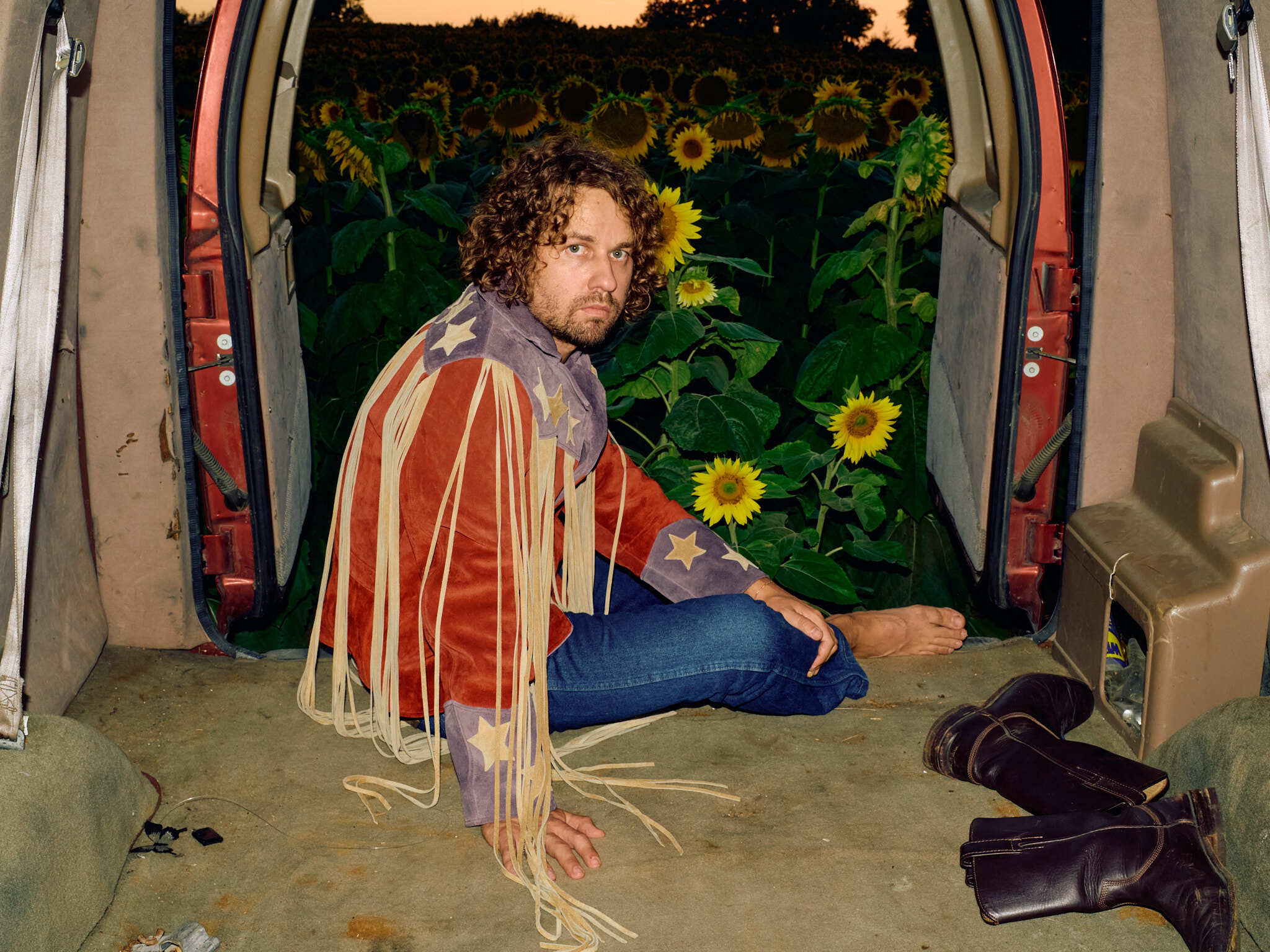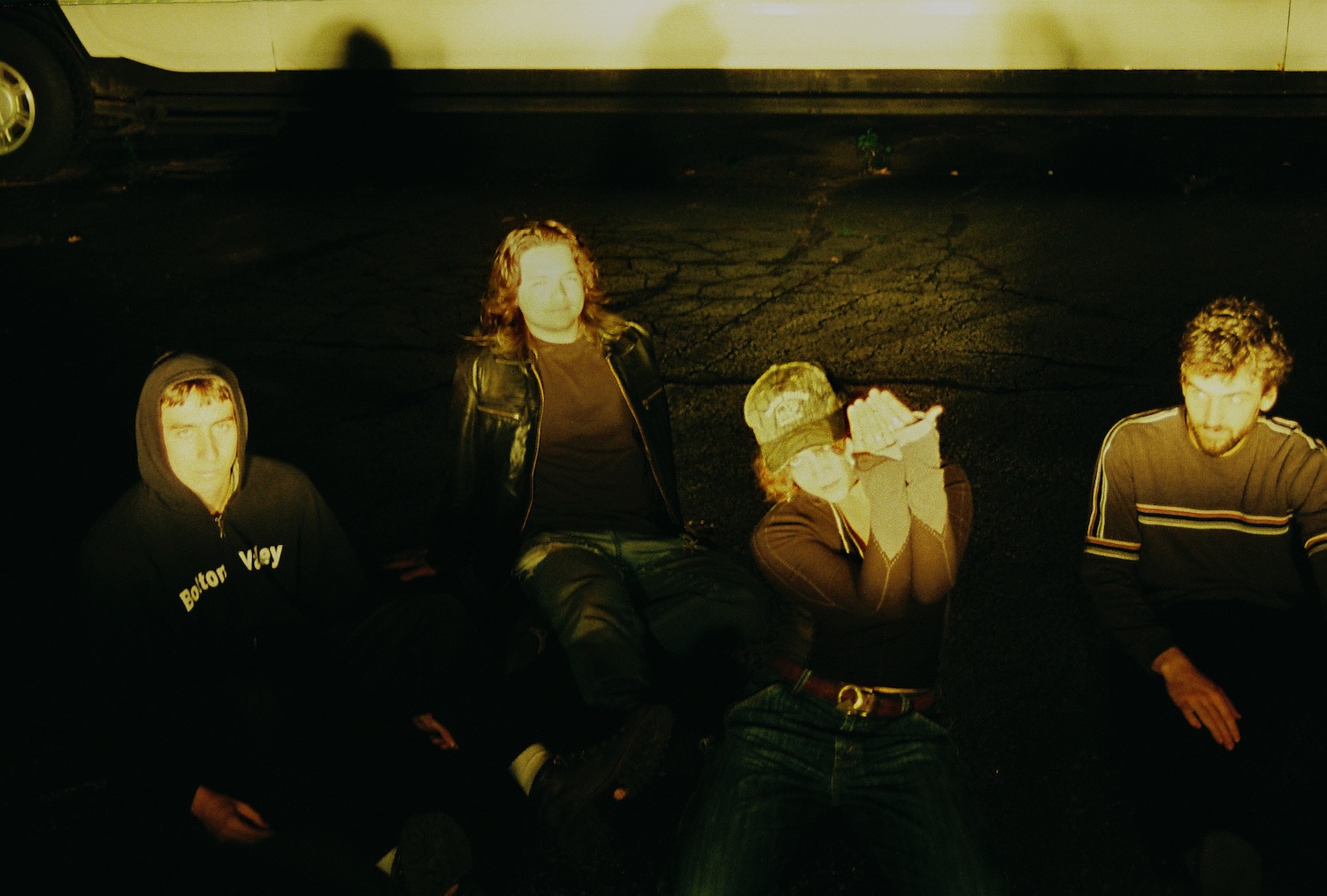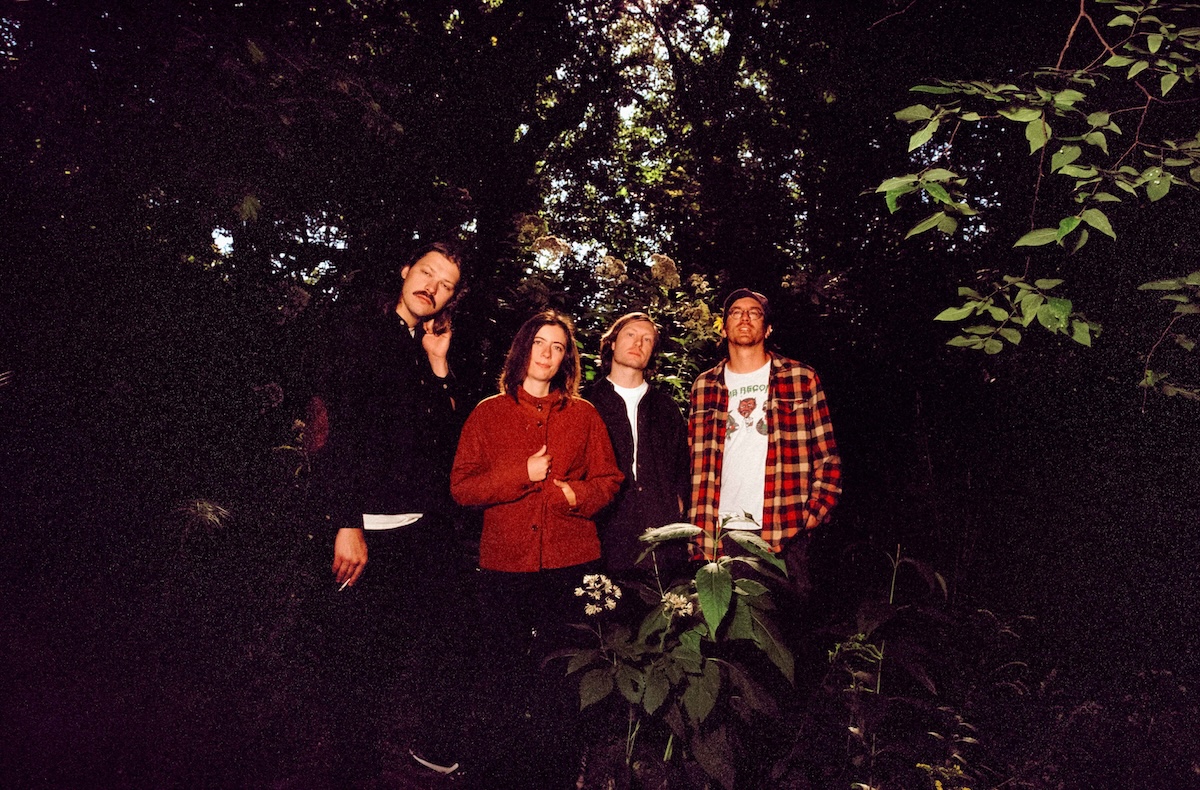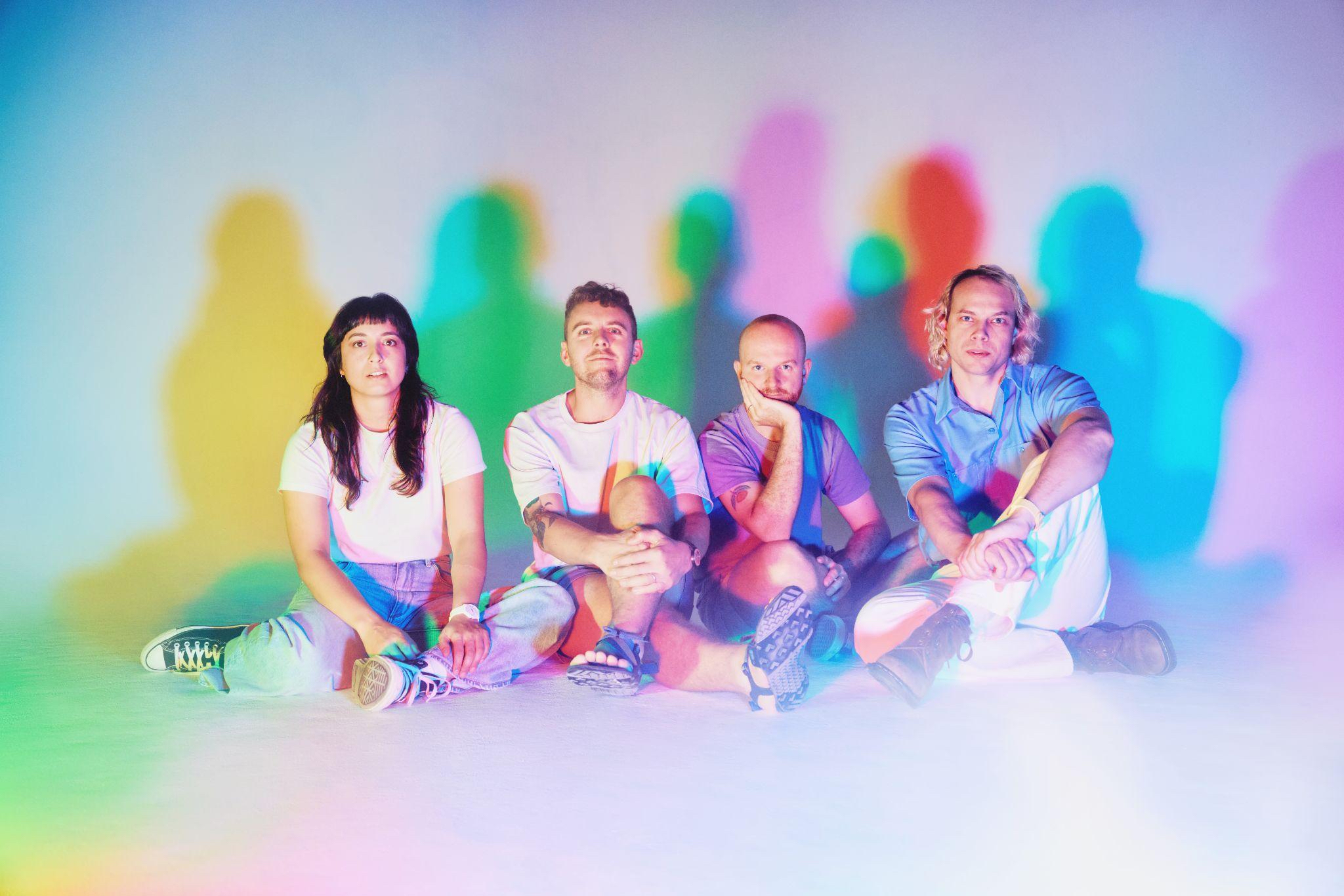

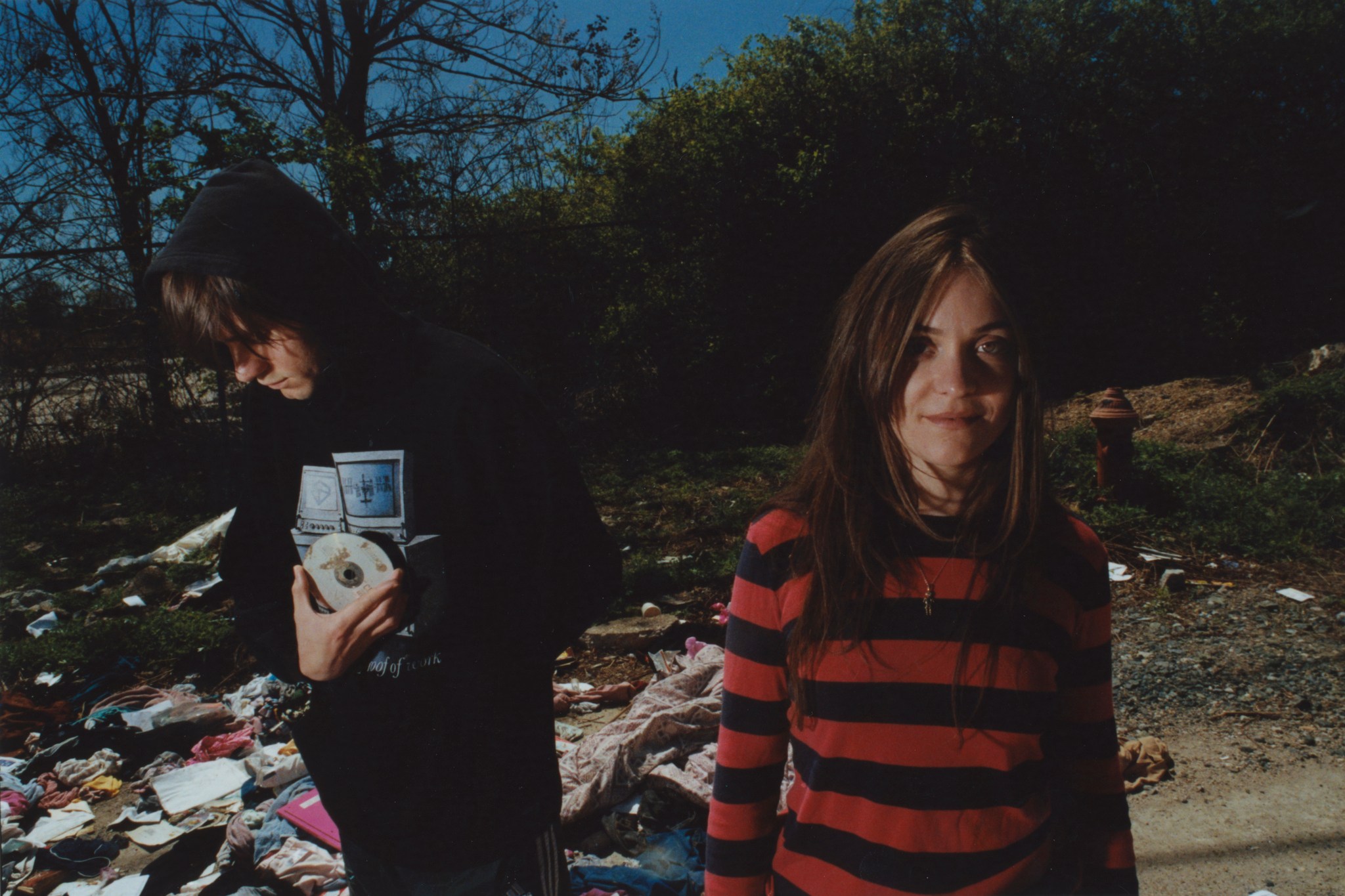
The Philadelphia duo @ have been beguiling listeners with their time-bending approach to folk music ever since forging their collaboration during the early days of the pandemic. With Autosmile, their second full-length and first for the storied 4AD label, they push their hypermodern yet timeless songcraft to new heights, exploring darker corners of their sound without ever losing sight of the light.
Out today, the album finds singer-songwriters Victoria Rose and Stone Filipczak still blurring influences in fascinating and inspiring ways, channeling avant-folk, grunge, psych, prog, indie-pop, and subtle electronics into a mercurial style all their own. I hear traces of Alice In Chains, Elliott Smith, Animal Collective, and a whole spectrum of '60s and '70s weirdo greats. But mostly I hear @ more fully seizing command of a style that feels like grasping at ancient magic.
"When I try to comfort my mind, I dream of an alternate timeline," they sing on "Punish My Mind," a fitting sentiment for an album that edges up against multiple traditions without ever fully belonging to any. The lyrics follow suit, disclosing the duo's longings, struggles, and epiphanies in vivid poetic strokes yet remaining elusive enough to demand further contemplation. Even when pouring their hearts out, these two are tantalizingly tough to pin down.
In conversation, too, Rose and Filipczak manage to be frank and forthcoming while retaining the sense of mystery around their songs. On a video call this week, they went through Autosmile track by track, illuminating one of the year's most exciting and thought-provoking new collections of music. Below, immerse yourself in the album while reading our interview.
1. "Bird"
Stone, in the statement you released with this song, you said it was inspired by these baby birds that kept turning up dead on your deck. So this was a repeat occurrence?
STONE FILIPCZAK: Yeah, it happened a few times. It happened every year at a particular time. This was inspired by a particular year. It was cool. It was really fascinating.
What was fascinating about it?
FILIPCZAK: It's just a sort of a dark omen. I spent a lot of time on that porch. I’d just walk out there to a fresh little corpse every midmorning. It felt like an example of some type of natural process going haywire and sort of misfiring in a way, because I think they were getting pushed out of the nest or something. It was a strange time.
You mentioned it as a dark omen. Overall, compared to the previous album and EP, Autosmile feels like a darker record. So it makes sense as an introduction. But on the other hand, the songs don't seem that binary in terms of tone. They feel more ambiguous than strictly dark. Am I on the right track with that?
VICTORIA ROSE: Definitely, yeah. For sure.
Is that something that you are consciously pursuing as songwriters or more of a reflection of the natural state of life on Earth?
ROSE: I think it's more of a reflection of a natural state on Earth. Absolutely. It's really hard to go into something and consciously be like, “I'm gonna make this really dark,” or anything really. You just have to write the song how it's developing.
FILIPCZAK: At some point while we were working on these songs, we were like, “Hmm, this is way darker in tone than our first album.” But we didn't set out to do that on purpose. I think the first album reflected a very interesting time period where, although it was COVID and obviously there was a lot of darkness in the world at that time, there was also a strange amount of levity and joy in the air as well. A lot of people had time to devote to hobbies and maybe even some spare cash. And it just felt like there was a lot of energy and creativity that, at least in our lives, got plowed into that first album, and we got to work on it a ton really quick. So even though it was obviously a hard time for everybody, it also had a strange air of optimism that made it onto the record. This album reflects a lot more doldrums and all the things that we went through over the period of the last five years.
Like personally or like societally?
FILIPCZAK: Probably both, but probably more so personally. I think it's a pretty personal album.
2. "Love In The Dark"
I found the use of “Hey” to introduce verses interesting. Speaking of personal songwriting, it adds a level of intimacy and maybe even informality to this song. Was that always part of it? Did the lyrics start with “Hey”? How did it end up being this motif?
ROSE: Oftentimes I'm writing a song, and I'm writing to a figure, another person. And in that way, adding, “Hey,” feels a little more casual or a little more specifically conversational, which is maybe how I'm feeling when I'm writing whatever it is that I'm writing. But also rhythmically it fits in, just throw this short, possibly nothing word into the beginning of this. It feels conversational and it works, you get an extra beat of words.
FILIPCZAK: It's also been something that's made it onto every one of our releases so far. There's a song that opens with “Hey.”
I didn't pick up on that.
ROSE: I think it's just a habit.
There are interesting things going on in this song with regard to plans versus fate and giving into nature versus working for desired outcomes. Do you feel like it plants a flag at the end, with the “line in the sand” thing, coming down on the side that we do have some agency? Am I on the right track with this at all?
ROSE: Totally, yeah. I think you have agency and the choice to lead with love and connection and understanding and empathy when appropriate, regardless of the outcomes or circumstances of a relationship. And without even necessarily knowing, like having any certainty in it.
Musically on this one, the guitars go nuts at the end. I hear some acoustics, some electric, but is there anything unique or special about the particular instruments being used on that one?
FILIPCZAK: The ending, that's kind of got like at least three guitars on there. There's Victoria's rhythm guitar playing chords. There's one electric guitar that's tapping along with the keyboard doing the like [sings the melody]. And then there's a solo that's a 12-string guitar that's I think doubled and harmonizing with itself. That's probably my favorite guitar on that track because it's blown up. You take the mic and turn up the preamp all the way, so it's totally distorted and blown out, and then it's a 12-string acoustic, so it's got this very intense kind of blobby, just huge weird super overdriven sound that's not coming from any type of pedal. It's just coming from a mic being turned up way too loud.
It's the same thing on the intro. The intro to that song has this really fuzzy electric guitar, and that's the same thing. It's just plugged straight into the interface with the input turned all the way up, so it distorts digitally. People have asked me what fuzz pedal is being used, and there's no fuzz pedal. It's just distorting a super cheap MBOX interface.
For live performances, people can bring their pedal boards, so it's not like having it not be a pedal makes it necessarily easier to perform. But do you like to try to set your songs up in a way that translates easier to performing it live? Or is the studio version of @ a separate animal?
FILIPCZAK: I think it varies song by song. Some songs we have the luxury of arranging live a little bit before we record them, and so those versions are a little bit closer together. But a song like “Love In The Dark,” we just went crazy with the arrangement and then figured out how to play it live later. When we play that song live, I have a distortion pedal that I kick on for those parts. And I wouldn't say it sounds particularly similar to the record. We're approximating and sort of reducing and minimizing, trying to communicate the song and focus on the songwriting rather than trying to emulate the recording.
3. "I Know You Are (But What Am I Thinking)"
You called this the most emo song on the album. What makes you say that?
ROSE: The melodies and lyrics, right?
FILIPCZAK: Well, I think it's the lyrics, but also the music in the middle part, especially the bridge, feels super emo. It's just a really regular chord progression that's very melodramatic, and then a line of lyrics that are all quite emotional. When we were working on that song originally, Victoria, I think you said to me, “This is the limit. We can't go past this for like how emo @ is allowed to sound.”
ROSE: [Sighs] Yeah.
There are some melodies on this one that are almost classical or baroque. What inspires you to incorporate those kinds of elements into the writing?
ROSE: Classical melodies! Huh, I didn't think of it that way.
FILIPCZAK: I can hear that for the [sings melody].
ROSE: Oh yeah, well, I did choir for like 10 years of my childhood, so I think a lot of that seeped into my melodic sensibilities. Pretty much that's it. But also that's a really over-the-top emo-type of melody that I threw in there.
I can see that. I'm starting to understand what you're hearing a little bit more.
FILIPCZAK: I hear that as almost kind of a Beach Boys melody or something.
ROSE: Definitely. I think it's all really contextual to like what the rest of the song sounds like.
And Brian Wilson's emo too, right?
ROSE: Yeah, he’s really emo.
FILIPCZAK: Definitely.
4. "Earthly Love"
This has some backing vocals from Nina Ryser. What's your connection to her?
ROSE: She's a really good old friend, and she's a really talented musician. She lives in Philly, and she played drums in our touring band for a couple of tours. And she sang some harmonies during the live version of that song, before we had ever recorded it officially. So why change a good thing, you know? Like, she's doing great harmonies here, so we might as well just record the song as it is because it's so simple already.
FILIPCZAK: That one's probably, of all of them, recorded as close to our live version, more so than the rest of them. And in fact, we actually recorded the vocals for that live, the three of us together in a room.
Is that unusual?
ROSE: Unusual for us, yes.
FILIPCZAK: I don't think people do that a whole lot anymore, live three-part harmonies. I was pretty psyched on getting that on the record.
This is another one where the ambiguity — maybe ambiguity is not the right word for this one, but you just come out and say, “Whether you're winning or losing, it's all the same.” You've got this vision of these struggles, or these things that haunt you, paving the way to something better. I’m wondering what you were thinking about or going through when you wrote this one.
ROSE: I feel like there's a lot of rhetoric around transcending your desire for love or a relationship, where you should be complete with yourself or seek something else or strengthen your own — a really valid [stance]. Or the idea of seeking spirituality and putting work into that instead of looking for things outside of you to make you feel good or better. And then being like, “Hm, but I don't really feel like it.” [Laughs.] That's all that song is about. I was just like, “Well, I don't actually feel like putting in all that work. I want the thing that I want.” But also the tension of — so yeah, that's the premise.
5. "Your Dog"
It instantly makes me think of a lineage of these other dog songs, from Iggy Pop saying “I want to be your dog,” to Soccer Mommy saying, “I don't want to be your fucking dog.” But then I thought about the line about waiting to evolve until you can express how you feel, and then I was like, “Maybe this is literally written from the perspective of a dog.” How should I be thinking about it?
FILIPCZAK: [Laughs.] I don't think you're wrong about that. It's literally about being a dog that evolves into a speaking creature. But it's obviously somewhat metaphorical.
OK, interesting. Because of those other songs, I was thinking, “He's just singing about a person being treated like a dog.”
FILIPCZAK: I think both interpretations are cool.
I like that this song is short and sweet. There are some other songs where the lyrical section is relatively concise, but you spread out a long instrumental passage around it, which is cool too. How did you decide that this one should be quick and to the point?
FILIPCZAK: There was no real decision around it. It’s just how it came out. This one was really quick. This was a “write it and record it in the same morning” type of song, so there wasn't a whole lot of thinking or second-guessing. It probably sounds different from the rest of the album, ’cause on a lot of the other songs, we were pretty cognizant of not wanting to write super short songs. Not purposely writing long songs either, but we didn't really want it to be an album full of little bitty things. We wanted it to feel kind of full. So I think in that context, this song sticks out as being definitely on the shorter side. It's also not really got a real song structure. It's not verse-chorus or anything. It's linear and then an outro.
6. "Untitled"
“Untitled,” then, takes a while before the lyrics even come in. And it’s so beautiful before, when it's just wordless. It feels like it could have easily been an instrumental. What was the seed of it? Was it a musical idea or this lyrical concept that you built out this whole thing around?
ROSE: It's definitely more of a musical concept. The lyrics are not — I think they're the most word salad-y lyrics of the whole record, and it's not really very important. But the music came first for sure, the guitar and the melody of the vocals. And then Stone and our friend Nino [Soberon] arranging around it. It was one of the first songs that we worked on. Definitely not the first, but we've been playing it for a while.
FILIPCZAK: This one's also definitely one that sounds pretty similar to our live arrangement too.
ROSE: Yeah, exactly. It’s one of the earlier ones. It’s an easy one for people to arrange around in a live setting because the guitar was relatively simple, but also very musical, if that makes sense. I don't have good vocabulary.
You mentioned not wanting the album to be a bunch of little bitty things. Can you tell me more about that impulse?
ROSE: Just in the tradition of like good classic songwriting, you want the songs to be really substantial. And we were writing from the perspective of like, “OK, we're with 4AD now. We have an album to put together.” So far less spontaneous than the recording of the previous album, Mind Palace Music, where we didn't even know we were making a record when we started. So most of the material that we brought to this record to be worked on, I think we brought our most complete-sounding stuff to it to make sure that all the songs felt like capital-s Songs.
I don't know if this factored into your decision at all, but there's been such a drive in the streaming era and the TikTok era of fragments and, “Quick, get straight to the chorus,” and, “Don't test people's attention span.” A lot of the best bands I've heard emerge in the 2020s have been pushing back against, not just the quick-bite thing, but pushing back against the clean-lined, streamlined, just everything that represents this ominous corporate big tech apparatus. Does this fit into that at all for you?
ROSE: Yeah, I think so. I don't know if it's super conscious. We're both really committed to making music, like the music that we like. A lot of that is older music. But yeah, absolutely. From my perspective, and I can't speak for Stone, I'm not gonna write music in the interest of streamlining it, if that's not what I'm naturally drawn towards.
FILIPCZAK: That being said, though, short songs can be cool, and a lot of great albums have great short songs, so we don't shy away from it either if it's appropriate.
ROSE: No, every song has its appropriate length, and it doesn't serve you to shorten it or stretch it in the interest of some kind of time agenda. It just has to be what it is.
7. "I'm Not In Pain"
I thought it was interesting that this one spotlights the cello probably the most, but then also it has the full rock band rhythm section. Was that an intentional juxtaposition there?
ROSE: Definitely. That one, from the time when I wrote it, I envisioned there being both elements. Because there are a lot of songs, like — you know, like ‘90s grunge cello? That's where I was hoping the song would go. I just have taken a lot of comfort in that sound, and so definitely was hoping for all of that to end up on the record for that one song.
I've heard songs before where they talk about how two people are better off apart just in terms of enjoying their own lives, but I thought this one was interesting where it seems to be about how you're better, more loving people apart. “We're giving more.” Am I reading that right?
ROSE: Totally, yeah. I think that's the case with a lot of people that are better off apart. Any kind of bad or codependent or toxic relationship can be really draining and take away your energy from other places or put you in a state of mind that isn't very pleasant to be around.
I appreciate the fact that you're thinking about it through the lens of not just what is going to make me happier. This is actually making me a better force for good in the world or something. Like it's not just about you.
ROSE: Thank you.
FILIPCZAK: The song also went through a bunch of different versions too, which I think is interesting. It's the only one that has a live drum kit. There's also one song on Mind Palace, our first album, that has a live drum kit, so it's become a tradition to have one song with drum kit. And in this case it was our friend Garrett [Burke], who learned a part that I previously had programmed on a MIDI roll. We have a whole other version of this song that’s got an electronic rhythm track. For that final album version, we decided to get our friends, Garrett and Andy [Loebs] to learn those parts on drum and bass so we could track a live rhythm section playing it. And we actually played guitars along. Originally, we were gonna try to get the entire guitar, bass, drums, everything together, and we didn't end up liking the way the guitar sounded, so we only kept the bass and drums. That was really fun. We've never done anything like that before, and it would be fun to do it again for sure.
ROSE: I think absolutely. I could even see a record with more than one song with live kit in the future.
FILIPCZAK: Oh, definitely.
It's interesting because I tend to think of that as the baseline. Maybe it's just what I was raised on or where my listening tends to gravitate, but it's interesting to have an aesthetic for your band where bringing in live drums and bass, that's what shakes things up.
ROSE: [Laughs.] Totally. Yeah, well, we don't really have that. That's not how we record, so it does shake things up, because it requires a whole different setting for us. We're used to recording in our houses on our computers, and you can't really do that so well with a kit, unless you want it to sound really experimental.
FILIPCZAK: There are a bunch of things that maybe sound like live drums that maybe trick the listener into thinking it's a drum kit or something on the record, but yeah, it's all tricks.
“Love In The Dark,” there's enough percussion happening all at once that it's like, “Oh, is this a drum kit, or is it a lot of separate pieces coming together?”
FILIPCZAK: Well, that's kind of the trick is like, I feel like you can get away with programmed drums pretty easily if you also include, like, real shaker and bongos, then the listener will fall for it if the kick drum's fake.
ROSE: We're tricking everyone.
8. "Punish My Mind"
What's the deal with the shrieking monkey? Why is that there?
FILIPCZAK: [Laughs.] It was just the right sound for that part of the song.
Where'd you find it?
FILIPCZAK: YouTube. All the nature samples are from YouTube.
Was it like, “This song really needs a shrieking monkey,” or was it like, “I've got this shrieking monkey and we need to write a song?”
FILIPCZAK: No, I think usually when the sound effects go in, it's like, “OK, this song sounds cool, but maybe this part needs a little extra something.” And I don't know, there's all sorts of things you could try. You could reach for another instrument. You could do a vocal. But sometimes it's fun to just try a sample. It's fun to put samples in music. And then, I don't know, for whatever reason, this one turned out to be a monkey.
ROSE: You can't put a lot of thought into the samples. You just have to go on YouTube and type in, like, “This sound.”
FILIPCZAK: Yeah, totally. You have to sort of enter a non-judgmental state and try putting a monkey on the track. And it will not always work, but sometimes it does. I think this time it worked out.
This one feels like it's part of a continuum with “I Know You Are,” like part of the same process of accepting love or something. How close or far off am I on understanding this one?
FILIPCZAK: I could see that. I don't know. They're written years and years apart, so I wouldn't say that they were consciously meant to be part of a duo. “Punish My Mind” was one of the first, if not the first song written for the album, whereas “I Know You Are” came towards the end. I see what you're saying about how they maybe touch on similar themes for sure. I think that's astute.
9. "Judgement Farmer"
This one really stands out on the record. It’s the most… I don't want to say “shapeless,” but I notice percussion the least. It feels less physical, more spiritual, if that makes sense. I would love to hear your thoughts about this song and where it came from.
FILIPCZAK: Yeah, you're right, it's definitely pretty formless. It’s kind of vaporware of a song.
There's these biblical references in it. Is there a backstory to this song, or a thought process fueling it?
FILIPCZAK: I think it's sort of like a chimera song. It's a few different ideas stuck together, I think it's all tied together by like the ending lines, like the “Going to be a judgment farmer/ Plant ’em and let ’em grow/ Reap ’em and let ’em go.” It's very literal, kind of like you're actually literally planting judgments in the ground type of metaphor. Then the first part is more about receiving a sign or a vision. Everything else is kind of filled in from there. I don't think the biblical stuff goes super hard, honestly. If I'm honest, [I was] kind of trying to finish the song and put stuff in that works. I don't think of it as a very Christian or biblical song. I think that stuff is in there to tie it all together. For me, the weight of the song comes at the end.
When I see “Cain and Abel” next to “farmer,” I think about how one of them had their livestock and the other one had the crops, and Cain, the killer, was the one who was a farmer. So I didn’t know if it was tied into that at all or that was a coincidence.
FILIPCZAK: Yeah, I like that interpretation for sure.
10. "Autosmile"
This is another one where it feels like a love song, but there are parts where it almost feels like a breakup song. Almost like it's your “thank u, next” or something.
ROSE: Definitely not “thank u, next,” but — well, maybe. Something about me is I'm very lovelorn. Something about me is that all my songs, I think, end up in this vein of it being ambiguous because it's been a rough road. But yeah, that song’s two sides of a coin. Like, I’m attached to this and also that makes me feel sometimes disempowered, but then I can figure out how to find that part of myself again.
Why is this the title track for the album?
ROSE: We didn't have a title for the song. I don't think there's any real reason.
FILIPCZAK: That's why, yeah. It needed a title, and we came up with the title for the album, and it was like, “Oh, let's just make that the title track.”
This is a beautiful song. I don't know if it was your choice or the label's choice or whatever to have this be the lead single, but I'd love to know how it was it decided that this was going to be the opening statement.
ROSE: I don't know. Do you remember, Stone?
FILIPCZAK: I don't think it was anyone's first choice, honestly. I don't think we can take credit for it, like, “Oh yeah, we knew it had to be the lead single.” I think we were just thinking for a long time about how to put our best foot forward, and honestly, it seemed like this would be a kind of crazy choice because it's almost seven minutes long. I don't think anybody thought of it as being a logical lead single.
But heck, I don't know. I think with some time, we wanted to put out something that feels like a big statement, and it had been a long time since we released music. And it seemed like out of all the songs that we had, this one represented the whole of the album pretty well. Whereas if we had picked something else, it maybe would have felt like a smaller cross section of what we were presenting with the album. Part of that is because the song is stripped down and minimal compared to a lot of the songs on the record. It felt like it wasn't putting a microscope on one particular musical concept, but rather putting the focus on the songwriting and our vocals and stuff. And that ended up feeling like the right move for a lead single. It was just totally coincidental that it also happened to be the title track. That was not intentional.
It's interesting that it is relatively minimal in terms of its arrangement. You would think that for a song that's almost seven minutes, you would have to bring in and take out all these moving parts to keep it interesting, but it has this really mesmerizing effect over the course of its runtime. Why do you think that is? What is it about this song that demands that it keep going and demands that it stretch out a little bit?
ROSE: Well, it's really interesting, the main part of the song is sandwiched by these reharmonizations of the chorus with that intro. It's a good minute or something long, and then you have a good amount of that at the end. The song is six minutes and 41 seconds, so the actual part of the song that's not that is probably around four minutes, which is kind of a standard, and it's just like verse chorus, verse chorus, bridge, solo thing, chorus at the end. And then you just add those two little chunks that I think are pretty… I always think of some early or middle era Animal Collective or something. Especially with the way that Stone puts those other vocal parts in there. They're known to be pretty mesmerizing. But I think because there are so many distinct sections to the song that it just unfolds in that way. But I have seen a couple of comments that are like, “This song’s really repetitive.”
FILIPCZAK: It's true that there are things coming in and out all the time in the arrangement. It's just not super obvious, but there's different guitar parts, there's like five different percussion instruments that come in and out. It's all kind of subliminal and in the background. But if you really listen to that arrangement, there's a lot going on that is keeping it fresh.
To me, it’s almost like a mantra being repeated. There’s this call echoing between the two of you. The chorus is one where it gains power from repetition, and it wouldn't be the same if you only went through it once.
ROSE: Oh! Well, I'm glad we repeated it.
FILIPCZAK: And it also starts on the chorus. I remember reading a Paul McCartney interview where he talks about how starting on a chorus is really risky because you risk repeating it too many times and burning it out. But that song essentially starts on a double chorus and ends on a double chorus. But the first chorus is, as Victoria said, played in an ethereal Animal Collective type of vibe. And I agree with you. I think the song is stronger because it is repeated so many times.
ROSE: I do think that putting a chorus over different types of music in a song is really exciting.
FILIPCZAK: For sure.
ROSE: It's almost like the opposite of being risky to me because of that. It’s almost like, “Oh man, now it sounds different! That's cool!”
FILIPCZAK: Yeah, it was super fun when we were working on arranging the song. We were playing it together for one of the first times, and I was like coming up with that harmonic riff for the intro, and then it was just kind of like, “Wait, Victoria, sing it, but over this.” Like, “Let's do a cappella with harmonics to start.” And it seemed like this really crazy idea, but then we tried it, and it worked really well, and I'm super glad that that's how it turned out.
11. "Amity"
This leads directly into “Amity.” That's another even sparser song, but I still feel like I hear a convergence of genres and ideas happening even when it's not coming from different instrumentation. Just the way the chord changes go from this more traditional sounding thing into — you mentioned grunge earlier. Is part of the way that you end up with this eerie, unique sound — does it come from the bones of the songs themselves, and not just the way that you decorate them with sound?
FILIPCZAK: Yeah, if I understand your question correctly, then yeah, probably.
And are you trying to bring together different songwriting traditions too? Are you consciously saying, “I want to merge these different sounds that maybe aren’t coming from the same place”?
FILIPCZAK: I don't think super consciously. We both like a lot of different eras of music and to try to write songs that reflect all the different things we like rather than trying to sound like one genre or one period of time.
ROSE: Definitely. I'm always drawn to making music that sounds like the music that I find really comforting. But I play guitar, so it spans a lot of different areas of guitar music, based on what I was really into growing up, mostly. It's the stuff I really hit when I was learning about music, and it all just kind of comes together for that reason.
FILIPCZAK: I feel like there's two eras that get referenced a lot in relation to our songwriting, which is ’60s, ’70s folk and singer-songwriter type of stuff, and then ’90s, 2000s grunge alternative songwriting stuff. Those are the two things that we get compared to the most, and that makes a lot of sense given how old we are and what we grew up with, mixed with what we became interested in later in our lives.
ROSE: Exactly. And the ’90s famously were kind of doing the ’70s. So there's a little bit of a through line there. But just because of the nature of the music that we make too, it's kind of like, those were two of the prime eras for some straight-up guitar music. It's when songwriting was on the radio.
This is one more where it feels open-ended. When I read these words, I hear the idea of connecting with another person, maybe that that's where true self-knowledge comes from, but also maybe there’s an emptying out of some sort. “There's nothing left inside of me/ Nothing left to know,” which could be a peaceful serenity kind of conclusion, or there's certainly a negative way to hear that too. Is it supposed to be an open-ended ellipsis at the end of the album?
FILIPCZAK: It's not supposed to be anything particular. It wasn't written to fill any particular function. But I definitely hear both of those sides in it for sure, and I think it's an open-ended song that can be interpreted a lot of different ways. I probably felt more empty while writing it. But I hope that it can serve many functions. I also think there's a lot of hope in that song too. It's definitely not a strictly sad one.
Autosmile is out now on 4AD.