

Skip to Content
Columns

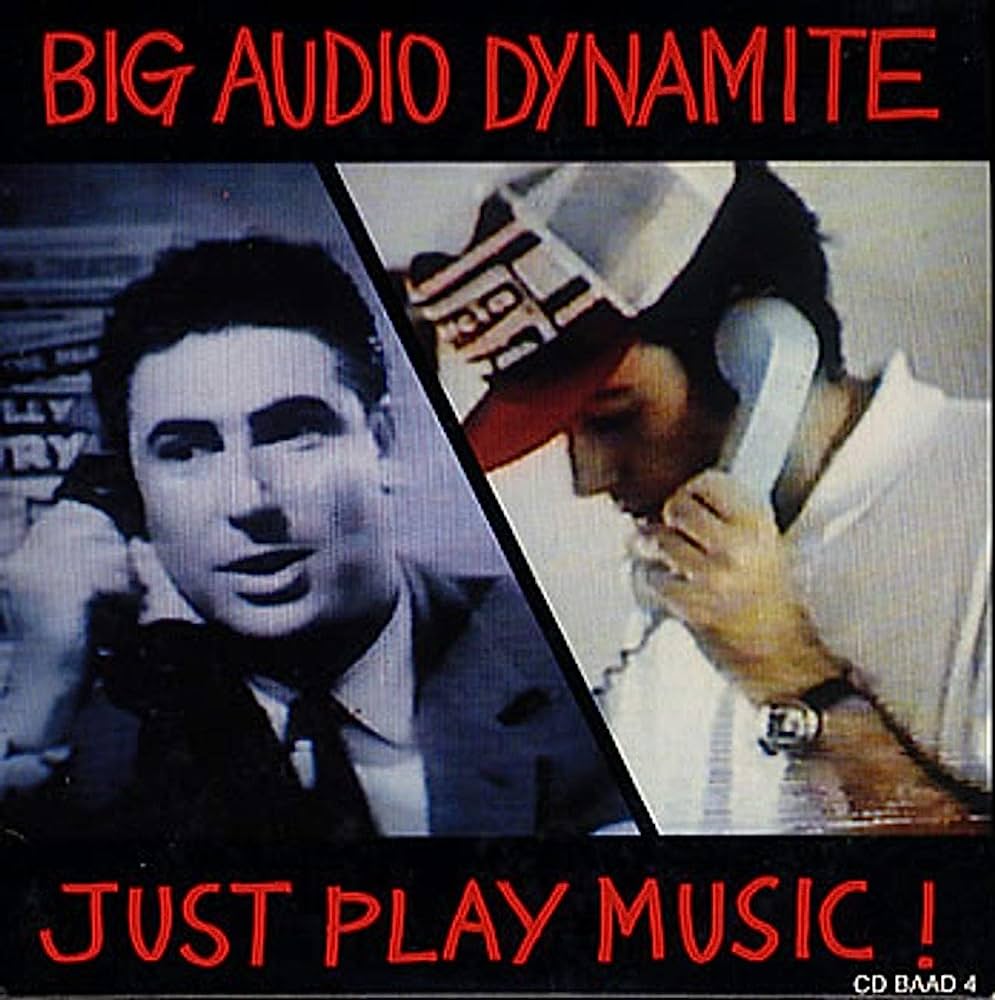
The Alternative Number Ones: Big Audio Dynamite’s “Just Play Music!”

September 17, 1988

  • STAYED AT #1:1 Week

In The Alternative Number Ones, I'm reviewing every single #1 hit in the history of the Billboard Modern Rock Tracks/Alternative Songs, starting with the moment that the chart launched in 1988. This column is a companion piece to The Number Ones, and it's for Members only.

Mick Jones must've been sick of talking about the Clash. I get it. I sometimes get sick of talking about the Clash, and I wasn't in the Clash. For everyone involved in the entire enterprise, the Clash must feel something like a millstone. The Clash were a miracle -- the pure-hearted leftist punks who carried themselves as messianic prophets and who actually had the songs, and the cultural resonance, to back it up. That's a tough act to follow.

The Clash lasted for 10 years -- maybe too brief, maybe too long. Mick Jones was only in the band for seven of those years. By 1988, Jones had been out of the Clash for half a decade, and he was four years and three albums into a whole new project that sounded, looked, and operated very little like the Clash. The Clash's narrative was always quixotically romantic, but most of that came down to Joe Strummer, the flag-waving firebrand whose rebel-rocker pose and gnarled bark helped define a way forward for a genre that, at least at the beginning, was way more interested in negation than sustainability. Jones was Strummer's counterbalance -- the mercurial and slightly weedy south London kid who didn't go to boarding school. He was the one who actually sang a whole lot of the hits: "Lost In The Supermarket," "Train In Vain," "Should I Stay Or Should I Go." Then he got fired.

Mick Jones was apparently an absolute pain in the ass toward the end of his time in the Clash, but the band needed him. The Clash could've taken time off and gotten their heads right, but that's not what they did. Instead, the Clash booted Jones, and then they fell apart without him, releasing one infamous dud of an album and then going their separate ways. Jones, meanwhile, linked up with an old friend and some new ones, and he put together a culture-clash band that drew on lots of cutting-edge forms of global dance music. This new band had some real tracks, but they weren't the Clash. By 1988, Mick Jones was probably getting tired of being reminded.

Big Audio Dynamite are not remembered as a canonical alt-rock act, but even by that band's standards, "Just Play Music!" has left virtually no footprint. When I started listening to alt-rock radio in the early '90s, I heard a lot of Big Audio Dynamite, but I never heard "Just Play Music!" I'm not sure I'd ever heard the song even once before I decided to start writing this column. Mick Jones might argue that this doesn't matter, that the whole point of music is that it resists and transcends the narratives that people try to put on it. That's what "Just Play Music!" is about. But when you write a song about narratives not being important, those lyrics become their own narrative. "Just Play Music!" has another serious issue, too: It's a pretty bad song.

It seems a shame to discuss Mick Jones' whole career, or even just the existence of Big Audio Dynamite, in the context of "Just Play Music!," but that's the job. When Billboard introduced the Modern Rock Tracks chart in 1988, the 29 alternative rock radio stations who reported to the magazine put "Just Play Music!" at #2. A week later, Big Audio Dynamite climbed to the top. It's a good thing Billboard didn't start that chart a week later than it did. Siouxsie And The Banshees' "Peek-A-Boo" is a strange, iconic record that paints late-'80s alt-rock radio in the best possible light. "Just Play Music!" plays around with some of the same musical ideas as "Peek-A-Boo," but it lands with a shrug. If "Just Play Music!" had been the first alternative #1, I don't know if I'd be writing this column.

Mick Jones was playing music before he was in the Clash. Jones was mostly raised by his grandmother, a Jewish woman who'd fled to London to escape the Russian pogroms. As a teenager, Jones was into early-'70s glam rock, and he briefly played in a band called the Delinquents. From there, he joined the London SS, a regrettably named group who recorded one demo but who never even played a show; his London SS bandmates went on to the Damned and Generation X. Somehow, though, the London SS had a manager: Bernard Rhodes, who soon introduced Jones to Joe Strummer. Jones was the one who initially put the Clash together after being galvanized by an early Sex Pistols show. The Clash played their first show opening for the Pistols in 1976. Mick Jones had just turned 21.

In the Clash, Mick Jones and Joe Strummer had one of those alchemical connections. They were better together than either of them could've been apart. I don't want this column to turn into another Clash hagiography; we've got plenty of those. But the Clash? That's a good band. Had some tunes.

Commercially, the Clash were a big deal in the UK right away. In the US, they didn't really become a force until their third album, the classic-among-classics London Calling. That record sold pretty well, and it generated breathless critical hosannas. The Clash stepped up and learned to carry themselves as an important band -- as the important band, maybe -- and they pushed their sounds and messages in a bunch of different directions. "Train In Vain," once a bonus track at the end of the album, became the Clash's first proper US hit, reaching #23 on the Hot 100. That's a pop song, and it's a great one. It's also a Mick Jones song.

1982's Combat Rock turned the Clash into full-on rock stars in the US. The album made the top 10 and went double platinum. "Rock The Casbah," an early-MTV staple, was a top-10 pop hit. ("Rock The Casbah" isn't anywhere near any list of my favorite Clash songs. Follow-up single "Should I Stay Or Should I Go," wasn't as big of a hit, but I like it a whole lot more.) The Clash opened for the Who at Shea Stadium. But there was a big problem: Those guys fucking hated each other by then.

Topper Headon, the drummer who actually wrote most of "Rock The Casbah," was the first to go -- fired right after the release of Combat Rock because his heroin addiction made him too unreliable. Mick Jones followed soon after, with Joe Strummer and Paul Simonon deciding to kick him out. In a 1986 SPIN cover story on Big Audio Dynamite, Jones still seems bummed about it: "That's all a shame, really, because if we'd have talked to each other, it probably wouldn't have happened. But we weren't even on grunting terms." One of the problems was that Jones really loved the music he was hearing out of New York -- stuff like hip-hop and post-disco club music. During a visit to New York, Jones ran out and bought a boom box. His bandmates clowned him with the nickname Wack Attack, but they got "The Magnificent Seven" out of that fascination.

Once the Clash booted him, Mick Jones was at loose ends. He joined General Public, the new wave band formed by Dave Wakeling and Ranking Roger, the two former leaders of UK ska stars the Beat. But midway through recording General Public's 1984 debut album All The Rage, Jones was out of that band, too. (He apparently played on their single "Tenderness," though.) Then Jones got together with his old friend Don Letts, and they got something else cooking.

Don Letts is a crucial figure in the story of UK punk rock. Letts, the son of Jamaican immigrants, worked at a boutique called Acme Attractions, which was one of the original sources for punk fashion. Letts also DJ'ed in nightclubs, and he basically introduced a whole lot of white British punks to reggae. Letts briefly managed the Slits, and he shot the Super 8 footage that became the 1978 documentary The Punk Rock Movie. Later on, Letts directed Westway To The World, the documentary about the Clash that came out in 2000. That's him on the cover of the Clash's Black Market Clash EP.

Letts didn't really consider himself to be a musician, but he wasn't much into the new wave that he was hearing in the early '80s. In that SPIN piece, Letts explains how he felt: "I cannot relate to this soft, safe music, ugly guys, and people ain't sayin' nothin'." Sounds like a good reason to start a band. Mick Jones and Don Letts rounded up a few untested musicians, and they formed Big Audio Dynamite in 1984. Jones didn't want to be as loudly political as he'd been in the Clash. Instead, he intended to make something fun: "We don't want to be bludgeoning people with our stern, preaching message. We've taken our soapbox and kind of tidied it up and made it look like a pink Cadillac. We try to make it a bit more glamorous, have a bit more to do with life."

There's a lot of Clash in Big Audio Dynamite's 1985 debut single "The Bottom Line," but there's a lot of other stuff, too. Mick Jones sings anthemic lyrics over drum-machine booms, an echo-drenched bassline that sounds like Liquid Liquid's "Cavern," and a sampled announcer voice talking about how the horses are on the track. (Letts did the sampling, and he also directed all the band's videos.) "The Bottom Line" is a great rock song that sounds charged with possibility. When it came out, Jones' old bandmates in the Clash were making Cut The Crap, the final album that nobody liked. With that single, Jones sounded like he was looking to the future while the Clash were stuck in the past.

"The Bottom Line" wasn't a huge hit on either side of the Atlantic, though it got some burn in American clubs. But Big Audio Dynamite followed that one with "E=MC2," which made it to #11 on the UK singles chart. BAD's debut album This Is Big Audio Dynamite, full of samples from Westerns, got some excited reviews. Today, it sounds messy and flimsy and primitive, but the energy is impossible to deny. These guys were hearing Prince and rap and synth-funk and '80s reggae and dance music, and all that stuff was lining up with their ideas about what punk was supposed to be in the first place.

The Clash broke up around the same time that the Big Audio Dynamite debut album came out. When that happened, Joe Strummer patched things up with Mick Jones, though they never played in a band together again. Strummer and Paul Simonon, the two people who'd fired Mick Jones, played cops in the video for "Medicine Show," the last single from This Is Big Audio Dynamite -- the closest we ever really came to a full Clash reunion. On Big Audio Dynamite's 1986 sophomore album No. 10, Upping St., Strummer helped out, doing uncredited production work and co-writing a few songs. I'm a pretty big Clash fan, and I can't pick out Strummer's contributions at all. (The deal with that terrible album title is it's the opposite of Downing St. You get it.)

Those first two Big Audio Dynamite albums weren't huge hits; they barely rippled in the US. Big Audio Dynamite opened for U2, a band who will soon appear in this column, on some European dates from the Joshua Tree tour; that's why they're performing in stadiums in the "Just Play Music!" video. The first three BAD albums came out in a span of less than two years, but the world was evolving faster than the band. In the UK, acid house took hold in the summer of 1988, and producers figured out how to flip samples with a whole lot more cleverness and technical dexterity than anyone in BAD could manage. In Big Audio Dynamite, the samples often didn't even fit the beats. There's a vast difference between those BAD tracks and the psychedelic sampling that British groups like MARRS and Coldcut were doing. Big Audio Dynamite wanted to create a whole new way of being a rock band, but these other acts were leaving behind the idea of rock bands entirely.

In the UK, house music quickly impacted the charts. But American modern-rock radio was still into the idea of the rock band, even if that rock band had keyboards or samplers. In lots of ways, Siouxsie And The Banshees and Big Audio Dynamite were forward-thinking groups, and it's cool that bands with people of different races and genders topped the Modern Rock chart before anyone else, especially when you consider that this column will eventually become a grim parade of white guys. But Big Audio Dynamite were only willing to go so far with their sound, and 1988's Tighten Up, Vol. 88 sounds like a band running low on juice.

"Just Play Music!" opens with a sample from Privilege, a late-'60s British film about a teen idol with too much power. That sample clashes badly with the bleepy, anodyne beat, which sounds like it was made for a cruise-ship party. The music just sounds shitty -- synthetic horn-stabs, steel-drum dings, beat programming that never quite brings the thwack. Somehow, it's slick and inept at the same time. The production seems to target radio play rather than clubs, but it's not good enough to stand out on the radio. When you're making a song about how music should transcend the noise that surrounds it, you want to make sure the song actually cuts through noise. "Just Play Music!" doesn't fulfill its end of the bargain.

I don't think I could bring myself to hate a Mick Jones song. In a different context, "Just Play Music!" could be pretty fun, and Jones seems to have a good time singing it, his playful honk never quite losing its vitality. The song's production does Jones' performance no favors, but since the producer is Mick Jones, he's got nobody to blame but himself. The track has no structure, no real hooks. It's also a complaint record: "If it's hitting, make it stick/ Do your job just play music/ Critics, mags, and interviews/ Who cares about bad reviews?" You don't write a lyric like that if you're getting good reviews.

Maybe Mick Jones is just offering heartfelt advice to younger artists who might otherwise get caught up in the bullshit. He sings that you should move his feet and touch his soul: "I can't play your interviews/ Can't hear your photographs." Sure. Fair enough. But those dinky little steel-drum sounds are not moving my feet or touching my soul. It's all too anemic to make much of an impression beyond vague exasperation. If "Just Play Music!" didn't come from a former member of the Clash, the song never would've gone anywhere.

Apparently, it didn't really mean that much to score a Modern Rock #1 hit in 1988. "Just Play Music!" didn't cross over to the Hot 100; none of the tracks from original-flavor Big Audio Dynamite did. The single only made it to #51 on the UK charts, and the Tighten Up, Vol. 88 album quickly disappeared. After the album's release, Mick Jones came down with a case of pneumonia that left him hospitalized for months. I guess he had a radio in his hospital room, since BAD's 1989 album Megatop Phoenix finally shows a few traces of acid-house inspiration. On the Modern Rock chart, lead single "James Brown" made it to #2. (It's a 7.)

On Megatop Phoenix, Big Audio Dynamite sounds something like an early-'90s dance-rock band, rather than like the bricolage-happy vanity project from the former Clash guy. After Megatop Phoenix, Big Audio Dynamite broke up. But Mick Jones wasn't done. He put together an entirely different version of the band, and he got deeper into the dance sounds that were sweeping across the UK. Down the road, that version of Big Audio Dynamite will appear in this column.

GRADE: 4/10

BONUS BEATS: As far as I can tell, "Just Play Music!" is not a song with any kind of legacy. It was a #1 hit, at least on this one chart, that was also an instantly-forgotten flop. How does that happen? It's weird. So let's look elsewhere in the Big Audio Dynamite catalog. Here's the group's 1985 track "BAD" soundtracking the scene from Ferris Bueller's Day Off, a perfect film, where Ferris and friends drop off Cameron's father's car with the parking valets:

GET THE STEREOGUM DIGEST

The week's most important music stories and least important music memes.