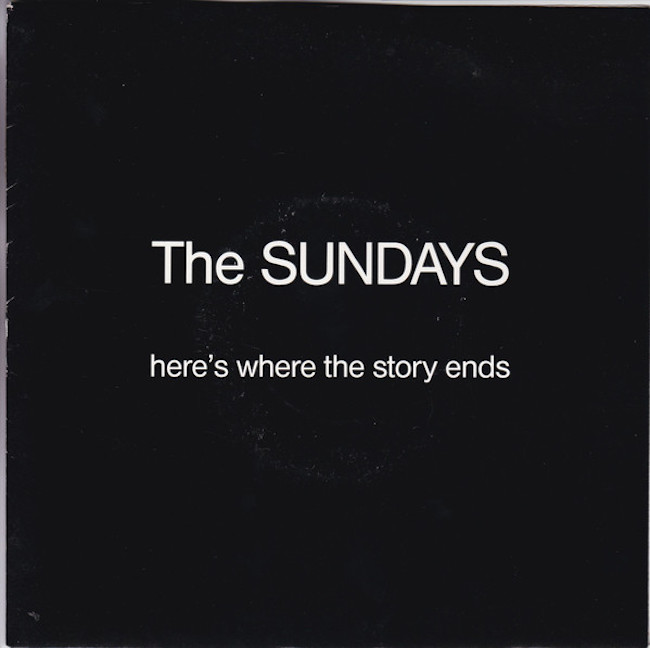
May 26, 1990
- STAYED AT #1:1 Week
In The Alternative Number Ones, I'm reviewing every #1 single in the history of the Billboard Modern Rock Tracks/Alternative Songs, starting with the moment that the chart launched in 1988. This column is a companion piece to The Number Ones, and it's for members only. Thank you to everyone who's helping to keep Stereogum afloat.
Every story ends. It sucks, but it's the truth. I'm writing this a little while after Pitchfork, the site where I worked before Stereogum, laid off a huge chunk of its staff, including some of my old friends and co-workers. Condé Nast, the company that bought Pitchfork long after I left, decreed that it should be under the banner of GQ or some such thing -- one more example, among so many, of big companies not even remotely understanding the things that they buy and fucking them all up on apparent whims. In this corner of the music internet, Pitchfork was the closest thing to a durable legacy institution, one that had run for decades without significantly altering its approach. Pitchfork will continue to exist, but its story, in a very real way, has ended.
I've been thinking a lot about Pitchfork, reading reflections from friends and strangers about what it means or meant, and it's been a profoundly bittersweet experience. I felt the same way a few years ago, when the Village Voice, another former employer of mine and another formerly beloved institution, went through its final death-rattles. The Voice's story has really ended. If you live long enough, you'll see a lot of stories end.
Writing this column and its Hot 100 companion has driven home that point again and again. Everything is ephemeral. Everything ends. Many of the bands who have appeared in this column still exist, in one form or another. Some play retro-minded nostalgia fests, and others headline stadiums. But in all matters not related to the bank accounts of these musicians, all of those stories have effectively ended by now. Even if a band has become an arena warhorse, touring on through the deaths of important members, the story of that band's impact has been over for a long time -- decades maybe. These bands and artists had moments, and all moments end. Otherwise, they wouldn't be moments.
The Sundays had a shorter story than most of the artists who have appeared in this column. It's a story that ended relatively quickly and definitively. The Sundays started in Bristol at the end of the '80s, released a grand total of three albums, and ceased all operations by the time the '90s were over. They're a band who started out singing about the end of a story, and then they saw their own story through to completion. There's beauty in that kind of concision, and then there's more beauty in the song that they sang about the story ending.
Billboard established the Modern Rock chart to trace the development of a wing of the music business that was still coming into its own -- the loose web of artists whose music didn't necessarily fit into any particular aesthetic hole but who were already thriving on the outer fringes of the mainstream. But most of the artists who reached #1 on the Modern Rock chart in its early years were long-established in one way or another. Many were veterans of the original UK punk explosion, and some, like Lou Reed, were already canonical inspirational figures when that explosion happened. Others, like R.E.M. or the Replacements, built up audiences by slogging away through the circuit of American clubs that had room for them. Even Sinéad O'Connor, still very young when she notched her two chart-toppers, already had one momentously important album before the chart came into existence.
In their moment, then, the Sundays were an anomaly -- a young band, on their first album, whose members didn't have long resumes in what was becoming the alt-rock world. You could hear aspects of late-'80s college rock in the Sundays' sound. Their rich, sparkling jangle owed a whole lot to the Smiths, and singer Harriet Wheeler's impressionistic whoop drew inevitable comparisons to Cocteau Twin Liz Fraser, though the two singers had enormously different approaches to writing and singing. It mattered that the Sundays were British; American modern rock radio was deep in the anglophile zone then. But the Sundays were fresh and immediate and as different as they were familiar, and the excitement around them was enough for the big single from their debut album to soar all the way to #1.
The Sundays started off at Bristol University in 1988. Harriet Wheeler had briefly sung for Cruel Shoes, a group that eventually evolved into the indie-pop band Jim Jiminee, but nobody else in the Sundays had any real experience playing in bands. At school, Wheeler and guitarist David Gavurin met, fell in love, and decided to try making music together. They wrote some songs, found a drummer and a bassist, moved to London, and played a single show, opening for a band that almost nobody remembers today. Immediately, record labels and press people came sniffing around. The Sundays were a near-perfect buzz band -- young, pretty, and in love, with a sound that suggested satisfied indolence and autumnal late-afternoon sunlight. Within a year, the Sundays had a UK deal with Rough Trade, and they signed on to DGC, a label that would become hugely important to the alt-rock boom, for American release.
In 1989, the Sundays released their debut single "Can't Be Sure." It's a gorgeous shimmer-sigh of a song, with underwater guitars that hit like lens flares and lyrics both vague and poetic: "And did you know that desire's a terrible thing?/ The worst that I could find/ And did you know that desire's a terrible thing?/ But I rely on mine." The song was a minor chart hit in the UK, and the always-excitable British music press flipped their shit for it. It was now time for the Sundays to make an album, which felt like an uphill climb, since they didn't yet have enough songs that they thought were good enough.
The songs came. The Sundays went into the studio with Ray Shulman, the former member of redoubtable '70s prog band Gentle Giant who's already been in this column for producing Ian McCulloch's "Proud To Fall." (Shulman died about a year ago.) At the beginning of 1990, the Sundays emerged with their debut album Reading, Writing And Arithmetic. Great record. Soft and confident. Pretty and unhurried. The Sundays weren't quite folk-rock or dream-pop. They were both of those things and neither. They didn't seen to care much about fitting into any particular lane. Instead, they took the sounds bubbling around them and translated those sounds into ecstatically chill bookstore music. They sounded like they were speaking a private language to each other, and that's about the coolest thing that a band can do.
In the UK, where the press often had the enviable power to get people to buy records, Reading, Writing And Arithmetic sold enough to make the top 10. In America, the album must've been a harder sell. The Sundays sounded resolutely weird and contentedly bored, and those aren't qualities that tend to play well over here. But the Sundays were right in the modern rock radio sweet spot, especially after they distilled their charms into a song as compact and focused as "Here's Where The Story Ends." That song was all over alt-rock radio when I started paying attention to my local station, and I really don't remember the first time I heard it. It's just always been there. It sounds like a song that's always been there.
"Here's Where The Story Ends" sounds small, but it sounds small in a big way. It's got one of those awkwardly busy strummy folk-rock grooves -- the guitars moving straight ahead while the bass does some jazzy wandering thing that seems like it might be a bad idea. Harriet Wheeler sings about feeling tongue-tied and trying to present her good side to strangers, and she seems puzzled, in an idle way, about how one might accomplish such a task. But then the chorus hits, and the song explodes like a soft firework. Tingly, prismatic guitar notes come falling down like rain as a slight yodel creeps into Harriet Wheeler's voice. Suddenly, she sounds so sad, and she also sounds like she's trying to convince you that her sadness is no big deal.
On "Here's Where The Story Ends," Harriet Wheeler sings about regretting the end of an old relationship -- pretty funny, since she and David Gavurin are still, as far as anyone knows, together today. "Oh, I never should have said the books that you read were all I loved you for" -- that's a bar. When the chorus comes back around, it gets longer and longer, and Wheeler loses herself more and more in the words that she repeats: "I cynically, cynically say the world is that way! Surprise! Surprise! Surprise!" "Here's Where The Story Ends" has some of the same blurry, otherworldly qualities that drove the shoegaze scene that was taking shape around the same time, but the Sundays never wanted to get loud like that. Instead, they bend time with quiet, unrushed grace, all their effects-pedal sounds working in service of Wheeler's euphoric regret.
Do you ever really enjoy missing something? Like savor the taste of your own longing? Once, after an early fight, my wife told me that she likes getting mad sometimes, and that shit blew my mind. I did not grow up in an environment where you could blow off steam for fun, but she was right; getting mad can really hit the spot sometimes. So can moping. That's what I hear in "Here's Where The Story Ends." It's a blissful, restorative mope session. Sometimes, a song like that tests my patience. Sometimes, it's exactly what I need to hear.
Evidently, it's what a decent percentage of the American listening public needed to hear in 1989. "Here's Where The Story Ends" got some good MTV rotation, and a whole lot of quiet guys developed terrible crushes on Harriet Wheeler. Reading, Writing And Arithmetic went gold and cracked the top 40 of the Billboard album charts. I think the record probably opened some eyes to how well this kind of prettily sad music could do commercially. The Cranberries, a band that will eventually appear in this column, came along a few years later, bringing a more streamlined and professionalized version of the Sundays' sound, and they sold many, many more records than the Sundays ever did.
The Sundays probably had some commercial momentum from the success of Reading, Writing And Arithmetic, but they either couldn't or wouldn't capitalize on it. The band's members always seemed spotlight-reticent, and they took their time recording a follow-up. Some of that was unavoidable. Rough Trade, their British label, went bankrupt, so they had to shift their business around -- not necessarily an easy thing, since they'd decided to manage themselves. Reading, Writing And Arithmetic went out of print in the UK for years. Eventually, the band came out with their sophomore album Blind, which was ultimately just as lovely and almost as successful as their first. Blind went gold in the US, and lead single "Love" made it to #2 on the Modern Rock chart. (It's an 8.)
Despite their continued success, though, the Sundays seemed to get tired of the hassles of being a working band. They came home early from their Blind tour and went into extended hibernation. Harriet Wheeler and David Gavurin got married and became parents. After a long absence, they came back with Static & Silence, a surprisingly jaunty 1997 album that they recorded at the couple's home studio. The grooves were brighter and happier, and sometimes they had strings and/or horns. Pretty-as-hell lead single "Summertime" actually became the Sundays' biggest UK hit, reaching the top 20 of the pop charts. On the Modern Rock chart over here, "Summertime" peaked at #10. (It's an 8.)
And that was it. The Sundays did a bit of touring behind Static & Silence, but they haven't played a show since 1997. Drummer Patch Hannan played on some records from Robyn Hitchcock, an artist who will eventually appear in this column, and produced a couple of British bands that I've never heard of. Bassist Paul Brindley founded some kind of digital-strategy music company. Harriet Wheeler and David Gavurin disappeared completely.
A decade ago, a writer for the American Airlines in-flight magazine went on a personal quest and tracked down Wheeler and Gavurin. Wheeler and Gavurin said that they were still making Sundays music but that they weren't sure it would ever come out. That was a long time ago, so now we can say that it probably won't come out -- that the Sundays might just be in that Bill Withers zone where they live out their lives making music for themselves and not for the rest of the world. That makes sense. That feels appropriate.
A quarter century after the end of their story, I can't really tell where the Sundays stand in the world today. Their hearts-a-fluttering sound has gone through several rounds of rediscovery, and there are still plenty of obsessive fans out there. A gorgeous cover of the Rolling Stones' "Wild Horses," originally recorded as a 1992 B-side, has tens of millions of Spotify plays, and it's shown up on a few soundtracks. (My wife walked into the room while I was playing it just now and said, "I think Napster told me this was Mazzy Star.") If the band decided to get back together tomorrow, I'm sure there are plenty of festivals and promoters who would pay large amounts of money to help that happen. But I suspect that the Sundays' legacy mostly starts and ends with "Here's Where The Story Ends." It's like they were telling us from the very beginning that the story would always have an end. Maybe there's a lesson there. Maybe we should keep that in mind.
GRADE: 8/10
BONUS BEATS: Here's Faye Wong, the Chinese singer and actress who I will love forever because of her role in Wong Kar-Wai's Chungking Express, singing "Wei Fei Zuo Dai," her Cantonese-language cover of "Here's Where The Story Ends," at a 1998 concert:
BONUS BONUS BEATS: The Sundays' original "Here's Where The Story Ends" didn't make the British pop charts. In 1998, however, the UK production duo Tin Tin Out and the singer Shelley Nelson made the top 10 with a nice little downtempo version of the track. Here's the video for their cover:
BONUS BONUS BONUS BEATS: Did you guys see that Edgar Wright wrote a front-cover blurb for my book? That was cool. That made me feel important. I don't know if Edgar Wright reads this column, but shout-out regardless. Here's Wright using "Here's Where The Story Ends" to softly soundtrack a tense and spoiler-packed bar scene in his very good 2013 movie The World's End:
BONUS BONUS BONUS BONUS BEATS: Here's the cool synthpop version of "Here's Where The Story Ends" that Youth Lagoon recorded for a 2015 SiriusXM session:
BONUS BONUS BONUS BONUS BONUS BEATS: Here's beabadoobee doing a very nice acoustic cover of "Here's Where The Story Ends" in another SiriusXM session last year:
(As lead artist, beabadoobee's highest-charting hit on what's now called the Alternative Airplay chart is "The Perfect Pair," which peaked at #12 in 2023. She also guested on Powfu's "Death Bed," which made it to #2 in 2020. It's a 4.)