

October 13, 1990
- STAYED AT #1:4 Weeks
In The Alternative Number Ones, I'm reviewing every #1 single in the history of the Billboard Modern Rock Tracks/Alternative Songs, starting with the moment that the chart launched in 1988. This column is a companion piece to The Number Ones, and it's for members only. Thank you to everyone who's helping to keep Stereogum afloat.
The Replacements were done. Paul Westerberg's mind was all made up. At that point, Westerberg was miserable. He and his bandmates weren't even talking to each other; they were using their managers as go-betweens instead. When Westerberg and Tommy Stinson, the bassist who was 12 when he first joined the band, did hang out, it was mostly to smoke speedballs together. Westerberg's drinking had gotten so bad that he could barely sing anymore, not that he ever had a beautiful songbird voice in the first place. Westerberg had just become a dad, but he was out cheating and carousing all the time, and his marriage was falling apart. He was turning 30, and he hated his life. He didn't want to lead this shambling mess of a rock band anymore.
Paul Westerberg didn't even want to make rock music. He was listening to folkier stuff, and he was writing songs that fit into that lane. Some prominent musicians had expressed interest in recording his songs, so he thought that maybe he should be a pro songwriter, or maybe a solo artist. He'd taken shot after shot at rock stardom with the Replacements, but it hadn't worked out. Despite tons of critical love, the Replacements had never become a big-selling act. They'd had a cup of coffee with the big-time when "I'll Be You," the lead single from their 1989 album Don't Tell A Soul, broke onto mainstream rock radio. But the album still couldn't even sell gold, and the Replacements continued to sabotage themselves at every opportunity.
So that was it. Paul Westerberg was over it. His next album wouldn't be a Replacements album. Instead, he was going solo. That was the idea, anyway. But the Replacements' managers, terrified at the prospect of losing their only halfway viable client, convinced him that Warner Bros., the band's label, wouldn't put any money into promoting a Paul Westerberg solo album. Instead, he needed to rethink this solo record and release it as a Replacements album instead. Eventually, Westerberg conceded. The Replacements would release one last LP, even if the vibes within the band were absolutely terrible and everyone in the group had already given up on the enterprise.
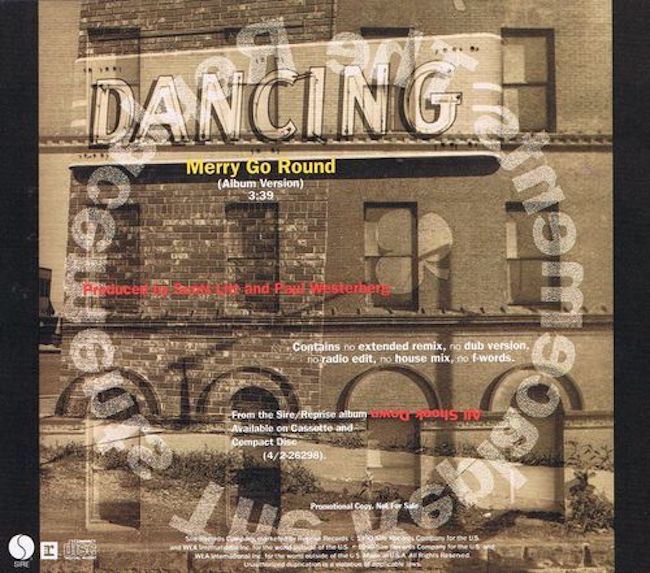
That's the context for 1990's All Shook Down, which did indeed turn out to be the final Replacements album. With that in mind, it's probably still not a shock that "Merry Go Round," the LP's first single, went to #1 on the Billboard Modern Rock chart. These were the early days of American alternative radio, when success on that chart was no indicator of actual commercial performance, and the Replacements still had plenty of cachet and goodwill. Instead, the surprise is that "Merry Go Round" is any good at all.
Officially, All Shook Down is a Replacements album. In reality, the LP exists in some perilously ambiguous in-between state -- half Replacements record, half Westerberg solo joint. Westerberg started recording the album with session musicians instead of his bandmates. When they did join in on the sessions, the other Replacements were none too thrilled at being kept out of the process. Westerberg wasn't really trying to write to their rollicking strengths, anyway. He wanted to make softer, quieter music. But Westerberg was still the same guy who'd led the Replacements for years, and he wasn't entirely ready to let go of the style that made him a cult figure in the first place. All Shook Down is a half-step, a product of indecisiveness. It sounds like one.
The Replacements recorded All Shook Down with Scott Litt, the producer who took R.E.M. to the commercial promised land. The Replacements and R.E.M. were labelmates at Warner, and both bands were products of the same nebulous and unformed '80s American underground. The Replacements saw R.E.M. as their competition, but this was a one-way rivalry. R.E.M. knew how to function in a major-label system, and the Replacements did not. Scott Litt had also worked on successful records from the Indigo Girls and Patti Smith; if anyone knew how to polish up a grimy and poetic act for mass consumption, it was that guy. Litt wasn't even a big Replacements fan, but he liked the challenge of finally making the crossover Replacements record that no previous producer had managed.
Naturally, the All Shook Down sessions were a mess. Most of Westerberg's songs were oblique messages to the people in his life, including his bandmates, and he was all kinds of depressed when he was writing them. The other Replacements were writing songs that they wanted to record, but Westerberg always shot them down. He didn't think that Chris Mars, the only drummer that the Replacements had ever had, was up to the challenge of the new songs, and he talked shit about Mars in interviews. When he first started work on the record, Westerberg didn't even tell his bandmates. Eventually, they showed up anyway.
When Paul Westerberg brought in session musicians to work on All Shook Down, he basically saw it as a chance to audition potential replacement Replacements. One of the musicians who he really liked was drummer Charley Drayton, a young session ace. Drayton is the drummer who actually plays on the album opener "Merry Go Round." In Bob Mehr's great Replacements biography Trouble Boys, Tommy Stinson remembers his reaction to Drayton's work on "Merry Go Round": "I thought, Jesus, if we had that kind of thing going on, we would be big." Westerberg invited Drayton to join the band, and Drayton declined.
"Merry Go Round" is about Westerberg's younger sister Mary, who later became a radio DJ. His lyrics are elliptical, but they capture something about growing up in a quiet and repressive house: "You wouldn't make a sound/ But I could hear your little heart pound/ And I watched your feet slip off the ground." Westerberg opens the track singing that "hush" was the first word that Mary heard, and he later switches it up just slightly: "Hush is the only word you know/ And I stopped listening long ago." He's grown up in the same situation, and it's fucked him up, too.
You don't have to know any backstory to hear a vague sadness and longing in "Merry Go Round." As with so many Replacements songs, that emptiness shares space with a strange jauntiness. Musically, "Merry Go Round" doesn't rock anywhere near as hard as plenty of earlier Replacements tracks, but it's got a gentle swagger. The production is clear and sharp, and Charley Drayton really does add some understated push-pull that the band never had, though he stops well short of adding in genuine syncopation. There's a bright jangle in Slim Dunlap's guitar, and it doesn't ultimately sound that different from the R.E.M. records that Scott Litt was producing around the same time. But Paul Westerberg's drunken bleat is nothing like Michael Stipe's voice, and there's a shambolic edge to the song that's pure Replacements. Even at their most professional -- and "Merry Go Round" is the Replacements at their most professional -- the band sounds like it could fall apart at any moment.
Sometimes, that tension between sloppiness and tightness worked to make the Replacements interesting. Sometimes, the band just sounds uncomfortable. For the most part, "Merry Go Round" slides into the latter category. There's a pleasant and amiable bop-along quality to the song, but it clashes with the ragged intensity of Westerberg's voice. He clearly has big things that he wants to say, but he can't quite coax them out of himself. I'm not a big Replacements guy, and I don't generally hear the wounded genius that so many people take from Westerberg's work. Instead, "Merry Go Round" is a pretty strong song that's somehow too clean and too sloppy for its own good. Still, I like the echo on the backing vocals and the brief but needly guitar solo. If "Merry Go Round" came on the radio, I wouldn't turn it off.
On some level, the Replacements wanted to be real-deal famous when they recorded All Shook Down, but they wouldn't commit to it. During the recording sessions, they got to know fellow Minnesota icon Bob Dylan, who was recording in the same studio at the same time and whose kids were big Replacements fans. (One of those kids, Jakob Dylan, will eventually appear in this column as the leader of the Wallflowers.) Apparently, though, the band just treated Dylan as a drinking buddy, and they didn't try to get anything out of the relationship besides a nepo-baby video director who didn't really know what he was doing yet. But we'll get to that.
Warner Bros. certainly paid to make All Shook Down into something that it could sell. Some big musicians appeared on the record. Benmont Tench, from Tom Petty's Heartbreakers, played organ, and Velvet Underground legend John Cale added viola to "Sadly Beautiful." "My Little Problem" is a duet with Johnette Napolitano, whose band Concrete Blonde has already been in this column. But she didn't like recording with Paul Westerberg. Napolitano flew out from London, where she was living, to record her vocal, but she left mid-session to get cigarettes and then flew straight back to England without telling anyone.
Before All Shook Down came out, Paul Westerberg quit drinking and moved back into his parents' house. When Westerberg did interviews to promote the record, he made it clear that the Replacements were done, going so far as to write "RIP Replacements" in a wet slab of cement while talking to a SPIN writer. Chris Mars read what Westerberg said about him in a Musician story, and he demanded a public apology from both Westerberg and the story's writer. Westerberg said he'd give that apology, but he never did, and Mars left the band and went solo.
As a solo artist, Chris Mars actually did pretty well for himself. "Popular Creeps," a single from Mars' 1992 solo debut Horseshoes And Hand Grenades, peaked at #9 on the Modern Rock chart. (It's a 7.) After a few solo records, Mars turned his attention to his career as a visual artist, and that's been a whole lot more successful than music for him. Much later, when the Replacements reunited, Mars mostly didn't take part.
The last thing that Chris Mars did as a Replacement was film the video for "Merry Go Round." It's a pretty boring and sedate clip. Understandably enough, the members of the band look like they'd rather be anywhere else; at one point, Tommy Stinson fixes his suspenders when he's supposed to be pretending to play bass. The clip was directed by Bob Dylan's young son Jesse, who was just starting a career as a music-video auteur. Later on, Jesse Dylan would direct a few movies, including the sloppy-but-fun Method Man/Redman vehicle How High.
The Replacements replaced Chris Mars with Steve Foley, a hard-partying Minneapolis native who was a big fan of the band, and they eventually went out on tour. They opened for Elvis Costello, someone who's already been in this column once and who will eventually be back, and that run was way less eventful that their previous disastrous outing with Tom Petty. All Shook Down didn't sell as well as Don't Tell A Soul, but the band kept issuing singles, which landed on the Modern Rock chart and nowhere else. "Someone To Take The Wheel," a song that's specifically about the Replacements falling apart, peaked at #15. In the early days of 1991, "When It Began" went all the way to #4. (It's a 6.)
Plenty of Replacements fans absolutely hated All Shook Down, deriding it as a soft and directionless sellout record. Critics generally liked the album, but the reaction was fairly muted. On the Pazz & Jop poll, critical vote put All Shook Down at #11 for the year, right between Prince's Graffiti Bridge and the Chills' Submarine Bells. (Old Pazz & Jop lists will always fascinate me.) In any case, the reception to All Shook Down wasn't enough to convince the Replacements that they should continue on as a band. A 1991 show at the Taste Of Chicago festival ended up being their final gig. The band members ended it by leaving the stage, one by one, as their roadies took their instruments and played instead.
After the Replacements broke up, Slim Dunlap mostly played in local Minneapolis bands. Tommy Stinson and Steve Foley formed a new group called Bash & Pop, who made warm-and-fuzzy Replacements-style rockers that got good reviews but never charted anywhere, including on the Modern Rock chart. Eventually, Stinson became Duff McKagan's replacement in Axl Rose's zombified Chinese Democracy-era version of Guns N' Roses, which was definitely a strange twist of fate. Tommy's older brother Bob Stinson, the deposed guitarist who started the Replacements in the first place, died of organ failure in 1995. In 2008, Steve Foley died of an accidental overdose.
The Replacements didn't get much of a chance to benefit from the '90s alt-rock explosion that they might've helped inspire, but Paul Westerberg did. As a solo artist, Westerberg got his big start with Singles, the 1992 Cameron Crowe film that happened to capture Seattle in the moment that grunge was becoming a dominant cultural force. Westerberg composed the Singles score, and he had two songs on the mega-popular soundtrack album, which was otherwise dominated by ascendant Seattle bands. The Scott Litt-produced "Dyslexic Heart," the first of Westerberg's solo singles, peaked at #4. (It's an 8.)
In 1993, Westerberg released 14 Songs, his first solo album, and it did pretty well. Westerberg again reached #4 on the Modern Rock chart with lead single "World Class Fad," a grumpy attack against all the new-jack alt-rockers who were doing things that the Replacements never could. (It's an 8.) Plenty of people heard "World Class Fad" as a diss track against Kurt Cobain, though Westerberg insisted that he didn't respect Cobain enough to write a song about him. In Trouble Boys, there's a story about Westerberg and Cobain staying at the same San Francisco hotel in 1992. One night, they rode in the same elevator without saying a single word to each other.
If Paul Westerberg thought Kurt Cobain was ripping him off, I think that was pure paranoia. I hear very little Replacements influence in Nirvana, a band who will eventually appear in this column. But plenty of Replacements disciples did well for themselves in the '90s. I hear a ton of Replacements in the Lemonheads, the Gin Blossoms, and the Goo Goo Dolls -- all bands who will be in this column eventually. Soul Asylum, who were essentially the Replacements' adoring little brothers on the Minneapolis scene, will show up in this space as well.
Paul Westerberg's career did not take off in the wake of the alt-rock explosion. His solo work was spotty and infrequent, and he hasn't been on the Modern Rock chart since 1996, when his single "Love Untold" peaked at #21. In 2006, he randomly wrote the songs for the animated movie Open Season, and he brought Tommy Stinson in to play on those tracks. In 2012, Westerberg and Stinson recorded Songs For Slim, an EP of covers to raise money for their old bandmate Slim Dunlap, who'd suffered a stroke. Chris Mars played on one song and did the cover art. The record came out under the Replacements' name.
The Replacements -- really Paul Westerberg, Tommy Stinson, and a couple of ringers -- played their first reunion show at Chicago's Riot Fest in 2013, and they went on to do some successful touring, including Coachella in 2014. Billie Joe Armstrong, whose band Green Day will be in this column plenty of times, sat in with them during a bunch of shows. There was talk of another album, too, but it never materialized. Instead, when the Replacements played the 2015 Primavera Sound Festival in Portugal, Westerberg announced that it would be their final show. Thus far, that's been true. There's something heartwarming about that. Even as elder statesmen who had a great opportunity to cash in on all the goodwill from their earlier and more anarchic days, the Replacements simply could not keep their shit together.
GRADE: 7/10
BONUS BEATS: "Merry Go Round" apparently soundtracked a scene from a 1991 Beverly Hills 90210 episode -- the one where Shannon Doherty's Brenda Walsh tries stand-up comedy -- but I sadly could not find video of that scene. There haven't been any prominent "Merry Go Round" covers, either, unless you count Paul Westerberg playing the song live as a solo artist. So let's go with a different track from All Shook Down. Here's the lovely version of "Sadly Beautiful" that the ailing country-pop great Glen Campbell released in 2008:


