

Skip to Content
Columns

The Alternative Number Ones: Siouxsie And The Banshees’ “Kiss Them For Me”

July 6, 1991

  • STAYED AT #1:5 Weeks

In The Alternative Number Ones, I'm reviewing every #1 single in the history of the Billboard Modern Rock Tracks/Alternative Songs, starting with the moment that the chart launched in 1988. This column is a companion piece to The Number Ones, and it's for members only. Thank you to everyone who's helping to keep Stereogum afloat.

Here's something that I recommend: Go back and look at footage of Siouxsie And The Banshees on the first Lollapalooza tour in 1991. There's a decent amount of it out there. The first episode of Lolla, the new Paramount+ docuseries about the festival, tells the story of that first tour, and people speak about the Banshees in hushed tones. Whenever the Banshees appear onscreen, they look so goofy. One of them is usually dressed like an actual clown. A couple of others could be rocking leftover costumes from a regional dinner-theater Pirates Of Penzance production. Siouxsie Sioux herself might come off like she's about ready to play a belly dancer in a '40s movie. But if you sit and watch them for a second, the only acceptable response is: "Yo, that's a band."

Siouxsie And The Banshees were not the headliners on that first Lollapalooza tour. That role went to Jane's Addiction, who were mere months away from total dissolution. Jane's put the tour together, and they're responsible for the branding that now brings tens of thousands of dangerously stoned teenagers to Chicago's Grant Park every summer. But the Banshees were on the bill right under Jane's, and their presence was crucial for its success.

By taking part in Lollapalooza, Siouxsie And The Banshees tied that tour in with a grand punk and goth lineage that stretched back nearly a decade and a half. The Banshees had history. They were the only band that could claim both Sid Vicious and Robert Smith as ex-members. They'd inspired entire generations of left-of-center musicians. They were the first group ever to land a #1 hit on the newly instituted Billboard Modern Rock chart, which makes them the first band ever to appear in this column. For much of summer 1991, while Lollapalooza crossed the country, the Banshees once again had the top song on that chart. It was the biggest American hit of their entire run, and it was an absolute banger, a perfect song.

When this column last checked in with Siouxsie And The Banshees, it was for "Peek-A-Boo," the yips-and-samples freakout that became the biggest alternative-radio hit of 1988. The Banshees followed that single with their #2 hit "The Killing Jar." (It's a 9.) After that, Siouxsie and husband/Banshees drummer Budgie went to Spain and recorded Boomerang, the second album from their off-and-on side project the Creatures. On that record, they leaned into horns, big drums, and old-timey glamor. "Standing There," the LP's lead single, peaked at #4. (It's a 6.)

When Siouxsie and Budgie got back to their main gig with the Banshees, they took those sounds with them, though they tempered their freakiest tendencies. The Banshees recorded 1991's Superstition with Stephen Hague, an American producer best known for his '80s work with British new wavers like Pet Shop Boys and New Order. Nigel Godrich, later Radiohead's chief collaborator, was an assistant engineer on the record; it was one of his first credits.

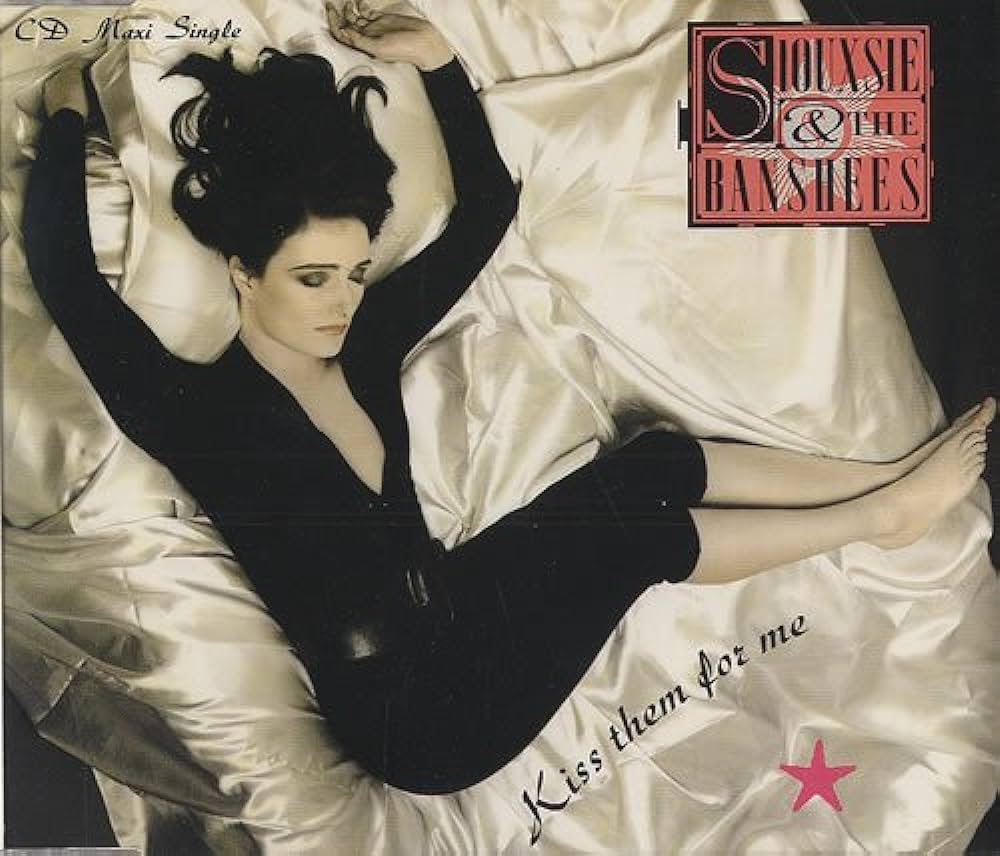
When Superstition came out, plenty of critics were bummed to hear the Banshees, a band that was once known for cold and dark guitar textures, make a record that leaned so hard into synths and dance-pop beats. I'd agree that Superstition is nowhere near the best Banshees record, but its approach comes together gorgeously on "Kiss Them For Me," which was the album's first single and opening track. When you put a song like that up front, it has a way of making everything else look dim in comparison.

"Kiss Them For Me" got its title from a 1957 Stanley Donen romantic comedy, and its inspiration was Jayne Mansfield, one of that film's stars. Mansfield isn't Cary Grant's main love interest in Kiss Them For Me, but she's second-billed anyway. She was one of the reigning sex symbols of her era -- a blonde bombshell who got her start posing for Playboy and whose publicity stunts, tabloid romances, and striptease club shows were just as famous as her movie roles.

Jayne Mansfield was killed in a 1967 car wreck while on the way to a club gig in New Orleans. For decades, people said that she'd been decapitated in the accident, which wasn't true. Mansfield's driver rear-ended a tractor-trailer that suddenly slowed down, and all three adults in the front seat were killed. Three of Mansfield's kids -- including three-year-old Mariska Hargitay, who's been the star of Law & Order: SVU for most of my life -- were asleep in the back, and they were all OK. For people who are fascinated with the intersection of sex, death, and celebrity, the Jayne Mansfield story is irresistible -- a Hollywood-age spin on the Marie Antoinette myth. Mansfield becomes less of a human being, more of a dream-life abstraction.

The dream-life abstraction is what Siouxsie Sioux sings about on "Kiss Them For Me." Siouxsie's lyrics are a portrait of a beautiful girl who's always drawn toward the miasmic light of public attention: "No party she'd not attend/ No invitation she wouldn't send/ Transfixed by the inner sound of your promise to be found." Siouxsie evokes this glamorous life in quick flashes -- heart-shaped pools, pink champagne fountains, Mansfield's "divoon" catchphrase. She describes Mansfield's death the same way: "On the road to New Orleans, a spray of stars hit the screen." There's no moral, no lesson to be learned. As rendered in song, the Jayne Mansfield story is just an intoxicating, evanescent whirl, an apparition that cannot last.

The music works much in the same way, though there's no retro glamor in its style. Instead, Siouxsie And The Banshees use every available newfangled trick and stylistic mutation to make you feel dizzy. Siouxsie herself is bright and calm and proper. She sighs with contentment about these visions, even when they get dark at the end. All around her, things erupt. The guitars are Nile Rodgers-style quasi-funk crab-walks. The keyboards glimmer and glow. The drums hit like bulldozers falling out of the sky. We need to talk about these drums.

The main sound that drives "Kiss Them For Me," even more than Siouxsie Sioux's voice, is incredibly simple -- a few ticcing mechanical hi-hats and an echo-drenched snare that kicks you in the gut. If you paid close attention to '80s rap, those drums should sound familiar. "P.S.K. What Does It Mean?" was the independently released 1985 debut single from the Philadelphia rapper Schooly D, and it's widely considered the first gangsta rap song in history. (The P.S.K. of the title means Park Side Killas, the gang that Schooly ran with.) Schooly produced the track himself, and it's a prime example of the kind of stripped-back minimalist thunder that came into vogue with the advent of the 808 drum machine. The song still sounds so hard and simple that it's practically alien.

The "P.S.K." drums have been sampled on hundreds of records over the years. You can hear those drums on tracks from Biggie Smalls, Eminem, Jennifer Lopez. Siouxsie And The Banshees got to those drums before just about anyone else. On tracks like "Peek-A-Boo," the Banshees had already shown their willingness to engage with the new sounds that were arriving in genres like rap and acid house. But those "P.S.K." drums aren't just some rap shit. They are some rap shit. The Banshees understood the concussive power of those drums, and the built a whole track out of it. In a 120 Minutes interview, host Dave Kendall asked the Banshees if Stephen Hague "was responsible for kind of the house-y beat" on the track, and guitarist Steve Severin just laughed: "That was my irresponsibility. He's never been to a house. He's never been to a rave in his life." (It would've been cool if Schooly D got songwriting credit, but that didn't happen.)

"Kiss Them For Me" is not strictly electronic, and it's nowhere near minimal. It doesn't sound like house music, either. The track has these waves of sound all crashing -- spiraling dreamy guitars, quasi-Eastern string figures, the kind of echo that makes everything bleed into everything else. On the bridge, there's this stuttery vocal effect that sounds like a sample glitching out, but that's not what it is. It's Talvin Singh, the London tabla master who played a big role in mainstream electronica later in the '90s, doing konnakol, a percussive singing style that's common in Indian Canartic music. Singh plays tablas on the track, too.

All that stuff working together is dizzying, overwhelming. Siouxsie And The Banshees' past music could be overwhelming, too, but it usually came through as a kind of stentorian darkness. There's darkness in "Kiss Them For Me," but it's mostly in the subtext, the allusions to the car crash. Musically, the song is bright and joyous, and it registers as an ecstatic mutant strain of pop music. That's how we received it, too. "Kiss Them For Me" was a top-40 hit in both the US and UK. It was actually bigger in the US, peaking at #23 on the Hot 100. The hype surrounding "Kiss Them For Me" and Lollapalooza probably bled into one another -- two more signs that music and culture were shifting.

Siouxsie And The Banshees' Superstition never became a big hit on the album charts, and follow-up singles "Shadowtime" and "Fear (Of The Unknown)" didn't crack the top 10 on the Modern Rock chart. ("Shadowtime" peaked at #13, "Fear (Of The Unknown)" at #12.) But the Banshees did make the top 10 a year later. Tim Burton got a whole Prince album for 1989's Batman, but the only original track in 1992's Batman Returns was "Face To Face," a song that he asked the Banshees to write and record for the movie. If you know what Tim Burton's haircut looks like, it shouldn't surprise you that he was a Siouxsie fan. ("Face To Face" peaked at #7. It's an 8.)

Siouxsie And The Banshees didn't come out with another album until 1995's Mirage, which they recorded with Velvet Underground legend John Cale. That record was a commercial flop, and only one single made the Modern Rock chart. ("O Baby" peaked at #21.) Shortly afterward, the Banshees broke up. Siouxsie and Budgie recorded a couple more Creatures albums, but then they split, both as a band and as a couple. Siouxsie released the 2007 solo album Mantaray, and then she went quiet for a long time.

For decades now, Siouxsie Sioux has been a fascinating, reclusive presence. She goes years without performing. In 2015, she released the one-off single "Love Crime." It was her first song since Mantaray, and she made it for the last episode of the TV show Hannibal. She hasn't released a new song since then.

Last year, Siouxsie Sioux returned to the stage for a few solo shows, her first in a decade. A couple of months ago, she and Iggy Pop recorded a new version of his classic "The Passenger," which the Banshees covered in 1987. The new Siouxsie/Iggy duet version of "The Passenger" was for a British ice cream commercial. How does that happen? How do you release absolutely nothing for nine years and then sing a song for an ice cream ad? It doesn't make sense, but there's something awesomely mysterious about that senselessness. Or maybe it was just a good paycheck; I have no idea.

Siouxsie Sioux can do whatever she wants. For a decade and a half, she and the Banshees reinvented themselves over and over, leaving people's heads spinning. From a certain perspective, we're still trying to catch up to where they were at any point in their collective journey. "Kiss Them For Me" isn't a canonized classic like some of the other 1991 songs that we'll discuss in this column, but it's a singular piece of work that still casts a spell. Siouxsie has lots of classics, but this is the one for me.

GRADE: 10/10

BONUS BEATS: Here's the very cool "Kiss Them For Me" cover that School Of Seven Bells released in 2010:

GET THE STEREOGUM DIGEST

The week's most important music stories and least important music memes.