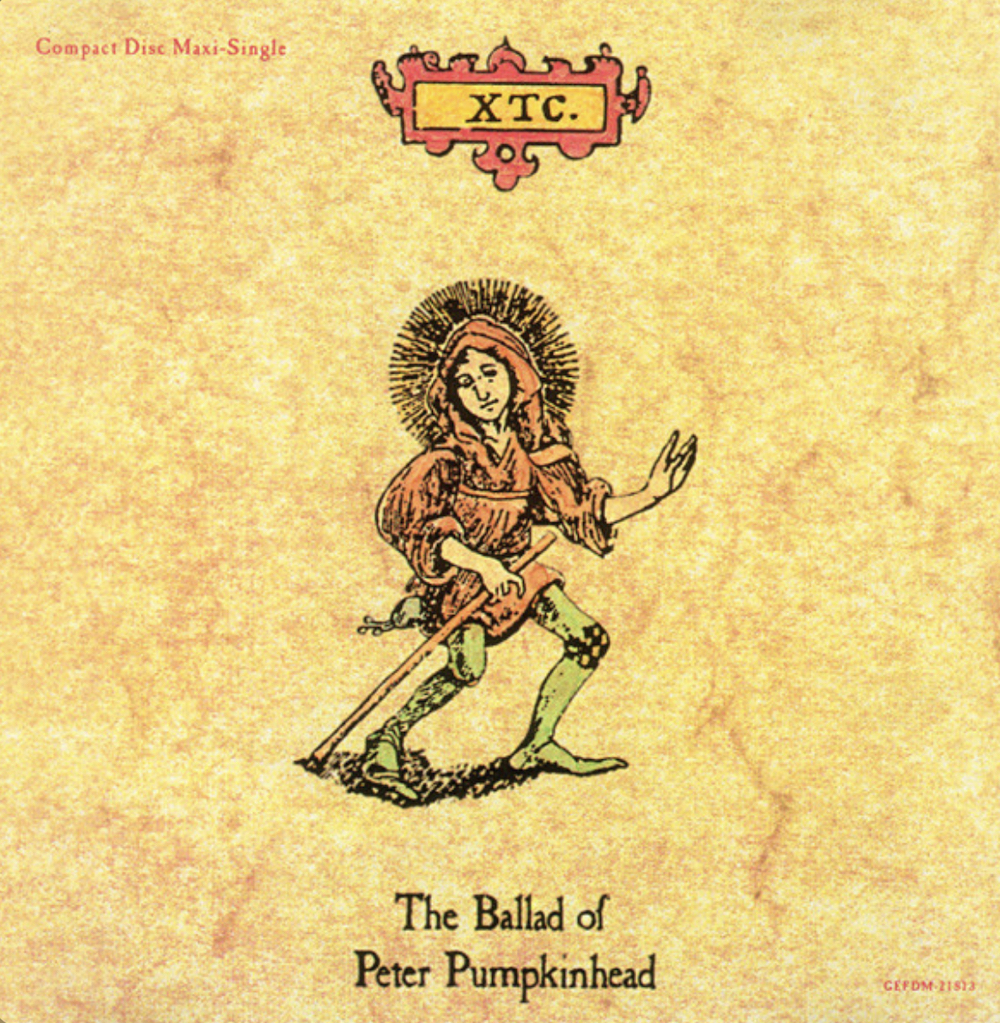
May 30, 1992
- STAYED AT #1:2 Weeks
In The Alternative Number Ones, I'm reviewing every #1 single in the history of the Billboard Modern Rock Tracks/Alternative Songs, starting with the moment that the chart launched in 1988. This column is a companion piece to The Number Ones, and it's for members only. Thank you to everyone who's helping to keep Stereogum afloat.
I'm about to make some enemies. Or maybe I'm about to make some eeeeyh-nuh-mayyys. I get absolutely no satisfaction out of this. If you're reading this column, you presumably paid actual cash money to support this particular website and, by extension, to keep me supplied with electricity and sour gummi worms. For this, I salute you. But judging by the comments section's reacted the last column about XTC, there's also a good chance that you're one of the people who enjoys the madcap highfalutin quasi-pop stylings of the demonstratively eccentric British band. If that's you, feel free to stop reading right now. Because I think "The Ballad Of Peter Pumpkinhead" is ass.
That's not a spoiler. You shouldn't be surprised. XTC's music is exactly the kind of cleverly clever, whimsically whimsical look-at-me smartypants bullshit that has always driven me up the wall, and I think I made that clear in the last column. In XTC's decades-long catalog, there are at least a couple of songs that I genuinely fuck with, like "Generals And Majors" and "Dear God." But XTC's overriding impulse was always to overload their songs with layer upon layer of sparkleflash frippery and then to sing those songs like they're trying to startle their garden gnomes. I find most of their music to be intensely offputting, and it remains fascinating to me that this group could've ever been considered a theoretically commercial proposition. This stuff is simply not for me. It really couldn't be any less for me.
XTC had a frustrating career, one of those classic arcs where they were constantly at war with their record label. They didn't make enough money, and they spent a lot on the records that they made. They also bristled at the idea that they should pursue anything other than their most idiosyncratic ideas. They didn't perform live at all after frontman Andy Partridge suffered a nervous breakdown in 1982, which probably didn't help their fortunes. But someone in some record-label office decided that XTC had some potential, so they remained locked into a miserable contract for many, many years. Maybe they didn't mean it that way, but "The Ballad Of Peter Pumpkinhead" plays like a last-ditch attempt at making something resembling a hit, and its big, chunky production really only serves to make an already-grating sound even more obnoxious.
There are lots of ideas on "The Ballad Of Peter Pumpkinhead," and I assume that lots of ideas is high on this list of why people like XTC. The song's storytelling framework is pretty strong. It's about a political figure who rises up by telling people the truth and appealing to their better selves, so the people in power do everything they can to humiliate and crush and ultimately kill this person. The cynicism displayed on "The Ballad Of Peter Pumpkinhead" has been proven correct again and again, but I'd still want to jump out the window of a moving car if the song came on the radio. I'm not sorry for feeling this way, but I do feel bad for anyone who paid to read me shitting on a band that they love. Can't say I didn't warn you.
Here's something stupid that's always bothered me about "The Ballad Of Peter Pumpkinhead": It's not about Pumpkinhead. In 1988, the legendary special effects wizard Stan Winston made his directorial debut with Pumpkinhead. Winston, IMDB tells me, went on to make a 1990 Anthony Michael Hall film gknown as A Gnome Named Gnorm, as well as Guns N' Roses' "You Could Be Mine" video and the Michael Jackson short film Ghosts -- a small but impactful filmography for a guy better known for doing awesome special effects in better movies. Pumpkinhead is a horror flick about a freaky-looking demon that's called forth from hell because some bikers accidentally ran over a little kid, or something. I never actually saw Pumpkinhead, I don't think, but I definitely used to scare myself by looking at the video box in Blockbuster.
Pumpkinhead, as far as I know, is not some sacred and untouchable horror classic, but XTC didn't make "The Ballad Of Peter Pumpkinhead" until four years after Pumpkinhead came out. By the time XTC released that song, the 1994 direct-to-video sequel Pumpkinhead II: Blood Wings was presumably already into pre-production. Maybe Andy Partridge didn't steal the Pumpkinhead name, but there was already another Pumpkinhead out there in the cultural conversation. I'm guessing nobody ever got the two Pumpkinheads confused, but did it just not occur to anyone that they should change the name? Like, what if Tim Robbins' 1992 film Bob Roberts -- another movie I haven't seen, but one that radiates the same kind of early-'90s middlebrow political-satire vibe as "The Ballad Of Peter Pumpkinhead" -- was really called Bob Cryptkeeper or Bob Pinhead From Hellraiser? That would be weird, right? It's not a fatal flaw, but it never sat right with me.
To hear Andy Partridge tell it, he did not get the idea for "The Battle Of Peter Pumpkinhead" from the horror movie Pumpkinhead. Instead, he carved a Halloween jack-o'-lantern that he really liked, and he didn't want to throw it away after Halloween, so he just put it up on his fence and watched it rot instead. In a 2006 interview, Partridge said, "I'd see the rotting head, and I started to think, 'What did he do to deserve to be executed -- to be put on a spike on Traitor's Gate here? He did nothing wrong. He was kind of perfect.' And then I thought, 'Hmmm, what would happen if there was somebody on Earth who was kind of perfect?' I just started to extrapolate on that idea, and really mess around with it in a kind of Dylanesque way."
In the text of the song, there's nothing to suggest that Peter Pumpkinhead has a pumpkin for a head. Instead, he's a prophet figure, and his mythology is liberally drawn from the stories of Jesus Christ and John F. Kennedy. Here's a guy who comes to town and spreads wisdom and cash around. He gains a following, and he begins to right society's injustices. Along the way, he pisses off lots of powerful people. When the government entraps him in a sex scandal, the people don't stop loving him, so instead Peter Pumpkinhead gets literally crucified while grinning on live TV. It's not the subtlest story.
"The Ballad Of Peter Pumpkinhead" came out at a time when Kennedy-related conspiracy theories had a huge grip on the public imagination. A year earlier, Oliver Stone's JFK was a full-on prestige blockbuster. It's kind of funny that "The Ballad Of Peter Pumpkinhead" arrived during the rise of Bill Clinton, whose real problem was that he made too many friends among all the people who would keep us on our knees. Four years after "Peter Pumpkinhead," Clinton signed the Telecommunications Act, which cleared the way for corporate radio-station consolidation and eventually led to alt-rock radio becoming a gurgling, homogenized post-grunge swill-pit. That's not what knocked bands like XTC out of radio favor, though. That would've happened anyway.
After their 1989 album Oranges & Lemons, XTC were in a not-bad place commercially. That album sold fairly well, and "The Mayor Of Simpleton" -- a song that is not about a political figure, pumpkin-headed or otherwise -- became XTC's only Hot 100 hit. After that LP's relative success, however, XTC still owed tons of money to their label, and they took a few years off, with the band members pursuing other projects. When they got back together, Andy Partridge had written a whole pile of songs. The band didn't want to leave their families behind to record in the US, so they brought in Gus Dudgeon, a veteran British producer who'd been Elton John's go-to collaborator. They didn't really like working with him, and you can tell.
Nonsuch, the album that XTC recorded with Gus Dudgeon, is a big mess that's full of showy Beach Boys-ish flourishes. In that sense, it's not that different from the layered, fussy albums that came immediately before, but it's also got a brighter, more commercial sheen. Plenty of fans were mad about that. I'm not an XTC fan, but I'm not especially happy about that, either. "The Ballad Of Peter Pumpkinhead" is the first song on the LP, and I find it to be almost oppressively unpleasant. I don't know whether the problems come from XTC, Dudgeon, or some combination of the two, but it really doesn't work for me.
You can tell what they're going for. "The Ballad Of Peter Pumpkinhead" opens with the sound of a guitar being plugged in -- a sign that XTC are going to rock about as hard as they ever rocked. The track has chunky power-pop guitar chords and big, loud drums and cymbal-splashes. (XTC recruited Fairport Convention drummer Dave Mattacks for Nonsuch.) Andy Partridge honks on a harmonica whenever he's not bleating, and he does a lot of bleating. The loud, brittle production clashes badly with the busy arrangement, and the result feels like it's yelling at me about how charming it is.
Look: I don't like Andy Partridge's voice. We all have voices like that, right? You hear someone sing, and it tickles some animal part of your brain that refuses to accept the sound. Partridge is one of those guys for me. I like plenty of nasal-honk singers, but this particular nasal honk is too much for me. On "Peter Pumpkinhead," Partridge over-emphasizes every syllable: "Governments who would slurrr hee-is nyame." Maybe this is just me continuing to justify my knee-jerk 12-year-old reaction, but I don't like anything that Partridge does vocally on this song. I don't even like when he begins the song by yelling, "Let's begin!" I'm like, "Please. Don't begin."
Maybe Partridge declaimed every line like that so that people could understand every lyric on the radio. If that's the case, it worked. I picked up on the disconnect between the shiny music and Peter Pumpkinhead's tragic and sordid story even when I was a kid wishing that my local modern rock station would turn this song off and put on L7 instead. Maybe the satire worked on me. Maybe it trained some part of my brain to distrust bullshit hero narratives, or maybe it trained some other part of my brain to accept bullshit hero narratives. But I was never happy when "Peter Pumpkinhead" came on the radio. It was an instant change-the-station song. If the modern rock station was playing "Peter Pumpkinhead" and the hard rock station was playing something like Van Halen's "Right Now," I'd just impatiently toggle between both stations until one of those songs was over.
"The Ballad Of Peter Pumpkinhead" was actually the second single from XTC's Nonsuch album. The first was "The Disappointed," which I never heard on the radio. "The Disappointed" was a minor pop hit in the UK, where it reached #33, but I get the feeling that the song didn't even get a push in the US. "The Ballad Of Peter Pumpkinhead," meanwhile, got heavy modern rock play but barely got any burn on mainstream rock stations. The video, with its cutesy Kennedy allusions, got played on 120 Minutes a few times.
After "Peter Pumpkinhead," XTC peaked at #18 on the Modern Rock chart with their Nonsuch track "Dear Madam Barnum," and then they never made it onto that chart again. Nonsuch only reached #97 on the American album charts -- way lower than Oranges & Lemons or Skylarking. It got a Grammy nomination for Best Alternative Album, but it lost to Tom Waits' Bone Machine, an album that never got any significant alternative radio play. XTC planned to release another Nonsuch single called "Wrapped In Grey," but the story is that Virgin, XTC's British label, printed up a bunch of singles and then changed their mind, figuring that the track was a dud and destroying all the copies.
After Nonsuch, Andy Partridge had a big idea for an XTC album: A record of '70s-style bubblegum pop with way-too-horny lyrics and with all the tracks credited to different fictional bands. That actually sounds kind of fun, but Virgin wasn't into it. After years of struggles with the label, that was the breaking point. XTC didn't break up, but they went on strike, refusing to record any new music for Virgin. Prince did something similar at the time, and his campaign against his label got a lot of hype, but XTC were not Prince. They basically just did nothing for years.
Eventually, XTC negotiated their way out of their Virgin contract, and they recorded two more albums, 1999's Apple Venus Volume 1 and its 2000 companion piece Wasp Star (Apple Venus Volume 2). Longtime guitarist Dave Gregory finally quit during the recording sessions. Those records got decent reviews but didn't really sell, and principal XTC members Alan Partridge and Colin Moulding eventually got sick of each other and stopped working together. XTC have been effectively inactive since 2006, but all of the band's members participated in the 2017 documentary This Is Pop.
Partridge and Moulding are apparently cool with each other again now, but there's no plan for any new XTC music. That's fine with me. This column represents my last attempt to get anything out of XTC's work. I'm done trying. It's just not for me. If it's for you, congratulations, but I will now go back to ignoring this band forever. Plenty of other fussy, punk-adjacent British bands will appear in this column, and I like some of them just fine. But this is XTC's last time in this column, and it's my last time listening to XTC on purpose. It's over. I'm free.
GRADE: 3/10
BONUS BEATS: For reasons that I cannot begin to comprehend, the Crash Test Dummies, a band that will eventually appear in this column, covered "The Ballad Of Peter Pumpkinhead" for the soundtrack of the 1995 film Dumb & Dumber, and their version was a bigger UK hit than XTC's original. Jim Carrey didn't appear in the video for the Crash Test Dummies' cover, but Jeff Daniels did, and he played his Harry Dunne character as a guy who became accidentally famous after getting a pumpkin stuck on his head. Here's that video: