May 15, 1993
- STAYED AT #1:1 Week
In The Alternative Number Ones, I'm reviewing every #1 single in the history of the Billboard Modern Rock Tracks/Alternative Songs, starting with the moment that the chart launched in 1988. This column is a companion piece to The Number Ones, and it's for members only. Thank you to everyone who's helping to keep Stereogum afloat.
Now this is more like it.
Depeche Mode attempted to rebrand themselves with "I Feel You," the first single from their 1993 album Songs Of Faith And Devotion. "I Feel You" was built on elements that already existed in the group's music, but it took those elements way further, and it presented them in an entirely different way. Suddenly, singer Dave Gahan was a long-haired, tatted-up rocker who talked about Neil Young and Soundgarden in interviews, and the band's new sound was a hyper-processed blues-rock snarl. The message was: This band would never make blinky-blink '80s synthpop, what are you taking about, you must be thinking of some other Depeche Mode. It's the '90s, baby! Depeche Mode are ready to rock!
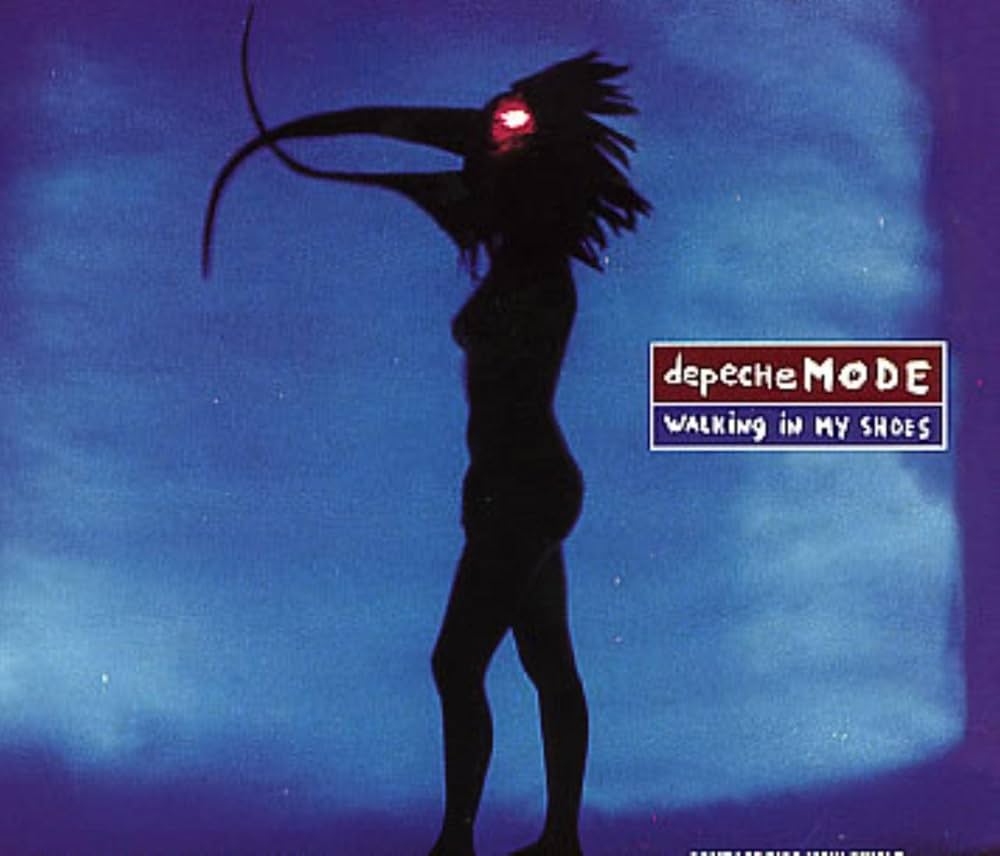
"I Feel You" was successful enough to get a long stretch at #1 on the Billboard Modern Rock chart, but it was not altogether convincing. Fortunately, Depeche Mode followed "I Feel You" with a single that corrected that overreach -- a classic-style twinkle-brood that's still very much a cultural artifact of the early '90s. "I Feel You" was the work of a band convinced of its own uncoolness and desperate to catch up. I don't get any of that from "Walking In My Shoes," a song that comments on the band's self-destructive hedonism while giving their great Violator-era style the slight updates that it probably needed. "Walking In My Shoes" turned out to be Depeche Mode's final Modern Rock chart-topper, but they're still a remarkably successful band today, and this song is a textbook demonstration of how they've been able to keep it rolling.
The hedonism was real. When Dave Gahan moved to Los Angeles and gave himself a cool-rocker-dude makeover, he embraced many of the same excesses as actual LA rocker dudes. Specifically, he developed a terrible heroin problem that came close to ending his life more than once. Gahan also divorced his first wife and married his second; his clean-cut image wasn't the only thing that he ended. At the same time, Martin Gore was drinking a lot, and I'm sure other stuff was happening within the band. The British synthpop guys were not exempt from the tendencies that destroyed so many rock-star lives in that turbulent time.
Dave Gahan wasn't the only Depeche Mode member getting into hedonistic self-destruction in the early '90s, but he was doing it more visibly and severely than his bandmates. With that in mind, I think of "Walking In My Shoes" as a very nice piece of writerly empathy. Martin Gore wrote "Walking In My Shoes," as he wrote most Depeche Mode songs. As with most Depeche Mode songs, Gore handed it to Gahan to sing. Since "Walking In My Shoes" is all about being judged for your pursuits and proclivities, I think of the song as Gore helping Gahan defend himself, on some Cyrano shit. Maybe that's simplistic. Maybe Gore felt like he was being judged, or maybe the song isn't that deep. Whatever the case, though, I think it's nice that Gore wrote a "haters, get off my dick" song for Gahan to sing. That's a real friend.
The message of "Walking My Shoes" is something like this: Yes, I do fucked up things all the time. I prioritize my own pleasure, and that leads me to places that you could barely imagine. I have hurt the people around me, and maybe I feel guilty about that. But if you were to live the live that I live, you'd commit all the same sins. Not only that, but you'd be worse. You wouldn't be able to function. You'd be like, damn, buddy, how did you do all that?
So many rappers have songs like this. It's sort of the default subject matter for almost any rap song in the past decade. Depeche Mode were obviously not the first rock band to write a song about how nobody can relate to the demands of the rock-star life. If I looked hard enough, I could probably find examples dating all the way back to the '60s. It's basically the defensive addict's motto: You can't judge me because you haven't lived my life. But the sentiment extends far beyond drug addiction, and Depeche Mode didn't take the song out of their live repertoire after Gahan got clean.
One of the coolest things about "Walking In My Shoes" is that it allows Dave Gahan to tap back into his debauched-altarboy persona. The best Depeche Mode songs are usually the ones about guilt, sex, and obsession, three great tastes that taste great together. Gahan might not typically write those songs, but he knows how to deliver them. There's a sleazy, knowing quality to his baritone, but there's also a soft, vulnerable purity. He brings both of those qualities to "Walking In My Shoes," singing in an insinuating purr while hinting at the panic behind the pose.
Gahan starts out by alluding to all the trials that he has to face: "I would tell you about the things they put me through, the pain I've been subjected to." Mo' money, mo' problems. But here's why he won't tell you all that: "This Lord Himself might blush." So. That means his trials are the horny type of trials, and the pain he's been subjected to might be the pain that he actively seeks out. In the next line, he tells us that our pulses would rush if we were to learn of the countless feasts laid at his feet, the forbidden fruits for him to eat. We can't even begin to fantasize about the fucked-up splendor of this little Caligula's life, and he doesn't want to scar us by telling us about it. Instead, he just wants to let us know that we would stumble in his footsteps. (In my case, he is right. I have some big-ass feet, and I could not literally wear the shoes of any Depeche Mode member. I'm not sure I could even squeeze three toes into Dave Gahan's pointy leather motorcycle boot.)
In the second verse, Gahan pretends to represent himself in court, presenting his final arguments for his ultimate innocence. Morality and decency have made a scapegoat of him, but he promises us that his intentions were pure. He doesn't say what those intentions were, merely that we cannot render judgment upon him until we've tried to be him. He pleads for empathy while humble-bragging about his sins. The line that always sticks out for me is the one where he imagines that nobody else could've "kept the same appointments I've kept." As in: I may be nodding out all the time and fucking strangers in dressing rooms at the leather-pants store, but I still show up to soundcheck on time. I'd like to see you do that.
The case that Depeche Mode present on "Walking In My Shoes" is not airtight, but that's why it's compelling. In real time, we hear a band of self-destructive people attempt to assure us that they're doing better than anyone else would do in their circumstances, as if that's the final word on the subject. But Dave Gahan doesn't even sound convinced. He sings the whole song in the same oozing baritone that he used on "I Feel You," but there's just a hint of quavering uncertainty in his delivery. It's a song about fucking up, sung by someone who really was fucking up, and that gives it a bit of extra juice.
It sounds cool, too. Depeche Mode put all sorts of obsessive studio-perfectionist intensity into "Walking In My Shoes." It's the rare Depeche Mode song that actually started with band members jamming in the studio, at least partly on traditional instruments -- Martin Gore on guitar, Alan Wilder on bass, a drum machine ticking behind them. (It couldn't be all traditional instruments. That would be weird.) The process was enough for them to figure out the basic riff and structure, but the actual recording took a whole lot more work than that.
"Walking In My Shoes" starts with a piano that's been run though a guitar processor, adding distortion to a sound that's supposed to be clear. Martin Gore also plays guitar with a lot of distortion on it, and the bass, which the band kept re-recording until they had to turn in the record, has some of the same dirty churn that the Cure had on "Fascination Street." Alan Wilder plays drums, but the band basically used him to come up with a series of breakbeat loops, which he and producer Flood threaded all through the track.
In a lot of ways, "Walking In My Shoes" sounds like it could've been on Violator. It's got the glowing synth riffs, the hooky throb, and the vaguely perverse sense of atmosphere. It's also got a big, instantly memorable chorus. We might not be able to walk in Dave Gahan's shoes, but we can let him lead us in an arena-sized singalong about it. Even the track's reverbed-out synth-strings recall the band's recent past, and they're so much better at that glimmering creep than at whatever they were trying to do on "I Feel You." But "Walking In My Shoes" also has the breakbeat-driven anxiety groove that I associate with a lot of big-budget early-'90s pop. With slight alterations, I could imagine circa-1993 U2 or Madonna releasing the same song.
It sounds like trip-hop, basically. The term "trip-hop" didn't exist yet in 1993. (At least according to Wikipedia, the British critic Andy Pemberton first used the word a year later, describing DJ Shadow in Mixmag.) But Massive Attack's Blue Lines, the definitive trip-hop text, came out in 1991. I'm pretty sure that the members of Depeche Mode heard Blue Lines, as well as the various rave-adjacent downtempo records that occupied the same cultural space. And anyway, lots of pop stars, British ones in particular, were making cinematic use of slowed-down breakbeats. Nobody says that George Michael made trip-hop, but he used similar tools to similar effect around that time.
That sound was heavy in the air, and it fit Depeche Mode a whole lot better than the gospel-blues stuff they attempted on some of their other Songs Of Faith And Devotion tracks. I think there's even some DJ scratching deep in the mix on "Walking In My Shoes," and it doesn't sound forced. It just sounds like a smart band hearing how these new sounds could complement what they were already doing. Flood probably deserves some of the credit there. Around the same time that he was producing Depeche Mode, he also worked on Nine Inch Nails' Pretty Hate Machine and on electronic-leaning records from Nitzer Ebb and Renegade Soundwave. In the years ahead, he'd establish himself as a freelance sonic mastermind for rock bands who were trying to do cool, cinematic things with electronics. "Walking In My Shoes" qualifies.
The "Walking In My Shoes" video leans into the song's gothy tendencies. The band's regular director Anton Corbijn shoots Dave Gahan in deep red light as he stands in front of a creepy-looking castle, like he's Satan or Dracula. We see extras, including the asshole village-chief guy from Willow, in makeup jobs that are supposed to convey deformation but mostly just look silly. For me, the silliness only enhances the hellish Hieronymus Bosch pretensions of the entire exercise. I like when the two purple-robed figures are supposed to float around together but they've clearly got Rollerblades on under their costumes. Those cheap, practical music-video effects never should've gone away.
Today, "Walking In My Shoes" has more Spotify streams than any other track on Songs Of Faith And Devotion, just barely edging out "I Feel You." But "Walking In My Shoes" didn't exactly have a huge cultural impact in its day. It reached #14 on the UK pop charts, and it went top-10 in a few mainland European countries. On the Hot 100, the song peaked at #69, which feels somehow appropriate. Songs Of Faith And Devotion went platinum -- good, but nothing like the crazy triple-plat career peak of Violator.
When "Walking In My Shoes" came on the radio, but I always thought it sounded cool and hypnotic; it was the first Depeche Mode song that ever really captivated me. At some point, I definitely checked the Songs Of Faith And Devotion CD out of the library, and I'm pretty sure "Walking In My Shoes" was the reason -- or "Walking In My Shoes" and "Mercy In You," anyway. Looking back, I'm a little shocked to discover that Depeche Mode never released "Mercy In You" as a single; maybe my local station went rogue to play that one. "Mercy In You" has all the dark, swirling power of "Walking In My Shoes," and I think it hits a little harder.
Depeche Mode followed "Walking In My Shoes" with the vaguely gospel-infused "Condemnation," and I wonder if they thought they were putting their spin on the things that dance-rock bands like Primal Scream and the Soup Dragons were doing with gospel choirs. But it didn't really work, and "Condemnation" stalled out at #23 on the Modern Rock charts.
Depeche Mode toured behind Songs Of Faith And Devotion for a long time. Later in 1993, the band released Songs Of Faith And Devotion Live -- a concert recording that was just every song on the original album, played live, in sequence. Even today, with streaming services providing at least some market for that kind of thing, this would be an insane thing for a band to do, especially a mostly-electronic band that tends to sound a lot like the record when they're onstage. But back then? To ask people to pay $16.99 for your already-existing album, but now with crowd noise between songs? That shows a level of unearned confidence that we may never see again.
Lots and lots of things went wrong on the Songs Of Faith And Devotion tour. There were drugs, fights, seizures, mental breakdowns, and at least one arrest. Halfway through the tour, Andy Fletcher decided that he'd had enough, and the band used roadie Daryl Bamonte as a touring member instead. In 1995, co-founding member Alan Wilder quit Depeche Mode, and he's only returned for one onstage reunion since. That same year, Dave Gahan attempted to take his own life, later saying that it was a "cry for help." In 1996, Gahan actually did die, but he was revived. Gahan overdosed on a speedball, and paramedics brought him back after his heart stopped. Soon after that, he checked into court-ordered rehab. Eventually, he married his third wife and became a Greek Orthodox convert. Life is long, or at least it should be. If you try walking in Dave Gahan's shoes for long enough, they might lead you to some unexpected places.
It's amazing that Depeche Mode were still able to function as a band after all that, and they did come close to breaking up. But Gahan cleaned up, and Depeche Mode returned with the 1997 album Ultra. By that point, the band was nowhere near the alt-rock zeitgeist, but they still had tricks up their sleeve. I've seen a few people say that Ultra is their favorite DM album, and it sold well enough to go gold. All three Ultra singles reached the Hot 100, and two of them did surprisingly well on alt-rock radio. Its lead single, the noisy-bleepy "Barrel Of A Gun," sounded kind of like Nine Inch Nails remixing Beck, and it reached #11 on the Modern Rock chart. The band followed that one with "It's No Good," which found a slightly more rave-centric version of the old Violator magic and went all the way to #4. (It's an 8.)
Depeche Mode have soldiered on ever since. They've fallen into a pattern. Every four years or so, Depeche Mode will come back with another sleekly broody album, and it'll bring the aging goths back out of the woodwork. Their sound is deep and rich enough that people are always rediscovering it. Every so often, we'll get something like "Never Let Me Down Again" playing over the end credits of the Last Of Us pilot. Lots of us will be like, "Whoa, holy shit, Depeche Mode," and the band will feel as culturally present as ever. Every strand of dark, swirly, mostly-electronic music from the past few decades, from Cold Cave to the Weeknd, owes something to Depeche Mode.
The latter-day Depeche Mode albums aren't going to eclipse Violator, but they've been way better than what anyone could expect from a legacy synthpop act. Depeche Mode continue to tour huge venues, and they sound completely at home on a big stage. I saw them headline one of the main stages at the stationary Chicago version of Lallapalooza in 2009. That's the only time that I ever went to that festival, at least in its post-'90s incarnation, and I had a terrible time -- just three days of stepping over catatonic teenagers in impossibly hot weather while watching bands who weren't ready for big crowds yet. But Depeche Mode were fucking awesome, and they turned my mood all the way around, at least for one night.
Amazingly enough, Depeche Mode never stopped racking up alt-rock radio hits. Whenever they'd come back with another album, they'd get at least some interest from radio programmers. "It's No Good" was the band's last top-10 hit for a very long, time, but they came close a few times. 2001's "Dream On" and 2009's "Wrong" both made it as high as #12. Depeche Mode have had 21 songs on the different versions of the Modern Rock chart over the years, starting in 1989 and going all the way to 2023. That's Chili-Pepper-esque longevity.
I wonder whether Depeche Mode almost ended again in 2022. That's when Andy Fletcher, one of the group's three remaining members, died suddenly at the age of 60. But Depeche Mode kept going after Fletcher's passing. A year later, they dedicated their album Memento Mori to Fletcher and went right back out on tour. They're a duo now -- Dave Gahan and Martin Gore, along with the many touring members that an enterprise like theirs requires. Gore co-wrote the Memento Mori lead single "Ghosts Again" with Psychedelic Furs leader Richard Butler, another person who's been in this column a bunch of times. The song reached #9 on what's now called the Alternative Airplay chart -- Depeche Mode's first top-10 hit on American alt-rock radio in 26 years. (It's a 6.)
At this point, Depeche Mode have permanent canonical legend status. They went into the Rock And Roll Hall Of Fame in 2020, and they're still perfectly capable of making something pretty good. I don't think anyone goes to Depeche Mode shows to hear the new songs, but the old one are bulletproof classics, and the new ones are better than they have to be. Very few of their peers can say the same thing. We'd all stumble in their footsteps. At this point, it seems like Depeche Mode could keep going forever. I hope they do.
GRADE: 8/10
BONUS BEATS: Remember when I said that "Walking My Shoes" is basically a trip-hop song? I have receipts. The track's excellently named Grungy Gonads remix is credited to two entities. One of them is Johnny Dollar, a producer who was in the Bristol Wild Bunch crew with the members of Massive Attack and who co-wrote "Unfinished Sympathy." The other is Portishead. Here's that remix, which goes pretty hard:
(Portishead's only Modern Rock chart hit is "Sour Times," which peaked at #5 in 1995. It's a 10.)